

Frozen Tools Forensics: Breakout Thresholds for Shane Pinto, Mason McTavish, Cole Perfetti, and More
Chris Kane
2025-08-08
Now that August is officially here, we are going to be transitioning from our roundup-related articles (like the MVP and playoff series') to some more specifically forward looking content. This week we are going to return to the idea of potential breakout players. Historically in this column we review the 4th year breakout candidates, but over the last couple of seasons we have transitioned to a more games played approach for breakout thresholds. This idea came from an article posted on June 30th, 2022 and is a good read so definitely go check it out. The brief summary is that there tends to be a game count by which players start to break out. In this case breakout is defined as a 25% year-over-year increase. What they found is that average size forwards need about 200 games, and defence plus exceptionally small, or larger forwards need about 400 games. Please go check it out for more details, but one section in particular caught my attention.
"It’s always a great indicator if you see that a player finishes the previous season with 230 or 240 career games and he just enjoyed a very strong second half. When you see that, then feel confident in a potential breakout for the year ahead."
That got me excited because here are a couple of variables that we can actively filter and sort for. With the right table or reports we can pull this information together and get a list of players who meet this criteria. According to this research it should be a list of players poised to do good things next year. The article also makes clear that these are all generalities, and there are definitely exceptions, but it made me very interested to see who might be on this list.
So how to pull together this data? Well we already know that we can run custom reports for the regular season (I am using Big Board), so if we pick a midpoint date (in this case I used Jan 9th) we can get point paces for players prior to and after that date. Looking at the difference there we can get a list of players who had a stronger second half than first half. There isn't a direct report for career games played, but with a little creative filtering on some longer term reports it can work.
Once I exported the reports with the data I needed, I combined them for a custom table for filtering. After applying the games played and point pace criteria we get a list of six names.
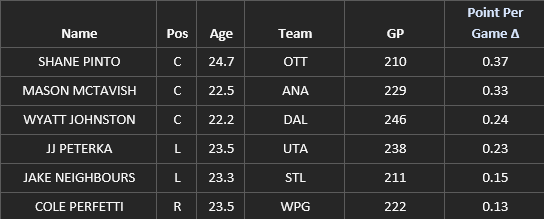
This is certainly an intriguing list. Some of these players already saw quite a bit of success in 24-25 so might not be prime candidates for a second breakout, but we will get to that in a minute.
What we really want to know though is what we might be able to expect from these players in the future. If we assume that this list has a higher probability of hitting that breakout status than than your typical player that means we are thinking these players will be more likely to put up at least 25% more points in 25-26 than they did in 24-25. That means we need to add some more point pace data to our table.
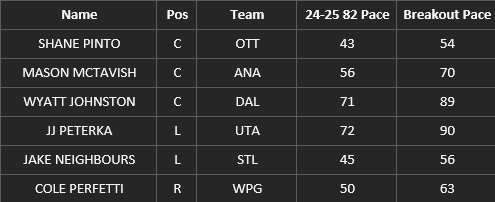
Let's dig in.
These breakouts usually happen because of a couple of factors. The first is just player progression. They have had a good run of games in the league, gotten their feet under them, figured out what they need to work on, and improved as players. They also tend to see an increase in deployment. More time on ice, playing in the top six, and/or on the top power-play. This deployment criteria are very much dependent on the coach, but in either case it can be hard to predict from the outside. We are going to do our best though to look at these players and see if they have room for improvements in their game and opportunity.
Shane Pinto has not had a linear trajectory, probably impacted by his 41-game suspension in 23-24. That was his best season by rates, where he saw the most ice time, shot rates, and power-play time. In that season he already was able to put up a 54-point pace. Unfortunately, he dropped in 24-25 in all of those categories which is not exactly what we want to see going into a potential breakout season. The other negative is that there is not an obvious deployment bump available. He is certainly not taking Tim Stutzle's top line role, and is unlikely to bump Dylan Cozens either. That means likely third line, second power-play duties. His 43-point pace in 24-25 was also propped up a bit by a higher-than-expected shooting percentage, which doesn't bode well for further breakout either. All that being said though, I am not going to write off Pinto. He has literally hit this breakout number before, with very similar deployment.
All signs seem to point up for Mason McTavish. He makes the list with a stronger second half and the right number of games, but also already saw a bit of a bump in 24-25 in his shot rates, overall time on ice, and power-play percentage. The result was two consistent mid 50-point paces. He seems like exactly the kind of player poised to break out. There are a few question marks though. There is a new coach and an augmented lineup. Trevor Zegras is out, but Mikael Granlund and Chris Kreider are in. A lot is going to depend on how the top six and top power play shake out, but I am cautiously optimistic for McTavish.
Wyatt Johnston has increased his point pace in each of the last two seasons, so it would come as no surprise if he were to do it again. The question is just how much more is in the tank? He played almost 19 minutes a night on average, saw 60% of the team's power-play time, had the highest shooting percentage of his career (though still seemingly within his reasonable range), and a team five on five shooting percentage over 11%. That isn't to say I think his season was a fluke or anything, but these are the kinds of numbers we would hope to see increase during a breakout season and they are already quite high. There is also the wild card of a new coach so we don't know exactly how Johnston will be used going forward. A full breakout by this calculation would be to reach 90 points, and while I think Johnston will be good and possibly even a bit better than 70, I am not sure I see him getting all the way to 90.
The same is going to be true for JJ Peterka. Peterka already made our division lists as someone who might not be able to repeat his 70-point pace from 24-25. He had an enormous 14% team five on five shooting percentage. If that had fallen more into the usual range for him, or really even the average top line player, we would have seen something closer to a 55–60-point pace from Peterka. Given that, and that he is moving to a new team, just repeating that 70-point pace would be a significant success, let alone breaking out again to 90 points.
Jake Neighbors is an interesting case. He makes this list, so we know he pointed better during the second half than in the first half. The troubling thing is that is the only thing that was better in the second half. His power play and overall ice time numbers dropped over the course of the season, as did his shot rates. He went from about two shots per game over the first half down to one shot per game at the end. Plus, with the emergence of Dylan Holloway and the arrival of Jimmy Snuggerud, Neighbors isn't so much the heir apparent that he used to be. He now has two seasons in the 40-point range, and his deployment and shot rates seem to have stalled out at best or regressed during 24-25. In addition, he had elevated personal and team shooting percentages that could complicate his ability to repeat that mid-40s pace even before considering a breakout. All things considered, neighbors’ profile gives a lot of mixed signals. He is someone worth watching for sure, but of this group may not have the best shot at hitting his breakout mark.
Cole Perfetti on the other hand seems to have a real shot. He has consistently managed a 45-50 point pace in the last three seasons with limited ice time and power-play exposure. The departure of Nikolaj Ehlers opens an opportunity for more power-play time (though might hurt him a little at even strength). Perfetti had a couple of strong runs through the season and generally was seeing higher time on ice numbers at the end of the season compared to the start. Like all of these players we will need to see where deployment shakes out, but Perfetti looks like a good preseason bet to have a better 25-26 season.
That is all for this week.
Do your part to support organizations working to make hockey for everyone.
Related Posts
Starting Goalies










Top Skater Views
| Players | Team | |
|---|---|---|
| ADAM JIRICEK |
 STL STL | |
| BEN KINDEL |
 PIT PIT | |
| COLE PERFETTI |
 WPG WPG | |
| JADEN SCHWARTZ |
 COL COL | |
| MATVEI MICHKOV |
 PHI PHI
| |
Top Goalie Profile Views
| Players | Team | |
|---|---|---|
| SERGEI MURASHOV |
PIT | |
| DYLAN GARAND |
 NYR NYR | |
| JUUSE SAROS |
 NSH NSH | |
| DAN VLADAR |
PHI | |
| JOEL HOFER |
STL
| |
LINE COMBOS
| Frequency |
 EDM Players EDM Players
| |
|---|---|---|
| 31.0 | VASILY PODKOLZIN CONNOR MCDAVID LEON DRAISAITL | |
| 20.1 | KASPERI KAPANEN FILIP HALLANDER JASON DICKINSON | |
| 19.9 | OWEN MICHAELS MATHIEU JOSEPH ALEX FORMENTON | |
DobberHockey Podcasts

Keeping Karlsson: Matchup Maximizer 2026/27 Week 3
Elan takes a look at the schedule for the upcoming weeks of NHL action and recommends players with good schedules that you should consider streaming in to win your head to head matchups.
Keeping Karlsson: Short Shifts – Sharks Looked Like Celebweenies
Elan recaps the major injuries, outjuries, game results and changed line combos that we’ve seen since Sunday’s mega-show.
Keeping Karlsson: Cole, There’s No Time!
Elan and Brian cover all the action from the first week of the NHL season, and identify our earliest must-adds, can-drops, sell highs and buy lows in your fantasy hockey leagues.
Keeping Karlsson: Matchup Maximizer 2026/27 Week 2
Elan takes a look at the schedule for the upcoming weeks of NHL action and recommends players with good schedules that you should consider streaming in to win your head to head matchups.

Fantasy Hockey Life: Tidy Takes Part 1
TiDy Admiral Ryan Downey and Victor Nuno break down recent trades in the FHL Tiered Dynasty’s top division, the Lord Stanley division. Tune in to consider trades between some of the best dynasty sharks we know, including patron polls on the trades and Victor’s analysis. Have a listen! Our show is part of the Dobber […]