

Ramblings: Update on Norris; Notable Improvements from Moser, Malinski, Hronek, Drysdale, Timmins, and Zellweger – February 20
Michael Clifford
2026-02-20
Teams have returned practicing and one bit of good news for the Buffalo Sabres is that forward Josh Norris was at practice and had shed his non-contact jersey, according to Matthew Fairburn. Norris was injured mid-January, but it looks like he'll be ready to go when Buffalo returns to game action on Wednesday.
Remember that before his injury, Norris was skating on Buffalo's top PP unit, so Jack Quinn's top power-play role is likely gone (for now).
*
A couple of weeks ago, these Ramblings covered some forwards who are set to hit the magical 200-game threshold later this season, including Bobby Brink, Zach Benson, and Alex Holtz. That Ramblings reviewed some of the improvements those three players have made this season which provides hope of good offensive performance either down the stretch this season, or next season.
We will set aside the 200-game barrier for now but keep our focus on improvements players have made to their game. Specifically, we are going to evaluate only defencemen today, and their tracking data changes at 5-on-5 this season compared to what they did across the two seasons from 2023-2025. That data is courtesy of All Three Zones, and any other player/team data is from Evolving Hockey, unless otherwise indicated.
These are the tracking stats we're covering:
- Contributions off the rush: the shots and assists leading to teammate shots off the rush, per 60 minutes (Rush/60)
- Contributions off the cycle+forecheck: the shots and assists leading to teammate shots off the cycle+forecheck, per 60 minutes (Cycle+Fcheck/60)
- Chance Assists: helpers on teammate scoring chances, per 60 minutes (SCA/60)
- Chance Contributions: individual scoring chances plus chance assists, per 60 minutes (SCC/60)
- Zone entries: how often a player dumps the puck into the offensive zone, carries it in, or passes it in, per 60 minutes (Entries/60)
- Carried Entry Percentage: how often a player's entries/60 are carried into the offensive zone by that player (Carry%)
- Entries and Exits: combined rate of all zone exits and entries by a player, per 60 minutes (Entry+Exit/60)
- Botch+Fail Percentage: combined percentage of botched defensive zone retrievals and percentage of failed zone exits (Botch+Fail%)
We are going by percentage increase, rather than raw totals. So, if a player usually has 10 zone entries per 60 minutes, and this season they're at 15 entries/60, the increase if 50% and not 5.0 entries/60. The red and blue dotted lines in the following graphs are the average percentage changed in each stat.
Last bit of warning: we are using a bit over a half-season sample. Once a lot more data comes in, things will change, so we are just using our best judgment as to what the changes mean.
Let's get to it.
J.J. Moser (Tampa Bay Lightning)
It was such a good first half of the season for Moser that he earned an eight-year extension from the Lightning. Though he's typically known as a solid defensive defenceman, Moser is averaging 0.94 points per 60 minutes a 5-on-5, a career-high for him in any season where he's played at least 50 games, and nearly 15% higher than his two-year average. One of the reasons for this is that he's seeing huge increases in his Rush/60 and Cycle+Fcheck/60 numbers:
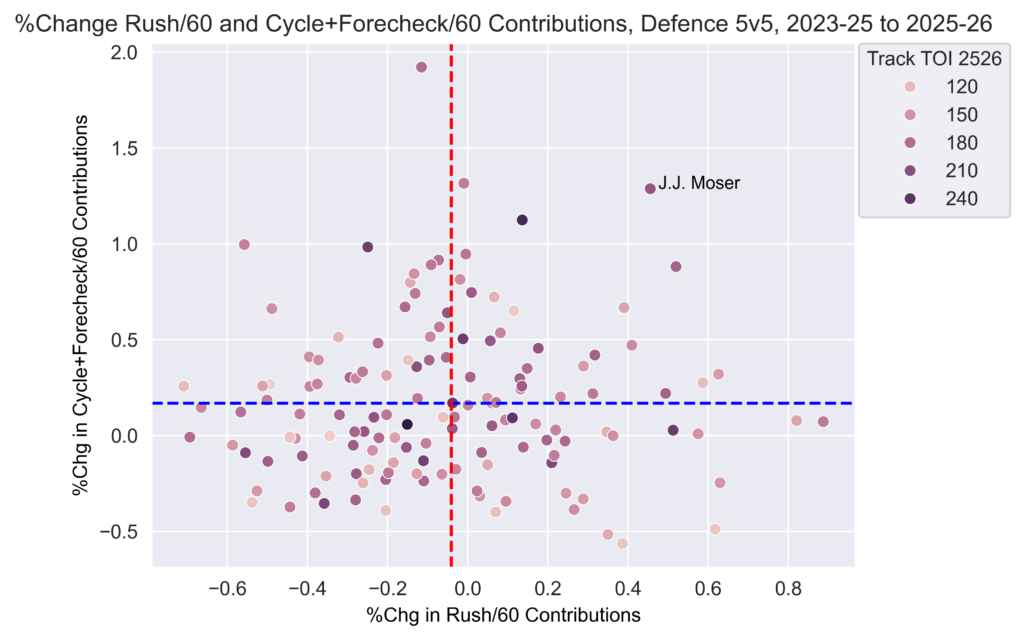
Not only is Moser registering more points than usual, but it's off the back of some of the largest improvements in his involvement both off the rush and off in-zone cycling/forechecking. In fact, he's 1 of 3 defencemen whose increase in both areas is at least the 84th percentile of all defencemen (the others are Morgan Rielly and Emil Lilleberg, both of whom were discussed yesterday).
Moser's problem for the fantasy game is that with Victor Hedman and Darren Raddysh on the roster, there are big obstacles to any meaningful power-play time. Even on a high-powered offensive team like Tampa Bay, if Moser only puts up a couple of power-play points all season, he'll be hard-pressed to produce more than the 31 points he had in 2022-23. At 1.4 shots and 0.75 hits per game, there aren't high-end peripherals to cover for the production shortfalls, either.
The lack of power-play role and modest peripherals puts Moser in the 'Better In Real Life Than Fantasy' bucket. Playing like this will certainly help the team create more offence, which is good news for Tampa's forwards and makes Moser a stream-able option some weeks in some leagues, but outside of deep fantasy formats, he is not a regular, meaningful contributor despite the significant improvements.
Sam Malinski (Colorado Avalanche)
The fun thing about Malinski is that he came onto our radars last season with solid tracking data. There wasn't anything super-elite that stood out, but it was impressive work in a depth role and showed some promise.
To say Malinski has made good on that promise is an understatement as he signed a four-year extension, sits 12th among defencemen with at least 600 minutes at 5-on-5 by points/60, and has also seen significant improvements in both his Rush/60 and Cycle+Fcheck/60 rates:

There is even more to it as well, as his chance assist rate has more than doubled and his shot rate has increased, so it's not just contributing in the different types of offensive attacks. This is a player who is making across-the-board offensive improvements that, if sustained, would make him a true high-end offensive defenceman.
He has to maintain these improvements, which is one thing. The other is that on a roster with Cale Makar and Devon Toews, Malinski is coming nowhere close to the top pair or top power-play unit. Makar is a free agent at the end of next season, but it's hard to see the Avalanche letting him walk, and Toews is also signed for several years. Unless Toews has a serious decline very soon, Malinski will never be higher than third on the depth chart at even strength, and second on the power play. That is a tough way to sustain fantasy value.
Filip Hronek (Vancouver Canucks)
With the Vancouver Canucks destined for the bottom of the league, and currently sitting 31st by goals/60 at 5-on-5, it'll be hard for many of their options to have fantasy value outside of deeper leagues. They have also been inconsistent with their power-play defencemen: since the Quinn Hughes trade, they have three blue liners who've played at least 20 games and have skated between 35-55% of the team's power-play time (per Frozen Tools). A low-scoring team and constant power-play changes are a tough way to build a reliable fantasy profile.
With all that said, we do have to highlight Hronek here because by both Entries/60 and Carry%, he has seen among the largest increases in both areas:
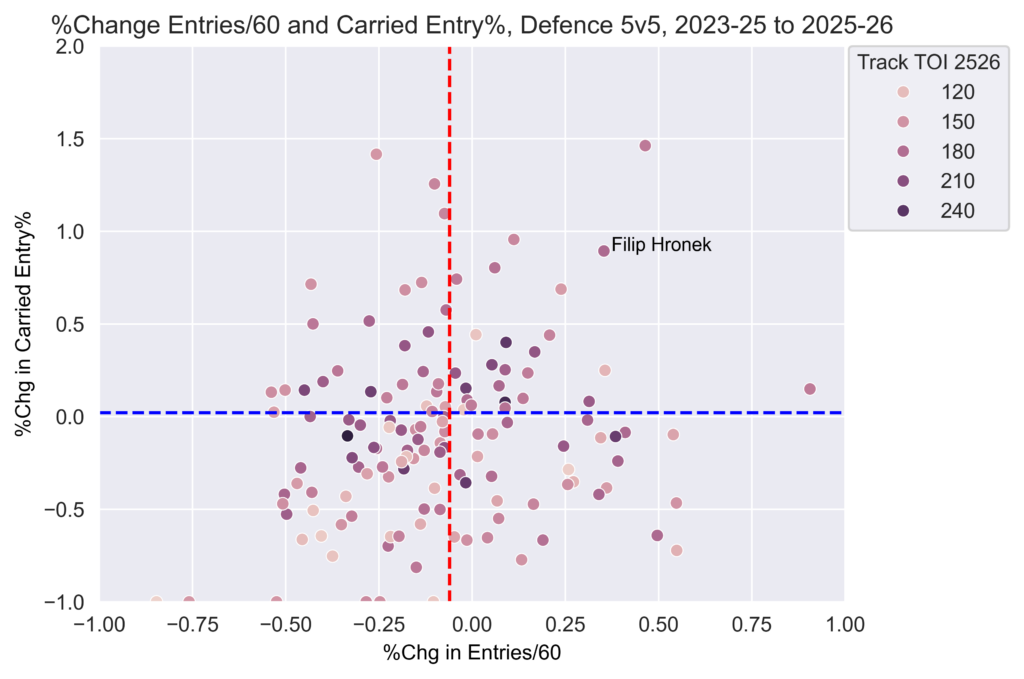
Losing Hughes as a defensive partner, on top of Vancouver's injuries and inconsistent scoring, hurts Hronek's upside. But it's still worth noting that he has 16 points in 26 games since the Hughes trade, averaging 1.4 shots, 1.3 blocks, and 1.2 hits per game in that span. Averaging 24:30 in ice time per contest is helping soften the team's goal-scoring issues, and Hronek being this involved offensively can keep him fantasy viable in a lot of formats the rest of the way.
Jamie Drysdale (Philadelphia Flyers)
It is always worth pointing out when a young defenceman is seeing some underlying changes either after a trade or when his team hires a new coach. That is why we're highlighting Drysdale's season here.
The reason we look at chance assists is because players with high rates of chance assists typically rack up actual assists – the top-10 from 2023-2025 include names like Adam Fox, Cale Makar, Lane Hutson, Roman Josi, Evan Bouchard, and Quinn Hughes. The reason we look at botch+fail% is because defencemen who can keep those percentages low help drive their team's goal-scoring rates upward, which also helps their point production.
With that in mind, here are Drysdale's 2025-26 improvements in SCA/60 and Botch+Fail% (and a negative change in Botch+Fail% is good):
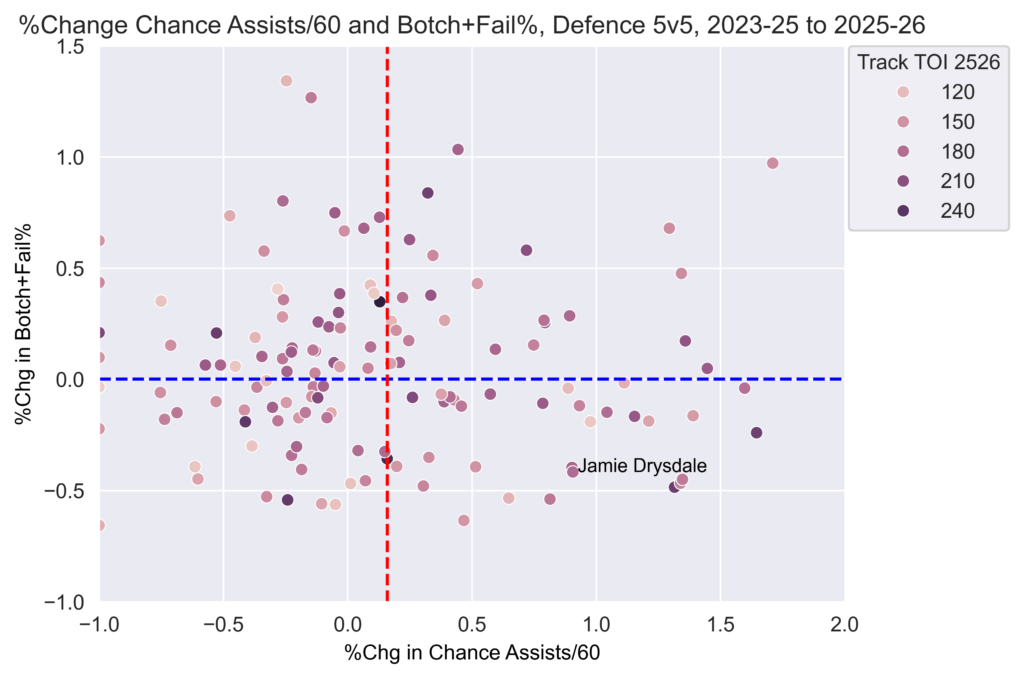
Overall, Drysdale's SCA/60 has nearly doubled while his Botch+Fail% has declined from 63% to 37%. That he's producing 0.94 points/60 at 5-on-5, by far a career-best and 40% higher than his two-year average, is not happenstance. It is a direct result in big improvements in things that lead to better point production.
In the 12 games since returning from injury in mid-January, Drysdale averaged 22:39 per game and led Flyers blue liners with 57.5% of the power-play time. Philadelphia isn't a great offensive team, but they aren't awful, and if Drysdale keeps playing like this, with 22-23 minutes a game and a top power-play role, he will be someone to keep tabs on in all fantasy formats.
Conor Timmins (Buffalo Sabres)
Hockey is a funny sport. At 0.81 points/60 at 5-on-5, Timmins' production rate is its lowest in his five full-ish seasons. At 2.3 goals/60 minutes at 5-on-5, Buffalo's goal-scoring rate with Timmins on the ice is the lowest of his five full-ish seasons. He also has the poorest play-driving numbers of his career, per Evolving Hockey.
Knowing all that, we might assume his tracking data is a mess, but it's quite the opposite: he has seen improvements in all eight categories we've looked at. The two we'll highlight are his Entry+Exit/60 rate and his Botch+Fail%:
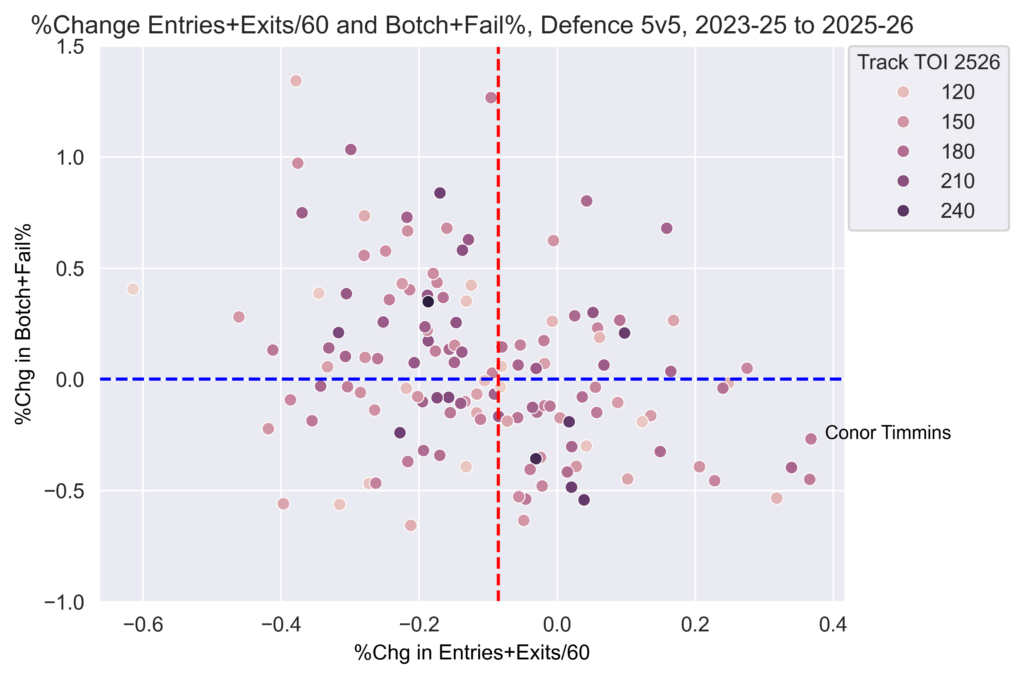
Not only has Timmins seen the largest improvement in his Entry+Exit/60 rate, he's seen a sizeable decline in his Botch+Fail%. When we factor in his positive changes elsewhere, we should see good goal-scoring rates with him on the ice, but we're not.
This is where sample size matters. Timmins' most common forward teammate is Tage Thompson. With those two on the ice at 5-on-5, the Sabres are scoring 0.8 goals per 60 minutes, but when Timmins is on the ice without Thompson, the team is scoring 2.9 goals per 60 minutes. The second number is much closer to what we'd expect.
Timmins suffered a broken leg in December and was given a 6- to 8-week timeline. He will hopefully be back when play resumes after the Olympics. The issue is that with 25 games left and stuck in a third-pair role when the blue line is healthy, there isn't much runway left or much of a role for Timmins to turn in meaningful production. It is something that can help the team in front of him, though.
Olen Zellweger (Anaheim Ducks)
It is a good news/bad news situation for Zellweger. The bad news is that since December 1st, Zellweger has lost 2:21 per game in ice time, which reflects the team's lack of faith in his play so far in 2025-26. He is also fourth in share of power-play time among Anaheim defencemen in that span. Losing a lot of ice time and a minimal power-play role is a bad combination.
The good news is that there are some positive developments in his offensive attack. His improvement in chance assists and contributions off the cycle+forecheck are both among the largest in our sample:
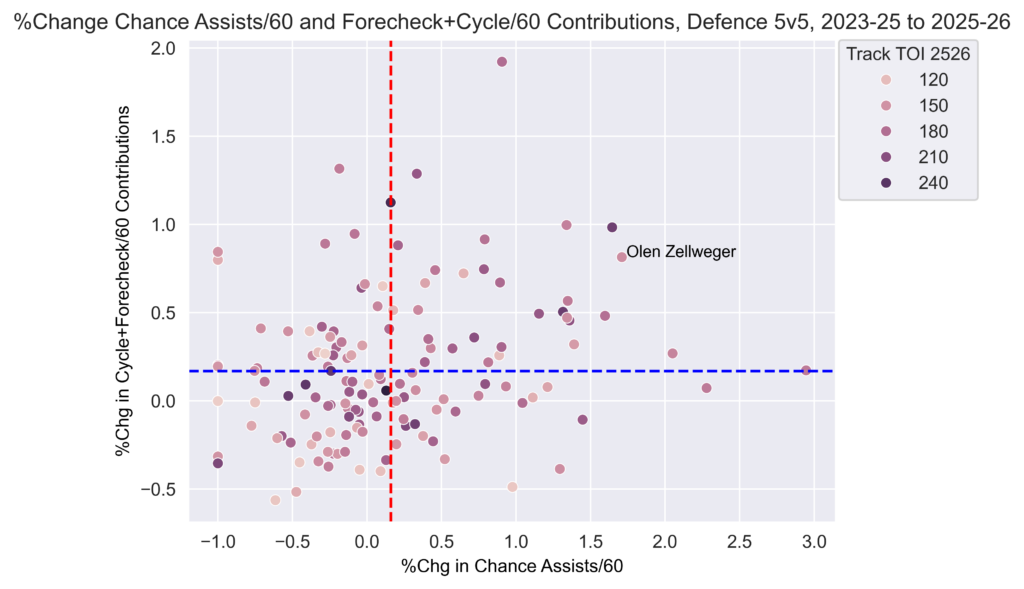
That jump in chance assists has led to Zellweger posting a career-best 0.93 points/60 at 5-on-5, and his primary assist rate is inside the 80th percentile of regular defencemen. He also has just 143 career games under his belt, so he won't cross that 200-game threshold until next season. That he's adding to his profile is a good sign, even if there are concerning trends elsewhere (notably, his Botch+Fail% has increased considerably).
Improvements in chance assists and contributions off the cycle won't matter much for Zellweger's fantasy value this season, though. Skating 16-17 minutes a night with minimal power-play time from a player who doesn't block or hit much doesn't give him meaningful fantasy value in any kind of format. Long-term, the continued improvements matter, just not for the balance of the 2025-26 campaign.
Related Posts


Starting Goalies













Top Skater Views
 T.B
 DET
 SEA
 CGY
Top Goalie Profile Views
 N.J
 WPG
 MTL
 EDM


LINE COMBOS
| Frequency |
 OTT Players | |
|---|---|---|
| 13.2 | FABIAN ZETTERLUND TIM STUTZLE CLAUDE GIROUX | |
| 13.1 | SHANE PINTO RIDLY GREIG MICHAEL AMADIO | |
| 8.3 | DYLAN COZENS ANDRE BURAKOVSKY DRAKE BATHERSON | |
DobberHockey Podcasts

Keeping Karlsson: Short Shifts – Hellebuyck’s Debut, Larkin Fall Out, and Much More
Elan covers all the big news since last Sunday’s mega-show including Hellbuyck’s first game, Larkin’s absence and much more in this week’s episode of Short Shifts.
Keeping Karlsson: Down Across the Helle-ware
On this episode of the Keeping Karlsson Fantasy Hockey Podcast, Elan and Brian dissect the implications of the Connor Hellebuyck trade, injury returns in Carolina and Washington, hot streaks in Philadelphia and Seattle, crease contenders in Calgary and San Jose, a must-add in Tampa Bay and a sell-high in Colorado for your fantasy hockey league.

Fantasy Hockey Life: Ep 506 Prospects with Plenty to Prove II
Victor and Jesse return to talk about more fantasy hockey prospects in critical seasons. Covered are David Reinbacher, Cayden Lindstrom, Dalibor Dvorsky, Bradly Nadeau, Ilya Protas, Charlie Stramel, Otto Stenberg, Emil Hemming, Trey Augustine, Sebastian Cossa, Jacob Fowler, Easton Cowan, Matthew Wood, Gabe Perreault, and Victor Eklund. Thanks to Mason Black @NHLRankKing for his polls. […]
Keeping Karlsson: Matchup Maximizer 2026/27 Week 5
Jeremy takes a look at the schedule for the upcoming weeks of NHL action and recommends players with good schedules that you should consider streaming in to win your head to head matchups.
Keeping Karlsson: Short Shifts – Injuries, Outjuries, and Duds
Elan talks about all the latest injuries, outjuries, big performances and duds over a tight 20 minutes in this week’s episode of Short Shifts.