

Frozen Tools Forensics: (Un)Sustainable Production from Samuelsson, Geekie, Stone, Nylander, and Raddysh
Chris Kane
2026-02-27
This week we are rounding out our look at some indicators of unsustainability from pre-Olympic action. The goal for each week is to identify a list of players who might be in line for a drop off in their pace.
To create the lists, we are focusing on two primary data points, individual shooting percentage and all situations IPP. I often look at team five on five shooting percentage as well, and we will be using that for individual player evaluation, but it wasn't one of the sorting criteria here. The idea is to look beyond a player's actual point pace and see if players are performing at their usual level. The list below then has a comparison of each player's data to date compared to their recent averages (about three seasons worth). The idea being that if a player has performed significantly different in their shooting percentage or IPP so far this season we might expect the remaining games to be more like their career average than the first portion of the season, and that would impact their point pace.
For this week we are looking at players who might be set to fall a bit in the remaining games, so their IPP and shooting percentages are higher than average.
The following table contains some basic player information (name, position, team, total games played so far, and point pace on the season), and then the difference between their current IPP and shooting percentage and their recent career averages. In this case a negative number indicates that their data could drop going forward.
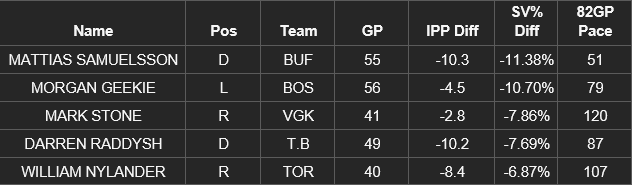
Mattias Samuelsson hadn't ever eclipsed a 20-point pace in any of the five seasons where he saw NHL games prior to this season. As of this writing, he sits at a 51-point pace. His 11 goals in 55 games are more than the seven other goals he has scored in 212 previous career games. He leads our list with a dramatically inflated IPP, shooting percentage, and team shooting percentage. It should be no surprise then to learn that we should not expect this point pace to continue. In theory it shouldn't be all doom and gloom: Samuelsson is playing more than 23 minutes a night, which is a career high (by almost a minute), and he has increased his shot rates to 1.4 a night. The points have really been gravy at this point as usually when he is rostered it is because of decent peripheral contributions. Going forward that is what we should expect though. Even with some of these increases it looks like his performance is worth maybe a 25-point pace, which is still a career high but a far cry from the incredible run he has been on to date.
Morgan Geekie is a bit of a conundrum. He spent 250 games buried in various lineups and his personal numbers (IPP, shooting percentage etc) were reasonably consistent, and what we might have expected given that deployment and what we thought we knew about him as a player. Since getting top deployment in Boston, his numbers have been dramatically different in a way that looks very unsustainable. He now is in his second season with a shooting percentage over 20 percent and it is currently almost at 25 percent. On the other hand, he has been doing this for 133 games, and it is almost entirely correlated to his elevation. So, what numbers do we regress toward? If we regress to his earlier career numbers, he halves his goal production and at best is putting up a 60-point pace. If we assume a higher shooting percentage in his current environment, then perhaps he can sustain something in the 65-70 range.
Mark Stone is on pace for a career year and at first glance that shooting percentage should give us some pause. The thing is though, even if you drop his shooting percentage down to his career norm, and regress some of his other numbers he is still on pace for the best season of his career. A huge part of that is the success of the power play because in 41 games Stone has 22 power-play points. That is a 44-point pace on the season, which is a dramatic increase from any of his previous numbers. The closest he came was actually in 24-25 with a 31 power-point pace over 66 games. So, will a 120-point pace continue? No but he could definitely go at a 90-100 point pace the rest of the way.
We have discussed Darren Raddysh before, so we won't go quite as deep here, but at least for now he has warded off the return of Victor Hedman. With his current deployment there is actually a lot to like here. It is not clear he can sustain an 85- to 90-point pace, but he is getting prime opportunities and deployment he has never seen before. Even if his shooting percentage regresses to his previous career numbers, he might still sustain a 70-point pace. It is also not clear that that should be the regression point given he has never been in this situation before. Any way you look at it, as long as he maintains the top power play and 25 minutes a night, he should continue to put up points.
Willian Nylander is on a 107-point pace over 40 games so far. It has been a career year and seems to be justifying the hope and hype for the season. There are some major red flags here though. In 2023-24 he put up basically a 100-point pace. He did it with almost 20 minutes a night, 73 percent of the team's power-play time, and shooting almost four times per game. This season he has dropped to 18 and a half minutes a night, 65 percent of the team's power-play, and worst of all is barely shooting over twice per game, essentially a career low. The reason he is hitting these point production heights is a personal shooting percentage over 20, a team shooting percentage over 15, and a career high points participation number. Now maybe in the absence of Mitch Marner there is a different orientation to where points are going to come from in Toronto so that IPP might be an indication of that change, but those shooting percentage numbers seem very unlikely to continue. Just for reference if those are all regressed to his previous numbers Nylander is on a 65-point pace. I don't think the situation is quite that dire, as there might be some actual changes hidden in the noise and it looks like the power-play has been particularly ineffective for Nylander so far and might be a place where he could see some improvement. The numbers do indicate that a point per game Nylander is much more likely than a 100-point Nylander though.
That is all for this week.
Do your part to support organizations working to make hockey for everyone.
Professional Women's Hockey League
Related Posts


Starting Goalies



Top Skater Views
| Players | Team | |
|---|---|---|
| ROOPE HINTZ |
 DAL DAL | |
| ALEX LAFERRIERE |
 L.A L.A | |
| LUKE HUGHES |
 N.J N.J | |
| OWEN TIPPETT |
 PHI PHI | |
| KEVIN FIALA |
L.A
| |
Top Goalie Profile Views
 WSH
WSH CBJ
CBJ MIN
MIN


LINE COMBOS
| Frequency |
 UTA Players UTA Players
| |
|---|---|---|
| 22.4 | NICK SCHMALTZ CLAYTON KELLER LAWSON CROUSE | |
| 21.9 | JJ PETERKA ALEXANDER KERFOOT MICHAEL CARCONE | |
| 15.7 | KAILER YAMAMOTO DYLAN GUENTHER LOGAN COOLEY | |
DobberHockey Podcasts

Keeping Karlsson: The 2026-27 Keeping Karlsson Breakfast Club
Don’t you forget about them! Elan and Brian remind you of at least one player on each NHL team whose name you might forget to consider at the draft table.

Fantasy Hockey Life: Tampa Bay Lightning with Erik Erlendsson
Erik Erlendsson joins the program to discuss the Tampa Bay Lightning. Jesse and Victor ask about pros Nikita Kucherov, Jake Guentzel, Brandon Hagel, Brayden Point, Anthony Cirelli, Ilya Mikheyev, Gage Goncalves, Conor Geekie, Benjamin Rautiainen, John Carlson, Victor Hedman, Charle-Edouard D’Astous, Andrei Vasilevskiy, Jonas Johansson, and Dennis Hildeby. In Cat’s instincts, Cat Silverman of InGoal […]
Fantasy Hockey Life: New York Rangers with Colin Stephenson
Colin Stephenson joins the program to discuss the New York Rangers.
Keeping Karlsson: Matchup Maximizer Schedule Deep Dive
Elan is joined by the Keeping Karlsson Accountability Czar Trev to take a deep dive into the NHL schedule for next season and how it should affect our drafting decisions.
Fantasy Hockey Life: Carolina Hurricanes with Ryan Henkel
Ryan Henkel joins the program to discuss the Carolina Hurricanes. Jesse and Victor ask about pros Sebastian Aho, Seth Jarvis, Andrei Svechnikov, Nikolaj Ehlers, Jackson Blake, Logan Stankoven, Jordan Staal, Bradly Nadeau, Felix Unger Sorum, Shayne Gostisbehere, K’Andre Miller, Alexander Nikishin, Sean Walker, Brandon Bussi, and Pyotr Kochetkov. In Cat’s instincts, Cat Silverman of InGoal […]