

Ramblings: Carolina Takes 2-1 Series Lead; Domi Injury; Changes in Shot, Block, Hit, and PIM Rates Among Defencemen – May 26
Michael Clifford
2026-05-26
Andrei Svechnikov fired home Carolina's third goal on their 38th shot of the night to lift the Hurricanes to a 3-2 overtime win on Monday night, giving the 'Canes a 2-1 series lead. Carolina had another dominant defensive performance, holding Montreal to just 12 shots on goal in over 74 minutes of game time, and zero shots over the final 24 minutes of the contest.
Taylor Hall and Shayne Gostisbehere had the other goals for Carolina. Hall finished with seven shots, two blocks, and two hits, and now has 13 points in 11 postseason games.
Lane Hutson and Mike Matheson scored the goals for Montreal. Jakub Dobes made 35 saves and was Montreal's best player on the night.
Game 4 is on Wednesday night.
*
Toronto reporter Lance Hornby tweeted that Maple Leafs winger Max Domi will be out indefinitely due to complications from an offseason surgery. The nature of the complications or surgery was not specified, but that this is being stated in May with training camp over three months away tells us this is a serious matter. Hopefully, whatever is going on with Domi is resolved safely and quickly.
*
In last week's Ramblings, we reviewed how peripheral production is changing across the league, focusing specifically on shots, hits, blocks, and penalty minutes among forwards:
- We started by seeing how rates have been changing over the last five seasons on a 60-minute basis, and also the percentage of a forward's overall peripherals coming from each category.
- We moved to the level of individual forwards to see how overall totals have changed in each category.
Today, we're repeating that process but moving to defence. That means we're starting with league-wide data to see how peripheral rates have changed among blue liners over the last five seasons and then evaluating how much of each peripheral stat is responsible for overall peripheral production.
Again, we are using data from Evolving Hockey. We are going to start by focusing on all-strengths play and then seeing if there's anything different when we look at just 5-on-5 play. As we did with forwards, when discussing penalty minutes, we are including just 2-minute and 5-minute penalties, leaving aside 10-minute misconducts.
Defencemen, like forwards, have seen their overall rates of peripheral production decline by varying levels across the last 4-5 years. The difference for defencemen is there is a huge decline in two of the four categories (Hits and Blocks) with a noticeable decline in shot rate:
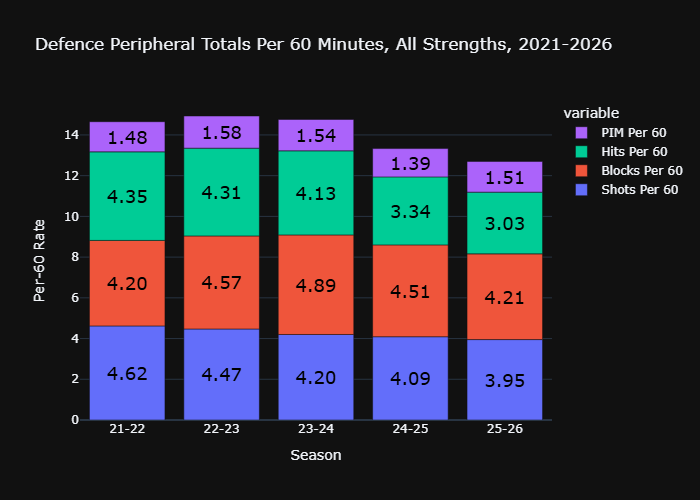
Just since the 2023-24 season, the rate of hits among defencemen is down nearly 27% while the rate of blocks is down nearly 14%. To put those drops into context, forwards saw their hit rates increase since 2023-24 while the block rate dropped just over 4%. The declines in hits and blocks for blue liners have been substantial, and that greatly alters their fantasy values. Where defencemen used to be a source of hits that lagged forwards just a bit, the hit rates are now considerably less. Their hits and blocks rates have declined in a significant way as league has shifted to more mobile defencemen throughout the three pairs.
Funny enough, there isn't that much of a drop in shot rate. The 60-minute rate has declined by 6% over the last two seasons, but the rate among forwards declined nearly 10% in the same stretch. In an environment where per-game shot totals have declined by over 8%, the fact that defencemen haven't seen a larger shot decline is notable. Again, this likely ties into their being more mobile up-and-down the roster than they were just a few years ago, but it is noteworthy all the same.
The 60-minute rates are one thing, but how much each peripheral stat is responsible for a defenceman's overall peripheral output is another. Adding the hit, block, shot, and PIM totals together, and then dividing each of the individual peripheral totals by that overall total, here is the share of each of the four stats by the average defenceman:
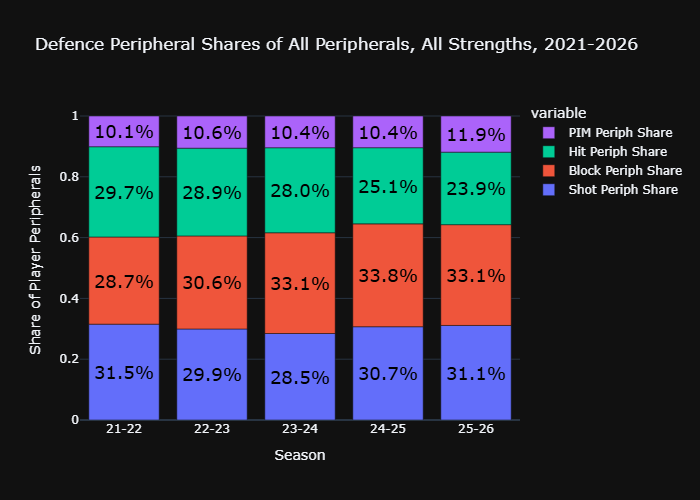
Penalty-minute share has seen a sizeable increase because of its relative stability even as things like block and hit rates have declined. Blue liners are getting a much bigger share of their peripheral output from their PIMs than they have at any point in the last five years.
What stands out is the hit share. Back in 2021-22, defencemen got nearly 30% of all their peripherals from their hit totals. This past season, that percentage fell for the fourth straight season, showing nearly a 20% decline across the last four campaigns. This helps to underscore just how much less defencemen are hitting in the modern NHL, and it's why finding defencemen who can put up 2+ hits per game, something that used to be a regular occurrence just 3-4 years ago, is now a rarity.
The interesting part is the block share. On a 60-minute basis, since the 2023-24 season, defencemen have seen their block rate decline nearly 14%. However, because their shot volume has dropped at a much lower rate than their forward counterparts, and because the hit rate has dropped so much, defencemen are getting 33.1% of their peripherals from their block totals, which is the exact same percentage it was back in 2023-24.
That consistent block share is why it's important to do a post-season analysis like this. It would be easy to see a 14% decline in block rates and conclude that the decline makes them rarer, and in turn makes blocks from defencemen more valuable. But because the peripheral share is identical to two years ago, and down very little from last year, that supposed rarity is not real. The prevalence of blocks is lower than it was, but its importance to an average defenceman's total peripheral output hasn't changed.
Another instance of why this type of analysis is important is the percentage from shots. Though the 60-minute shot rates among defencemen have declined over the last couple years, the drop has been less severe than it was among forwards, and pales in comparison to things like hits or even blocks. Because of that relatively low shot decline, the percentage of a defeceman's peripherals that comes from their shot totals has increased from 28.5% to 31.1%. Shots totals are a much bigger part of a defenceman's peripheral profile than they were a couple years ago despite the 60-minute decrease.
As we did with the forwards, we have to evaluate what happened at 5-on-5, not just at all strengths. There have been swings in power-play opportunities over the last five seasons, so what happens with all five players on the ice can tell us if there have been any real changes in how defencemen rack up their peripherals on a 60-minute basis:
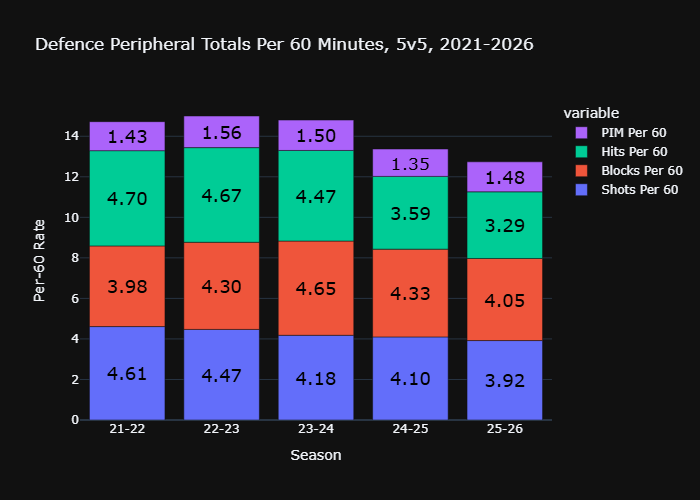
We won't go long here because what is happening at 5-on-5 mirrors what's happened at all strengths; relatively stable penalty minutes, a huge drop in hits, a sizeable drop in blocks, and a small decline in shots (about 6%) that is lower than the drop we saw among forwards (just over 10%).
It is the same story when we look at the share of peripherals. Since the 2023-24 season, defencemen have:
- Seen a large increase in PIM share of nearly 15%
- Seen a sizeable decrease in hit share of nearly 17%
- Seen a small increase in block share of just over 1%
- Seen a decent increase in shot share of just over 9%
The relative increases are a bit different than they were at all strengths, but consistent across the four categories. That is why just saying defencemen are getting fewer shots or blocks doesn't really tell us what's going on. It gives us the surface story, but when we dig a bit deeper, we see another story emerge.
To summarize what we've seen here today quickly:
- Penalty Minute totals per 60 minutes are down a bit from a couple of seasons ago, but the decline is small, and because of larger declines elsewhere, they are actually a much bigger percentage of an average defenceman's overall peripheral output.
- Hit volume, both on a 60-minute basis and as a percentage of all peripherals, are down significantly among defencemen. That reflects a genuine shift in the type of defenceman that teams are rostering more (or less) often than they were just a couple of years ago.
- Block rates have declined on a 60-minute basis, but because of the substantial decline in hits, the percentage of a rearguard's peripheral total that comes from blocks is identical to what it was two years ago. In other words, there is a decline in the number of blocks from a defenceman but not in the value of blocks from a defenceman.
- Shot rates have also declined, but the drop is not as steep as with forwards, and because of larger drops elsewhere, shot totals are actually a bigger percentage of a defenceman's overall peripheral output than just a couple of years ago.
Again, I understand this type of analysis can be a bit dry, but hopefully the importance of this kind of analysis has been shown. On Thursday, we'll see what it's meant for what we really care about: individual peripheral totals.
Related Posts
Starting Goalies













Top Skater Views
| Players | Team | |
|---|---|---|
| COLE PERFETTI |
 WPG WPG | |
| LUCA CAGNONI |
 S.J S.J | |
| IGOR CHERNYSHOV |
S.J | |
| TOMMY NOVAK |
 PIT PIT | |
| TRISTAN LUNEAU |
 ANA ANA
| |
Top Goalie Profile Views
| Players | Team | |
|---|---|---|
| DAN VLADAR |
 PHI PHI | |
| JOSEPH WOLL |
PHI | |
| SEBASTIAN COSSA |
 UTA UTA | |
| JAKUB DOBES |
 MTL MTL | |
| ADIN HILL |
 VGK VGK
| |
LINE COMBOS
| Frequency |
MTL Players
| |
|---|---|---|
| 19.7 | NICK SUZUKI CHRIS KREIDER COLE CAUFIELD | |
| 15.1 | JURAJ SLAFKOVSKY ALEX NEWHOOK IVAN DEMIDOV | |
| 13.8 | JAKE EVANS ZACHARY BOLDUC JOSH ANDERSON | |
DobberHockey Podcasts

Keeping Karlsson: Cole, There’s No Time!
Elan and Brian cover all the action from the first week of the NHL season, and identify our earliest must-adds, can-drops, sell highs and buy lows in your fantasy hockey leagues.
Keeping Karlsson: Matchup Maximizer 2026/27 Week 2
Elan takes a look at the schedule for the upcoming weeks of NHL action and recommends players with good schedules that you should consider streaming in to win your head to head matchups.

Fantasy Hockey Life: Tidy Takes Part 1
TiDy Admiral Ryan Downey and Victor Nuno break down recent trades in the FHL Tiered Dynasty’s top division, the Lord Stanley division. Tune in to consider trades between some of the best dynasty sharks we know, including patron polls on the trades and Victor’s analysis. Have a listen! Our show is part of the Dobber […]
Keeping Karlsson: Short Shifts – I Tried to be Like Parker Kelly
Elan is joined by Ryan Downey for the premiere of season 8 of Short Shifts! — KKUPFL late registration is ongoing! We’re still filling new divisions in the world’s greatest fantasy hockey league. Details at https://www.kkupfl.com/. Join the Keeping Karlsson patron community! Patrons get access to all our perks all year round, including KKUPFL […]
Keeping Karlsson: Shabanov Ranks
Elan and Brian fly through the final preseason lines for every NHL team ahead of opening night, and share their guys to watch– or look away from– in your fantasy hockey leagues.