

Ramblings: Evaluating Fantasy Value Drops from Matthews, Monahan, Kadri, Bratt, Miller, Marchment, and Connor – July 14
Michael Clifford
2026-07-14
Work has begun on the 2026-27 Dobber Hockey Fantasy Guide! There isn't an official release date yet, but it should be released in the next few weeks. It has everything fantasy managers need to prep for the upcoming season including projections, team-by-team breakdowns, advanced stats outlooks, rookies/call-ups to watch for, and a whole lot more. It is also constantly updated right up until the start of the regular season, so head to the Dobber Shop to pre-order your copy of the 2026-27 Fantasy Guide.
*
The Buffalo Sabres avoided arbitration with forward Peyton Krebs by signing him to a four-year deal worth $4.5-million annually, as reported by Elliotte Friedman. Krebs had a career-year with 12 goals and 39 points during a season where he got an extended look on the top line. I am dubious he repeats that performance as there is a lot of forward depth on the Sabres roster, especially with the breakout of Noah Ostlund, the emergence of Konsta Helenius, and the return of Jiri Kulich.
*
In a Ramblings last week, we discussed forwards who saw improvements in their fantasy value on a 60-minute basis. Today, we will go in the other direction and discuss forwards whose per-60 fantasy value fell in 2025-26 compared to 2024-25, and whether they can rebound.
The fantasy categories used for the evaluations are goals, assists, power-play points, shots, hits, blocks, penalty minutes (PIM), and face-off wins (FOW). For wingers, we may exclude FOW just to get an idea of what they produced without a category where most of them will garner a low score. All evaluations are relative to other forwards and replacement-level fantasy value. Generally speaking, replacement value for this write-up is around the 185th-ranked forward, or the top of the waiver wire list.
Data is from Evolving Hockey and Natural Stat Trick. Only players who played at least 41 games in both seasons will be included, giving us 337 forwards to sort through. Positions are from Yahoo.
Sean Monahan (Columbus Blue Jackets – C)
Whether we include the FOW component or not, there was no forward who lost more value on a 60-minute basis than Monahan:
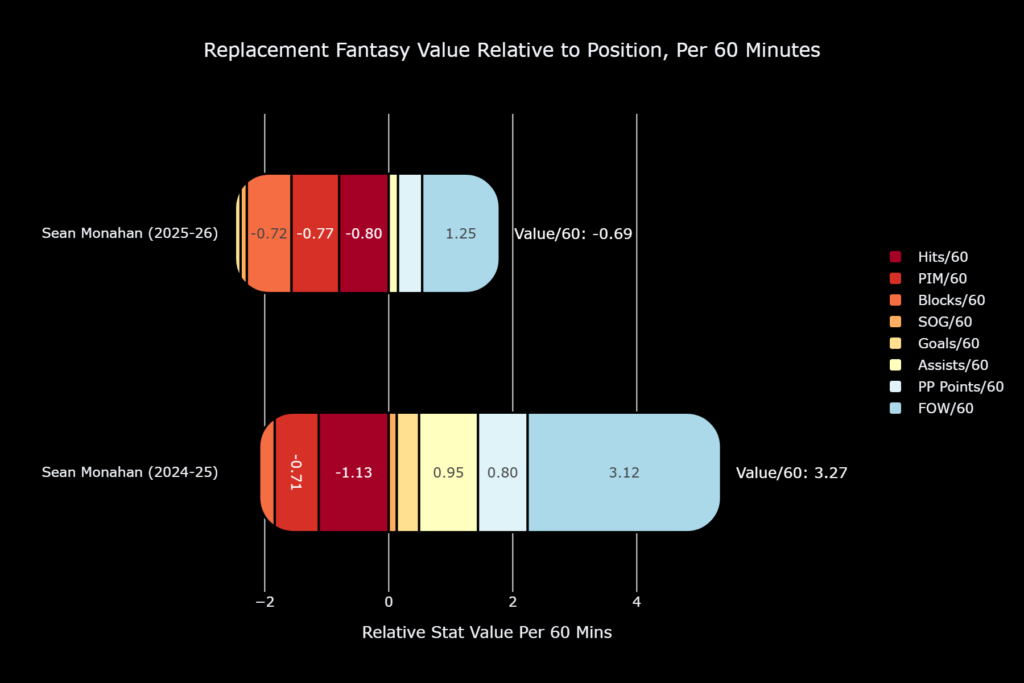
That will happen when you go from over a point-per-game player to under a half-point-per-game player.
Anyone who was relying on Monahan knows that he lost his top-6 role as the season wore on; Adam Fantilli became the locked-in top-line centre and Charlie Coyle's checking line took precedence over Monahan's second scoring line in terms of ice time. That change only got more severe as the season wore on: 14 of Monahan's 78 games played saw him skate under 15 minutes,12 of those 14 games came after American Thanksgiving.
It is hard to see Monahan regaining the magic he had a couple years ago. Assuming that Fantilli is re-signed, he will remain the top-line centre, and as long as Coyle's checking line remains effective, Head Coach Rick Bowness will, at best, split the ice time between that line and Monahan's line, if not outright favour Coyle. Without a top power-play role, which Monahan lost last year, he has no fantasy value outside of deep leagues.
J.T. Miller (New York Rangers – C)
Whether including FOWs or not, Miller had one of the three largest fantasy value drops on a 60-minute basis last season:
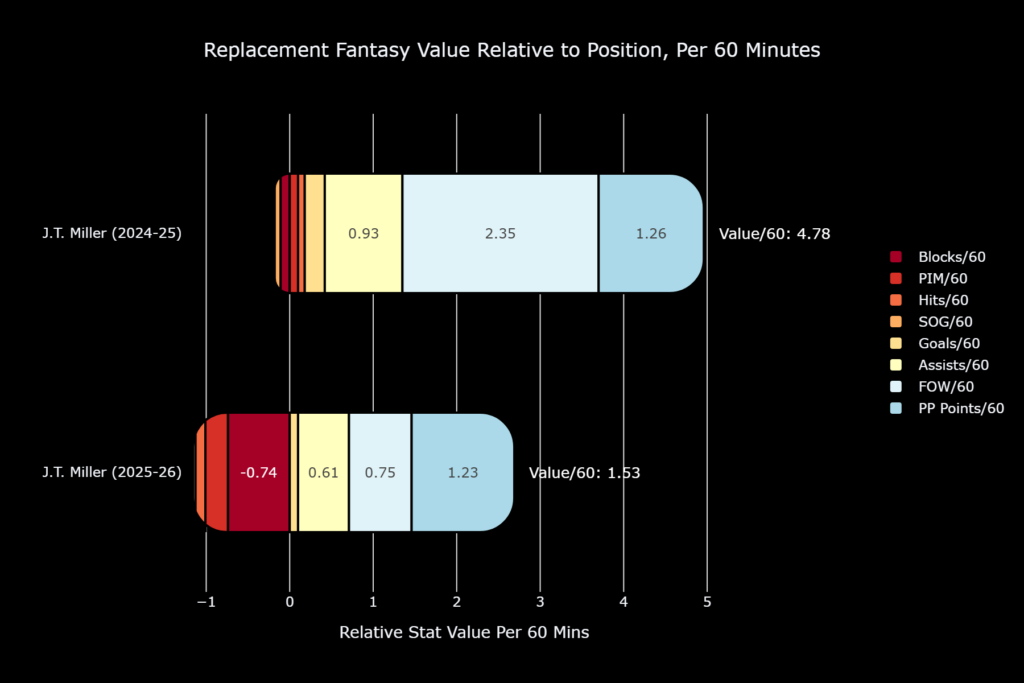
It is no secret that Miller was playing injured, missing time in December and January as well as in March with various issues. He did find a groove late in the season with 15 points in 15 games, but at that point it was probably too little, too late for anyone who drafted him as a top-50 player back in September.
Losing Artemi Panarin shouldn't hurt Miller much at 5-on-5 because they rarely played together. The good news is the Rangers added Sean Durzi in the offseason, and when he's healthy, he's a good puck-moving defenceman. The addition of Marcus Pettersson should also help a bit, which means that there are other Rangers blue liners who can move the puck when Adam Fox is off the ice, and that's a positive for the Rangers' captain.
Miller shot at least 12% in each season from 2015-2025 and had a three-year average of 16.4% heading into 2025-26. That makes his 11.8% conversion rate stand out, so it's not hard to see him adding a handful of goals to his total. A bigger problem is that he had declines in his rate of hits, blocks, and PIMs. What saved him is he played 20:09 per game, so his per-game rates weren't completely nuked, but his 60-minute rate of PIMs fell 20%, hits fell 30%, and blocks fell 35%. That high usage should persist thanks to the trade of Vincent Trocheck and Miller has a long track record of very good peripheral contributions. If those rates rebound anywhere near what they were the year before (if he's healthy, they should rebound to some degree), he can be a top-25 forward again.
Jesper Bratt (New Jersey Devils – LW)
As is the case with certain players in any fantasy season, how a manager feels about Bratt relies on the answer to this question:
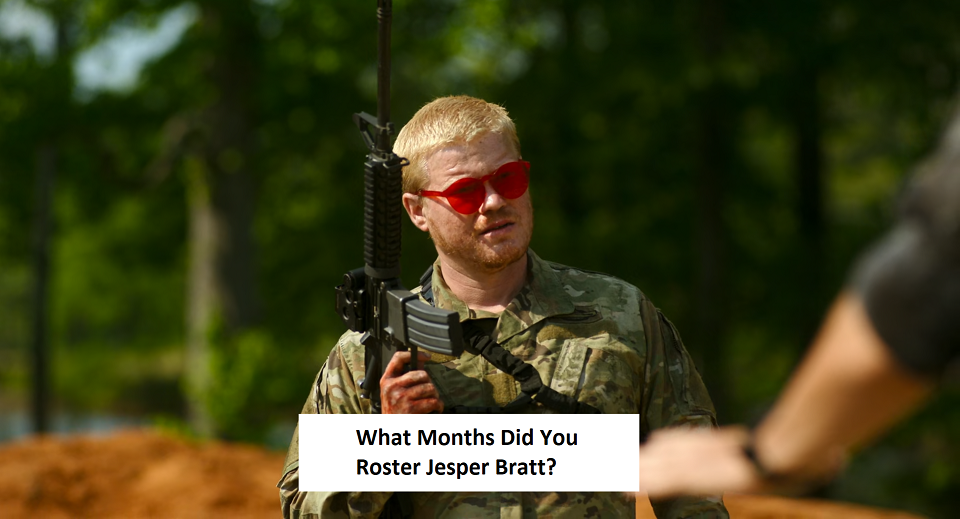
After the Olympic break, Bratt scored 9 goals, 21 assists, 53 shots, 21 hits, 4 blocks, and 7 power-play points in 25 games. Anyone with Bratt on their roster for head-to-head playoffs is probably happy with his season. Everyone else wouldn't be, though, because he saw a big decline in his fantasy value:
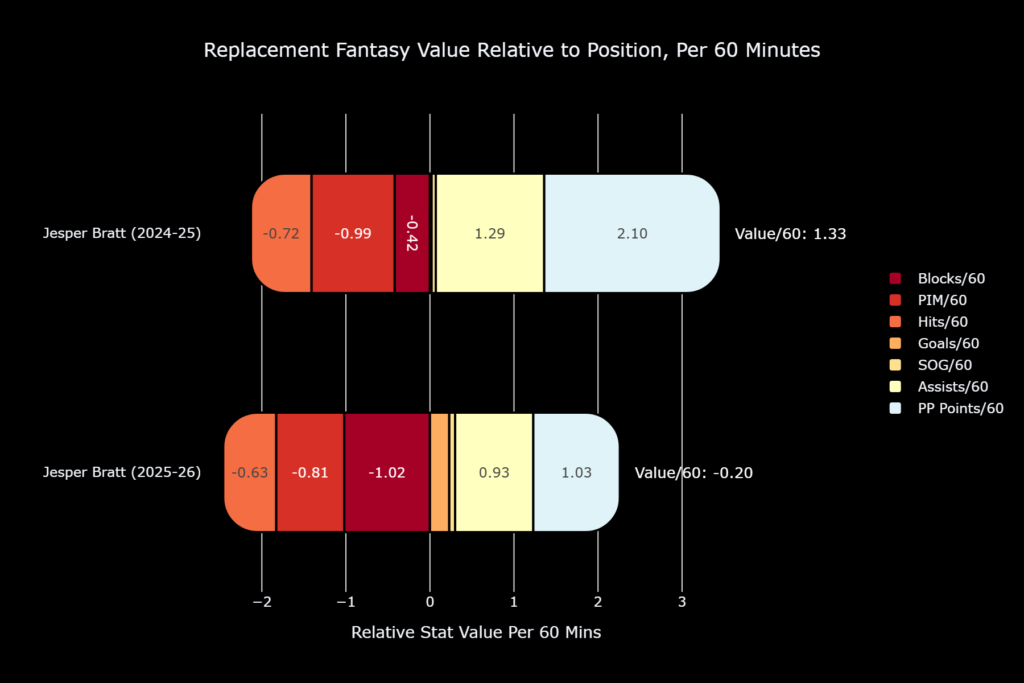
Here is the good news: two-thirds of the decline in per-60 fantasy value from Bratt was because of the power play. In 2024-25, he had 34 PPPs in 81 games but that fell to 20 PPPs in 82 games last season. Considering he averaged 28 PPPs every 82 games across the prior three seasons, and all the key power-play forwards are returning and healthy (looking at you, Jack Hughes), there is reason to believe in a bounce back. The Devils are not a team that made big changes to their forward group, so Bratt should be the team's top winger again, and he's still young enough (28 years old later this month) to where the age-related decline shouldn't kick in too hard just yet.
Mason Marchment (San Jose Sharks – LW)
Despite 230 more minutes played than the year prior, Marchment produced two fewer points, so it shouldn't be a surprise that he finds himself on our list:
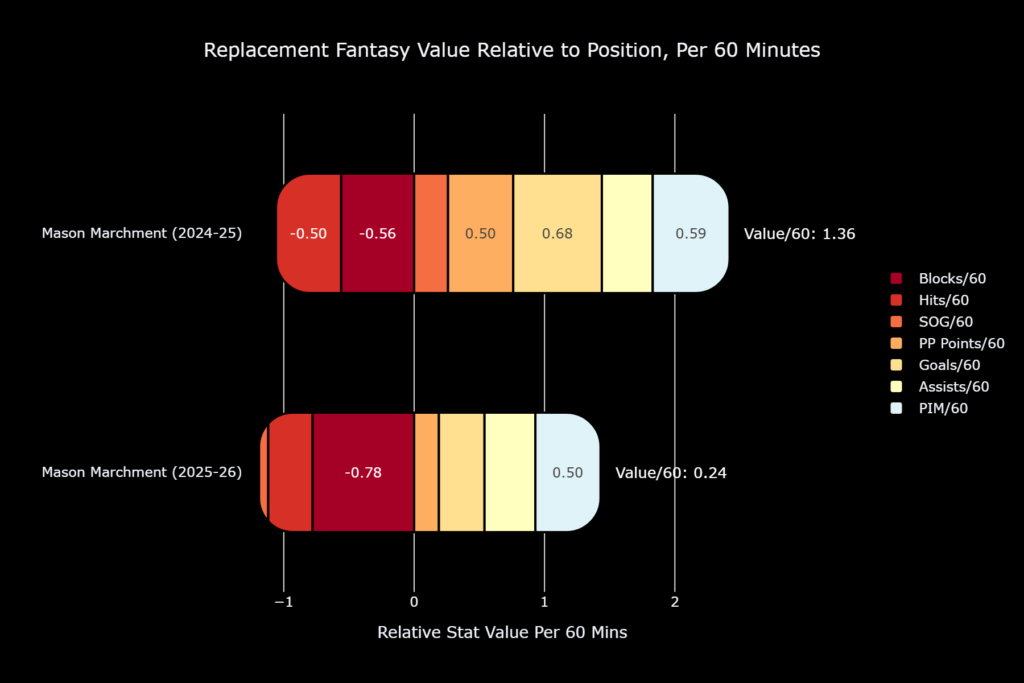
If we exclude FOWs, over half of Marchment's fantasy decline came from goals and shots, two categories that are intertwined with each other. Going to San Jose, that presents a bit of a dilemma.
Over the last two seasons, Will Smith has skated just under two-thirds of his 5-on-5 ice time next to Macklin Celebrini. When he's not on the ice with Celebrini, Smith's rate of shot attempts falls 34%. It isn't to say that Marchment will be as volatile, but this a team where there is a chasm of a difference between playing on the top line or not. If Marchment is a regular on Celebrini's wing, not only is he very likely to improve his fantasy value, but a career year is in the cards. If Marchment is a regular next to Alex Wennberg, then it's hard to see him being much better than last season. It makes him a high risk/high reward option at the draft table, and managers will have to decide how much risk they're willing to assume.
Nazem Kadri (Colorado Avalanche – C)
This is a situation where even if Kadri's production rebounds – I don't think he shoots 7.5% again – then his fantasy value will rely heavily on the settings of your league because Kadri saw a huge decline in his FOW rate last season:
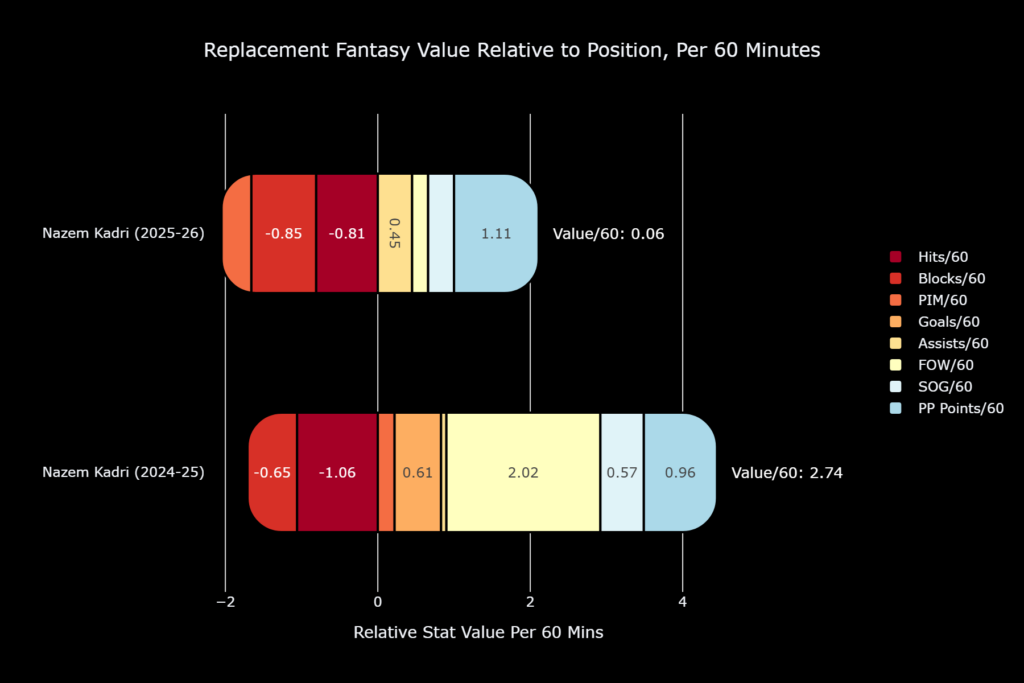
Here is the problem. Playing for Colorado is an immense upgrade to playing for the Calgary Flames. On the flipside, if Nathan MacKinnon and Brock Nelson are the top two centres, then Kadri is either a winger who sometimes takes face-offs, or a third-line centre who isn't playing with the team's top stars. Either way, he's going to lose fantasy value, so again, it matters what your league settings are. All told, we probably want him as a winger in the top-6 because he'll still take some face-offs, and I'd rather have him with 200-250 FOWs while skating next to MacKinnon than 550-600 FOWs skating next to Logan O'Connor.
Colorado is going to rely heavily on the top-half of the lineup again, and if Kadri can be a difference-maker on the power play, he can get back to the 25-goal, 60-point levels.
Kyle Connor (Winnipeg Jets – LW)
I wanted to add Connor here for a couple reasons. First, we see how someone like him needs a lot of minutes to bring fantasy value:
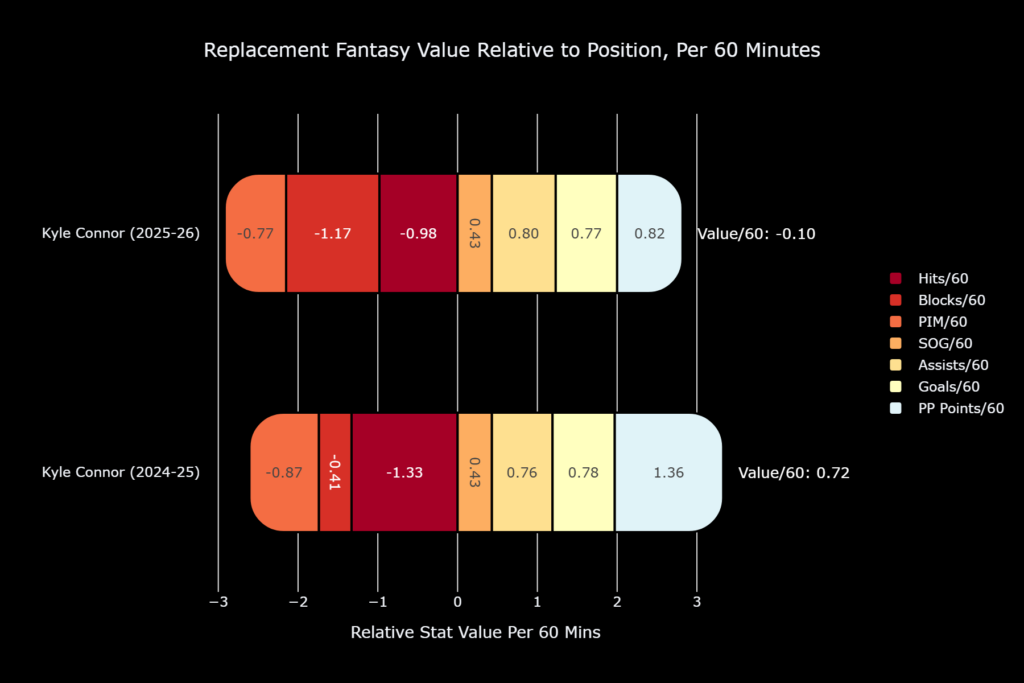
The other reason is how a decline in fantasy value can sometimes be viewed as a normalization in fantasy value. For this winger, nearly the entire decline in 60-minute fantasy value (-0.82) is the difference in his block total last season and the year before (-0.76). Back in 2024-25, Connor had 46 blocks, a career-high after posting six straight seasons with fewer than 25 blocks. He returned to that low block total in 2025-26 with just 19, so while he lost value, it really was just that he returned to where he normally is. The aberration was in 2024-25, not in 2025-26.
Auston Matthews (Toronto Maple Leafs – C)
Matthews undoubtedly had a down year, but it's always worth checking if it was just because he played 60 games, the fewest in any 82-game season of his career, or if it was because things go worse on a per-minute basis:
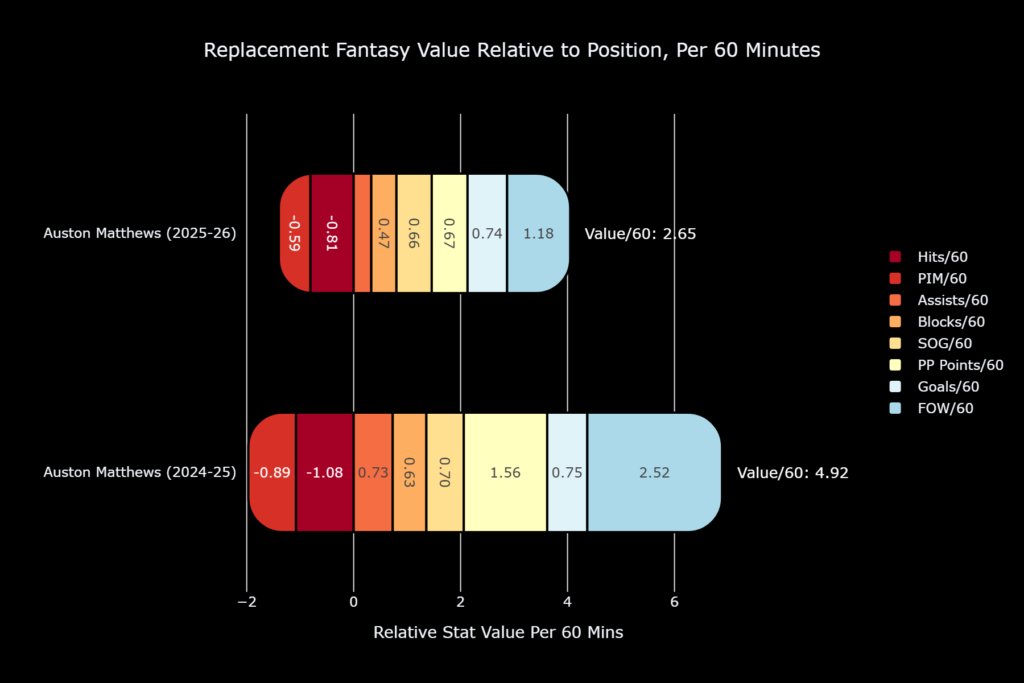
There was indeed a big decline in per-minute fantasy value, and face-off wins were a big part of it as nearly 60% of the decline came from FOWs. Whether that rebounds or not remains to be seen, but fantasy managers should keep in mind that whatever decline Matthews had compared to the year before was mostly because of this one category.
The other big chunk of the decline was in power-play production. His power-play points rate plummeted by over 40%, so in leagues without FOWs, the only real change from 2024-25 was the PP output.
That last part is what should give fantasy managers hope. We have seen Matthews have poor PP production in a season before: back in the Bubble 2021 season, his PP points rate was very similar to what it was in 2025-26, and the year after that low output, Matthews posted 28 power-play points in 71 games. If Darren Raddysh can help boost things from the blue line, and the forward group stays healthy, then Matthews can at least get back to where he was in 2024-25, which is a forward whose 82-game pace is something like 40 goals, 50 assists, 300 shots, 30 power-play points, 100 blocks, 50 hits, and 800 FOWs. It all depends on the power play rebounding and Matthews staying healthy, and if someone out there has a definitive answer to either of those questions, please let me know. (I wouldn't rely on him to play more than 70 games, and anything above that mark is gravy.)
Related Posts
Starting Goalies












Top Skater Views
 VGK
VGK BUF
BUF NYR
NYR MIN
MIN S.J
S.JTop Goalie Profile Views
 FLA
FLA OTT
OTT

LINE COMBOS
| Frequency |
 VAN Players VAN Players
| |
|---|---|---|
| 22.2 | MARCO ROSSI PAUL COTTER BROCK BOESER | |
| 18.7 | MAX SASSON AATU RATY BRENDAN GALLAGHER | |
| 18.0 | LIAM OHGREN DREW O'CONNOR LINUS KARLSSON | |
DobberHockey Podcasts

Keeping Karlsson: Delusions of Garandeur
Elan and Brian dive into the latest NHL hot streaks, cold streaks, line changes, outjuries, injuries, buy-lows and sell-highs to give you top notch tips in your fantasy hockey league

Fantasy Hockey Life: TiDy Takes Part 2
Last week, Victor Nuno and Ryan Downey broke down trades from our top tier dynasty league. This week, they consider some dynasty trades from other divisions. Have a listen! Our show is part of the Dobber Podcast Network and sponsored by Fantrax.com. Email [email protected] and ask to join our free discord. Join our Patreon at […]
Keeping Karlsson: Matchup Maximizer 2026/27 Week 3
Elan takes a look at the schedule for the upcoming weeks of NHL action and recommends players with good schedules that you should consider streaming in to win your head to head matchups.
Keeping Karlsson: Short Shifts – Sharks Looked Like Celebweenies
Elan recaps the major injuries, outjuries, game results and changed line combos that we’ve seen since Sunday’s mega-show.
Keeping Karlsson: Cole, There’s No Time!
Elan and Brian cover all the action from the first week of the NHL season, and identify our earliest must-adds, can-drops, sell highs and buy lows in your fantasy hockey leagues.