

Goaliepucks and the Three Netminders: Karel Vejmelka, Joel Hofer & Jeremy Swayman
Rick Roos
2026-08-05
Welcome back to Goldipucks and the Three Skaters, a play on words of the Goldilocks and the Three Bears story. Instead of there being three bowls of porridge though, I cover three skaters and declare one too hot (i.e., doing unsustainably better than he should), another too cold (i.e., doing unsustainably worse), and a third “just right” (i.e., producing where he should be). In addition, I also assign each a rating of 1-10, indicating how hot (rated 7-10, where 10 is the most unsustainably hot), cold (rated 1-4, where 1 is the most unsustainably cold), or “just right” (rated 4-7, where 5.5 is the most “just right”) he is.
Once during summer downtime, this column shifts focus from skaters to goalies, becoming "Goaliepucks and the Three Netminders." All is otherwise the same in that one of the three had a 2025-26 that was too hot, meaning he'll do worse in 2026-27, another was too cold, meaning he'll do better, while the third was "just right," meaning we should expect about the same from him overall in 2026-27. On tap for Goaliepucks are Karel Vejmelka, Joel Hofer, and Jeremy Swayman. Lock in your guesses, stack your pads, and read on!
Karel Vejmelka (64 GP, 38 W, 2 SO, 2,73 GAA, 0.897 SV%)
Although he's been a starter pretty much since he landed in the NHL at age 25, it wasn't until 2025-26 that Vejmelka became a fantasy asset, thanks to his 38 wins and 1458 saves, which put him in second in both categories among all goalies. Yes, his GAA and SV% were not pretty; however, that kind of volume paid dividends for many fantasy teams. What should we expect from him in 2026-27? A worse performance, as his peripherals likely will not improve and his wins total should shrink.
If you're wondering how Vejmelka won so many games despite his GAA and SV% being middle of the pack at best, look no further than goal support. In his 64 starts, Utah scored a whopping 3.59 goals per game. If that sounds high, it is, as the team averaged 3.27 goals per game for the season overall. Considering Vejmelka started 63 games, that is glaringly higher goal support than he should've received, leading to an inflated win total for someone with peripherals as poor as his. After all, even though there were 11 other goalies last season who, like Vejmelka, started 41+ games and had a lower SV% than his .897, only one, Linus Ullmark, won more than 50% of his starts, and barely, as he prevailed in 25 of 49. Clearly, Vejmelka's win total of 38 in 63 starts, for a 60% win percentage, was inflated.
Staying on Vejmelka's SV%, hopes of it rising are unrealistic, as even though it was .902 in games he started after one day of rest, it was .880 for both games started after two days rest and three days rest, and .916 for four or more days rest. Although well more than half his starts were after one day of rest, a combined 19 were after two or three, and just six came with four or more days rest. If his number of starts was to shrink, which is unlikely, he might actually fare better. As it stands however, look for more of the same in terms of SV%, in turn not helping him steal back wins he stands to lose in the normal course.
As for his GAA, clearly he turned a corner in that area in 2024-25, having been well north of 3.00 in each of his first three seasons. He inched upward from 2.58 in 2024-25 to 2.73 in 2025-26, plus did markedly worse in terms of GAA in the second half of 2025-26, likely due to the cumulative toll that all his starts had taken. Yes, Q4 in 2024-25 was his worst as well; but his Q3 that season was very good. So Vejmelka's likely continued high start volume for 2026-27 will serve to prevent his GAA from staying low enough to help him add wins to offset those he stands to lose.
Looking at other metrics, Vejmelka's High Danger SV% was .810, 14th worst among 42 goalies who played 1500+ minutes. Although Vejmelka's 18.18 average goal distance was fifth lowest among the 42, plus near the likes of Scott Wedgewood and Ilya Sorokin, and his average shot faced distance was 36.53 feet, which was 34th of the 42, and again in the company of elite netminders, he also gave up the third most rebounds of the 42. His low goal distance and high shot distance, which should otherwise help his peripherals, are not likely to do so because of his propensity to cough up rebounds.
Focusing last on Quality Starts and Really Bad Starts, Vejmelka was at similar rates for both versus 2024-25, when his SV% was slightly better and GAA a good bit better. Those areas should not have an effect one way or the other in 2026-27.
If you owned Vejmelka last season, you saw huge benefits in Wins and Saves. Thinking he can replicate his winning percentage is unrealistic, as the team scored disproportionately more goals in games he played, plus he's not likely to see gains in SV% or GAA which would help steal back some of the wins he stands to lose. As such, Vejmelka's 2025-26 was TOO HOT, and he gets a rating of 8.5, suggesting that like most goalies with his peripherals he should win less than 50% of the games he starts, not the 60% he won in 2025-26. That having been said, his GAA and SV% are not likely to get much worse, nor should his rates of Quality Starts or Really Bad Starts. He might however still have a high volume of saves. This is solely about wins, where the negative effects could be quite pronounced.
Joel Hofer (46 GP, 24 W, 6 SO, 2.58 GAA, .910 SV%)
After cameos in 2021-22 and 2022-23, Hofer became a full time back up for 2023-24. And despite superior stats as compared to incumbent starter Jordan Binnington, Hofer played just one more game in 2024-25 than 2023-24. Last season Hofer's strong play, plus continued poor results from Binnington, saw Hofer emerge as the 1A for the Blues, with 46 total starts. Can Hofer do even better, as despite six shutouts his GAA and SV% were virtually unchanged? The answer appears to be yes.
It is correct that Hofer's quality start rate has held fairly steady; and although he had four more shutouts in 46 games last season than in his 69 prior career games combined, he also had one more RBS last season alone than he totaled in his prior campaigns. Focusing first on shutouts, let's see if there are any comparables for a goalie age 25 or younger who had at least six shutouts in a season despite playing under 50 games. In NHL history it's happened twice, one being Chris Osgood, who went on to win over 400 games, and Jake Allen, who, like Hofer, showed promise as a back-up but in Allen's case when given the chance to be a starter was not up to the task. Mixed messaging there.
What does seem to suggest an even brighter future for Hofer though are his days rest stats for last season, as the less rest the better, his SV% being .965 on back-to-back starts, .926 on one day's rest, .917 on two days rest, .871 on three days rest, and .918 on four or more days rest. Last season he only had 18 games where he was appearing after one or two days rest, plus two back-to-backs, versus 13 starts of three days rest and 13 of four days or more of rest. If, as suspected, he becomes even more of a 1A, his days rest should be comparable to someone like Jet Greaves, who had 32 games with one or two days off, four back to backs, and only 18 starts of three or more days rest. In short, Hofer should see more action under circumstances where he's proven himself able to thrive. Yes, this would mean more starts for him overall; however, Q4 was his best of 2025-26, so fatigue should not be an issue.
His spike in Really Bad Starts versus prior seasons was frontloaded, as he had a mere one in his last 16 games. Not only were nearly none of those games Really Bad Starts, but 14 were Quality Starts. Rather than a true rise in Really Bad Starts, and holding steady in Quality Starts, Hofer was trending much better in both, boding well for 2026-27.
Even accounting for bumpier waters earlier in the season, and despite six shutouts, why is it that Hofer failed to win 50% of his games? In many cases it took a shutout to win, as his team provided 2.86 goals per game of support. Yes, that 2.86 was a tad more than the 2.82 they averaged for the season as a while; yet St. Louis had averaged 3.10 in 2024-25, so they were off their game yet figure to be better for 2026-27, especially since they had 106 goals in the first half, but 124 in the second half, with the second half pace translating to 3.02 per game. And in the last 12 games alone they had 44 goals, for a pace of 3.66 per game, which coincided with the formation of the Robert Thomas, Dylan Holloway, Jimmy Snuggerud line. In short, Hofer should get more goal support in 2026-27, translating to more wins.
Other positives for Hofer were his .915 even strength SV%, fifth best among the 28 goalies who played 41+ games last season, to go along with a top ten GSAA. Those stats are all the more impressive given he ranked all the way down at 36th in high danger SV% among the 42 goalies who logged 1500 or more regular season minutes. Although that is not a great stat to see, it can only go up in the normal course, especially since his average shot distance was the second highest in all of the NHL, meaning he is seeing shots that are easier to save, further underscored by him only having to face 28 rush attempts all season. In short, Hofer is a skilled goalie who should continue to be helped by his team defensively, plus, as noted above, more so offensively.
Although past comparables point in both directions, Hofer seems to be embarking on what should be a successful career, and thus his 2025-26 was TOO COLD. He might not have as many shutouts per start for 2026-27, but his QS and RBS rates should improve, as should his win total due to St. Louis giving him more goal support plus helping him defensively. Thus he gets a ranking of 2.50, where if he starts 50-55+ games he should join the 30 win club for the first but almost assuredly not the last time in his career, with GAA and SV% numbers as good if not better than they were in 2025-26.
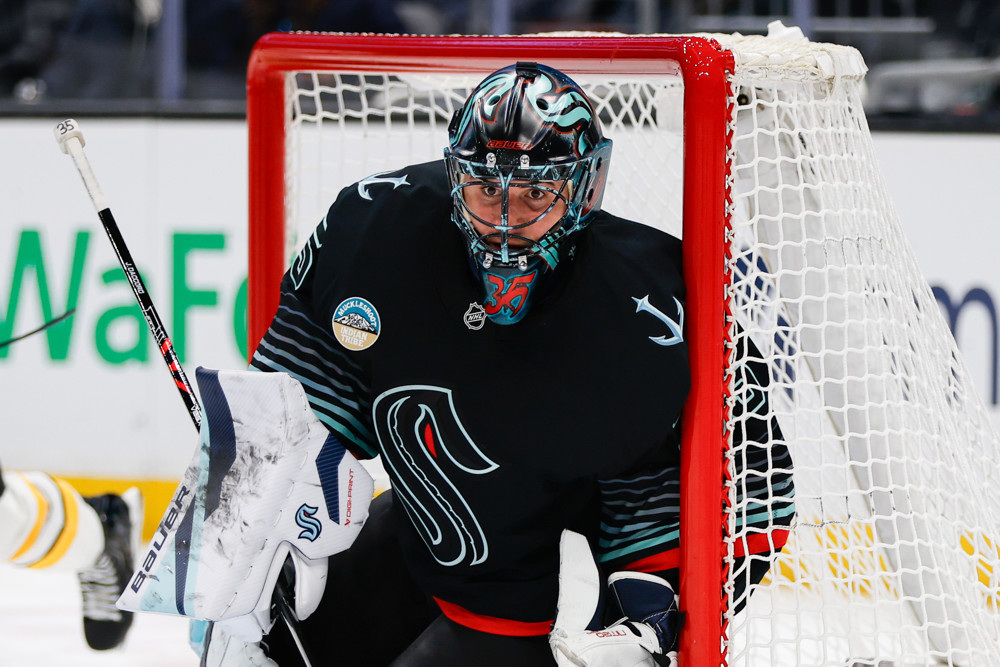
Jeremy Swayman (55 GP, 31 W, 2 SO, 2.69 GAA, 908 SV%)
After a historic 2022-23 that saw Swayman and Linus Ullmark split duties, and then more of the same in 2023-24, albeit with not as great results, push came to shove in 2024 and the Bs had to decide which of the two around whom to build. They went with Swayman, who then proceeded to post a 3.11 GAA and .892 SV% with only 22 wins in 58 starts in 2024-25. He rebounded quite well last season. Was 2025-26 a sign that as a starter he can put up the same numbers he did while a 1A/1B? Probably not, as the totality of his metrics suggests his 2025-26 season is likely to typify what we see from him, at least for the near future.
Swayman's major issue is his .889 SV% on one day of rest and .899 on two days of rest. It might've been understandable for him to have this problem in 2024-25 because it was the first time he saw that high of a volume of starts; but it did not improve for 2025-26. If he had three days of rest in 2025-26, his SV% climbed to .911, and it rose even further to .930 on four or more days rest. Perhaps realizing this, the Bruins had Swayman start 16 games on one of rest, 19 on two, 11 on three, and 7 on four or more. Either he starts more games on less rest, with a worse SV%, or he does more of the same, curbing his wins.
Swayman's less than stellar SV% also is an issue in that of the 19 goalies who appeared in 50+ games last season, he faced the third most SOG. The good news is it can't get much worse; however, it's unlikely to improve, plus there is the compounding issue of his SV% being lower for the amount of rest he's most likely to receive.
On the plus side, Swayman had a high danger SV% of .871, second best among 42 goalies who played 1500 minutes last season. Also, he did as well as he did despite giving up the most rebound attempts. Yet his average goal distance was 23.03 feet, which was third highest among the same 42 goalies. Basically, Swayman coughed up a lot of rebounds, but did a great job stopping them, as well as high danger shots. He allowed goals from a distance that is not typical of elite goalies, which was a problem since despite all the rebounds his average shot distance faced was 34.09, which was fourth highest of the 42. In all, this paints the picture of Swayman being great under pressure, but perhaps letting in too many easy goals. Given that he is at the extreme in almost all these categories, chances are if he was to see changes in a positive direction, it/they get offset by changes in a negative direction, for a wash.
Looking at Quality Starts, Swayman excelled, with a rate of just under 70%. That was a big jump, such that it could drop a good bit. But at the same time, his Really Bad Starts are seemingly trending down; so here too, even if his Quality Start rate falls it could be offset by a lower Really Bad Start rate. Similarly, Swayman excelled at ES, with a .923 SV%, yet was truly dreadful on the PK, allowing 45 PPGs, which was easily the most of any goalie. So yet again, it's a case of one metric having room to rise, but another possibly dropping.
I realize if you've read this far you knew going in that Swayman's 2025-26 was JUST RIGHT, and in fact it was. But that's the conclusion for an unusual reason, namely that he is either so great or so bad in so many metrics, chances are just as likely that if one was to improve another would get worse. Still looming is the reality that he is simply not at his best if starting on one or two days rest, which isn't ideal in that it will likely cap his start and win totals. Swayman gets a right down the middle rating of 5.5, as although some stats might rise and others may fall, his overall value as a goalie in most leagues should stay about the same. Of course, he also is still only 27, well below the age most goalie peak, so there is still a chance he connects all the dots and becomes a truly elite goalie. For 2026-27 at least, expect his value to stay the same overall,
***********************
Questions for Mailbag
My next mailbag has plenty of room for more questions. To get yours to me, you can either send (1) a private message to “rizzeedizzee” via the DobberHockey Forums, or (2) an email to [email protected] with “Roos Mailbag” as the subject line.
Related Posts
Starting Goalies



Top Skater Views
 S.J
S.J L.A
L.A SEA
SEA ANA
ANA


Top Goalie Profile Views
| Players | Team | |
|---|---|---|
| DAN VLADAR |
 PHI PHI | |
| CARTER HART |
 VGK VGK | |
| SERGEI MURASHOV |
 PIT PIT | |
| LOGAN THOMPSON |
 WSH WSH | |
| JOEL HOFER |
 STL STL
| |
LINE COMBOS
| Frequency |
 NSH Players NSH Players
| |
|---|---|---|
| 22.3 | STEVEN STAMKOS RYAN O'REILLY COLE O'HARA | |
| 19.9 | MATTHEW WOOD FILIP FORSBERG LUKE EVANGELISTA | |
| 16.6 | OZZY WIESBLATT REID SCHAEFER TYSON JOST | |
DobberHockey Podcasts

Fantasy Hockey Life: Nashville Predators with Emma Lingan
Emma Lingan joins the program to discuss the Nashville Predators

Keeping Karlsson: The 2026-27 Keeping Karlsson Breakfast Club
Don’t you forget about them! Elan and Brian remind you of at least one player on each NHL team whose name you might forget to consider at the draft table.
Fantasy Hockey Life: Tampa Bay Lightning with Erik Erlendsson
Erik Erlendsson joins the program to discuss the Tampa Bay Lightning. Jesse and Victor ask about pros Nikita Kucherov, Jake Guentzel, Brandon Hagel, Brayden Point, Anthony Cirelli, Ilya Mikheyev, Gage Goncalves, Conor Geekie, Benjamin Rautiainen, John Carlson, Victor Hedman, Charle-Edouard D’Astous, Andrei Vasilevskiy, Jonas Johansson, and Dennis Hildeby. In Cat’s instincts, Cat Silverman of InGoal […]
Fantasy Hockey Life: New York Rangers with Colin Stephenson
Colin Stephenson joins the program to discuss the New York Rangers.
Keeping Karlsson: Matchup Maximizer Schedule Deep Dive
Elan is joined by the Keeping Karlsson Accountability Czar Trev to take a deep dive into the NHL schedule for next season and how it should affect our drafting decisions.