

Ramblings: Broberg’s Pivotal Season; Novak’s Upside; Graf’s Potential; Sillinger’s Stagnation – August 4
Michael Clifford
2026-08-04
Every offseason here at Dobber Hockey, the entire group of editors and writers go team by team to review their respective offseason moves and what it means for player fantasy values in the upcoming campaign. There is one team posted each day, and this year's edition starts today over at The Dobotomy with Ian Gooding covering the Winnipeg Jets. Go see what he has to say about the Jets and check back each day as we work our way through all 32 teams.
*
One of the teams that I will be covering in those offseason reviews is the St. Louis Blues. Having started digging in a bit yesterday, the player that interests me the most is Philip Broberg.
For fantasy managers, an important annual exercise is updating what you think of players. Most of the time, an opinion doesn't change much, but sometimes, new evidence shows up and can wildly alter your outlook. That happened with me and Broberg. I didn't think much of him as a prospect or his early Edmonton Oilers years, but I thought showed some very good puck-moving ability in the 2024 playoffs and it turned my opinion of him. One offer sheet from the St. Louis Blues later, and Broberg is now a genuine top-pair calibre defenceman, and probably a number-1 defenceman. Not in the elite tier with the likes of Cale Makar, Quinn Hughes, and Lane Hutson, but in the next tier with guys like Jackson LaCombe and Josh Morrissey.
However, real-life value doesn't always translate to fantasy value. There are plenty of great real-life defencemen who are not great, or even good, fantasy defencemen. Think of names like Jaccob Slavin, Damon Severson, and Gustav Forsling. They have provided some fantasy production, but what they do for their franchises far outstrips what they do for their fantasy managers.
That might be the case with Broberg. Using 5-on-5 tracking data from All Three Zones, we will look at assists on teammate scoring chances, high-danger passes, zone exits with possession, and carried zone entries, all of them relative to the league-average defenceman. It basically gives us two groups of stats: playmaking and transition. Over the last two seasons, during Broberg's breakout, the playmaking side of his ledger is well below average, but the transition side is well above average:
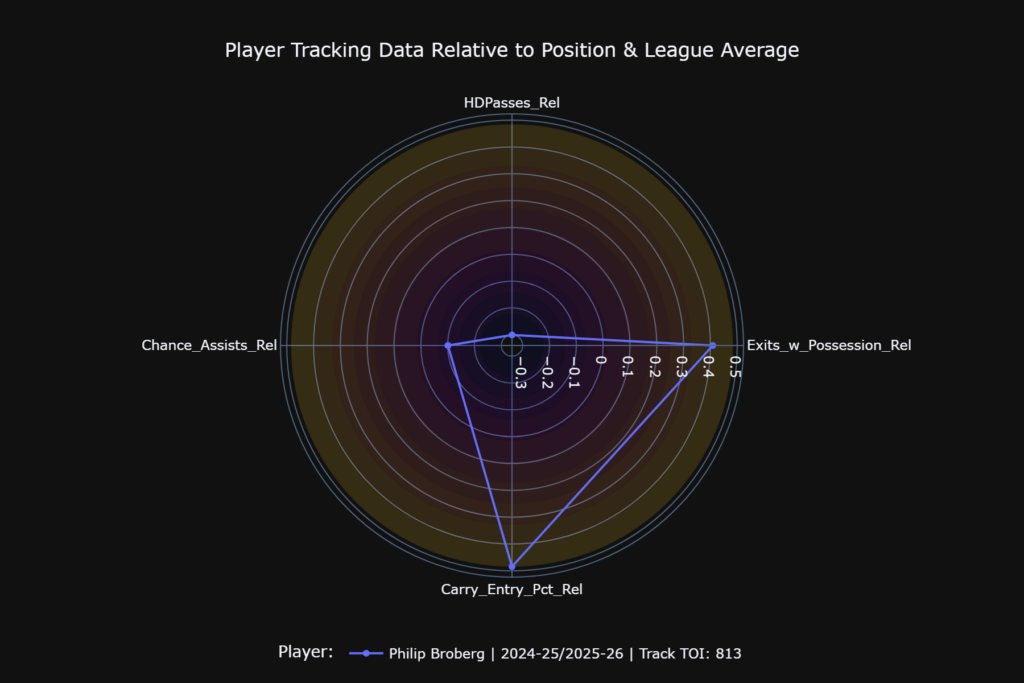
That is worrying for his fantasy value. Broberg is clearly very talented at getting the puck out of the defensive zone and into the offensive zone with control, and that is very valuable in helping his team score goals. But without that playmaking connective tissue between the transition and the goal-scoring, there are going to be some assists missing. Compare that to what LaCombe has done over the last two years:
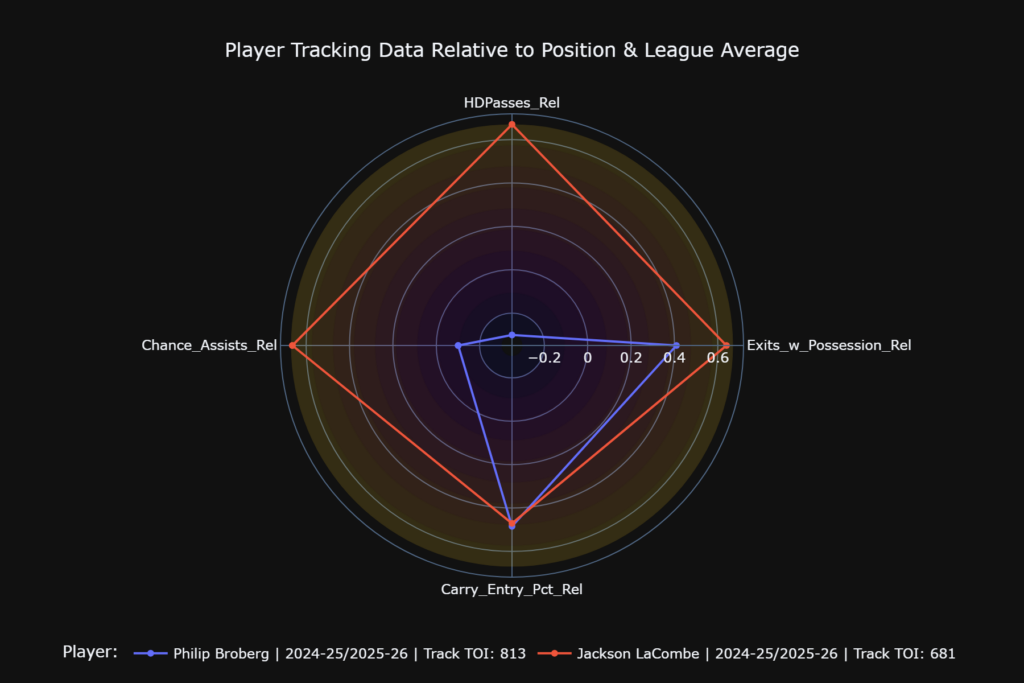
In that span, the St. Louis Blues and Anaheim Ducks have the same 5-on-5 scoring rate. Despite that, LaCombe's primary assist rate at 5-on-5 is 26% higher than Broberg's. Given what we see in the graph just above, there's a reason for that.
This will be a telling season for Broberg. He is now 25 years old, in his third post-Oilers season, and he crossed the 200-game threshold back in January. Everything is lined up for him to take a big step forward. If he can't add a playmaking dimension to his game, he might be the next Forsling. That is a great real-life player, and reasonable fantasy hockey depth, but unlikely to be a high-end fantasy producer.
*
Be sure to grab a copy of the Dobber's 2026-27 Fantasy Hockey Guide! It is available for purchase now in the Dobber Shop, includes an interactive draft list, and will be updated constantly right up until the start of the regular season.
*
Over the last couple of weeks, there have been a few notable depth signings that I haven't touched on yet, so I want to get to that today. Ian wrote about a couple of them over the weekend, so check out what he has to say here. Contract data from PuckPedia.
The first was Novak re-upping with the Pittsburgh Penguins for three years at $4.65-Million per season. After a down year with Nashville in 2024-25, the Predators traded him to the Penguins, and he returned to his 40-something-point level with 16 goals and 26 assists in 82 games. He also set a career-high in shots (130), blocks (34), hits (12), and penalty minutes (24). Those aren't good peripheral levels, but career-highs are better than career-lows.
One reason I was very high on Novak when he put up 88 points in 122 games across the 2022-23 and 2023-24 seasons was his playmaking. Going back to the 5-on-5 tracking data, his assists on teammate scoring chances was a whopping 124% above the league-average forward while his high-danger pass rate 64% above the league average:
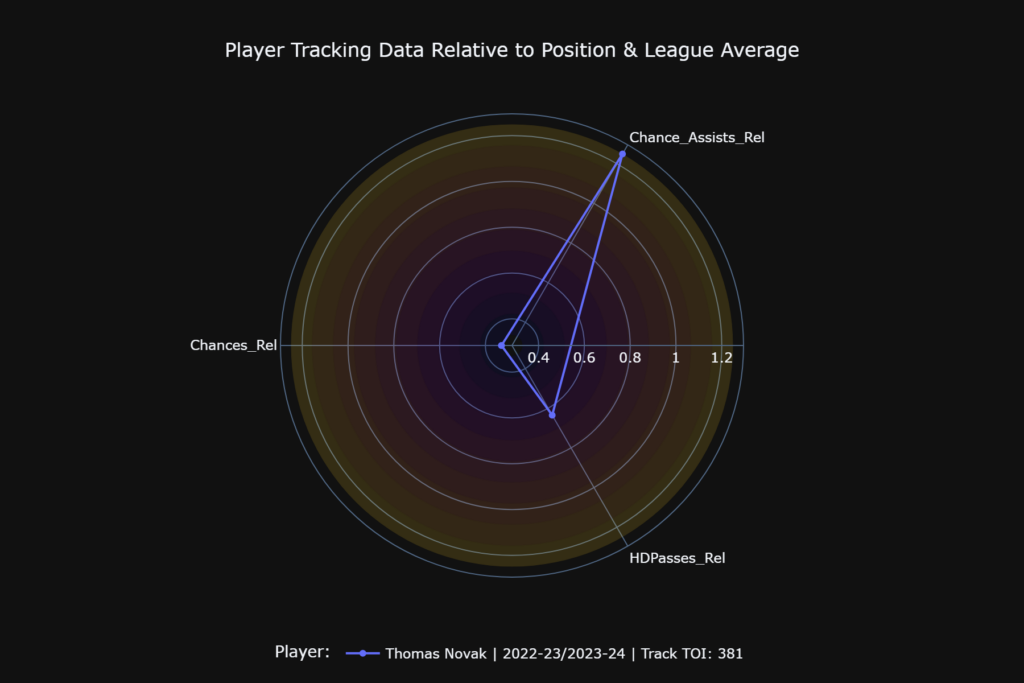
Over those two years, Novak's primary assist rate at 5-on-5 was that of a mid-tier first-line forward (per Evolving Hockey), and tied with Dylan Larkin, Mats Zuccarello, and Sebastian Aho. He hadn't put up huge totals yet, but he was very productive in his limited ice time, and that gave me a lot of hope that with the right usage he could turn into a 20-goal, 50-assist forward.
Then he had a genuinely poor 2024-25 season, whether by production rates or tracking data, and concerns mounted. The good news is that after a down year (purple line), his rate of scoring chances, assists on scoring chances, and high danger passes rebounded (orange line):
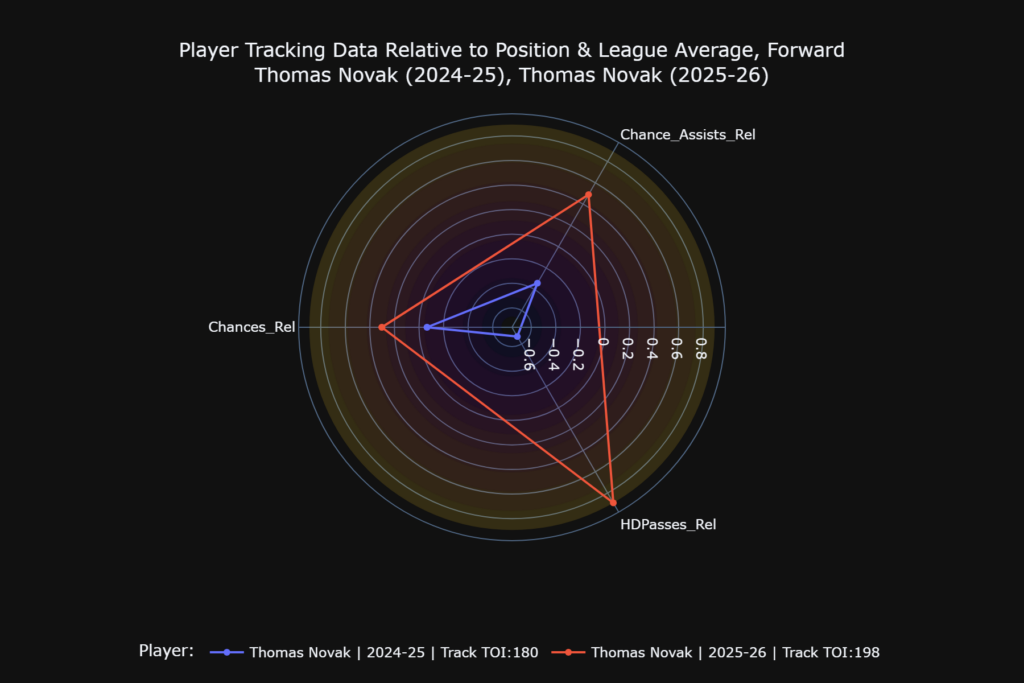
His primary assist rate at 5-on-5 reverted to nearly what it was in that prior two-year stretch, and had his 5-on-5 shooting percentage (9.4%) been more typical for him (around 15%), then he passes the 20-goal mark and pushes towards 50 points.
There are two big roadblocks preventing his next step in the fantasy game. The first is the power-play time as he earned just 25.3% of the team's PPTOI last season (per Frozen Tools), eighth among their regular forwards. Anthony Mantha is gone, but they brought in Andrei Kuzmenko, so Novak is a long way away from truly meaningful PP production.
The other issue is the trust of his coaches. Pittsburgh had 10 forwards get an empty-net point last season, and none of them were Novak. The team uses their superstars when they need a goal and the superstars or grinder forwards when defending a lead. Novak is neither, so without the PPTOI or empty-net situations, Novak will be hard-pressed to get to the 50-point mark. He truly does have 60-point potential, but not with secondary PP usage and 14 minutes a game.
Collin Graf
It was a breakout year for Graf with 21 goals, 25 assists, 118 shots, 88 hits, 48 blocks, and 12 PIMs. That earned him a three-year extension worth $4.25-Million per season as he looks to build off that very good effort.
What is instantly notable is that Graf surpassed Tyler Toffoli on the right side of the depth chart last season. That is very important because the Sharks have Will Smith and Kiefer Sherwood on the right side. With Graf passing Toffoli, it gives Graf a spot in the top 9. There is always a chance Graf slides and Toffoli rises, but Toffoli is 34 years old with 1062 career NHL games. He is still productive, but his play has declined, and he's not the player he was 3-4 years ago.
What is less obvious but also important is that Graf has been a very efficient player for his brief career. Over the last two seasons, among 329 forwards with at least 1250 minutes at 5-on-5, Graf is 11th by expected goals per shot attempt. When we factor in shooting percentage, he lines up with a couple of other productive young wingers:

The big problem is the lack of power-play usage. He earned less than 10% of San Jose's PPTOI last season and though William Eklund, Jeff Skinner, and Philipp Kurashev are gone, they added Mason Marchment and drafted Ivar Stenberg. At best, Graf will be on the second PP unit and will likely not be on either. That caps his fantasy upside.
The second problem is that the Sharks struggled to score when Graf was on the ice without Macklin Celebrini. That led to Graf producing far more 5-on-5 points (19) in his 402 minutes with Celebrini than in his 644 minutes without Celebrini (13 points). He might see some top-line TOI, but Graf could struggle to produce next season if Michael Misa can't help boost the offence.
The good news is that Graf does get a lot of empty-net situations, particularly when defending a lead, and that can give him some extra points. It doesn't make up for the lack of PP usage, but it helps.
Graf improved at both ends of the ice last season and turns 24 years old in September. There is a chance he racks up some more points, but last season should be seen as a short-term high-water mark, and I am not expecting more than that.
Sillinger was signed to a three-year extension with a $4.625-Million cap hit, but I never saw the appeal in his game. He had some decent multi-cat fantasy value in 2023-24 with 32 points, 157 shots, 74 blocks, and 119 hits, but his 5-on-5 goal scoring rate over the last three years is that of a genuine fourth-line forward, similar to Kevin Stenlund and Colin Blackwell. His primary assist rate in that span is in the 55th percentile, or just above league average. Sillinger is only 23 years old, but he has five seasons to his name and has never been more than a fourth liner. It seems as if the Columbus Blue Jackets finally figured that out last season as he lost 1:42 of ice time per game.
Sometimes, a player doesn't produce well in a lesser role but has some hallmarks of a potential breakout; we saw that earlier with Novak. That isn't the case with Sillinger. If we use the same three tracking stats we used for Novak – rate of scoring chances, assists on teammate chances, and high-danger passes – he comes in below average in all three areas, ranging from -20% to -42%:
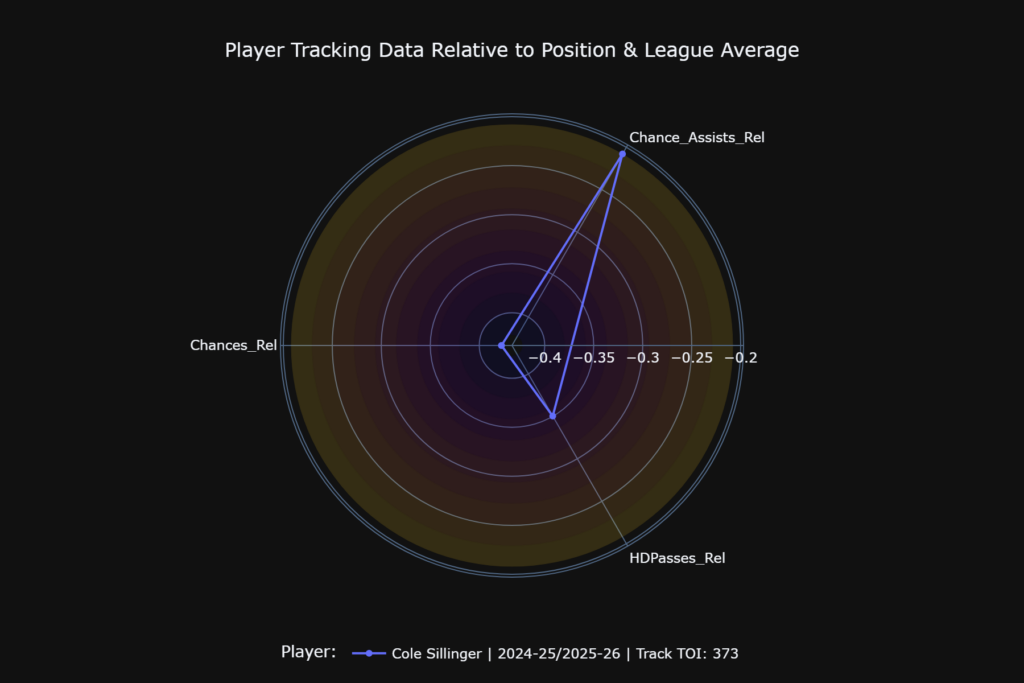
He also isn't particularly good in transition. Not as bad as the graph for scoring chances and passing, but the best we could say is league average. I could be more empathetic to a player who just turned 23 years old earlier in the offseason, but with 367 regular season games to his name, this might just be who he is.
As long as Sillinger skates 15-16 minutes a game, he can be a 30-point, 100-hit player. That offers some multi-cat value, but he has not improved his offensive skills, and there doesn't seem to be another level in his fantasy value. Maybe he takes a step – who saw Mathieu Olivier coming? – but there isn't much evidence he will.
Related Posts




Starting Goalies



Top Skater Views
| Players | Team | |
|---|---|---|
| LUKE EVANGELISTA |
 N.J N.J | |
| JOSH DOAN |
 BUF BUF | |
| MASON MARCHMENT |
 S.J S.J | |
| MAVRIK BOURQUE |
 NSH NSH | |
| FRANK NAZAR |
 CHI CHI
| |
Top Goalie Profile Views
| Players | Team | |
|---|---|---|
| DAN VLADAR |
 PHI PHI | |
| SCOTT WEDGEWOOD |
 COL COL | |
| SPENCER KNIGHT |
CHI | |
| YAROSLAV ASKAROV |
S.J | |
| JOEL HOFER |
 STL STL
| |
LINE COMBOS
| Frequency |
COL Players
| |
|---|---|---|
| 15.5 | NATHAN MACKINNON ARTTURI LEHKONEN GABRIEL LANDESKOG | |
| 10.6 | JOEL KIVIRANTA PARKER KELLY JACK DRURY | |
| 9.8 | BROCK NELSON MARTIN NECAS NAZEM KADRI | |
DobberHockey Podcasts

Fantasy Hockey Life: Nashville Predators with Emma Lingan
Emma Lingan joins the program to discuss the Nashville Predators

Keeping Karlsson: The 2026-27 Keeping Karlsson Breakfast Club
Don’t you forget about them! Elan and Brian remind you of at least one player on each NHL team whose name you might forget to consider at the draft table.
Fantasy Hockey Life: Tampa Bay Lightning with Erik Erlendsson
Erik Erlendsson joins the program to discuss the Tampa Bay Lightning. Jesse and Victor ask about pros Nikita Kucherov, Jake Guentzel, Brandon Hagel, Brayden Point, Anthony Cirelli, Ilya Mikheyev, Gage Goncalves, Conor Geekie, Benjamin Rautiainen, John Carlson, Victor Hedman, Charle-Edouard D’Astous, Andrei Vasilevskiy, Jonas Johansson, and Dennis Hildeby. In Cat’s instincts, Cat Silverman of InGoal […]
Fantasy Hockey Life: New York Rangers with Colin Stephenson
Colin Stephenson joins the program to discuss the New York Rangers.
Keeping Karlsson: Matchup Maximizer Schedule Deep Dive
Elan is joined by the Keeping Karlsson Accountability Czar Trev to take a deep dive into the NHL schedule for next season and how it should affect our drafting decisions.