

21 Fantasy Hockey Rambles
Dobber Sports
2026-10-18
Every Sunday, we share 21 Fantasy Rambles from our writers at DobberHockey. These thoughts are curated from the past week’s 'Daily Ramblings'.
Writers/Editors: Ian Gooding, Michael Clifford, Alexander MacLean, Puneet Sharma, and Dobber
___
1. Injuries haven’t been uncommon during the first part of the season, but the New York Rangers were hit with the worst possible injury news last week. According to multiple sources, starting goalie Igor Shesterkin will miss the rest of the regular season with a lower-body injury. Shesterkin left the game against the Washington Capitals two Fridays ago, unable to put weight on his right leg after it hit the post when he slid back to cover the right side of the net.
Shesterkin was on average the fifth goalie drafted in Yahoo leagues (ADP 44), which makes sense because he has been widely regarded as a top-5 goalie for the past few seasons. Since Shesterkin was drafted around the fourth round, this is a difficult blow for fantasy teams that were expecting his consistent volume of games played and higher-than-average probability of quality starts.
The Rangers were already without backup Joonas Korpisalo for four more weeks, also because of a lower-body injury. That means 24-year-old Dylan Garand is expected to be the Rangers’ starter for at least the next few weeks. Garand was placed on waivers to be sent to the AHL before the season, so thank goodness for the Rangers he went unclaimed! Garand is worth targeting in all leagues, especially among those fantasy leaguers rostering Shesterkin. He is unproven as an NHL goalie, but he had some decent AHL numbers last season (20-10-8, 2.73 GAA, .913 SV%). (oct11)
2. The Ottawa Senators got some good injury news and some bad injury news on Thursday. On a positive note, they welcomed back defenceman Artem Zub, who hadn’t played yet this season due to a knee injury. It also seems like as if defenceman Jake Sanderson is nearing return, as Bruce Garrioch reported that he may need a couple more days of skating with the team but it seems as if his return to the lineup will be sooner rather than later.
The bad news is that winger William Eklund underwent surgery on his ankle and will be out 10-12 weeks. That timeline would put him out until somewhere around the Christmas holiday, or later. This is not a team with tremendous winger depth, and it takes an important piece of their offensive attack away. They have tried different options like Ridly Greig, Fabian Zetterlund, and Warren Foegele in the top-6 without Eklund, but all have been demoted at one point or other. This isn’t a case where there is a clear option to take Eklund’s prime offensive minutes. (oct16)
3. The Winnipeg Jets have designated defenceman Josh Morrissey as week-to-week. That is not good news for a Jets team that had gotten off to a pretty good start this season. Not having Connor Hellebuyck at all is one thing, but not having your Norris-calibre defenceman is a big problem. Expect Neal Pionk to keep running the top PP unit for now. (oct16)
4. An unfortunate update on Dallas Stars forward Matt Duchene, who underwent core muscle surgery and will miss three months. Duchene had yet to play this season and missed 25 games last year. If he returns in three months’ time, that is sometime in the middle of January. For now, Sam Steel and Jamie Benn are getting regular turns in the top-6, but the player I’m keeping an eye on is Justin Hryckowian. (oct13)
5 Entering Saturday action, here are two players that have been early-season surprises and how sustainable their production may be going forward:
With six points over nine games, Cuylle’s scoring rate has increased over past seasons. Cuylle has also been an all-around multicategory contributor, averaging over four hits per game. Another positive is that Cuylle is benefiting more from an increased shot rate (2.4 SOG/GP) than an inflated shooting percentage (13.6 SH%).
Cuylle may still have a tough time breaking his career highs of 20 goals and 45 points, though. He is currently on the Rangers’ second power play, which should be good for a few more points. However, Cuylle has mainly lined up with Eeli Tolvanen and Noah Laba at even strength. This appears to be the Rangers’ third line, which won’t really help Cuylle with scoring attempts. Cuylle is worth retaining in leagues that count hits, but he doesn’t need to be rostered in pure scoring leagues. (oct17)
So far, a change of scenery is working wonders for McTavish. In his first season with the St. Louis Blues, McTavish is off to a fast start with five goals and eight points in seven games. McTavish has points in six of those games while scoring goals in back-to-back games. The shot total is a great sign, as he is averaging nearly four shots per game – up two shots per game from last season.
There aren’t a whole lot of red flags, although McTavish may be due to slow down at some point anyway. McTavish’s shooting percentage currently sits at 18.5%, while his 5-on-5 shooting percentage is at 14.6%. Although his usage likely won’t decline the way that it did last season with the Ducks, McTavish is still averaging a modest 15:39 per game with power-play minutes between the first and second unit. Don’t count on McTavish being a point-per-game player going forward, but his fantasy value appears to be on the rebound after trending the wrong way last season with the Ducks. (oct17)
7. Waiver Wire Targets
The week that just passed looked like one of the tougher weeks to find waiver-wire options, with a lot of teams playing on the busy nights. Entering it, I wanted to highlight a few players who may be worth adding to your watchlist moving forward. If we see an increase in deployment, that could lead to an uptick in production. Keep in mind that some of these players may not be the best fit for this upcoming week, but could provide some value in the weeks ahead.
Mikael Granlund (C/LW) – 29% owned
Even with Anaheim only playing twice this upcoming week Granlund is just 29% owned in Yahoo!, there is a good chance he is still available in your league, and I would be looking to add him. Granlund has been on a heater to start the season, recording seven points (2G, 5A) in five games. He followed up another multi-point performance over the weekend with two assists, four shots, a block and 19:23 of ice time. He is averaging 19:43 per game and has been seeing time on the first power-play unit, giving him multiple avenues to produce. The one drawback for the short-term is Anaheim's two-game schedule, which limits his immediate streaming appeal. However, I would not let that stop you from picking him up. His early production, consistent ice time and power-play deployment make him more than just a short-term option. Now is a good time to grab him before his ownership climbs. (oct12)
8. Trevor Connelly (LW) – 3% owned
With Viktor Olofsson out week-to-week after getting off to an excellent start with four goals and an assist through four games, Trevor Connelly is worth a look as a short-term waiver option. Connelly has seen some power-play minutes in Olofsson’s absence, but how long that lasts is anyone’s guess, so keep an eye on lineup changes. His ice time has also taken a nice jump over the last two games, logging 15:26 and 14:12 after hovering around the 11-minute to start the season. His latest outing against the Kings was his best yet, recording a goal, an assist and six shots, with both points coming on the power play. Connelly now has four points and 15 shots through six games, with a 13.3% shooting rate. The shot volume is encouraging, although it’s still a small sample size, and we’ll need to see if he can maintain that production as the season progresses. Vegas plays four games this coming week, making Connelly an interesting streaming option for those looking for some short-term upside. (oct12)
9. Roman Kantserov (RW) – 8% owned
Roman Kantserov is more of a watchlist option as Connor Bedard returned to practice on Sunday and skated on a line with Patrick Kane and Kantserov. If that combination sticks once Bedard returns to the lineup, Kantserov could be worth a look on the waiver wire. He is only owned in just 8% of leagues and scored his first goal as a member of the Blackhawks. He came off a strong KHL season, recording 64 points (36 goals, 28 assists) in 63 games. There is some upside here, particularly if he gets an opportunity to play alongside Bedard and Kane, but I would not rush to add him just yet. Chicago plays only three games this week, all on busy nights, which makes it tougher to justify picking him up for immediate production. For now, I would keep Kantserov on your watchlist and monitor how the lines shake out once Bedard is ready to return. If he sticks with Bedard and Kane, he could become a more appealing option. (oct12)
10. Jack Quinn (RW) – 15% owned
I feel like we have been down this road before but here we go again. I am rolling with Jack Quinn especially with the Sabres playing four games this week. He is seeing top-six deployment primarily with Noah Ostlund and Zach Benson and glimpses on the top line while also getting an opportunity on the power play. His increased ice time is another positive trend, averaging 20:00 through Buffalo’s first five games compared to 15:39 on average last season. Quinn has two goals in five games and while it is early in the season his shooting volume has also increased to 2.8 shots per game, up from 2.3, which is encouraging if he can maintain that pace. The power-play opportunity is particularly appealing, with Quinn seeing 3:28 per game so far, up from 2:14 last season. The only thing with Buffalo is that the line combinations can change, but the increased deployment and four-game schedule is still a positive sign for Quinn so there may be enough upside to make him worth a look in deeper leagues. (oct12)
11. Over a couple of Ramblings last week, I reviewed early shot trends among specific forwards and defencemen. The first Ramblings covered Jackson Blake, Bobby McMann, Will Cuylle, and Adam Jiříček, and the second Ramblings went over Emil Heineman, Owen Tippett, and Zayne Parekh. Today, I want to finish off the trilogy and do one more update on early shot trends.
This analysis is done using ‘Market Share’. That term is simply the percentage of a team’s shots a particular player takes when he’s on the ice. So, if the Colorado Avalanche have taken 100 shots with Cale Makar on the ice, and he took 20 of those 100 shots, his market share is 20%. Among forwards, elite Market Share percentages are around 30-35% with high-volume guys over 25%, and among defencemen the elite Market Share rates are in the 22-25% range and high-volume guys are over 20%.
For today, we will be going over even-strength minutes only (including empty net situations). Data is scraped from NHL play-by-play. We are using all shot attempts, so goals, shots missed, shots on net, and shots blocked. All data as of the morning of Monday, October 12th.
Additional data from Natural Stat Trick or Frozen Tools.
Tage Thompson (Buffalo Sabres)
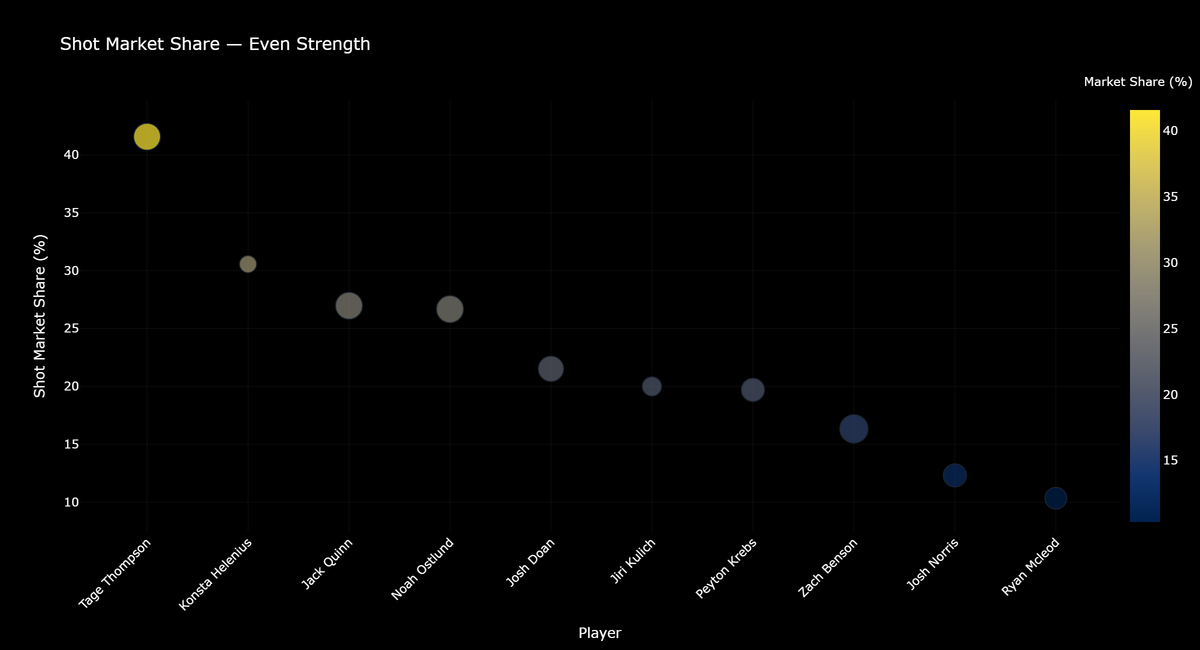
Tage is typically a high-volume shooter anyway, landing around 29-31% of the Market Share in each of his last three seasons, but starting this season at 41.6% is another level entirely. He won’t stay this high all year, but it’s very possible that this start portends an even higher volume season than normal. Considering he’s top-10 by shot rate per minute across the last two years, that he’s second in the league so far this season is a very good sign for his offence.
The only concern right now is that Tage’s volume on the power play is down a fair bit from where he normally is (around 27%). That his seven shot attempts on the PP have turned into six SOG has artificially inflates his PPSOG rate so we want to see him shoot more on the man advantage. (oct13)
12. Kent Johnson and Matthew Knies (Columbus Blue Jackets)
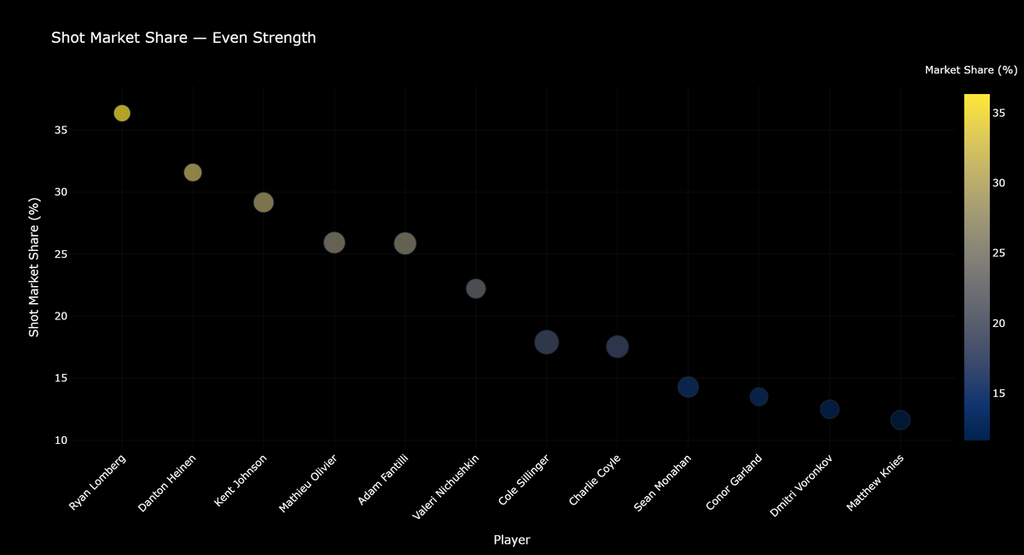
It has been a solid start for Johnson with two goals and three points in four games. Back in 2024-25 when he had his breakout with 24 goals and 57 points in 68 games, Johnson managed an even-strength Market Share of 22.1%. That he’s begun this season around 29% tells us his solid start isn’t just a function of a high shooting percentage (though that is part of it), but that Johnson is genuinely getting more involved offensively, and that’s a good sign as he looks to rebound from a down 2025-26 campaign.
On the flipside, Knies is Johnson’s line mate and Johnson shooting so much is taking some volume away from Knies. Having line mates that shoot was the norm for Knies in Toronto, but his 11.6% Market Share pales in comparison to his 18.3% over his last two years with the Maple Leafs. One key difference is he’s skating about 45% of his even-strength time with Zach Werenski, and though Werenski’s shot volume isn’t where it normally is, once he starts shooting more, it will cut into Knies’ ability to juice his own shot rate. This will be an interesting balance to follow as the Jackets accumulate more games played. (oct13)
13. Alex DeBrincat and Michael Brandsegg-Nygård (Detroit Red Wings)
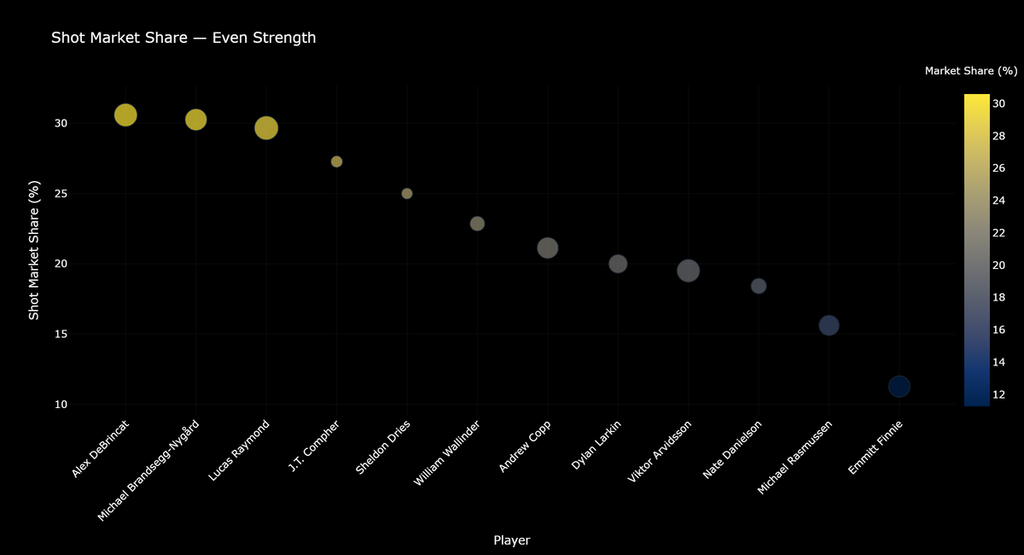
The Red Wings have just 10 goals in five games, but it should be said that their second-line duo of DeBrincat and Brandsegg-Nygård are thriving offensively. Both have even-strength Market Shares over 30%, and that’s nothing new for DeBrincat (he was over 30% across the previous two seasons), but Brandsegg-Nygård being right there beside him doing the same is a very good early sign.
So far this season, the Red Wings are generating 63 shot attempts per 60 minutes with Brandsegg-Nygård on the ice, which leads the team. They have only played five games, so we’ll see where this stands after 25 games, but this is very encouraging early on for a team that doesn’t have a lot of positive stories. (oct13)
14. Filip Forsberg (Nashville Predators)
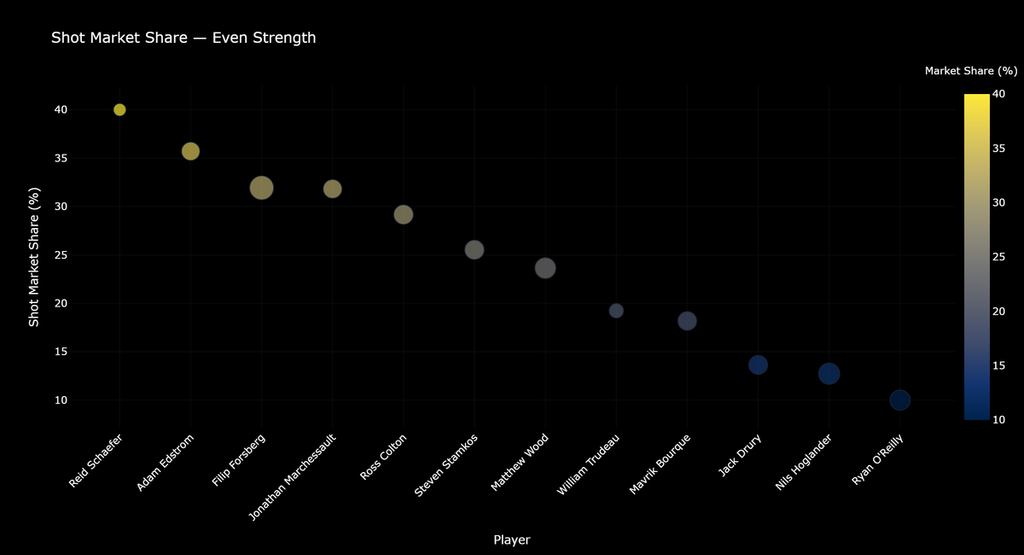
With no goals in five games, fantasy managers may be having some consternation around Forsberg’s early-season production. However, his even-strength Market Share is just under 32%, right in line with his 31.9% over his previous two seasons. Aside from having zero goals, his big problem is just 8/24 shot attempts have turned into shots on goal, a far cry from the 44.6% in those prior two years. Once he starts landing more shots on target, and that shooting percentage turns around, he will start filling the net.
The real issue is that Nashville is generating just 52.7 shot attempts per 60 minutes with him on the ice at 5-on-5. That number was at least 59 per 60 minutes each season since 2014. He is shooting as much as ever, but if Nashville doesn’t raise its volume, he could be in for a down year that doesn’t necessarily reflect his play, but the play of his teammates. This is something to monitor, anyway. (oct13)
15. Jimmy Snuggerud and Mason McTavish (St. Louis Blues)
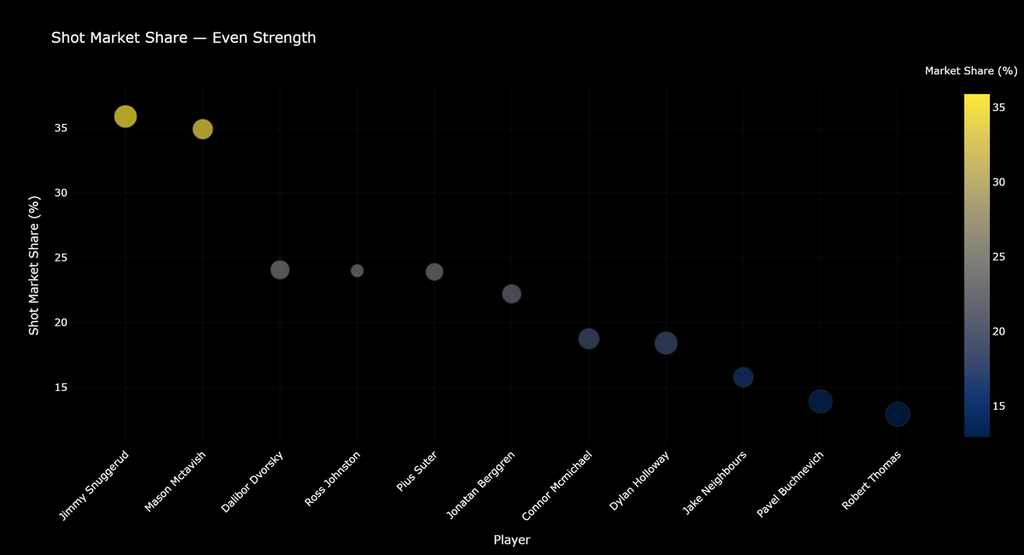
If St. Louis wants to return to the postseason, they need production from young forwards like Snuggerud and McTavish. These two have scored five goals in five games, so a good start on that front. The former sits just over a 35% even-strength Market Share and the latter just under 35%, so it’s clear who the triggermen are early on for St. Louis’ top-6 forwards.
This is abnormal for McTavish, who was between 22-24% in his last two years with Anaheim, but Snuggerud was nearly 29% in his rookie year with St. Louis. There is reason to believe Snuggerud can exceed 30% this season, so the player to watch is McTavish. He won’t stay at 35%, but if he can land in the 25-30% range, he is in line for a big bounce back season, top PP minutes notwithstanding.
[Follow the link for more…] (oct13)
16. Over my last few Ramblings, I have been going over early shot trends in the NHL. Today will be another look at shot trends, but from a different angle. This will be reviewing players who are getting unlucky in turning their shot attempts into shots on goal. In any small sample, SOG totals can be misleading because a player might have taken 30 attempts but only landed 10 of them on target, or just 33%. They might have 10 shots in 7 games, but with a normal attempt/SOG conversion rate, that kind of shot attempts volume likely means 15+ shots. Over a full season, that difference adds up.
Last year, there were 383 forwards who skated at least 560 minutes. Those forwards turned 51.1% of their shot attempts on goal, and 5/6 of them landed at least 46.7% of their attempts on goal. So, assuming consistent shot attempt volume and ice time, any forward below that 46.7% attempt/SOG ratio thus far in the 2026-27 campaign is due for more shots on goal in the coming months.
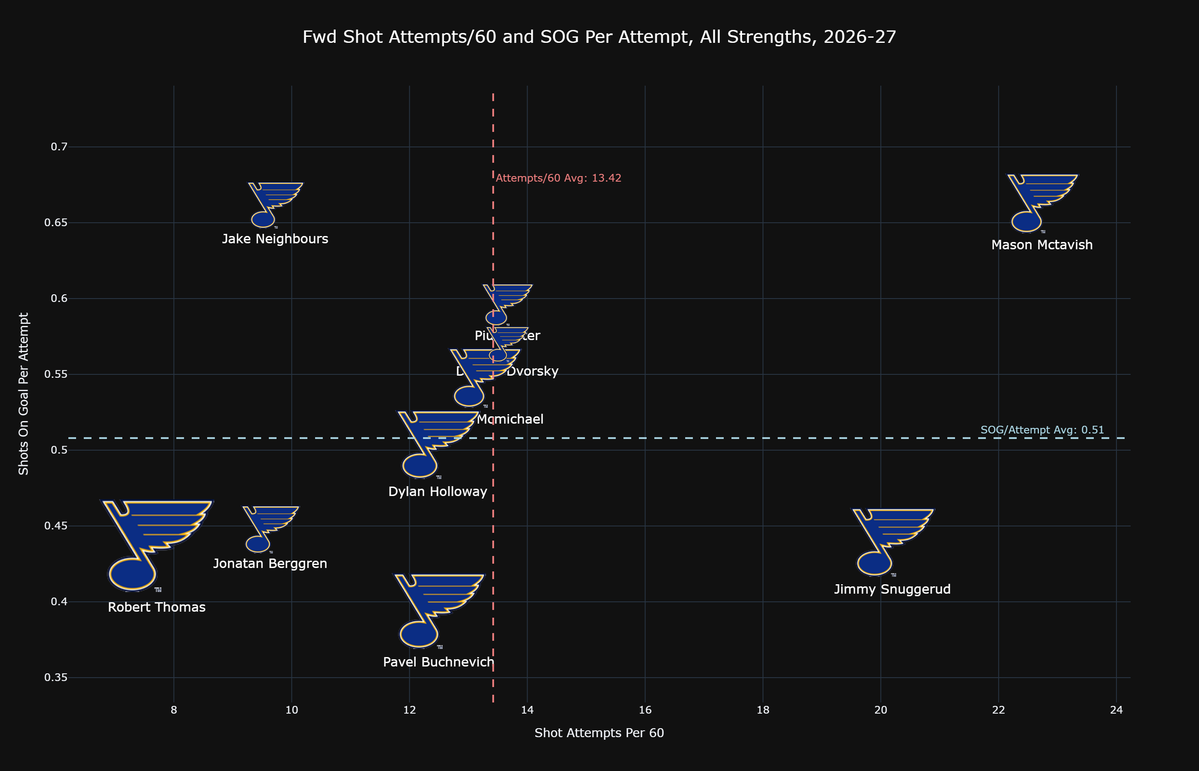
In the following graphs, we are looking at individual shot attempts per 60 minutes and what percentage of those attempts have turned into shots on goal. Also, the bigger the player logo, the more ice time per game that player gets. So, we are looking for forwards in the bottom-right quadrant with big team logos.
The red and blue dotted lines are the averages for the two stats we’re looking at.
Data taken from NHL play by play and current as of the morning of Wednesday, October 14. We are limiting the sample to forwards with at least 75 minutes played, which gives us 300 forwards.
Nikita Kucherov (Tampa Bay Lightning)
With just one goal and nine shots in six games, there may be some frustrated Kucherov fantasy owners out there. However, he has landed just 9/34 of his attempts on goal (26.5%), the fourth-worst ratio among the 300 forwards in our sample:
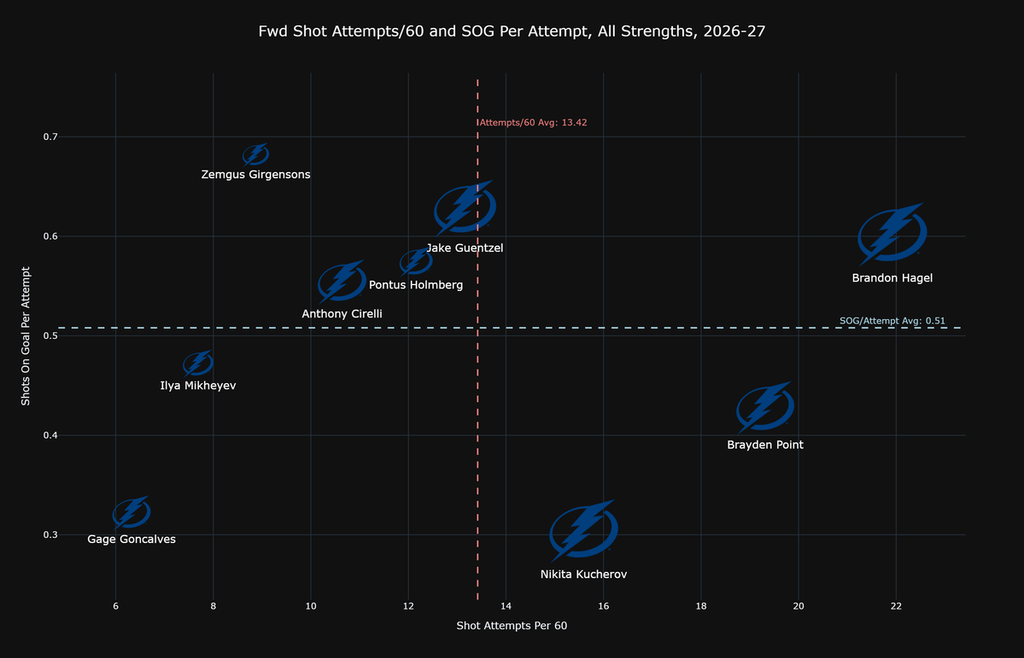
Over the prior two seasons, he managed to turn 45.8% of his attempts into shots on goal, and even a low year in 2025-26 saw him at 43.3%. He has been cheated out of 6-7 shots on goal, and 15-16 shots in six games looks a lot better than nine.
The bigger issue is the shot attempt volume has dropped considerably. He took 20.7 attempts per 60 minutes last season, and 20.0 the year before. So far in 2026-27, that number is just 15.6. Even as his SOG/attempt ratio climbs, unless he starts shooting more often in general, he could fall short of 3.0 shots per game for the first time in a decade. Something to keep an eye on over the next month. (oct15)
17. Shane Pinto (Ottawa Senators)
Though not as bad as Kucherov, Pinto’s SOG/attempt conversion rate is very low, sitting at 32% through seven games, leading to 11 shots in those appearances:
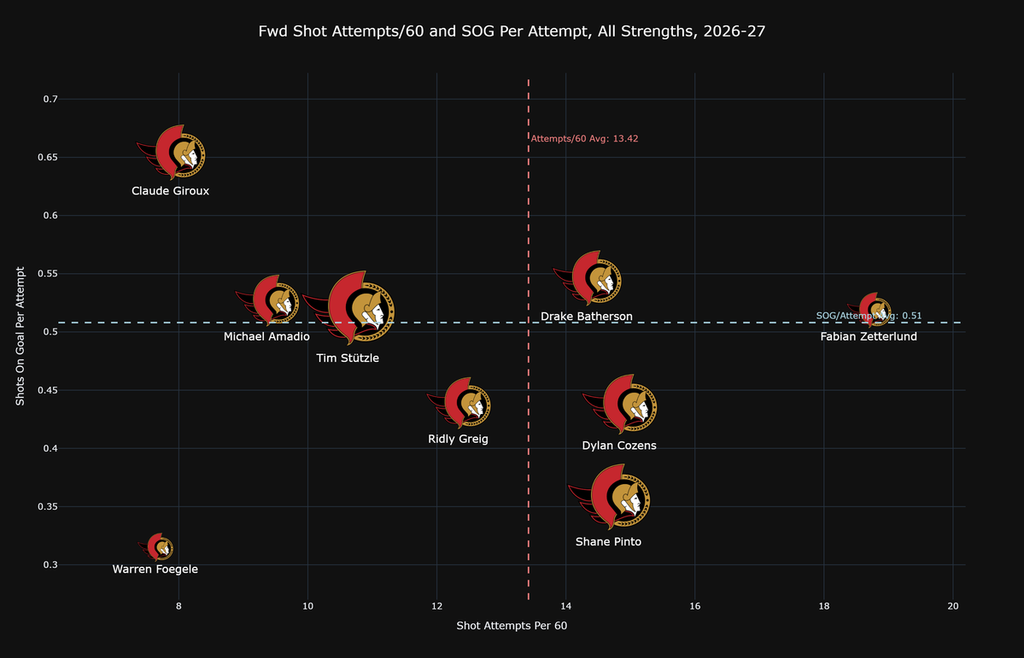
Unlike Kucherov, Pinto’s shot attempts per 60 minutes have increased from the last two seasons. He usually turns 49% of his attempts into shots on goal, so he’s been short-changed about six shots on goal. With a more normal SOG/attempt conversion rate, at his ice time level, he’d be looking at roughly an 11% SOG increase from last season. With his typical shooting percentage, that’s roughly an extra three goals and 20 shots in a full campaign. Once things start normalizing for Pinto, if he can keep up his overall shot volume, he could not only reach 25 goals for the first time, but 30 goals are within reach. (oct15)
18. Rickard Rakell (Pittsburgh Penguins)
We will give a mention to Egor Chinakhov here, who has a lower SOG/attempt conversion rate than Rakell:
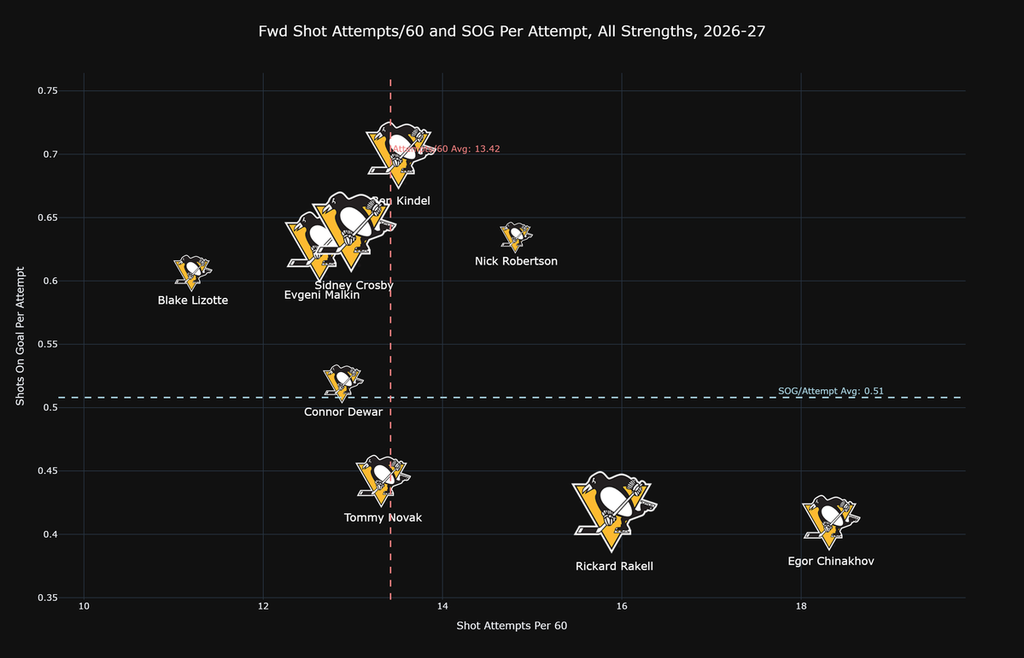
The reason for focusing on Rakell is he’s averaging nearly 20 minutes a night while skating on the top line. He has turned fewer than 38% of his attempts into SOG; last year, that was a whopping 56.5%, and 52.5% across the last two seasons. He is missing 5-6 shots on goal from where we would expect him, and that would push him near 3.0 shots per game. With his ice time, and at a typical shooting percentage of about 14%, that is easily a 30-goal season in a full year. There might be a fantasy manager out there panicking about Rakell and willing to sell low – he is a guy to take a chance on over the next 75+ games. (oct15)
19. Adrian Kempe, Alex Laferriere, and Quinton Byfield (Los Angeles Kings)
It does worry me when we see a bunch of players from the same team falling into the bottom-right quadrant, and the Kings are one of them:
Here are the SOG/attempt rates for Kempe, Laferriere, and Byfield over the prior two seasons, and then so far in 2026-27:
- Kempe: 46.1% / 39%
- Laferriere: 47.9% / 40.9%
- Byfield: 47.5% / 44.8%
There isn’t a massive difference for each of these players – three shots for Kempe, two shots for Laferriere, one shot for Byfield – but it always stands out when there is a group of top forwards from the same team on this kind of list, and it is part of the reason why the Kings are struggling to score. They are among the worst teams at creating quality shot attempts, and if the low-quality attempts aren’t getting to the net, then there is a very big problem here. Something else to keep an eye on over the next month. (oct15)
20. Jimmy Snuggerud (St. Louis Blues)
Across the first 77 games of his career, Snuggerud turned 49.5% of his shot attempts into shots on goal. So far in 2026-27, that number is just 41.2%:
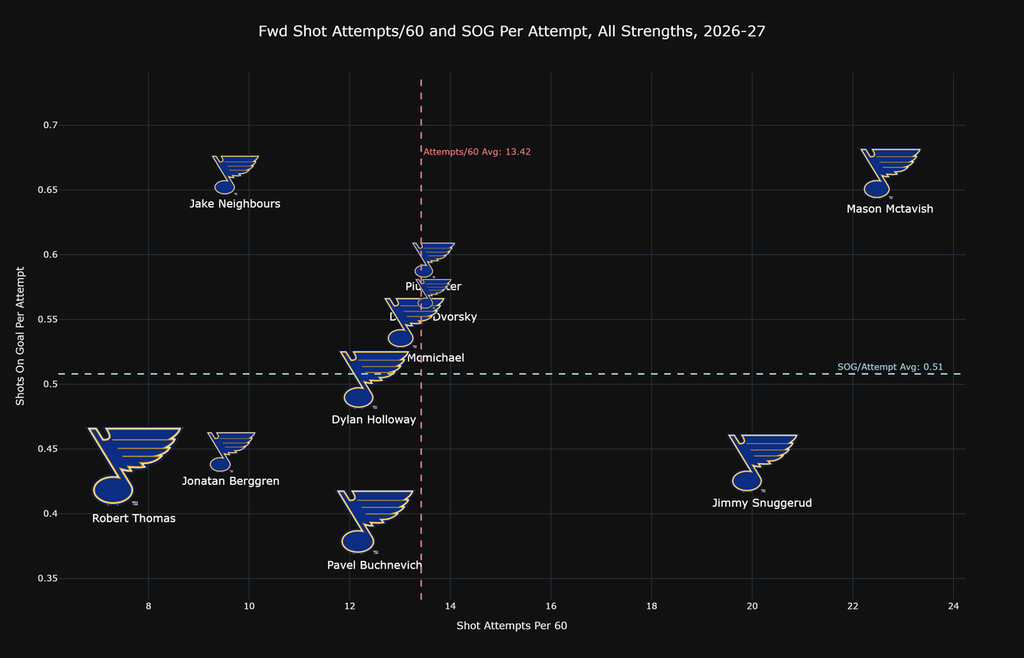
It isn’t a massive difference, but it probably has short-changed him a few shots, and for a guy that already has three goals in six games, extra shots would always be welcome. He has increased his shot attempts per 60 minutes by 18% compared to last year, and if he can hold onto that uptick in volume, he would be looking at an extra 30-35 shots in a full season. Over 84 games, that translates to an extra 4-5 goals. He is already pacing for his first career 30-goal season, and once those shot attempts start turning into more shots on goal, the incoming blow from a shooting percentage decline will soften. (oct15)
21. Logan Cooley (Utah Mammoth)
He doesn’t fit our shot volume parameters, but it is worth mentioning that Cooley has landed just 25% of his shot attempts on goal:
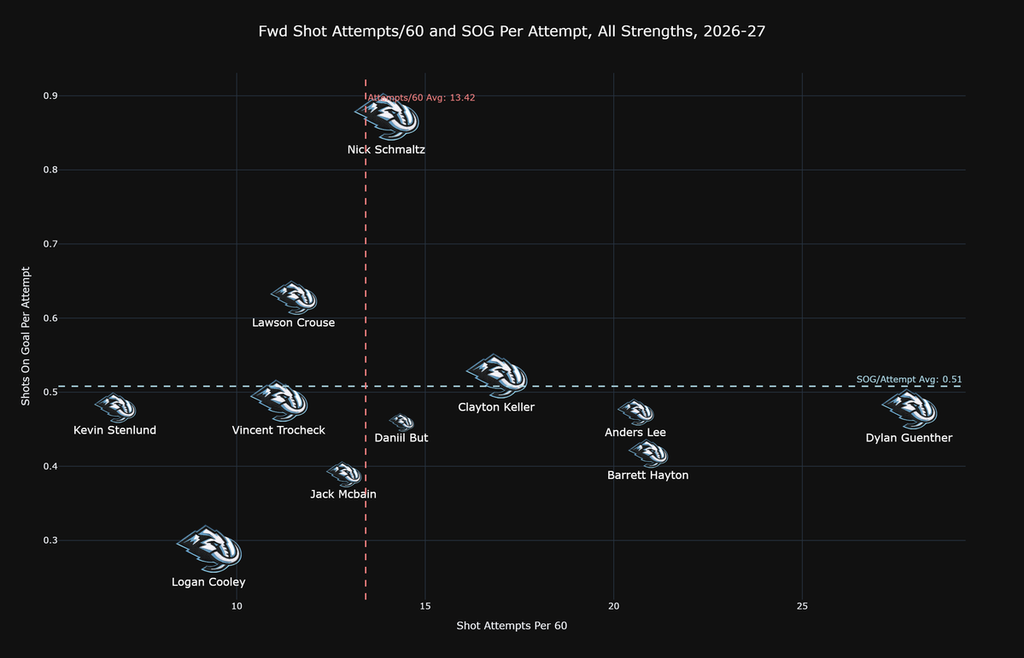
Over the first three seasons of his career, Cooled had a very high ratio, turning 54.2% of his shot attempts into shots on goal. He has just five SOG in seven games to start the 2026-27 campaign, and that number should actually be 10-11 shots in seven games. Even with zero goals in seven games, if he plays close to a full season, he should still push the 20-goal mark. This isn’t a guy to panic over.
[Follow the link for more…] (oct15)
Have a good week, folks!
Thanks for continuing to support the website and if you’re bored and need a fantasy hockey fix – visit the gang in the forum here.
Related Posts
Starting Goalies







Top Skater Views
| Players | Team | |
|---|---|---|
| JACK QUINN |
 BUF BUF | |
| MASON MCTAVISH |
 STL STL | |
| T.J. HUGHES |
 COL COL | |
| QUINTON BYFIELD |
 L.A L.A | |
| FRASER MINTEN |
 BOS BOS
| |
Top Goalie Profile Views
| Players | Team | |
|---|---|---|
| JACOB FOWLER |
 MTL MTL | |
| SERGEI MURASHOV |
 PIT PIT | |
| DYLAN GARAND |
 NYR NYR | |
| JET GREAVES |
 CBJ CBJ | |
| CARTER HART |
 VGK VGK
| |
LINE COMBOS
| Frequency |
L.A Players
| |
|---|---|---|
| 21.4 | ARTEMI PANARIN ALEX LAFERRIERE ADRIAN KEMPE | |
| 16.2 | SCOTT LAUGHTON ERIK HAULA JOEL ARMIA | |
| 11.8 | COREY PERRY ANDRE LEE SAMUEL HELENIUS | |
DobberHockey Podcasts

Fantasy Hockey Life: Ep 505 Prospects With Plenty to Prove Part 1
Victor and Jesse return to talk about prospects with plenty to prove. This week it’s: Tij Iginla, Berkly Catton, Konsta Helenius, Zayne Parekh, Igor Chernyshov, Jett Luchanko, Axel Sandin-Pellikka, Artyom Levshunov, Michael Hage, and Carter Bear. Have a listen! Our show is part of the Dobber Podcast Network and sponsored by Fantrax.com. Email [email protected] and […]

Keeping Karlsson: Matchup Maximizer 2026/27 Week 4
Elan takes a look at the schedule for the upcoming weeks of NHL action and recommends players with good schedules that you should consider streaming in to win your head to head matchups.
Keeping Karlsson: Short Shifts – NHL Frozen Frenzy Recap
Elan and Lewis recap the Frozen Frenzy as well as two big returns and more!
Keeping Karlsson: Delusions of Garandeur
Elan and Brian dive into the latest NHL hot streaks, cold streaks, line changes, outjuries, injuries, buy-lows and sell-highs to give you top notch tips in your fantasy hockey league
Fantasy Hockey Life: TiDy Takes Part 2
Last week, Victor Nuno and Ryan Downey broke down trades from our top tier dynasty league. This week, they consider some dynasty trades from other divisions. Have a listen! Our show is part of the Dobber Podcast Network and sponsored by Fantrax.com. Email [email protected] and ask to join our free discord. Join our Patreon at […]