

Ramblings: Buy-Low Opportunities on Crosby, Fantilli, and Foerster – October 27
Michael Clifford
2026-10-27
Drafting well and working the waiver wire are two keys to a successful fantasy season. The third key is knowing when to buy low and when to sell high on a player. Today, we're going to do that by looking at Individual Points Percentage (IPP), which is how often a player registers a point when their team scores a goal with them on the ice. At this point last season, there were 32 forwards whose IPP was down 20% from the prior two seasons, averaging an IPP rate of 35.7%. From that point onward, their average IPP leapt to 63.1%, and half the group got within 5% of their initial 2-year IPP. The ones who didn't quite regain their form were guys who got pushed down their lineups like Ondrej Palat, Trent Frederic, Oliver Bjorkstrand, Warren Foegele, and Philipp Kurashev.
So, we are going to review three forwards whose IPP to start the 2026-27 season is far off their prior two-year average and are not really candidates to be pushed down the lineup. Data from Natural Stat Trick and Frozen Tools.
Sidney Crosby (Pittsburgh Penguins)
At 39 years old, we are all just waiting for the bottom to fall out of Crosby's production. With just seven points in 12 games to start the year, there may be concern that the huge age-related decline has finally started. The good news for sharp fantasy owners is that his abnormally-low IPP of 46.7% is far off his two-year average, presenting a good buying opportunity:

If Crosby's IPP is anywhere near normal, he is sitting with 11 points in 12 games, and his fantasy managers aren't panicking. There are some shot volume concerns here, so he may not reach the 30-goal mark this year, either overall or as an 84-game pace, but Frozen Tools has him with a 25% secondary assist percentage. Last year, that was 37.8% and the year before it was 43.1%. He may struggle to reach 30 goals unless his shot volume improves, but he is still very much in line to reach 40 assists.
Perhaps the days of Crosby averaging 90 points every 82 games are behind him, but that doesn't mean his production will fall off the table, and he's someone from whom we should still expect 70 points (or at least a 70-point pace depending on games missed). If you're reading this and are fine with 70 points rather than 90, go see if his fantasy manager is panicking yet.
Adam Fantilli (Columbus Blue Jackets)
This one is probably the biggest risk of our three names. On one hand, Fantilli's 40% IPP is way off his two-year average of 65.7%. He should probably have seven points in nine games rather than four:

On the other hand, Head Coach Rick Bowness seems truly fed up with his team, so it's a wonder what kinds of line combinations we'll see in the coming weeks. Either way, Columbus is actually generating more shots with Fantilli on the ice this year (34.9 per 60 minutes) than last year (33.3) and they're shooting just 9.4% in his minutes, down from a two-year average of 11.1%. A more typuical IPP and team shooting percentage has Fantilli with eight points in nine games, double his current mark.
Even with Bowness' unpredictability, Fantilli has crossed the 20-minute mark in four straight games and is now sitting with over three shots per game. He even has 10 blocks and 18 hits in his nine appearances. He may not be a 75-point forward, but the numbers are there to support a 60-point season, and that may come with very good across-the-board peripherals. In multi-cat formats, this is someone I'm inquiring about.
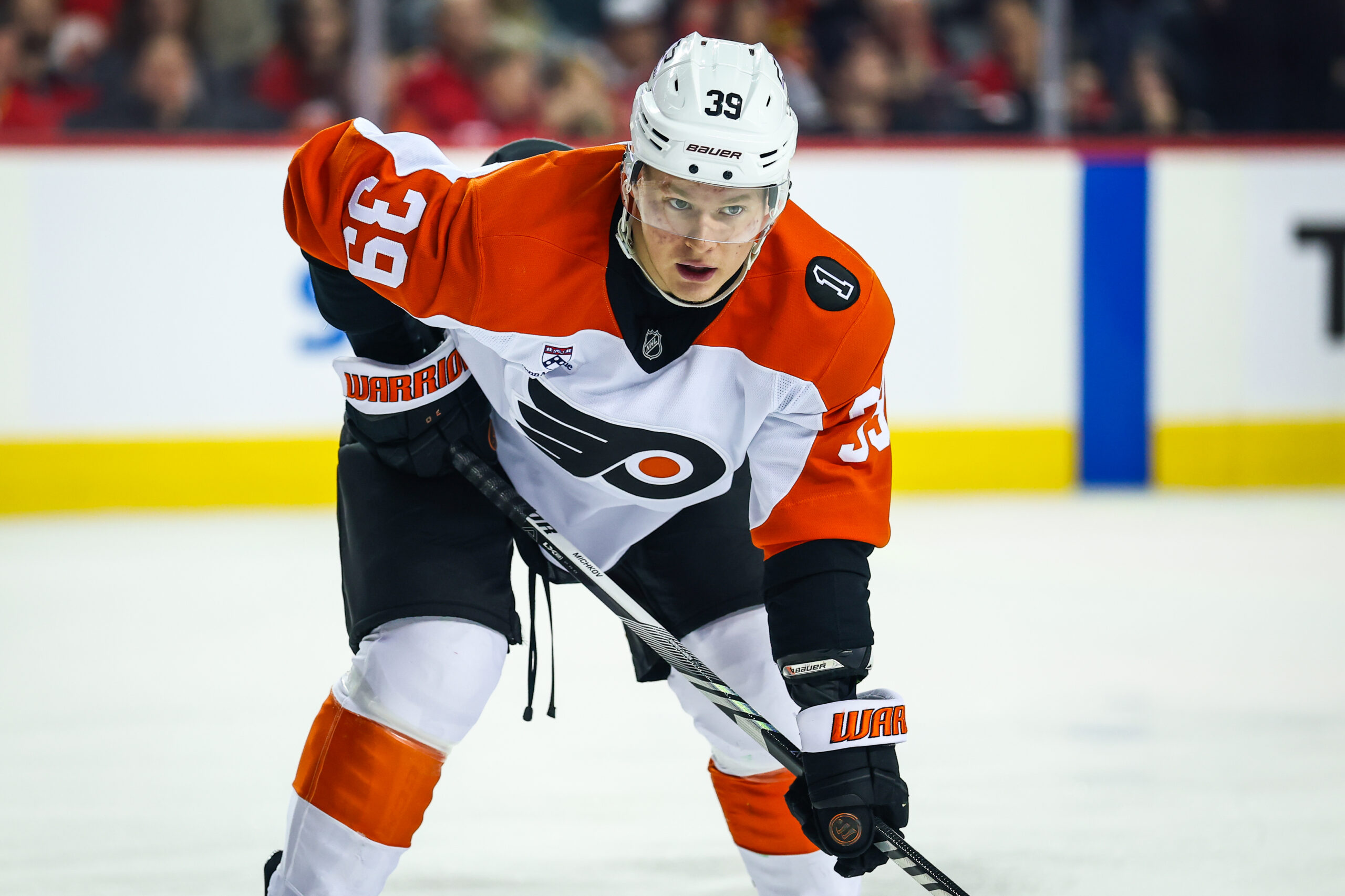
Tyson Foerster (Philadelphia Flyers)
It is notable that despite the Flyers starting the season with nine straight losses, and Foerster having just two points in 12 games (both goals), he has averaged over 18 minutes a game in his last three outings, being 1 of 3 Flyers forwards to exceed that mark. Of course, he is on this list because his IPP so far this season (28.6%) is considerably far away from his two-year average (65.9%):

Even if we go back three years and include his modest rookie campaign, Foerster's IPP should be twice as high as it is. Putting up four points in 12 games rather than two points doesn't really do a whole lot for his fantasy value, and he's not someone who typically racks up assists anyway, but this is a player who should be on a 30-goal pace. He is far away from that, and it's what gives him good buy-low value.
The added benefit here is that Foerster is currently sitting with 19 hits in 12 games. He has typically been a little over a hit per game for his career, but if he can stay anywhere close to 1.5 hits per outing, it gives him much more multi-cat value than he otherwise would have. The Flyers won't be a high-scoring team, but Foerster still has the look of a guy who can threaten 25 goals, 200 shots, and 125 hits. Even 90% of those marks would be a very good multi-cat option, and he is someone to grab on the cheap right now.
Related Posts



Starting Goalies













Top Skater Views
 T.B
 CAR
 N.J


Top Goalie Profile Views
| Players | Team | |
|---|---|---|
| JACOB FOWLER |
 MTL | |
| DEVIN COOLEY |
 CGY | |
| DARCY KUEMPER |
 L.A | |
| STUART SKINNER |
 WPG | |
| MICHAL POSTAVA |
 DET | |
LINE COMBOS
| Frequency |
 MIN Players | |
|---|---|---|
| 22.1 | KIRILL KAPRIZOV JOEL ERIKSSON EK MATT BOLDY | |
| 17.3 | MICHAEL MCCARRON BLAKE COLEMAN BOBBY BRINK | |
| 15.6 | DANILA YUROV YAKOV TRENIN MAXIM SHABANOV | |
DobberHockey Podcasts

Keeping Karlsson: Down Across the Helle-ware
On this episode of the Keeping Karlsson Fantasy Hockey Podcast, Elan and Brian dissect the implications of the Connor Hellebuyck trade, injury returns in Carolina and Washington, hot streaks in Philadelphia and Seattle, crease contenders in Calgary and San Jose, a must-add in Tampa Bay and a sell-high in Colorado for your fantasy hockey league.

Fantasy Hockey Life: Ep 506 Prospects with Plenty to Prove II
Victor and Jesse return to talk about more fantasy hockey prospects in critical seasons. Covered are David Reinbacher, Cayden Lindstrom, Dalibor Dvorsky, Bradly Nadeau, Ilya Protas, Charlie Stramel, Otto Stenberg, Emil Hemming, Trey Augustine, Sebastian Cossa, Jacob Fowler, Easton Cowan, Matthew Wood, Gabe Perreault, and Victor Eklund. Thanks to Mason Black @NHLRankKing for his polls. […]
Keeping Karlsson: Matchup Maximizer 2026/27 Week 5
Jeremy takes a look at the schedule for the upcoming weeks of NHL action and recommends players with good schedules that you should consider streaming in to win your head to head matchups.
Keeping Karlsson: Short Shifts – Injuries, Outjuries, and Duds
Elan talks about all the latest injuries, outjuries, big performances and duds over a tight 20 minutes in this week’s episode of Short Shifts.
Keeping Karlsson: Never Tell Me the Podz
Elan and Brian do a wellness check on the Maple Leafs, lament Chicago and Buffalo snoozers, wonder whether and which Flyers have figured it out, and pick out the Capital standing out from the crowd.