

The Journey: OHL Prospects Making Their Mark in 2026–27
Victor Nuno
2026-11-21
The OHL is producing some intriguing breakout performances this season, with Guelph’s high-powered offense leading the way. From established NHL prospects taking significant steps forward to overlooked players emerging as legitimate scoring threats, several young talents are reshaping their fantasy outlooks.
For dynasty managers, the key is identifying whose production reflects sustainable development and whose value has yet to catch up. Here are ten OHL prospects worth watching in 2026–27.
Ryan Roobroeck, LW, Guelph Storm — Chicago Blackhawks (2026, 2nd Round, 35th Overall)
Roobroeck has emerged as one of the OHL’s most dangerous offensive players, sharing the league scoring lead with 33 points while sitting among the goal-scoring leaders with 18. After producing 30 goals and 58 points in 49 games with Niagara last season, the 6-4 winger has taken a substantial step forward since joining Guelph. His shot generation is particularly encouraging, with 110 shots through 19 games, approaching six per contest. His 16.4% shooting percentage is strong without suggesting his production depends entirely on an unsustainable finishing streak. Hockey Prospecting’s NHLe model also reflects his offensive progression, projecting an increase from 29 in his draft year to 43 in his D+1 season.
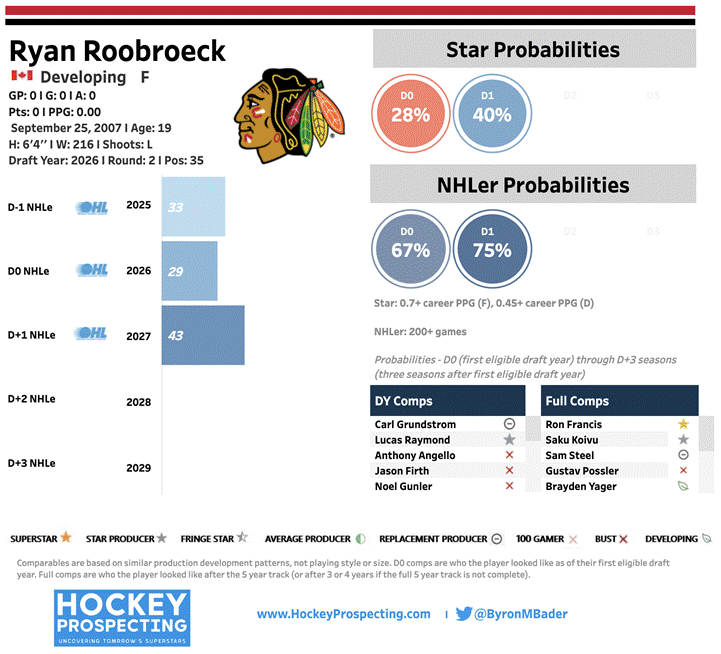
For dynasty managers, that combination of size, goal scoring, and shot generation provides an attractive foundation. Hockey Prospecting has raised Roobroeck’s probability of becoming an NHL star from 28% to 40%, while his likelihood of playing at least 200 NHL games has increased from 67% to 75%. Those are encouraging improvements, although his historical statistical comparables remain mixed, ranging from Lucas Raymond to less successful prospects. Improvements in skating, puck handling under pressure, and his ability to create offense independently will ultimately determine his NHL ceiling. Chicago has an intriguing power-forward prospect whose fantasy value deserves another look, particularly in leagues rewarding goals and shots.
Dima Zhilkin, LW/C, Saginaw Spirit — 2027 NHL Draft Eligible
Zhilkin entered the season as one of the OHL’s more intriguing 2027 draft prospects, and his performance has strengthened that reputation. The Saginaw captain has collected 17 goals and 33 points through 22 games, building on a 2025–26 campaign in which he produced 75 points in 59 contests. His 98 shots and 17.3% shooting percentage suggest his production is supported by meaningful offensive involvement. His transition from wing to center adds another dimension to his development, potentially increasing his long-term NHL value.
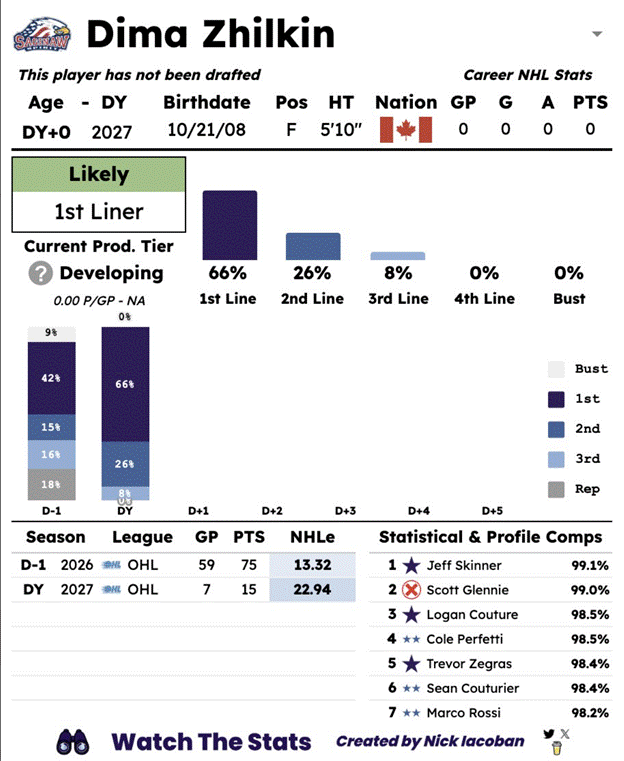
Zhilkin’s statistical projections are particularly impressive. According to Nick Iacoban’s Watch The Stats model, his probability of becoming a first-line NHL player has climbed from 42% to 66%, with another 26% probability of reaching second-line status. His NHLe has also increased from 13.32 to 22.94, reflecting a substantial improvement in his offensive trajectory. Historical statistical comparables include Jeff Skinner, Logan Couture, Cole Perfetti, and Trevor Zegras, although these represent developmental similarities rather than guaranteed outcomes. Combined with his expanding positional versatility and commitment to Michigan for 2027–28, Zhilkin is making a compelling case as a potential first-round selection and an increasingly attractive dynasty prospect.
Owen Griffin, C, Guelph Storm — Columbus Blue Jackets (2025, 5th Round, 160th Overall)
Few players on this list have improved their fantasy outlook as dramatically as Owen Griffin. The Columbus fifth-round selection has recorded 31 points through 19 games, including an OHL-leading 22 assists. After producing 67 points in 66 games with Oshawa last season, Griffin is now operating at a substantially higher offensive level. His playmaking has been central to Guelph’s success, particularly alongside Ryan Roobroeck and Tyler Hopkins. However, his relatively modest shot generation, just 48 shots through 19 games, suggests his fantasy upside may be more dependent on assists than goals. His 18.8% shooting percentage could also regress.
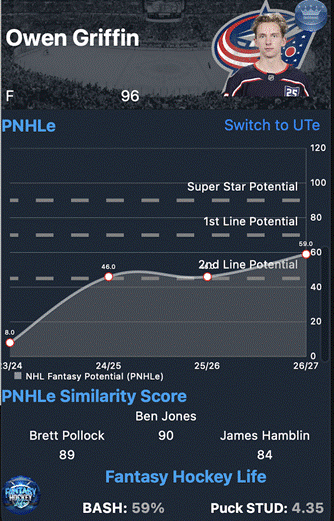
Griffin’s rising production is also reflected in his NHL Rank King profile, where his pNHLe has climbed from 46 two seasons ago to 59 in 2026–27, pushing him into the range associated with second-line NHL potential. That is a meaningful improvement for a fifth-round selection, particularly after his projection remained relatively flat last season. The challenge is separating Griffin’s individual development from the benefits of playing on a loaded offensive roster. Nevertheless, producing more than a point and a half per game is difficult to dismiss. His ability to create opportunities for teammates gives him an intriguing offensive profile, although he’ll need to demonstrate that his playmaking can translate against stronger competition. Griffin deserves consideration in deeper dynasty formats, where his draft pedigree may have kept him off managers’ radars.
Pierce Mbuyi, LW, Owen Sound Attack — Pittsburgh Penguins (2026, 3rd Round, 86th Overall)
Mbuyi continues establishing himself as one of the OHL’s more dangerous finishers. The Pittsburgh third-round selection has 16 goals and 28 points through 22 games, building on a sophomore campaign in which he scored 32 goals. His offensive profile is particularly interesting from a fantasy perspective because nine of his 16 goals have come on the power play. Mbuyi has generated 74 shots, averaging more than three per game, although his 21.6% shooting percentage suggests some regression may be inevitable. Hockey Prospecting’s NHLe model reinforces his offensive progression, with his rating climbing from 20 in his D-1 season to 27 in his draft year and 33 in his D+1 season.
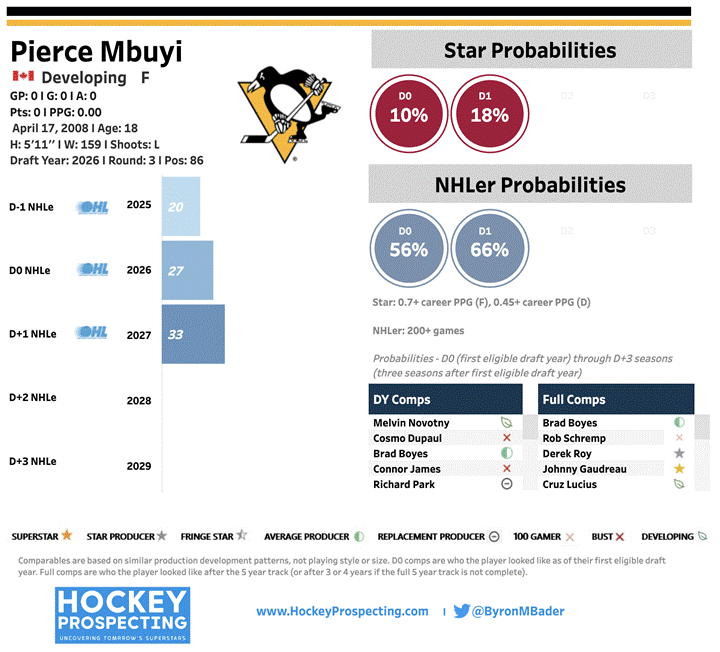
Mbuyi’s goal-scoring instincts are apparent, and his improving projections provide additional encouragement. Hockey Prospecting has increased his probability of becoming an NHL star from 10% to 18%, while his likelihood of playing at least 200 NHL games has risen from 56% to 66%. His historical statistical comparables include Brad Boyes, Derek Roy, and Johnny Gaudreau, although the model also identifies less successful outcomes, illustrating the uncertainty surrounding his development. His reliance on power-play production remains a concern, and improvements in even-strength scoring and playmaking will be important. Nevertheless, Pittsburgh has an intriguing offensive prospect whose third-round selection may understate his fantasy potential, particularly in leagues rewarding goals and power-play production.
Vladimir Dravecky, D, Guelph Storm — New York Islanders (2026, 5th Round, 141st Overall)
Dravecky might be the most intriguing dynasty target in this group, particularly given the premium placed on productive offensive defensemen. The Islanders selected him in the fifth round of the 2026 NHL Draft and signed him to an entry-level contract in October. His development has been remarkable. After recording 28 points in 58 games with Brantford last season, he has nearly matched that total in just 19 games with Guelph. His 19 assists place him among the league’s leading playmakers, while eight power-play points demonstrate his ability to contribute with the man advantage.
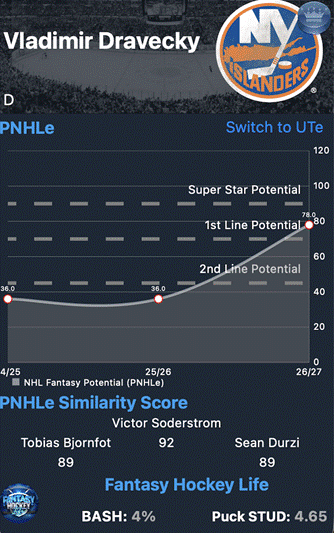
Dravecky’s offensive progression is even more striking when viewed through NHL Rank King’s fantasy-focused pNHLe model. After registering a PNHLe of 36 in each of the previous two seasons, his projected 2026–27 mark has surged to 78, placing him above the model’s first-line potential threshold and approaching its superstar tier. His closest statistical comparables include Victor Söderström, Tobias Björnfot, and Sean Durzi, although the model’s modest four percent blocks, shots, and hits (BASH) rating suggests he won't get much in the way of peripherals. Playing in Guelph’s high-powered offense certainly helps, but this substantial increase in projected fantasy production is difficult to ignore. If Dravecky can sustain his offensive development while improving his defensive consistency, the Islanders may have found considerably more upside than his fifth-round selection initially suggested.
Braidy Wassilyn, LW, Saginaw Spirit — Undrafted (2027 NHL Draft Re-Entry Eligible)
Wassilyn is one of the OHL’s more interesting redemption stories. Selected fourth overall in the 2024 OHL Priority Selection, he entered junior hockey with significant expectations but went undrafted in 2026 after recording 46 points in 61 games split between Niagara and London. His move to Saginaw has provided a fresh opportunity, and Wassilyn has responded with 30 points through 22 games. His 13 goals have come on 69 shots, producing an 18.8% shooting percentage, while his 17 assists suggest his offensive development extends beyond simply finding the back of the net. Hockey Prospecting’s NHLe model reflects that improvement, with his rating jumping from 18 in his draft year to 34 in his D+1 season.
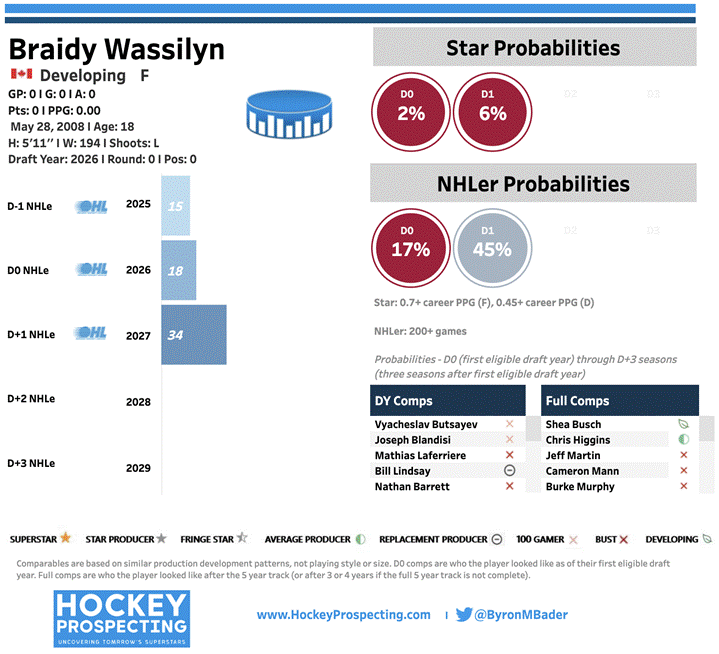
Wassilyn’s improving projections provide some encouragement for dynasty managers willing to look beyond his undrafted status. Hockey Prospecting has increased his probability of becoming an NHL star from two to six percent, while his likelihood of playing at least 200 NHL games has climbed substantially from 17% to 45%. However, his historical statistical comparables, including Shea Busch, Chris Higgins, and Joseph Blandisi, illustrate a wide range of potential outcomes, and his star probability remains relatively modest. Playing alongside Zhilkin creates favorable opportunities, but Wassilyn’s offensive improvement deserves recognition. His commitment to Boston University for 2027–28 provides another developmental pathway, and continued production could put him back on NHL scouts’ radars. He remains a speculative dynasty target, but one whose trajectory is moving in the right direction.
Adam Novotný, LW, Peterborough Petes — Vancouver Canucks (2026, 1st Round, 24th Overall)
Novotný’s transition to North American junior hockey has been remarkably smooth. The Vancouver first-round selection has produced 14 goals and 28 points through 21 games with Peterborough, including eight power-play goals. Having already gained professional experience in Czechia, Novotný entered the OHL with a different developmental foundation than many of his peers. His shot generation may be the most impressive aspect of his early production, with 104 shots, nearly five per game, while converting at a reasonable 13.5% rate. That combination suggests his goal scoring is supported by legitimate offensive involvement rather than unusually favorable shooting luck.
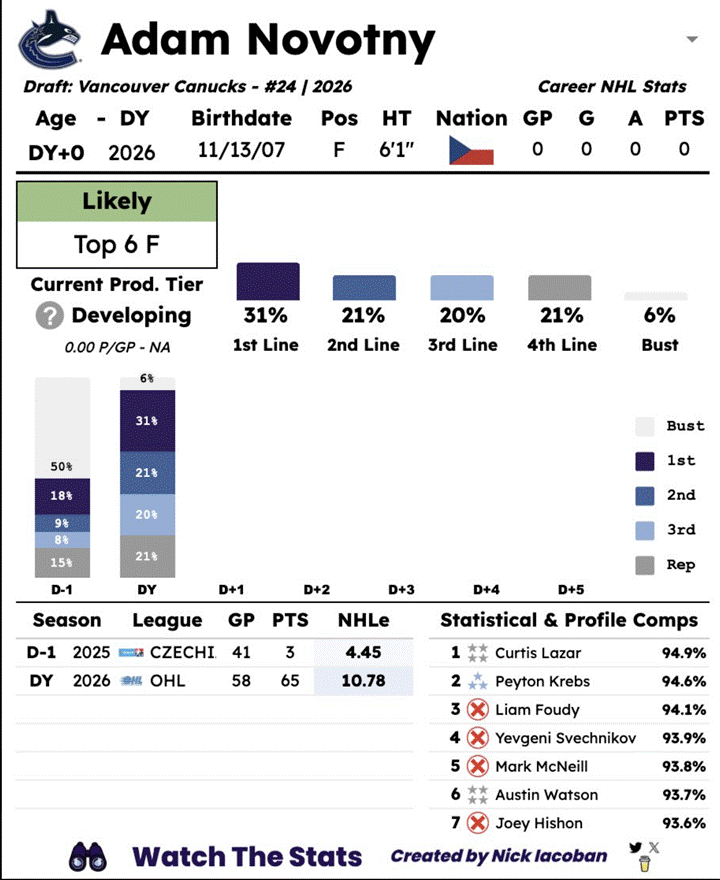
Novotný’s long-term outlook is also encouraging according to Nick Iacoban’s Watch The Stats model, which projects a 31% probability of becoming a first-line NHL forward and another 21% chance of reaching second-line status. His combined 52% top-six probability represents a substantial improvement from the previous season’s 27%, while his projected bust probability has fallen from 50% to just six percent. Historical statistical comparables include Curtis Lazar, Peyton Krebs, and Liam Foudy, illustrating that strong projections don’t necessarily translate into high-end fantasy production. Nevertheless, his first-round pedigree, impressive shot generation, and successful adjustment to North American hockey make him an attractive dynasty asset. Continued development at even strength could push his offensive ceiling even higher.
Tyler Hopkins, C, Guelph Storm — Toronto Maple Leafs (2025, 3rd Round, 86th Overall)
Hopkins has become another important contributor to Guelph’s impressive offensive attack. The Toronto third-round selection has recorded 11 goals and 26 points through 19 games, demonstrating substantial offensive growth. His 69 shots represent nearly four per game, providing a convincing foundation for sustained goal-scoring production. Unlike some junior players whose numbers are driven primarily by opportunistic finishing, Hopkins is generating enough chances to remain productive even when his 16% shooting percentage fluctuates.
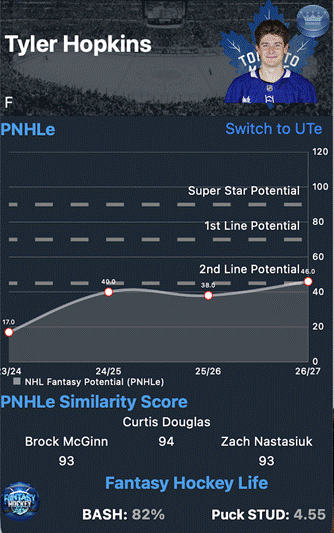
Hopkins’ fantasy profile also gets a boost from Mason Black’s pNHLe model, which shows his projected NHL fantasy potential climbing from 17 in 2023–24 to 40 in 2024–25, dipping slightly to 38 in 2025–26, and then rising again to 46 this season. That places him above the model’s second-line potential threshold, while his 82% BASH rating suggests meaningful value from peripheral categories such as blocks, shots, and hits. His closest pNHLe similarity scores are Curtis Douglas, Brock McGinn, and Zach Nastasiuk, which adds some uncertainty to the projection, but the current trend is still encouraging. Playing alongside Roobroeck, Griffin, and Dravecky creates favorable opportunities, yet Hopkins is doing enough individually to strengthen his case as an under-the-radar dynasty target in deeper leagues.
Aiden Kelly, C, Brantford Bulldogs — 2028 NHL Draft Eligible
Kelly provides an early reminder that age-relative production matters enormously when evaluating junior prospects. The 16-year-old center has already collected ten goals and 23 points through 18 games, an impressive accomplishment considering the physical challenges of competing against players several years older. Selected 20th overall in the 2026 OHL Priority Selection, Kelly arrived with considerable offensive credentials after producing 35 points in 20 games with Detroit Little Caesars 15U last season. His 51 shots and 19.6% shooting percentage suggest some fluctuation in goal scoring is possible, but his overall offensive involvement at such a young age is encouraging.
Kelly remains a longer-term prospect, but his early production makes him a player dynasty managers should be monitoring closely ahead of the 2028 NHL Draft. His development will depend on adding strength, improving consistency, and demonstrating that he can continue creating offense as opponents become more familiar with his game. Producing well above a point per game at 16 is an encouraging early indicator, particularly for a center still developing physically. While it’s too early to establish his NHL ceiling, another productive season could put him firmly on the radar as one of the more intriguing offensive prospects in the 2028 draft class.
Bogdan Yakushevsky, RW, Windsor Spitfires — 2027 NHL Draft Eligible
Yakushevsky has enjoyed one of the OHL’s more impressive rookie campaigns. The Russian winger has recorded ten goals and 25 points through 22 games after joining Windsor as the 46th overall selection in the 2026 CHL Import Draft. His transition to North American hockey has been remarkably effective, earning OHL Rookie of the Month honors for October after producing 19 points in his first 15 games. His strong opening stretch also earned him an A rating from NHL Central Scouting. His 49 shots and 20% shooting percentage suggest that his goal-scoring pace may be difficult to maintain without increased shot generation.
From a dynasty perspective, Yakushevsky represents an intriguing 2027 draft prospect whose value could increase substantially over the coming months. Russian players transitioning to North America sometimes need time to adjust to smaller ice surfaces and a more direct playing style, making his immediate success particularly encouraging. Continued improvement in shot generation, even-strength production, and his ability to create offense independently will help determine his offensive ceiling. His early success has already made him a player worth monitoring closely as the 2027 NHL Draft approaches.
The OHL is producing some compelling dynasty storylines, from Roobroeck’s impressive shot generation to Dravecky’s remarkable offensive breakout. Encouraging statistical projections for Zhilkin, Novotný, and Hopkins add to the intrigue, while overlooked prospects like Wassilyn and Mbuyi offer potential value. The challenge remains identifying which players can sustain their development and translate that production to the NHL. For dynasty managers, getting ahead of those trends can make all the difference.
Thanks for reading! See you next week. For more fantasy hockey analysis, or if there’s a prospect, topic or theme you’d like me to cover, follow and message me on X: @VictorNuno12.
Related Posts
Starting Goalies



Top Skater Views
 SEA
 CHI
 PHI
 T.B
Top Goalie Profile Views
| Players | Team | |
|---|---|---|
| JAKUB DOBES |
 MTL | |
| LOGAN THOMPSON |
 WSH | |
| JACOB FOWLER |
MTL | |
| JOEL HOFER |
 STL | |
| STUART SKINNER |
 WPG | |
LINE COMBOS
| Frequency |
 CAR Players | |
|---|---|---|
| 26.6 | LOGAN STANKOVEN NIKOLAJ EHLERS JACKSON BLAKE | |
| 19.4 | ANDREI SVECHNIKOV WILLIAM CARRIER SEBASTIAN AHO | |
| 14.6 | JORDAN STAAL JORDAN MARTINOOK SETH JARVIS | |
DobberHockey Podcasts

Keeping Karlsson: Short Shifts – Bedard’s Injury Fallout and Crazy Goalie Results
Elan and Lewis cover all the big fantasy news since last Sunday’s mega-show including a big time injury and some crazy goalie results.
Keeping Karlsson: Cutter With All The Gs
A double whammy in Colorado, ice cold power plays and personnel in Ottawa and Buffalo, hope for a new goal scoring king, and confusing NHL creases.

Fantasy Hockey Life: Minnesota and Vancouver Dynasty Stock Watch
This week, Victor and Jesse talk Minnesota Wild and Vancouver Canucks prospects. Included: Adam Benák, Ryder Ritchie, Riley Heidt, Charlie Stramel, Aron Kiviharju, David Špaček, Zeev Buium, Braeden Cootes, Liam Öhgren, Jonathan Lekkerimäki, Tom Willander, Elias Pettersson (D). Have a listen! Our show is part of the Dobber Podcast Network and sponsored by Fantrax.com. Email […]
Keeping Karlsson: Matchup Maximizer 2026/27 Week 8
Elan takes a look at the schedule for the upcoming weeks of NHL action and recommends players with good schedules that you should consider streaming in to win your head to head matchups.
Keeping Karlsson: Short Shifts – Top Fantasy News to Know
Elan covers all the big fantasy news since last Sunday’s mega-show in a compact sub-30 minute Short Shift.