

Ramblings: Howard Traded to Edmonton; Potential Improvements for Pospisil, Gourde, Hayton, Benson, and Couturier – July 10
Michael Clifford
2025-07-10
It had been rumoured that Isaac Howard was going to be traded from Tampa Bay and that happened late on Tuesday night as the prospect forward was sent to Edmonton in exchange for prospect forward Sam O'Reilly. Howard then signed a three-year entry-level contract.
This is a good bet for Edmonton. Maybe Howard turns into an impact player, or maybe he doesn't, but after losing Dylan Holloway, they needed some infusion of youth up front. This helps with that. And going to play with a team with Connor McDavid and Leon Draisaitl may not pay off right away – Howard earning a consistent top-6 role is not likely – but this is great news for his upside 2-3 years down the road.
*
With two months until training camps start, it's time to look ahead to the 2025-26 season. To do that, let's look back to recent seasons. The next two Ramblings are going to look at expected goal rates at the individual level, what we can learn from recent campaigns, and how we can apply that to finding goal scorers the 2025-26 season. We will be using data from Evolving Hockey, the data is at all strengths, and today we are starting with forwards.
The first thing to note is that goal-scoring tends to underperform individual expected goals rate. Of course, that isn't universal among every single forward, but when looking at pairs of seasons (2021-2023, 2022-2024, and 2023-2025), forwards have generally scored fewer goals than expected goals they've generated:

The column to the right shows the difference between rate of goals scored and rate of expected goals generated. Forwards score fewer goals than they do generate expected goals, and the gap is growing.
With that said, a difference of about 7% isn't huge. Using the average goal and expected goal rates in the 2023-2025 seasons, a difference of about 7% for a forward with 1400 minutes in a season, which is a borderline top-line rate, is the difference of about two goals. Given how much variance there can be among player goal scoring from season to season for any number of reasons like teammate quality, team change, or just plain old luck, a two-goal gap for a 1400-minute season isn't a huge deal.
It gives good reason to look at recent individual expected goal rates and see who could see a rebound or a break-out in 2025-26. Here are some forwards that are worth circling for goal-scoring in 2025-26.
Martin Pospisil (Calgary Flames)
Over the last two seasons, there have been 314 forwards with at least 1500 minutes of ice time. Of that group, there are four who've scored at least 100% fewer goals than their expected goal rate. That means if they generated 1.0 expected goals per 60 minutes, they actually scored 0.5 goals/60 or less. One of those four players is our titular Pospisil:

The shooting percentage is a problem. He shot 6.8% as a rookie and cut that nearly in half as a sophomore with 3.5% shooting. There are players who will just naturally be low-percentage shooters, and maybe Pospisil is one of them, but I also think the 2024-25 season was about Pospisil adjusting his play.
As a rookie, Pospisil took a ton of penalties (among forwards he took literally the most two-minute penalties every 60 minutes), and it was costing his team and giving him a reputation among referees. As a sophomore in 2024-25, the rate at which he took penalties was cut nearly in half. He also saw a drop in expected goals rate. It appears he was going over the line less, and that may have cost him some shot quality. But he still has an edge, and it's unlikely he repeats that 3.5% shooting. He doesn't have to shoot 13% or something, but if he can even get to 10%, this is a guy who can easily be a 10-goal, 30-point, 300-hit forward. People in multi-cat leagues may have soured on him after some declines from his rookie season. That makes it a good time to buy into a rebound.
Yanni Gourde (Tampa Bay Lightning)
Across 197 with Seattle from 2022-2025, Gourde shot 9.2%. Not great, but not absolutely terrible, and a stark contrast to the 2.9% he shot post-Trade Deadline with Tampa Bay in 2024-25. That list of four forwards with the largest gap between goal-scoring and expected goals generated from 2023-2025? Gourde was just outside the -100% barrier:

Remember that once Gourde got to Tampa Bay, he spent some time on the top line with Brayden Point and Nikita Kucherov as Jake Guentzel was moved alongside Anthony Cirelli. That won't be a thing all season, but we do know it's something they're comfortable with, and any top-line minutes are welcome.
In the five-season span from 2017-2022, Gourde shot 15.3%. That has declined in the last few seasons, and that's not unexpected for a player that is on the wrong side of the aging curve. There is also the danger that Gourde ends up as a fourth-liner as the team's open top-9 roles are taken by younger players like Gage Concalves and Conor Geekie. However, my feeling here is that Gourde will be used most often on the third line and is also a 'break glass in case of emergency'-type of guy who will get some top-6 minutes whenever the team has an injury or a line is in a cold spell. Gourde also saw his shot rate increase when he got to Tampa Bay, and he's a guy who can bring a good amount of PIMs and hits. He has the potential to rebound to a 15-goal, 40-point, 50-PIM, 100-hit option and is likely going to have a depressed ADP because of his down year.
Barrett Hayton (Utah Mammoth)
Not far below Gourde in terms of underperforming their expected goals rates is Hayton:

Hayton already had a rebound from a down 2023-24 season, but it's worth highlighting the kind of exception he is. Consider this:
- There were 54 forwards from 2023-2025 to skate at least 1500 minutes and produce at least 1.2 expected goals per 60 minutes.
- Those 54 forwards averaged 1.29 actual goals scored per 60 minutes. For a player like Hayton who had 1320 minutes in a full season last year, that is about a 28-goal season.
- Of those same 54 forwards, only seven scored fewer than 1.0 goals per 60 minutes, only two scored under 0.8 goals per 60 minutes, and Hayton was the lowest at 0.73 goals per 60 minutes.
There are players who are just bad shooters and have difficulty finishing. However, Hayton's three-year stretch from 2020-2023 saw him shoot 11.5%, which was just below average for forwards. The last two seasons saw him average 10.6% shooting, or the 26th percentile. He is 25 years old, healthy, and on a rising team that should be in the playoff mix. He can build off the 20 goals he scored with the real issue being his role as there is a difference between top-6 minutes skating with two of Clayton Keller, Dylan Guenther, Nick Schmaltz, and JJ Peterka, or third-line minutes with Lawson Crouse and Alex Kerfoot. There is a top-6 role for him, he just needs to hang onto it. If he can, there could be a career year ahead.
Zach Benson (Buffalo Sabres)
50 Cent once told us to Get Rich Or Die Tryin', and that will be me and Benson in fantasy for the next 3-4 years. He is a guy that I will be constantly drafting, waiting for that breakout to come, because there's a lot under the hood to like about this player.
One reason to believe is that he has had back-to-back seasons with at least 1.0 expected goals generated per 60 minutes. This is the entire list of forwards since 2007 to skate at least 800 minutes in each of their age-18 and age-19 seasons and produce at least 1.0 expected goals per 60 minutes in each of the two years: Andrei Svechnikov, Auston Matthews, Brady Tkachuk, Connor McDavid, Jeff Skinner, John Tavares, and Taylor Hall. Oh, and Zach Benson, too. Each of the first seven names all scored at least 1.0 goals per 60 minutes in their first two years and Benson… did not:
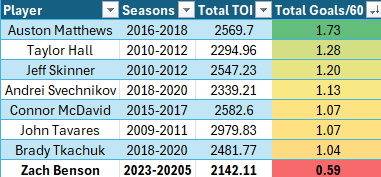
Benson is not an Auston Matthews-type scorer in the waiting, but either he's going to have one of the biggest outlier careers we've ever seen, or Benson is going to follow suit with most of the players on this list. My bet is the latter, and while there is justified optimism among Jack Quinn believers that the Peterka trade will mean a much more productive season from him, Benson is also in the mix. What will really keep him from ascending in the fantasy game is a lack of top power-play time, but it won't be the slightest surprise if he pops off for a 20-goal, 50-point season even without that top PP time. The lack of peripherals minimizes his value in multi-cat formats, but he's a guy to circle as late-round value in leagues that favour production over peripherals.
Sean Couturier (Philadelphia Flyers)
Rick Tocchet was hired as Philadelphia's new head coach. If nothing else, Tocchet preaches creating shot quality as from the time he was hired as Vancouver's coach on January 22nd, 2023 until the end of the 2024-25 season, the Canucks were 2nd in the league by shooting percentage (only Tampa Bay was higher). Shot quantity is sacrificed at the altar of that shooting percentage, and it can make the downswings pretty brutal, but this is good news for Sean Couturier who saw a big gap between his expected goals and actual goals over the last two years:

At this point, it's easy to forget that Couturier was a high-percentage shooter for several years. In fact, from 2016-2021, he shot 13.5%, which was around the 80th percentile of regular forwards. That has decreased in recent seasons for any number of reasons (age, injury, team quality) but Couturier has the coach that can turn that percentage around and make him a 20-goal guy again, with upside of pushing 30 goals. The Flyers don't have a Quinn Hughes, but they do have Matvei Michkov a year older, Trevor Zegras in from Anaheim, and Travis Konecny as a top winger in the league. Do not be surprised that if Couturier can stay healthy, he has his most productive season since the pandemic, both overall and on a per-game basis.
Related Posts
Starting Goalies













Top Skater Views
 DET
DET CHI
CHI STL
STL BOS
BOS


Top Goalie Profile Views
| Players | Team | |
|---|---|---|
| DYLAN GARAND |
 NYR NYR | |
| DEVON LEVI |
 EDM EDM | |
| JACOB FOWLER |
 MTL MTL | |
| JAKUB DOBES |
MTL | |
| JOSHUA RAVENSBERGEN |
 S.J S.J
| |
LINE COMBOS
| Frequency |
 PIT Players PIT Players
| |
|---|---|---|
| 20.4 | TOMMY NOVAK EVGENI MALKIN EGOR CHINAKHOV | |
| 20.2 | BRYAN RUST RICKARD RAKELL SIDNEY CROSBY | |
| 19.3 | NICK ROBERTSON BLAKE LIZOTTE CONNOR DEWAR | |
DobberHockey Podcasts

Keeping Karlsson: Short Shifts – NHL Frozen Frenzy Recap
Elan and Lewis recap the Frozen Frenzy as well as two big returns and more!
Keeping Karlsson: Delusions of Garandeur
Elan and Brian dive into the latest NHL hot streaks, cold streaks, line changes, outjuries, injuries, buy-lows and sell-highs to give you top notch tips in your fantasy hockey league

Fantasy Hockey Life: TiDy Takes Part 2
Last week, Victor Nuno and Ryan Downey broke down trades from our top tier dynasty league. This week, they consider some dynasty trades from other divisions. Have a listen! Our show is part of the Dobber Podcast Network and sponsored by Fantrax.com. Email [email protected] and ask to join our free discord. Join our Patreon at […]
Keeping Karlsson: Matchup Maximizer 2026/27 Week 3
Elan takes a look at the schedule for the upcoming weeks of NHL action and recommends players with good schedules that you should consider streaming in to win your head to head matchups.
Keeping Karlsson: Short Shifts – Sharks Looked Like Celebweenies
Elan recaps the major injuries, outjuries, game results and changed line combos that we’ve seen since Sunday’s mega-show.