

Ramblings: Black Friday Deals on Weegar, Hanifin, Skjei, Point, Miller, and Johnson – November 28
Michael Clifford
2025-11-28
We are nearly 30% of the way through the regular season, which means firm decisions need to be made about fantasy rosters. Managers hoping for a championship need to look around the league at which players could bolster their roster, and that's what we're doing here today. We are seeking players who are Black Friday sales targets, or guys who've underperformed their potential fantasy value and could be had for relatively cheap in a trade.
To do this, we are going to look at a few different areas:
- Individual Points Percentage (IPP) which is the rate at which a player earns a point when his team scores with him on the ice. So, if a player has been on the ice for 20 goals this season, and he has 10 points, he has an IPP of 50%.
- On-Ice Shooting Percentage (OISH%), or the rate at which a team scores with a player on the ice. For example, if a defenceman is on the ice for 200 team shots, and the team has scored 20 goals on those 200 shots, that defeceman's OISH% is 10%.
- On-Goal Percentage (OG%), which is how often a player's shot attempts turns into a shot on goal
The focus will be mainly on veterans as we are comparing to prior seasons, and it will start with defencemen before moving to forwards. Data is from Natural Stat Trick.
To clarify the visuals below, here's a guide:
- The horizontal axis shows change in IPP from 2023-25 to 2025-26.
- The red vertical line is the average change in IPP.
- The vertical axis shows the change in OISH%.
- The blue horizontal line is the average change of OISH.
- The colour of the dots is the change in shot attempts/shots on goal. The lighter the colour of the dot, the lower the change, so the light colours are a negative change and the dark colours are a positive change.
Clear as mud? Great. Let's look at some players to target on the cheap.
MacKenzie Weegar (Calgary Flames)
At the top of the list is a perennial multi-category stud who has been off to a very slow start, and when looking at this graph, it's clear why this is happening:
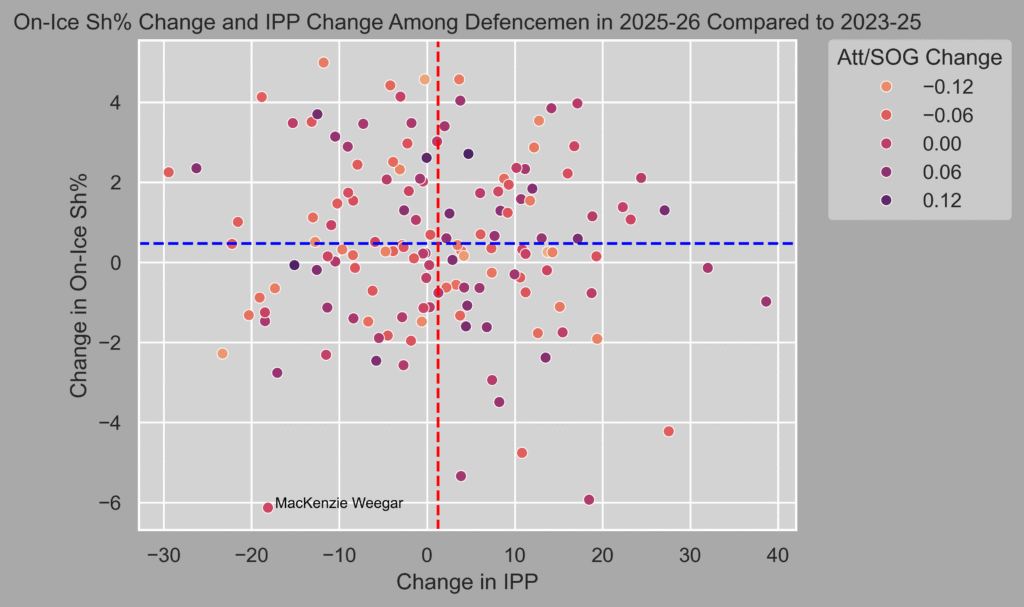
As things stand at the Thanksgiving break, Weegar has seen the largest drop in on-ice shooting percentage, averaging 10.9% across the prior two seasons and sitting at 4.8% so far this year. That is even with the team's rate of shots and expected goals with him on the ice being right in line with the previous two years. Weegar has zero goals and four assists in 25 games, highlighting just how bad a start it has been. Had his OISH% and IPP been similar to the last two years, he would have 4 goals and 15 points. But they're not, so he doesn't.
Calgary is dead last by goals per 60 minutes this season, but they were 29th by goals/60 last season so it's not as if their offensive struggle is unexpected, and what has happened with Weegar has been terribly bad luck through 25 games. With Rasmus Andersson likely to be traded at some point and Zayne Parekh both injured and not having the trust of the coaching staff yet, Weegar seems likely to return to the top PP unit this season, too. With a lot of positive regression in store, he seems poised to have a big second half in multi-cat formats.
Noah Hanifin (Vegas Golden Knights)
Two things can be true about Hanifin:
- He is unlikely to earn top PP minutes with any type of regularity this season, and that lowers his fantasy ceiling compared to the earlier parts of his Vegas tenure.
- Even without the top PP time, he has been very unlucky.
Here is where Hanifin sits in changes to IPP and OISH% this season:
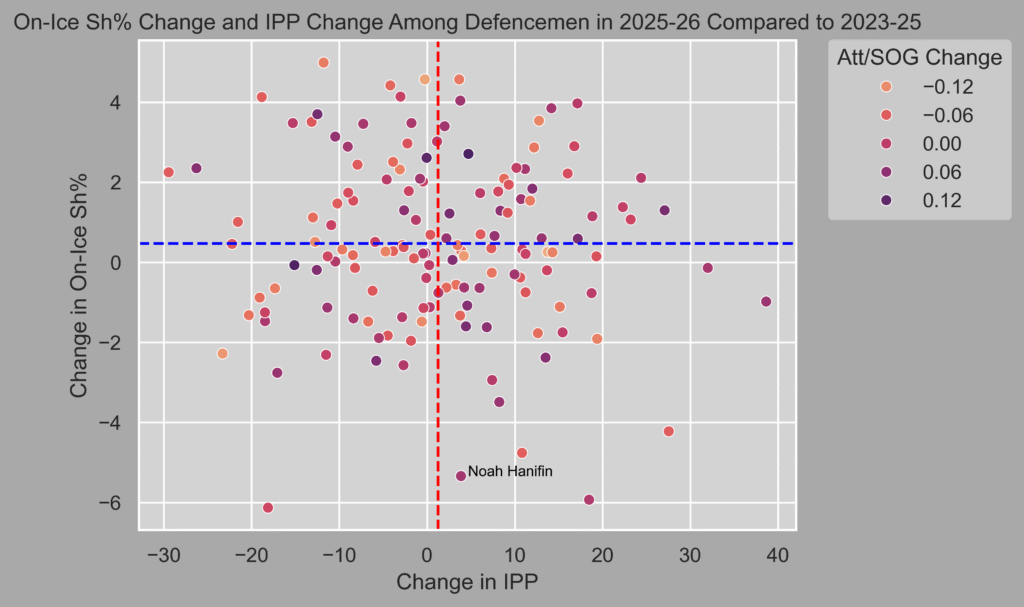
While Hanifin's IPP is consistent with his prior two seasons, his OISH% has completely crashed. That is not just due to a lack of top PP time, either: Vegas shot 9.7% with Hanifin on the ice at even strength in his first two seasons with the team, a rate that is 5% this season. If his normal rate were approaching 10%, he'd have 6 points in 13 games instead of 3 points in 13 games.
Aside from the positive OISH% regression to come, the positive for Hanifin is that he's earning 38% of the team's even-strength ice time this season compared to 36% last year (per Frozen Tools). Even without the top PP time, the injury to Alex Pietrangelo has Hanifin at 23:15 per game in ice time, an increase of 1:42 from last year. It has helped his peripherals improve and if he maintains that elevated peripheral level when the points start flowing more regularly, he'll be just fine in multi-cat formats.
Brady Skjei (Nashville Predators)
While Skjei's OISH% hasn't really changed much – a drop of less than 1% compared to the prior two seasons – it's his IPP that draws us here as he's seen one of the largest declines in the league:
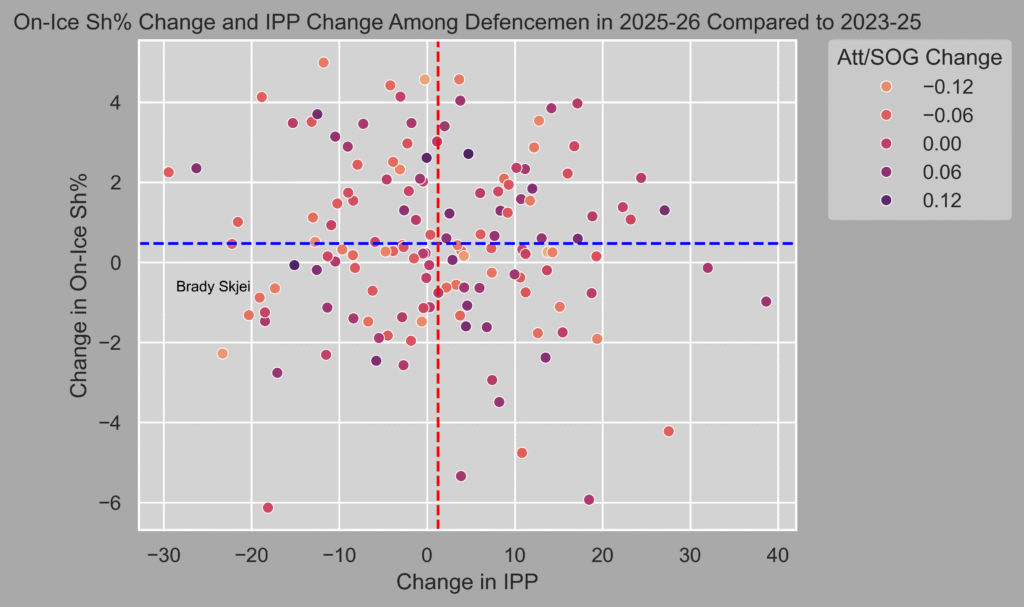
Skjei has eight seasons where he's played at least 60 games. In each of those seasons, his IPP has been between 35-50%, and seven of those eight years saw him exceed 40%. So far in 2025-26, his IPP is 30%, a far cry from the 49.1% across the prior two seasons. He should probably have 2-3 goals and 9-10 points on the campaign, rather than the zero goals and six points he actually has. It may not seem like a huge difference, but it puts him in line for 6-7 goals and 20-25 points the rest of the way.
Nashville is a poor offensive team (again) and with Roman Josi healthy, Skjei will not earn top PP minutes. However, he won't be this bad offensively all year and getting him for extremely cheap can offer some depth multi-cat value the rest of the way. Maybe just not in leagues that count plus-minus.
*
With defencemen out of the way, let's move to the forwards.
Brayden Point (Tampa Bay Lightning)
With just 3 goals and 8 assists through 21 games, there have been fewer bigger busts to start the season than Tampa Bay's top centre. While his individual shooting percentage is a big reason for this – he sits at 6.8% after three straight years over 20% – that is only one piece of the puzzle because Point has seen a huge decline in OISH% and a noticeable decline in IPP:
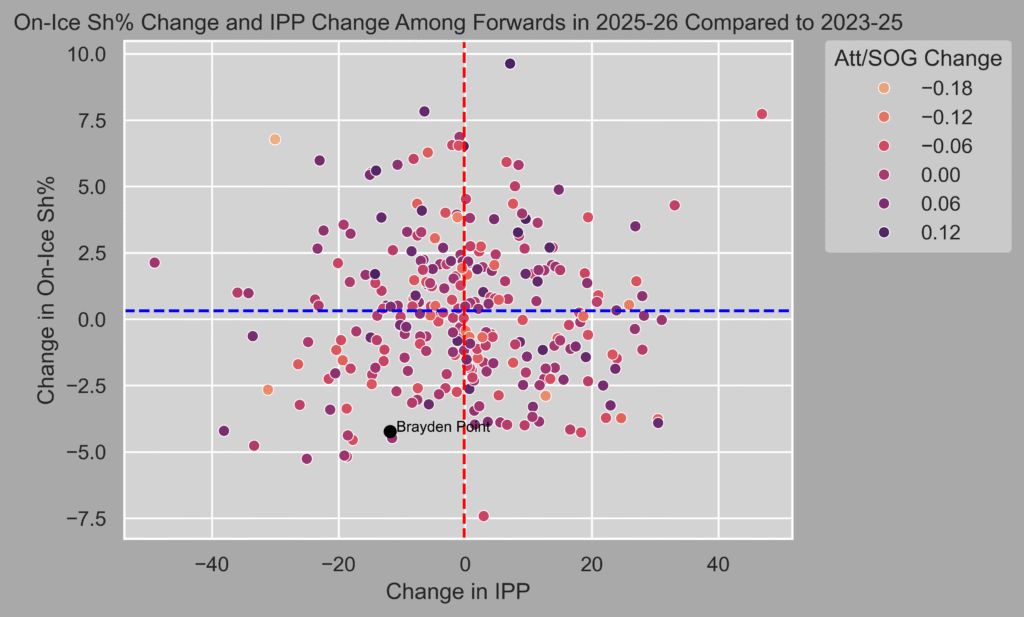
Tampa Bay has shot at least 13% with Point on the ice for four straight years and he's never been below 11% in any season of his career. That is why his 10% OISH% really stands out. He has also managed a point on at least 60% of the goals scored with him on the ice in every season where he's played at least 70 games; he currently sits at 50%. He probably should be between 18-20 points rather than the 11 points he actually has.
The big problem (aside from the shooting percentage) is Tampa Bay's power play. This is a team that led the league in PP goals from 2023-25, averaging 0.8 PP goals per game. This year, they have just 12 PP goals in 23 games, putting them on pace for 35% fewer PP goals than their two-year average. They are shooting 12.2% with Point on the ice for the power play after averaging over 18% across the prior two seasons. Presuming that the Lightning power play gets on track, there is too long of an elite track record for Point to stay anywhere close to this level for the rest of the season.
J.T. Miller (New York Rangers)
This one makes me a bit nervous because there have been rumours – and they are just rumours – that maybe Miller has been playing through some type of injury, which is why he's missed time recently. Sometimes, a player is underperforming because they're unlucky, and sometimes they're playing below their potential because they're playing injured (Thomas Harley comes to mind). We don't really know one way or another, but it's worth mentioning.
Anyway, here is where Miller stands by change in IPP and OISH%:
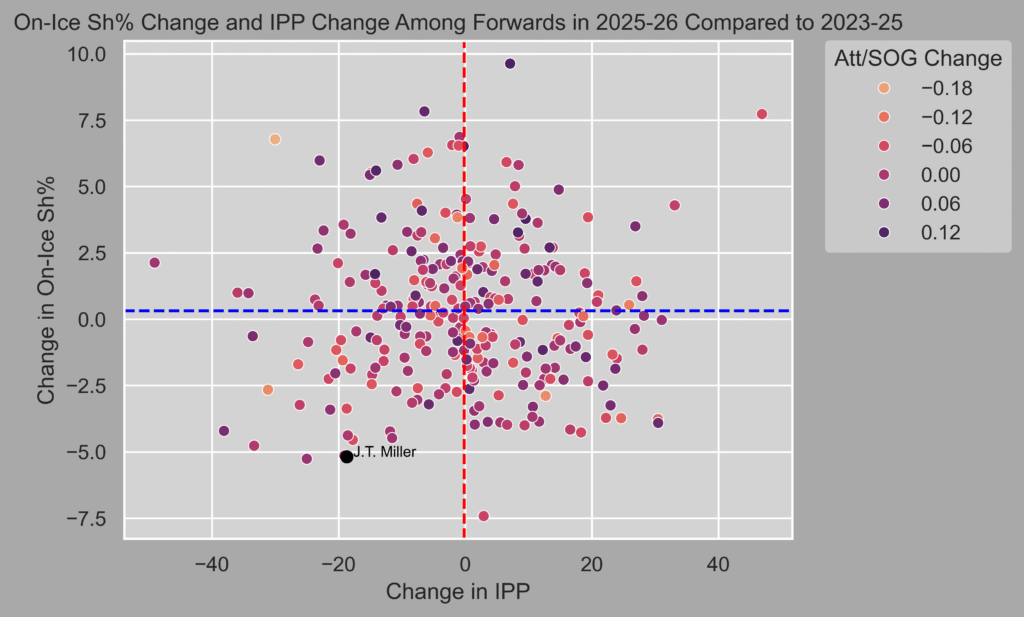
There has been a decline of a little over 10% in his IPP, but a huge decline of nearly 5% in his OISH%. It isn't a huge surprise, given the Rangers' lack of goal scoring this season, but it's still surprising to see Miller's OISH% at 9.7% considering he's been over 10% for 10 straight years, going back to his first tenure in New York. He has seven straight years over 11% and four of his last five years have been over 13%. He is with a new team, but he generally drives shooting percentages upwards, and that hasn't happened this season.
The good news is the Rangers are generating over 30 shots and 3.9 expected goals per 60 minutes with Miller on the ice, right in line with where he usually is. He's also landing over 2% fewer shot attempts on goal, so there is a lot of positive regression to come. Hopefully, anyway.
Kent Johnson (Columbus Blue Jackets)
Anyone that drafted Johnson wishing he'd build off his 2024-25 season has been sorely disappointed. Readers can probably guess where this is going as he's been one of the unluckiest players in the entire league:
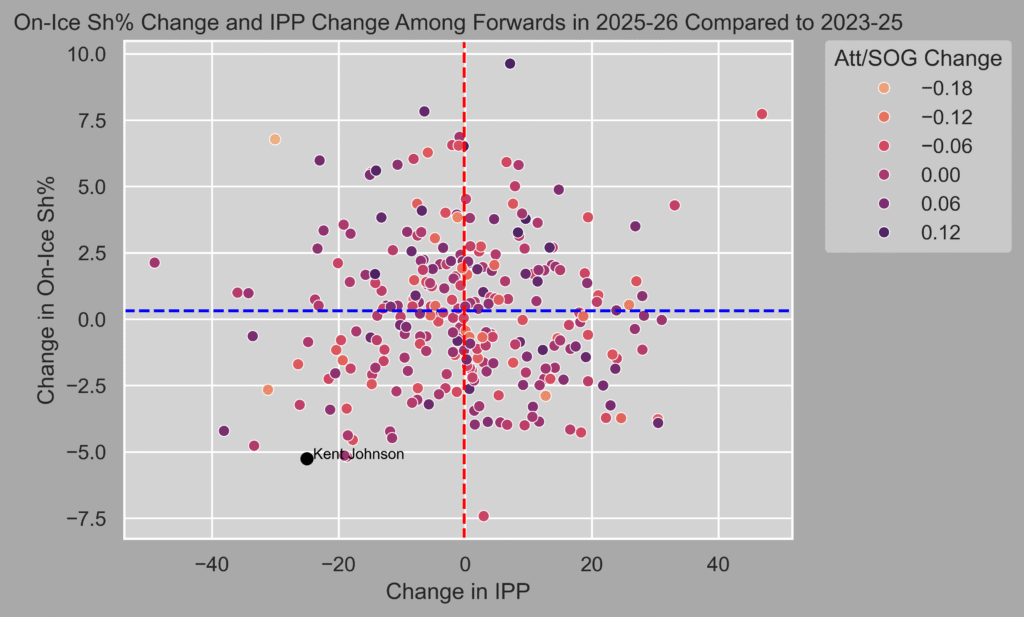
Johnson has gone from a two-year average of 63.5% by his IPP all the way down to 38.5% so far this season. Also, the team is shooting just 6.8% with him on the ice in 2025-26 compared to just over 12% across the prior two years. As with Noah Hanifin earlier, this isn't just about the power play, either: at even strength, Columbus is shooting 6.2% with Johnson on the ice, a rate that was over 10% each of the prior two years, averaging 11.8%. It wouldn't be the least bit surprising to see that 6.2% OISH% double what it is now, which really highlights how unlucky he's been.
The issue with Johnson is that until this turns around, he's not good enough defensively to earn the trust of the coaching staff (he's already been a healthy scratch once). However, it is unlikely things will stay this bad for the rest of the year and now is a good chance to get him for very cheap in a trade and enjoy that positive regression in the second half.
Related Posts
Starting Goalies







Top Skater Views
 STL
STL CHI
CHI BOS
BOSTop Goalie Profile Views
 EDM
EDM NYR
NYR MTL
MTL S.J
S.J WSH
WSH

LINE COMBOS
| Frequency |
 DET Players DET Players
| |
|---|---|---|
| 21.8 | EMMITT FINNIE ALEX DEBRINCAT MICHAEL BRANDSEGG-NYGARD | |
| 11.7 | DYLAN LARKIN NATE DANIELSON VIKTOR ARVIDSSON | |
| 11.2 | LUCAS RAYMOND MICHAEL RASMUSSEN ANDREW COPP | |
DobberHockey Podcasts

Keeping Karlsson: Short Shifts – NHL Frozen Frenzy Recap
Elan and Lewis recap the Frozen Frenzy as well as two big returns and more!
Keeping Karlsson: Delusions of Garandeur
Elan and Brian dive into the latest NHL hot streaks, cold streaks, line changes, outjuries, injuries, buy-lows and sell-highs to give you top notch tips in your fantasy hockey league

Fantasy Hockey Life: TiDy Takes Part 2
Last week, Victor Nuno and Ryan Downey broke down trades from our top tier dynasty league. This week, they consider some dynasty trades from other divisions. Have a listen! Our show is part of the Dobber Podcast Network and sponsored by Fantrax.com. Email [email protected] and ask to join our free discord. Join our Patreon at […]
Keeping Karlsson: Matchup Maximizer 2026/27 Week 3
Elan takes a look at the schedule for the upcoming weeks of NHL action and recommends players with good schedules that you should consider streaming in to win your head to head matchups.
Keeping Karlsson: Short Shifts – Sharks Looked Like Celebweenies
Elan recaps the major injuries, outjuries, game results and changed line combos that we’ve seen since Sunday’s mega-show.