

Ramblings: Updates on Fox, Terry, and Kyrou; Buying Low on Nurse, Broberg, Doughty, and Walker – January 29
Michael Clifford
2026-01-29
Elvis Merzlikins was the starting goalie for Columbus on Wednesday night. This is kind of important because that makes four of the last seven games started by Merzlikins, all seven games coming under the tenure of Rick Bowness. This is… not ideal for anyone with Jet Greaves on their fantasy roster. Greaves had started nearly 75% of the games over the prior two months, but Bowness seems determined to make Merzlikins the starter. Why? There are three reasonable answers:
- They're trying to pump Merzlikins' trade value, maybe get a half-dozen good games from him, and then trade him at the Deadline.
- They're trying to outright tank for a good draft pick.
- They're trying to keep Greaves' counting stats down – wins, specifically – as he's a pending RFA and they want to keep his contract as low as possible.
Any other explanation is incorrect or a lie.
*
Adam Fox was at New York Rangers morning skate in a non-contact jersey on Wednesday :
A good sign for Fox's return, but with just a week until the Olympic break, it's a wonder if they just don't give him those few extra weeks to recover 100%.
*
Lou Korac reports that both Jordan Kyrou and Jake Neighbours are considered day-to-day rather than week-to-week for the St. Louis Blues. It doesn't appear as if either will suit up on Thursday night, but they shouldn't be out for very long (more on the Blues a bit later).
*
According to Patrick Present, Troy Terry joined the team in Vancouver and practiced with them on Wednesday. He has been out of action for over three weeks with an upper-body injury but looks like he will return to the lineup sooner rather than later.
*
In my Ramblings on Tuesday, we covered some forwards who are due for improved production down the post-Olympic stretch run. The hope here is to provide fantasy managers with some buy-low options for the final third of the season (or just straight-up add them via waivers), particularly those fantasy managers that need a big swing to either work out or flame out.
Today, we are doing the same thing but moving to the blue line. Again, we are limiting the sample to defencemen who've skated at least 250 minutes since December 1st, we are looking at all strengths, data is current as of the morning of Wednesday, January 28th, and is from Evolving Hockey.
The two main data points we're using are team expected goals-for per 60 minutes (xGF/60) over actual goals-for per 60 minutes (GF/60) with a given player on the ice, and Individual Points Percentage (IPP, or their goals-for participation rate).
Darnell Nurse (Edmonton Oilers)
What makes Nurse so valuable in multi-cat leagues is that even when he's going through a stretch that he's currently mired in – 7 points in 28 games since December 1st – his peripherals float his fantasy value. That has been the case here, as he has 54 shots, 56 blocks, 36 hits, and 42 PIMs in those last 28 games. It is what makes him hard to trade for because the person with Nurse on their roster will (or should) know this as well.
Peripherals aside, Nurse has been cheated out of some points:
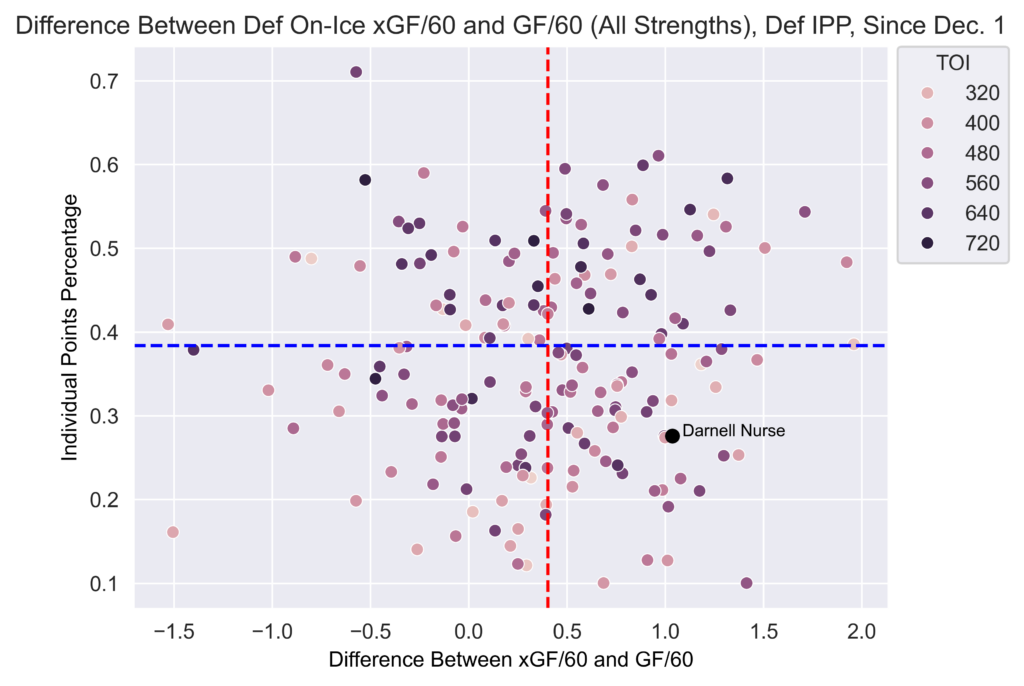
The difference between Nurse's xGF/60 and GF/60 rate is one of the 25 largest in our sample. On top of that, his IPP of 27.6% is considerably lower than normal: He exceeded 40% each season from 2022-2025 and was over 50% through the end of November. He is also the only Edmonton defenceman in our sample with an xGF/60 over GF/60 differential greater than 1.0 with an IPP under 30%. Spencer Stastney has a low IPP, and Alec Regula has a higher xGF-GF differential, but neither have the combination that Nurse does.
As mentioned in the Ramblings on Tuesday, public expected goals models like the one used at Evolving Hockey have been over-counting expected goals this season. For defencemen, it means they typically are averaging an xGF/60 rate around 14% higher than their GF/60 rate. However, even factoring in that over-counting, if the team were scoring at the rate it should be with Nurse on the ice, and he's figuring in on his typical 41% of goals, he'd have 13 points in his last 28 games rather than 7 points. It speaks to the upside that is on the table for Nurse after the Olympic break.
Just one word of caution here: after the Olympic break, the Oilers are 1 of 5 teams with 24-or-fewer games on the schedule and they have the fifth-hardest schedule by opponent points percentage (per Frozen Tools). Nurse is due for a big turnaround, but factoring in both games played and opponent strength, the Oilers might have the worst fantasy schedule of any team from late February onward.
Drew Doughty (Los Angeles Kings)
This is the conundrum with Doughty: on the season, the Kings are 30th by goals per minute, a rate that sits 28th if we look just since December 1st. They are also scoring the fifth-fewest power-play goals per game. That is not a very good environment for Doughty to rack up the points, and that has certainly been the case with just 1 goal and 4 assists in his last 24 games. Evan Bouchard had more points on Saturday night than Drew Doughty has in the last 8+ weeks.
With all that said, Doughty does have the hallmarks of positive regression coming; his xGF/60 over GF/60 differential is the 11th-largest in our sample and he's figuring in on just 25.2% of goals scored with him on the ice after being over 40% each season for the last decade. It puts him in company with very few others around the league:
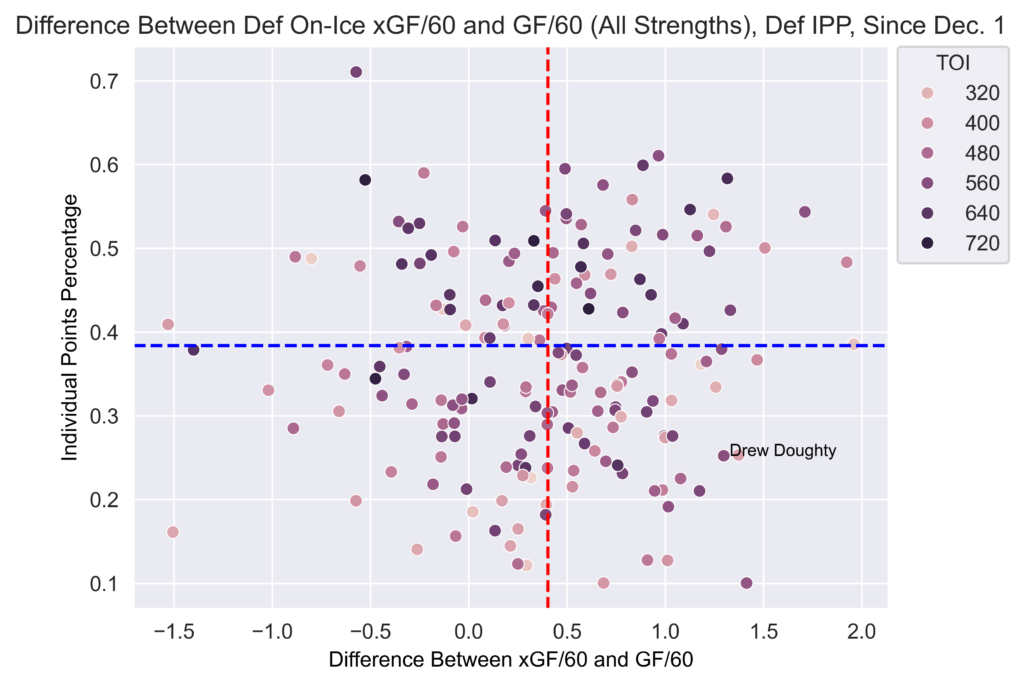
Anze Kopitar is on the mend and may be returning before the Olympic break. The Kings may also add some scoring at the Trade Deadline (though given Ken Holland's offseason moves, that might make the team worse). Either way, from today onward, Los Angeles is tied with four other teams for the most games remaining (31), they are 1 of 11 teams with at least 16 home games, and their opponent points percentage gives them the third-easiest schedule. Not only is Doughty due for some positive regression, but the final 7+ weeks of the season gives him a great schedule for it to happen.
Sean Walker (Carolina Hurricanes)
When I said that Doughty's signs of positive regression put him in company with few others around the league, that was true. What is also true is that one of those few others around the league is Sean Walker:
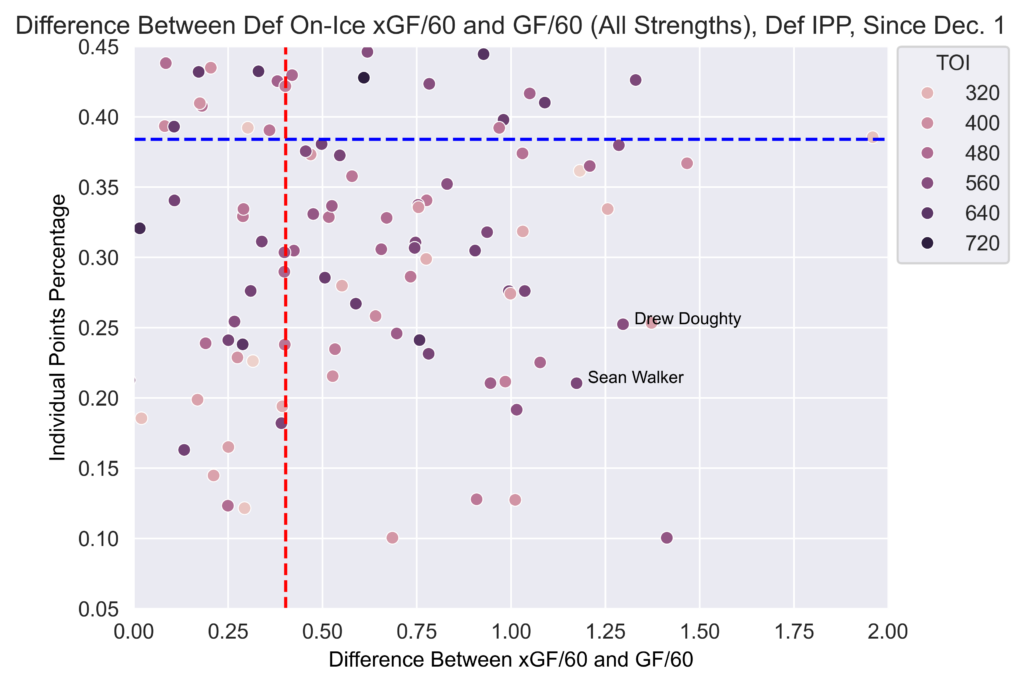
Of the 182 defencemen in our sample, Walker is the only defenceman to have a 90th percentile mark highest xGF/60-GF/60 gap and for lowest IPP.
To that point on Walker's IPP: this stretch has seen him register a point on just 21% of goals scored with him on the ice. In his first full season with Carolina, Walker's IPP was 33.3% and he averaged 33.7% across the 2022-2025 seasons. When adjusting Walker's xGF/60 – GF/60 differential for the over-counting of xGF we discussed, subtracting an additional 50% on top of that because the Hurricanes often generate far more xGF than actual GF, and normalizing Walker's goal participation to 33%, he probably should have had around 10 points over his last 27 games. Instead, he registered just five.
Without a power-play role, Walker's production upside is limited, but he's still averaging over 20 minutes a game since Jaccob Slavin's return. With his peripherals, even averaging around 20:30 per appearances could leave him over 2.0 shots, 1.3 blocks, and 1.5 hits per game. From today through the end of the season, the Hurricanes 1 of just 8 teams with at least 30 games remaining and at least 10 of those games coming on 'light' days. As with Nurse, the fantasy manager with Walker on their roster knows his peripheral value, but there should be more production value coming, and that makes him a target for the stretch run.
Philip Broberg (St. Louis Blues)
As with Doughty, it's tough to believe in Broberg simply because of St. Louis' severe scoring issues. However, across his first 94 games with the Blues from the start of the 2024-25 season through to the end of November in 2025, he managed a point on 47.6% goals scored with him on the ice. It is what kept him close to a 35-point pace in that span, which is roster-able in non-shallow formats.
The reason Broberg is in this column is that IPP number has been cut by more than half, going from 47.6% across those 94 games to just 23.1% across his last 26 games:
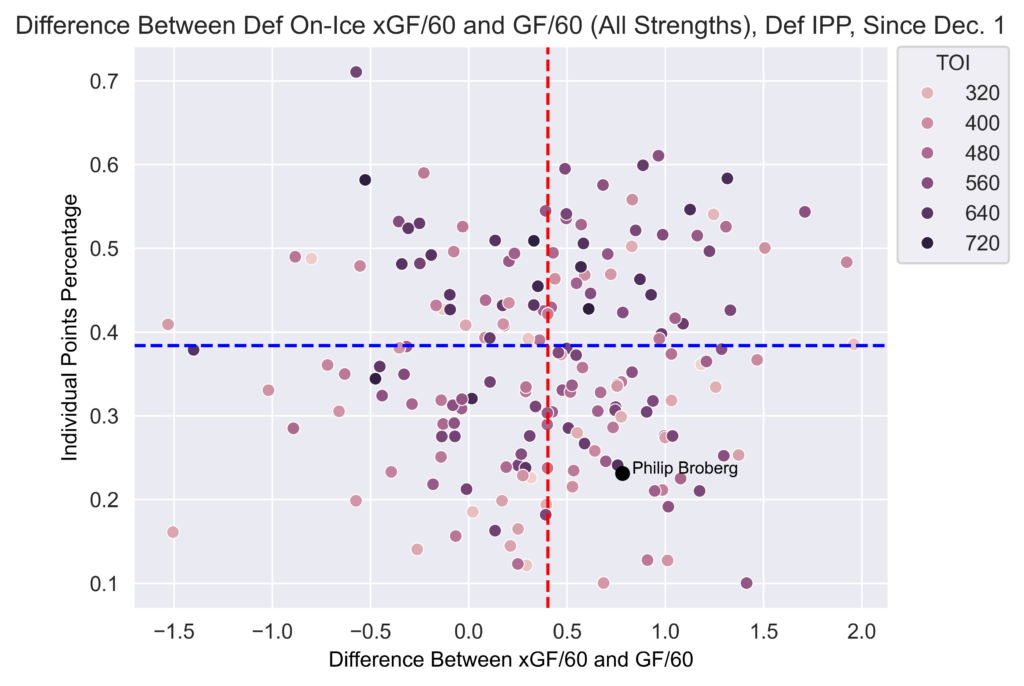
Broberg doesn't have a huge xGF/60-GF/60 differential (0.78), but it is nearly double the league average (0.4) and he's figuring in on far fewer goals than he should. That all matters for the stretch run.
There are a couple of other things that matter here. The first is that the Blues should welcome back both Robert Thomas and Dylan Holloway to the lineup either just before, or immediately after, the Olympic break. It gives the club their top centre, and one of their top two wingers, back. That matters for the team's goal-scoring rate.
The second point is that Broberg has been getting some PP time lately. He has managed over 20 power-play minutes in the month of January alone, more than he had through his first 41 games of the season (14 minutes). Whether he holds that role or not is another matter, but if he can get regular power-play time over the final eight weeks, it adds a dimension to his fantasy profile he's never had in St. Louis. It probably won't be very productive because the Blues' power play has generally not been poor, but some PP production is always better than none.
St. Louis' post-Olympic schedule isn't remarkable in one way or another – 25 games played and .566 opponent points percentage puts them in the middle of the league for both – but it's that the Blues are getting top forwards back, Broberg is due for positive regression, and he may have a regular PP role down the stretch that are all important here. Fantasy managers desperate for some defensive depth should check in with their league mate with Broberg on their roster, or just check the waiver wire.
Related Posts




Starting Goalies







Top Skater Views
 N.J
 T.B
 BUF
 EDM



Top Goalie Profile Views
| Players | Team | |
|---|---|---|
| STUART SKINNER |
 WPG | |
| LINUS ULLMARK |
 OTT | |
| DYLAN GARAND |
 NYR | |
| DAN VLADAR |
 PHI | |
| JOEL HOFER |
 STL | |
LINE COMBOS
| Frequency |
 COL Players | |
|---|---|---|
| 11.9 | JADEN SCHWARTZ NATHAN MACKINNON ARTTURI LEHKONEN | |
| 10.6 | BROCK NELSON GABRIEL LANDESKOG NAZEM KADRI | |
| 8.0 | MARTIN NECAS GABRIEL LANDESKOG NAZEM KADRI | |
DobberHockey Podcasts

Keeping Karlsson: Short Shifts – Injuries, Outjuries, and Duds
Elan talks about all the latest injuries, outjuries, big performances and duds over a tight 20 minutes in this week’s episode of Short Shifts.
Keeping Karlsson: Never Tell Me the Podz
Elan and Brian do a wellness check on the Maple Leafs, lament Chicago and Buffalo snoozers, wonder whether and which Flyers have figured it out, and pick out the Capital standing out from the crowd.

Fantasy Hockey Life: Ep 505 Prospects With Plenty to Prove Part 1
Victor and Jesse return to talk about prospects with plenty to prove. This week it’s: Tij Iginla, Berkly Catton, Konsta Helenius, Zayne Parekh, Igor Chernyshov, Jett Luchanko, Axel Sandin-Pellikka, Artyom Levshunov, Michael Hage, and Carter Bear. Have a listen! Our show is part of the Dobber Podcast Network and sponsored by Fantrax.com. Email [email protected] and […]
Keeping Karlsson: Matchup Maximizer 2026/27 Week 4
Elan takes a look at the schedule for the upcoming weeks of NHL action and recommends players with good schedules that you should consider streaming in to win your head to head matchups.
Keeping Karlsson: Short Shifts – NHL Frozen Frenzy Recap
Elan and Lewis recap the Frozen Frenzy as well as two big returns and more!