

Ramblings: Carolina Earns Game 2 Overtime Win; Karlsson Returns for Vegas; Shot Improvements for Samuelsson, Raddysh, Byram, Nemec, and Luke Hughes – May 5
Michael Clifford
2026-05-05
Taylor Hall poked home a loose puck with a minute left in the first overtime period as the Carolina Hurricanes toppled the Philadelphia Flyers 3-2 in Game 2 of their second-round matchup. Hall now has points in all six games he's played this postseason, totaling three goals, six assists, 16 shots, and eight hits in all. He and his line mates have been marvelous so far in the postseason.
Seth Jarvis and Nikolaj Ehlers had the other goals for the Hurricanes.
Jamie Drysdale and Sean Couturier scored the goals for the Flyers. Drysdale is up to four points in eight playoff appearances as he's helped boost the scoring from the back end.
The Flyers had their chances to win the game, including a breakaway from Travis Konecny in overtime, but Frederik Andersen stopped 34 of the 36 shots sent his way for his sixth win in six postseason starts.
Dan Vladar was excellent in net for the Flyers, but took the hard-luck loss by allowing three goals on 42 shots.
Game 3 goes Thursday night back in Philadelphia.
*
William Karlsson returned to the lineup for the Vegas Golden Knights as they began their series against Anaheim on Monday night. Karlsson had been out since early November with a lower-body injury and is a key piece of the forward depth that Vegas has.
William Karlsson returned to the lineup for the Vegas Golden Knights as they began their series against Anaheim on Monday night. Karlsson had been out since early November with a lower-body injury and is a key piece of the forward depth that Vegas has.
A late third-period goal from Ivan Barbashev proved to be the difference in Game 1 as Vegas took a 3-1 win. Brett Howden got the party started with his fifth of the playoffs while Mitch Marner added an empty-net tally. Marner also assisted on the Howden goal, and the former Maple Leaf now has nine points in seven games through this postseason.
Carter Hart stopped 33 of 34 shots in the win.
Mikael Granlund scored the lone Ducks goal and keeps up his point-per-game pace in the 2026 playoffs.
Karlsson skated on the third line and had 11:09 of total ice time.
*
In a pair of Ramblings last week, we reviewed forwards who saw improvements or declines in the percentage of their team's shot attempts. In the first Ramblings, we focused on forward improvements in shot attempts from guys like Connor Bedard, Leo Carlsson, Shane Pinto, Cole Perfetti, and more. In the second Ramblings, we went the other way and highlighted declines in shot attempts from names like Adam Fantilli, Brady Tkachuk, Matias Maccelli, Peyton Krebs, and others.
Today, we continue with the same theme but move to the defencemen. Below, we'll start with blue liners who saw an improvement in their market share (market%) of their team's shot attempts. For anyone unfamiliar with the term 'market share' in this context:
Market share is simply the percentage of a team's shots that a player takes when he's on the ice. So, if the Washington Capitals average 60 shot attempts per 60 minutes with Jakob Chychrun on the ice, and Chychrun takes 15 of those 60 attempts, his market% is 25%, or 15/60.
Market share is used because it can find players who have high shot volume but play for teams, or have line mates, who don't generate a lot of shots. It also helps normalize the shot rates of players who play for teams that do generate good shot volume.
We are using just even-strength ice time, excluding empty net situations, limiting our defencemen to those with at least 700 even-strength minutes both in 2024-25 and 2025-26, and focusing on those age-25 or under. The sample will include defencemen of all ages to give us some reference points, but they won't be listed here. Well, with one exception.
Mattias Samuelsson (Buffalo Sabres)
It was an incredible bounce-back season for Samuelsson who had 13 goals in 78 games, or nearly double what he produced in the first 212 games of his career (7). He also put up 41 points, or nearly triple his previous career-best mark of 14. When we consider all the reasons why Buffalo had such a big turnaround, Samuelsson having such a great year is high on the list.
He got a bit lucky, shooting 11.9% against a three-year average of 4.1%, but there was also improvement in his underlying process because he increased his market% of shot attempts over 5%. That was the second-largest increase of any defenceman in our sample and over double the improvement of the next-closest under-25 blue liner:

Samuelsson had so far to climb that finishing with 16.8% of the even-strength shot attempts is a huge improvement, but it also puts him outside the top-half of defencemen overall, or the rate of a high-end #4 defenceman. It is why he got big minutes – 22:50 per game – but still finished with just 109 shots. All the same, if he's a guy who can put up nearly 125 shots in 82 games, rather than 80-90, it adds to the great shot/block peripherals he already has in his fantasy hockey profile.
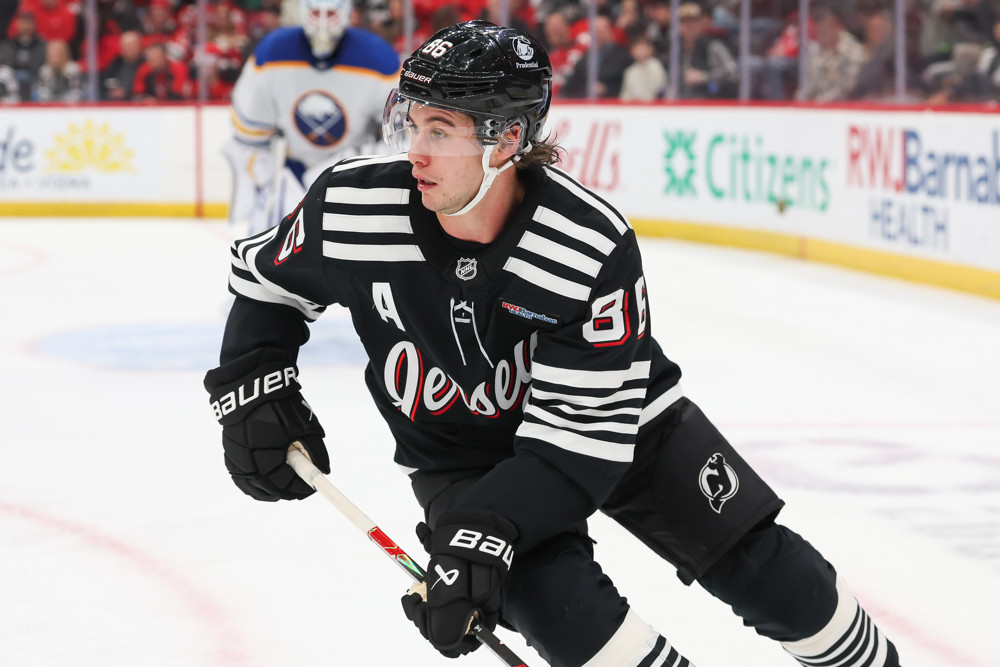
Luke Hughes (New Jersey Devils)
From an analysis standpoint, The Younger Hughes may have had one of the most interesting seasons of any player in the league. He averaged 23 minutes a game, saw some sizable jumps in key areas of his tracking data (from All Three Zones), was New Jersey's top PP defenceman for large chunks of the season, and still saw a career-low in points per game. If we go back to last September, and someone told me that Hughes will skate 23 minutes a game with a lot of top PP time and have big improvements in some important tracking data, I would have been very high on him. Thankfully, no one did that.
Setting all that aside, Hughes did have the sixth-largest jump in market% of shot attempts of our defencemen, and second-largest for anyone age-25 or under:

Taking 22.2% of the shot attempts isn't quite to elite Zach Werenski-type levels yet, but it is in the next tier down with names like Darren Raddysh and Rasmus Andersson. Maybe there's something to the fact that Hughes was taking more of the shots and considering he shot 4% overall and 3.4% at even strength, that it wasn't a great idea to do that. However, at this shot volume and his ice time rates, it puts the 200-shot plateau in play. He just crested the 200-game mark in January, too.
Darren Raddysh (Tampa Bay Lightning)
This is an article for younger players, and Raddysh turned 30 years old in February. However, he didn't even get to the NHL until his age-25 season, had just 176 career games from 2021-2025, and saw a huge breakout season in 2025-26, so he is worthy of inclusion.
It is easy to chalk up Raddysh's 212 shots in 73 games to the fact that he saw a massive increase in ice time, including 24:04 per game from American Thanksgiving onward, which is Rasmus Dahlin-level. But he also saw a notable jump in his market share of even-strength shot attempts, landing 12th on our list of 131 blue liners:

In the section on Hughes, it was mentioned that he and Raddysh weren't quite to the elite level of Zach Werenski or Jakob Chychrun, but they are in the next tier below them, and that is something that leads to 200-shot seasons. Raddysh eclipsed that mark in 2025-26, and his market% means he's a threat to do it again in 2026-27, whether in Tampa Bay or elsewhere (I do think he re-signs with the Bolts, he just hasn't done it yet).
Simon Nemec (New Jersey Devils)
Back in March, these Ramblings covered Nemec's improvements in some of his facilitation tracking data like assisting on teammate scoring chances and zone entries. It led to a slight improvement in his 60-minute assist rate in even strength when compared to his first two seasons, which is good considering the Devils finished 30th by even-strength goal scoring (per 60 minutes).
To go with that facilitation is the fact that Nemec also improved his shot rate, coming in 17th of our 131 defencemen by improvement in market%:

At 19.3%, Nemec was roughly the rate of a #2 defenceman, in range of names like Thomas Chabot and Mikhail Sergachev. It means that high shot-volume seasons aren't in the cards just yet – he's not in the Raddysh/Hughes tier – but with enough ice time, he can push for 150 shots on goal, even without top power-play time. A reminder that Nemec just turned 22 years old in February and won't reach the 200-game plateau until sometime after Christmas.
Bowen Byram (Buffalo Sabres)
Byram scorched the Boston Bruins in the first round with three goals and five points in five games, reminding us that much of the excitement around Byram's potential came from his great performance when the Colorado Avalanche made a run to the Stanley Cup in 2022.
When it comes to shooting, Byram's hallmark has long been elite percentages rather than volume. In fact, per Hockey Reference, going back to 2021-22, he is the only defenceman in the league to shoot at least 10% in at least four of the last five seasons (minimum of 25 games a season) – Cale Makar has three, and he's the only other name with more than two. Over the last five regular seasons, Byram leads all defencemen by shooting 11%, Makar is second at 10.5%, and no other defenceman is over 9% (minimum of 300 games). If he could keep that shooting percentage and increase his shot volume? Well…
It was given away in the picture in Nemec's section, but Byram saw a good jump in his market share of shot attempts in 2025-26:

To be clear, 14.3% of the shot attempt market% is still very low, ranking as a borderline #6 defenceman, in line with names like Spencer Stastney and Drew Helleson. However, just that jump with his ice time levels means he can repeat 100-shot seasons like he just had (109). At his conversion level, he's a genuine threat for 10 goals every year. He doesn't turn 25 years old until next month and looks to finally be healthy after years of concussion problems, so further improvements are possible. If that happens, 10 goals are the floor, not a reasonable expectation.
Related Posts
Starting Goalies











Top Skater Views
| Players | Team | |
|---|---|---|
| COLE PERFETTI |
 WPG WPG | |
| LUCA CAGNONI |
 S.J S.J | |
| IGOR CHERNYSHOV |
S.J | |
| TOMMY NOVAK |
 PIT PIT | |
| TRISTAN LUNEAU |
 ANA ANA
| |
Top Goalie Profile Views
| Players | Team | |
|---|---|---|
| DAN VLADAR |
 PHI PHI | |
| JOSEPH WOLL |
PHI | |
| SEBASTIAN COSSA |
 UTA UTA | |
| JAKUB DOBES |
 MTL MTL | |
| ADIN HILL |
 VGK VGK
| |
LINE COMBOS
| Frequency |
 SEA Players SEA Players
| |
|---|---|---|
| 23.4 | MACKIE SAMOSKEVICH JARED MCCANN MATTY BENIERS | |
| 22.5 | CHANDLER STEPHENSON BOBBY MCMANN JORDAN EBERLE | |
| 20.6 | SHANE WRIGHT KAAPO KAKKO BERKLY CATTON | |
DobberHockey Podcasts

Keeping Karlsson: Cole, There’s No Time!
Elan and Brian cover all the action from the first week of the NHL season, and identify our earliest must-adds, can-drops, sell highs and buy lows in your fantasy hockey leagues.
Keeping Karlsson: Matchup Maximizer 2026/27 Week 2
Elan takes a look at the schedule for the upcoming weeks of NHL action and recommends players with good schedules that you should consider streaming in to win your head to head matchups.

Fantasy Hockey Life: Tidy Takes Part 1
TiDy Admiral Ryan Downey and Victor Nuno break down recent trades in the FHL Tiered Dynasty’s top division, the Lord Stanley division. Tune in to consider trades between some of the best dynasty sharks we know, including patron polls on the trades and Victor’s analysis. Have a listen! Our show is part of the Dobber […]
Keeping Karlsson: Short Shifts – I Tried to be Like Parker Kelly
Elan is joined by Ryan Downey for the premiere of season 8 of Short Shifts! — KKUPFL late registration is ongoing! We’re still filling new divisions in the world’s greatest fantasy hockey league. Details at https://www.kkupfl.com/. Join the Keeping Karlsson patron community! Patrons get access to all our perks all year round, including KKUPFL […]
Keeping Karlsson: Shabanov Ranks
Elan and Brian fly through the final preseason lines for every NHL team ahead of opening night, and share their guys to watch– or look away from– in your fantasy hockey leagues.