

Ramblings: Power-Play Cogs in Bedard, Fantilli, Schmaltz, Barzal, and Pettersson – May 12
Michael Clifford
2026-05-12
Parker Kelly scored his first goal of the postseason to break a 2-2 deadlock in Game 4 between the Colorado Avalanche and Minnesota Wild to give the Avalanche a 3-2 lead, and eventually help them to a 5-2 win after empty-net goals from Nathan MacKinnon and Brock Nelson. This puts Colorado up 3-1 in the series, and gives them a chance to close things out on Wednesday night back in Colorado.
Nazem Kadri and Ross Colton also scored for the Avs.
MacKenzie Blackwood got the start in net for Colorado and stopped 19 of 21 shots for his first win of the postseason.
Nico Sturm and Danila Yurov had the goals for the Wild.
Both Sam Malinski and Artturi Lehkonen missed this game for Colorado.
*
We generally have a good idea of which players will be high-end power-play producers – we know Nikita Kucherov and Connor McDavid, if healthy, will rack up the PP points. But how can we look for players who might be able to rack up PP points other than just simply plugging in guys who are getting power-play time? Who should we avoid?
The tracking data from All Three Zones includes tracking data at 5-on-4. Among the various categories, there are zone entries and individual chances. Because there are more zone entries than chances, we will weigh a single entry less than a single chance, but there is a positive relationship between the percentage of a team's tracked entries and chances at 5-on-4 by an individual player, and that player's points/60 rate:
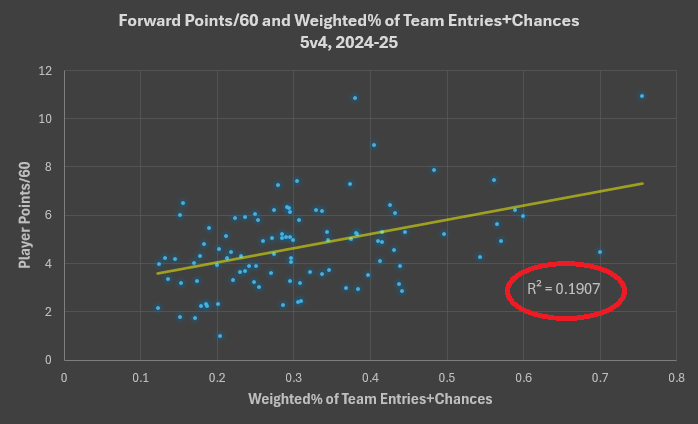
Essentially, players that have a big share of starting the play (the entry) or ending the play (the scoring chance) tend to put up more points than those who don't. That is intuitive, and while the correlation (red circle) isn't strong, it isn't that bad compared many other power-play measures we use.
Knowing that forwards who gobble up a big share of their team's entries and chances on the power play can typically put up more PP points, which forwards stand out (either good or bad)? Glad you asked.
Connor Bedard (Chicago Blackhawks)
Bedard had 21 PP points in 69 games this past season, an 82-game pace of 25 PP points. The year before, he had 29 in 82 games. He clearly is the engine of the young Blackhawks' man advantage unit, and that shows up when we look at his percentage of the team's tracked entries and chances at 5-on-4 from this past season:

At the top, we see Connor McDavid, which should be a surprise to no one, but then Bedard is in second place behind him. While McDavid has a sizeable gap ahead of Bedard, there is a bigger gap between Bedard and the next player (Macklin Celebrini) than there is between McDavid and Bedard. It isn't anything ground-breaking that Bedard is a significant part of Chicago's power play, but there's a difference between being a big part of the power play and being the focal point.
Think of it like a car. There are a lot of separate pieces responsible for a car functioning properly, but if the engine doesn't work, the rest doesn't matter. McDavid is the engine for the Edmonton Oilers, and Bedard is the engine for the Blackhawks. The difference is one guy also has Leon Draisaitl and Evan Bouchard on the ice with him and the other does not. If options like Frank Nazar and Anton Frondell can take steps forward next season, Bedard can take another leap in PP production, and thus his overall production.
Adam Fantilli (Columbus Blue Jackets)
It is funny how expectations work. Compared to 2024-25, Fantilli improved his total assists (+12), points (+5), shots (+23), hits (+26), and power-play points (+9). And yet, it still feels like his season was a bit of a disappointment, right? We do have to keep in mind he just crested the 200-game plateau in March, and he won't turn 22 years old until October.
Fantilli's power-play production, even if it was an improvement, was a big letdown. At 5-on-4, he had 10 points in 201 minutes, a rate of 2.98 points per 60 minutes. Among 86 forwards with at least 200 minutes at 5-on-4, he ranked 82nd in points rate. When we see his percentage of team entries+chances, that kind of makes sense:

That percentage is a little more than half the percentage we just saw for Bedard. He splits entries and chances with Kirill Marchenko, and then Zach Werenski gets a big chunk of time with the puck, too. Fantilli isn't the go-to guy on the power play; instead, he is one cog among many. That should change as he and the team around him matures, but it does raise questions about how high his PP production upside is in 2026-27.
Nick Schmaltz (Utah Mammoth)
At 19:43, Schmaltz led the Mammoth forwards in overall ice time per game and was 2:20 higher than the third-most used forward. He became a big part of the team getting back to the playoffs, and when we look at the power play, he is one of the more intriguing names in our data:

Notice the gap in entry+chance% between Schmaltz and Kirill Kaprizov. There is a glut of forwards all around 54-59%, including Jack Eichel, Nathan MacKinnon, Sam Reinhart, Jack Hughes, and Schmaltz. That he was so heavily involved in the Mammoth power play is a bit surprising when we consider that Clayton Keller led them in PP points (27), but it was Schmaltz who led them in PP goals (11). It probably won't be long until Dylan Guenther takes that distinction, but Schmaltz showed out very well here.
There are concerns. In between the entry and the chance, it's clear that Keller gets a lot of touches on the puck. Then we have Guenther turning into one of the top goal scorers in the league, and Logan Cooley establishing himself as a top-line centre. However, as long as Schmaltz is getting 19-20 minutes of total ice time with a top PP role, he will continue to threaten for 70+ points.
Mathew Barzal (New York Islanders)
Just from a strict production standpoint, I think one of the greatest 'what ifs' of the last 15 years is what if Barzal had been drafted by Colorado, Florida, Dallas, or Boston – the four teams who picked right before the Islanders in 2015 – rather than the Islanders? Assuming everything else occurs as it has, imagine what we might think of Barzal if he spent the last 5-10 years as the winger for Nathan MacKinnon or the centre for David Pastrnak. But I digress.
Once we get past that glut of forwards we mentioned in the Schmaltz section, there are several forwards in the mid-40% range, and Barzal is one of them:

The Islanders are an interesting team because among their forwards, Barzal had as many entries himself (48) as the next five highest forward totals combined. He improved his 60-minute PP points rate by 30% when compared to his shortened 2024-25 season, and the Islanders improved their team PP goal rate by 38%. Having a healthy Barzal (and drafting Matthew Schaefer) helped the power play a lot, even if they weren't very good overall.
A big problem here is what happens when Barzal doesn't have the puck. Not only was he responsible for a lot of the team's entries and chances, but he also had by far the highest passing totals on the roster. Among their forwards, he was a one-man show, and the top power play teams – think Edmonton, Dallas, or Vegas – have several options who can make plays once the puck is in the zone. That isn't the case with the Islanders, so Barzal might be able to put up 20 PPPs because he's so heavily involved in everything, but until the forwards around him improve dramatically, he won't reach the 30+ plateau; opposing penalty kills are too good to have 1-2 players responsible for everything.
Elias Pettersson (Vancouver Canucks)
Quickly, I want to highlight Pettersson because he did have a very tough production season overall, but he was clearly still a key piece of the Vancouver power play:

It doesn't feel like it, but Pettersson's 5-on-4 points rate of 6.1 per 60 minutes was a four-year high, and the second highest of his career (6.4 in 2021-22). Putting up that kind of PP production on a roster that was tied for the second-lowest overall goal total is one positive to take away from his season.
I am a believer in Zeev Buium and the Canucks still have Brock Boeser and Jake DeBrusk. The ingredients are there for the Canucks power play to hover around league average again, or at least not be awful. If Pettersson can keep up this involvement, he can flirt with 25 PP points in a full season. The question for his fantasy value is if things can improve at 5-on-5, and that's a horse of a whole different colour.
Related Posts

Starting Goalies







Top Skater Views
 DET
DET STL
STL CHI
CHI BOS
BOSTop Goalie Profile Views
 EDM
EDM NYR
NYR MTL
MTL S.J
S.J WSH
WSH

LINE COMBOS
| Frequency |
 PHI Players PHI Players
| |
|---|---|---|
| 21.8 | TYSON FOERSTER CHRISTIAN DVORAK DENVER BARKEY | |
| 21.8 | TREVOR ZEGRAS OWEN TIPPETT SEAN COUTURIER | |
| 16.2 | MATVEI MICHKOV PORTER MARTONE NOAH CATES | |
DobberHockey Podcasts

Keeping Karlsson: Short Shifts – NHL Frozen Frenzy Recap
Elan and Lewis recap the Frozen Frenzy as well as two big returns and more!
Keeping Karlsson: Delusions of Garandeur
Elan and Brian dive into the latest NHL hot streaks, cold streaks, line changes, outjuries, injuries, buy-lows and sell-highs to give you top notch tips in your fantasy hockey league

Fantasy Hockey Life: TiDy Takes Part 2
Last week, Victor Nuno and Ryan Downey broke down trades from our top tier dynasty league. This week, they consider some dynasty trades from other divisions. Have a listen! Our show is part of the Dobber Podcast Network and sponsored by Fantrax.com. Email [email protected] and ask to join our free discord. Join our Patreon at […]
Keeping Karlsson: Matchup Maximizer 2026/27 Week 3
Elan takes a look at the schedule for the upcoming weeks of NHL action and recommends players with good schedules that you should consider streaming in to win your head to head matchups.
Keeping Karlsson: Short Shifts – Sharks Looked Like Celebweenies
Elan recaps the major injuries, outjuries, game results and changed line combos that we’ve seen since Sunday’s mega-show.