

Frozen Tools Forensics: Reflecting on Breakout Predictions for Pinto, McTavish, Johnston, Peterka, Neighbours, and Perfetti
Chris Kane
2026-05-29
Back in August we used this article posted on June 30th, 2022 to identify a few potential breakout candidates for 2025-26. The summary is that there tends to be a game count by which players start to break out. In this case, "breakout" is defined as a 25 percent year-over-year increase. What they found is that average-sized forwards need about 200 games, and defencemen plus exceptionally small or larger forwards need about 400 games. Please go check it out for more details, but one section in particular has caught my attention, and I have been using it the past several years to identify potential breakout candidates in the off season.
"It’s always a great indicator if you see that a player finishes the previous season with 230 or 240 career games, and he just enjoyed a very strong second half. When you see that, then feel confident in a potential breakout for the year ahead."
Back in August I ran the numbers and came up with the list of players below. It includes their 82-game pace from 24-25 and what that 25 percent year over year increase would amount to.
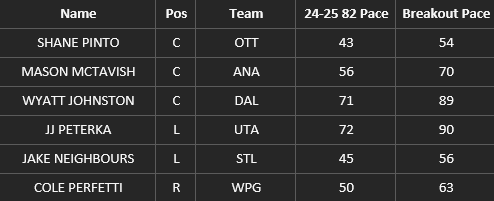
Today we are going to reflect on their seasons and see how they stack up to the projection.
Shane Pinto's breakout potential was projected at 54 points. His 82-game pace for 25-26? 52 points. I am going to call this one a win. It was always a question given Ottawa's centers what his actual deployment was going to be, but Pinto managed to play a career high 18:43 per game, with a decent chunk of second power-play time. He went on a couple of runs early in the season and as of the last write-up in February, I was concerned that the indications meant he would not be able to sustain a 50-point pace, but he did, and everything looks fairly reasonable. He has historically seen a lower team shooting percentage while he is on the ice so it is harder hard to tell whether he got a bit of good fortune here or if his situation improved compared to previous years, but either way, while Pinto didn't blow the doors off in 25-26 he provided some depth value and met his projection.
Mason McTavish had a 56-point pace in 24-25 leading to the projection of a 70-point 25-26. The reality was pretty far from that. In that initial article, and then again in February, the concern was all of the change that Anaheim was likely going to see. They brought in a new coach, a bunch of forwards, and had some other guys looking to take a step, so a very likely outcome was a different deployment than the successful second half that got McTavish on this list in the first place. That very much happened and not for the better. McTavish lost about a minute and a half on average, was not on the top power-play unit, dropped half a shot per game, and actually lost time as the season progressed. Overall, he landed at a 45-point pace, so he lost ground, and also was clearly passed on the depth chart by several players. It is very unlikely that there are significant changes to the forward core during the offseason, so there isn't currently a ton of optimism for a breakout next year.
Wyatt Johnston's 71-point pace in 24-25 was his third consecutive point increase and the projection was for yet another in 25-26, up to an 89-point pace. Johnston managed to keep the trend alive and improved yet again, putting up an 86-point pace. Again, we are going to count this one a win. Johnston played over 20 minutes a night on average, saw almost 75 percent of the team's power-play time, and scored a career high 45 goals. He did also see a career high shooting percentage but given 27 of his goals were scored on the power play, we should expect that shooting percentage to be a little higher than usual. There was a lot to like in 25-26 and no real reason to expect that he won't be able to do it again.
JJ Peterka went into the off season looking a lot like Johnston on the surface. He was coming off of a career high 72-point pace and was looking to break out even further. Unlike Johnston though, there were warning flags everywhere. Even last summer in that initial article the takeaway was that he would be lucky to repeat that 70-point season let alone improve upon it and the most likely outcome was a drop in production. Fast forward and Peterka finished the season with a 47-point pace. So much of this was predictable. His 24-25 scoring was inflated by a very high team shooting percentage and he was moving to a team where he was going to be just one of several potential scoring options. His deployment was a huge question mark, and he ended up dropping more than two minutes of ice time, about 20 percent of the team's power-play time, and below two shots per game in much more of a secondary scoring role for Utah. Honestly this pace feels about right until he gets a bigger opportunity.
Jake Neighbors matched his 25-26 season with a 43-point pace. That is all well and good for him, but not what we were hoping for. It is kind of a similar story to McTavish. There were reasons for optimism in his numbers, but they didn't take into account the full team context. There were new players moving up in the organization and Neighbors was clearly passed over by Dylan Holloway and Jimmy Snuggerud. Neighbors bounced around a bit in the lineup, but clearly the best place to be is with Robert Thomas and the top line of Thomas, Holloway, and Snuggerud was locked in post Olympic break. Overall he basically stayed even, dropping a little bit in shot rate and time on ice. We were right to look at St. Louis for a breakout, and Neighbors had something of the pedigree and experience in the organization, but the actual opportunity went to Holloway and Snuggerud.
Cole Perfetti is the single most disappointing player on this list. He is a 10th overall pick who has been slow to breakout, but was coming off a career high 50-point season, right as Nikolaj Ehlers departed providing a top power-play opening. A guy who was in the right ballpark for games played, was coming off a strong second half and career-high point pace, with a ready-made opportunity for increased deployment. It seemed too good to be true – it turns out it was. Perfetti was injured to start the season and then just never stepped into that role. When in the lineup he maintained similar deployment, and while he did increase his shot rates slightly, ended up dropping to a 39-point pace (his worst since his rookie year). He was consistently on a second line and second power play while guys like Gabriel Vilardi, Alex Iafallo, and Jonathan Toews got opportunities on the top line and top power play. Perfetti's ice time ticked up a bit toward the end of the season, and guys like Gustav Nyquist and Toews are not under contract at the moment, so maybe there is a chance for an increased role in the future, but the current outlook is not super optimistic.
That is all for this week.
Do your part to support organizations working to make hockey for everyone.
Professional Women's Hockey League
Related Posts
Starting Goalies









Top Skater Views
| Players | Team | |
|---|---|---|
| JACK QUINN |
 BUF BUF | |
| MASON MCTAVISH |
 STL STL | |
| T.J. HUGHES |
 COL COL | |
| QUINTON BYFIELD |
 L.A L.A | |
| FRASER MINTEN |
 BOS BOS
| |
Top Goalie Profile Views
| Players | Team | |
|---|---|---|
| JACOB FOWLER |
 MTL MTL | |
| SERGEI MURASHOV |
 PIT PIT | |
| DYLAN GARAND |
 NYR NYR | |
| JET GREAVES |
 CBJ CBJ | |
| CARTER HART |
 VGK VGK
| |
LINE COMBOS
| Frequency |
 PHI Players PHI Players
| |
|---|---|---|
| 23.3 | TREVOR ZEGRAS TYSON FOERSTER CHRISTIAN DVORAK | |
| 19.8 | SEAN COUTURIER MICHAEL BUNTING DENVER BARKEY | |
| 16.2 | MATVEI MICHKOV PORTER MARTONE NOAH CATES | |
DobberHockey Podcasts

Keeping Karlsson: Short Shifts – NHL Frozen Frenzy Recap
Elan and Lewis recap the Frozen Frenzy as well as two big returns and more!
Keeping Karlsson: Delusions of Garandeur
Elan and Brian dive into the latest NHL hot streaks, cold streaks, line changes, outjuries, injuries, buy-lows and sell-highs to give you top notch tips in your fantasy hockey league

Fantasy Hockey Life: TiDy Takes Part 2
Last week, Victor Nuno and Ryan Downey broke down trades from our top tier dynasty league. This week, they consider some dynasty trades from other divisions. Have a listen! Our show is part of the Dobber Podcast Network and sponsored by Fantrax.com. Email [email protected] and ask to join our free discord. Join our Patreon at […]
Keeping Karlsson: Matchup Maximizer 2026/27 Week 3
Elan takes a look at the schedule for the upcoming weeks of NHL action and recommends players with good schedules that you should consider streaming in to win your head to head matchups.
Keeping Karlsson: Short Shifts – Sharks Looked Like Celebweenies
Elan recaps the major injuries, outjuries, game results and changed line combos that we’ve seen since Sunday’s mega-show.