

Ramblings: Zegras Re-Signs; Evaluating Fantasy Value Increases or Decreases for Gauthier, Heiskanen, Point, Harley, and More – July 17
Michael Clifford
2026-07-17
The Philadelphia Flyers announced an extension for forward Trevor Zegras, signing him for four years at $9.125-million per season, a substantial raise on the $5.75-million AAV deal he just completed. Even with the rising cap, he goes from a 6% cap hit to an 8.8% cap hit, being paid as a top-50 player.
For fantasy managers in salary cap leagues, this is a tough pill to swallow. It isn't that this makes him instantly droppable, but if he's being paid as a top-50 player, it gives us a barometer for what he needs to do in fantasy to be worth it. To be a top-50 fantasy player, he needs to be a top-45 skater, assuming a half-dozen goalies (give or take) finish in the top-50. To be a top-45 skater in multi-cat formats, a forward who doesn't hit or block much like Zegras needs an 82-game pace approximating 35 goals, 55 assists, 25 power-play points, 260 shots, 60 PIMs, and 400 FOWs; the only threshold he's reached in any season of his career is the PIM total. Even in points-only leagues, a forward needs to be a 40/40 or 30/60 option to get into that range. It is a high bar.
It isn't hard to see some cap league managers hanging onto Zegras if they are saving a bunch of cap space elsewhere with entry-level deals or guys who signed a contract 3-4 years ago in a depressed salary cap era. Those will be infrequent situations though, and a 30-goal, 50-assist season may not be enough to recoup his cap hit.
*
Work continues on Dobber's 2026-27 Fantasy Hockey Guide, which is available now for pre-order in the Dobber Shop. This edition will include players projections, team-by-team outlooks, call-ups/rookies to monitor, category-specific draft targets, and whole lot more. The best part is because it is a digital edition, it is constantly updated right until the start of the regular season due to injuries, trades, role changes, or anything of the sort. Get a headstart on your league mates and help support what we do year-round by pre-ordering your copy today!
*
My last four Ramblings have covered skaters who had a sizeable gain or drop in fantasy value on a 60-minute basis in 2025-26 compared to 2024-25, and whether they'll decline or rebound in 2026-27. To this point, we have reviewed:
- Forwards whose fantasy value increased.
- Forwards whose fantasy value decreased.
- Defencemen whose fantasy value increased.
- Defencemen whose fantasy value decreased.
Today, we'll wrap up this series by evaluating forwards and defencemen with substantial improvements or declines that I didn't get to cover yet. There is only so much room in each article to write meaningfully about a player, and these are the interesting ones that just missed the cut in various categories.
A reminder that this is based on production per 60 minutes, is compared to players at the same position (forwards to forwards and defencemen to defencemen), and relative to the league-average replacement-level fantasy value. That would be roughly the overall fantasy value of a top waiver wire option in a 14-team league.
Among forwards, the stats are goals, assists, power-play points (PPP), shots, hits, blocks, penalty minutes (PIM), and face-off wins (FOW), though we may exclude FOW for wingers to put them on a bit more level playing field. The stats for defencemen are the same without FOWs, and all listed positions are taken from Yahoo.
Data for evaluations is from Evolving Hockey or Natural Stat Trick, unless otherwise indicated.
Let's start with the improvements.
Evgeni Malkin (Pittsburgh Penguins – C/RW)
It is unfortunate that Malkin missed 28 games because he had his first point-per-game season in three years. The missed time made him an unreliable fantasy asset despite such a large increase in his 60-minute fantasy value:
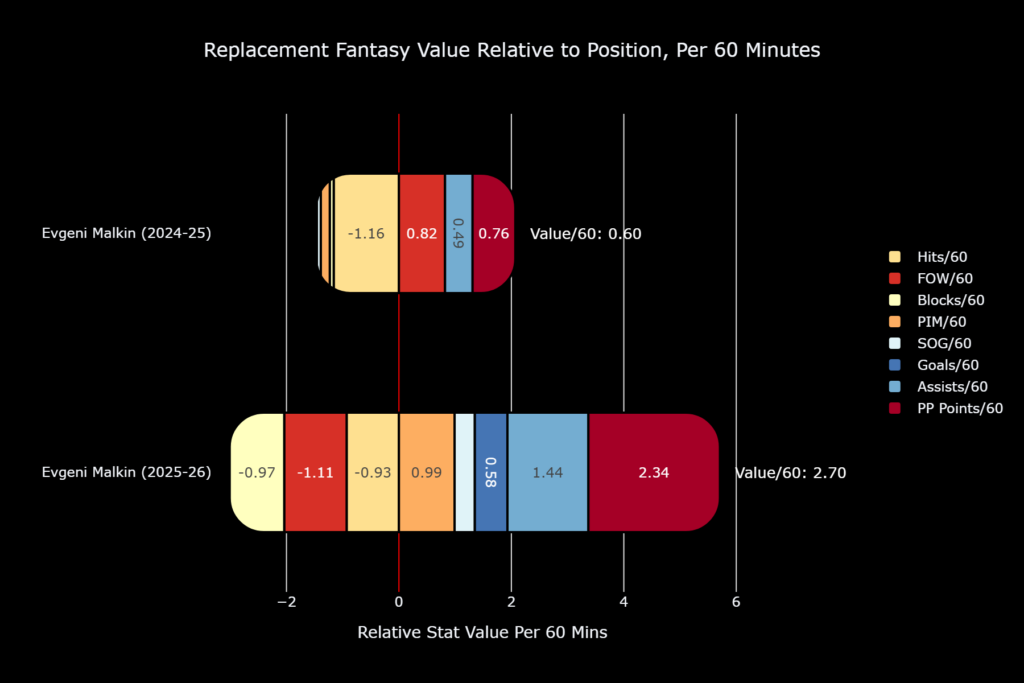
One of the reasons Pittsburgh had such a successful year was the power play, finishing top-10 in the league in PP goals per 60 minutes for the first time since 2022-23. Malkin managed 22 power-play points in just 56 games, another indicator of just how much fantasy value he could have had if he had played 75-80 games.
The big question is whether Pittsburgh will replicate last year's success or whether it was a last-gasp surge from their Hall-of-Fame core. All their key forward pieces, save Anthony Mantha, are returning, but there has been a lot of turnover on the blue line. How it all works together is an open question, and Malkin turns 40 years old in a couple of weeks. There should be faith that this team can keep up their offensive performance, especially if Ben Kindel takes another stride, but Malkin's inability to stay on the ice is a concern again. It makes it hard to draft him as a top-100 player.
Cutter Gauthier (Anaheim Ducks – LW/RW)
One reason to do analysis like this is to find things both unexpected and important. That is the case with Gauthier because, yes, him scoring 41 goals and finishing sixth in the league by shots is a big chunk of his fantasy increase. What is overlooked is where even more gains can be made, and that's in his block rate:
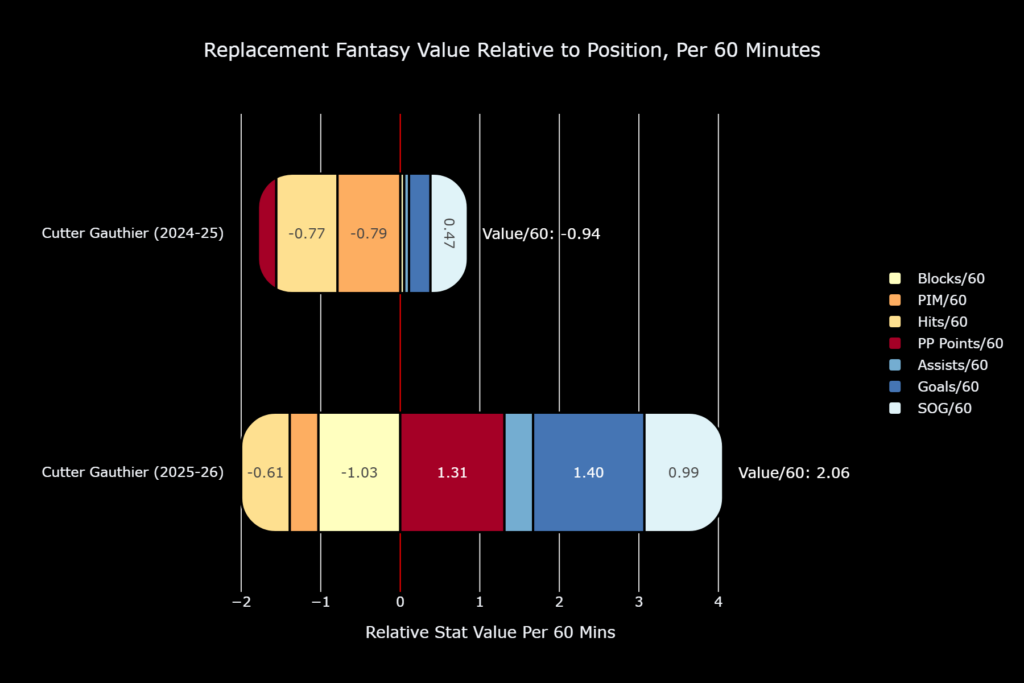
In 2024-25, Gauthier had 51 blocks in 1160 minutes, and that crashed to 20 blocks in 1312 minutes this past season. Had he held onto the same block value in 2025-26 that he had as a rookie, then he posts the second-largest increase in fantasy value per 60 minutes. I imagine that fantasy managers were perfectly happy trading 21 extra goals, 13 extra power-play points, and nearly 100 extra shots for the price of 31 blocks, but it shows how he can be (a lot) better in multi-cat formats even if his goal, assist, and shot totals remain static. He doesn't have the track record to say whether he will improve those blocks, but the fact that he's already done it gives some hope, and it isn't as if we haven't seen high-end goal scorers block a lot of shots before (Auston Matthews, Elias Pettersson, and Sam Reinhart come to mind).
Miro Heiskanen (Dallas Stars)
This is an instance where Obvious Answer Is Obvious, but Heiskanen's substantial leap in fantasy value was a function of power-play production, which boosted his goal and assist production:
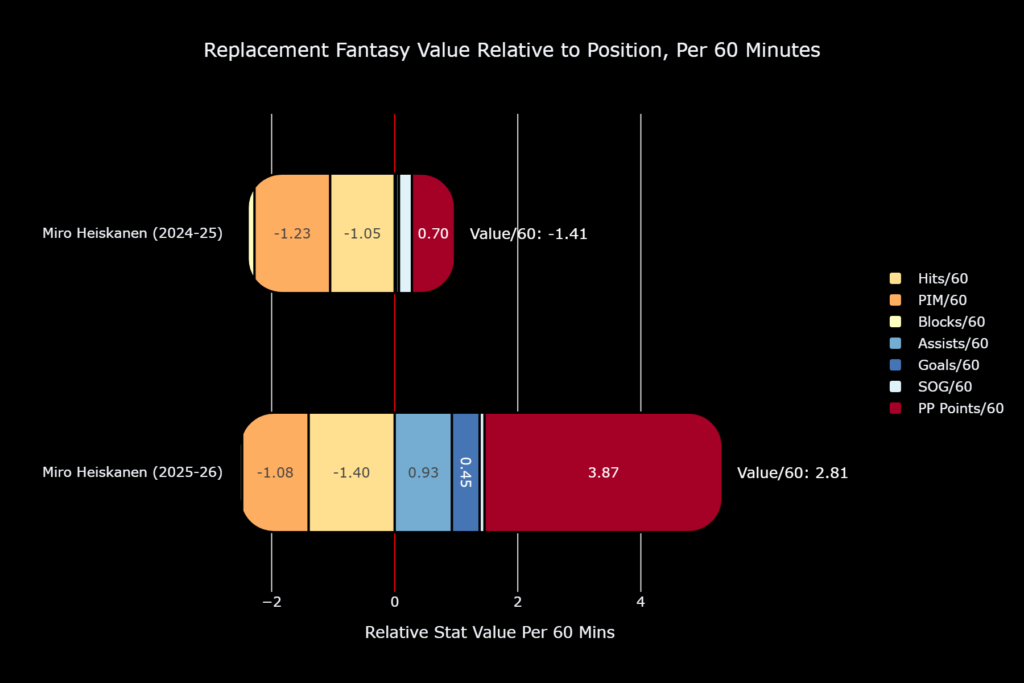
That huge production jump is nice, but it highlights the underlying issue with almost any fantasy defenceman: the power play. Over the last three years, Heiskanen has managed 1.2 points per 60 minutes at even strength, which is good but 30-35% worse than the elite offensive defencemen. That disparity shows up when we see how the gap in his PP production per 60 minutes between the two seasons (3.17) is larger than his overall fantasy value in 2025-26 (2.81). In other words, if he has modest PP production, it's very possible he's worse than replacement level on a 60-minute basis.
Of course, the reality is he has the top PP role in Dallas and he skates 25 minutes a game. Those two things help paper over a lot of other issues with his fantasy value. All the same, fantasy managers should keep in mind that Thomas Harley is still around and if the team ever makes a change, Heiskanen may not even be roster-able in smaller leagues.
Justin Faulk (Detroit Red Wings)
What does it look like when a 15-year veteran posts a career-high shooting percentage after averaging 3.8% across the prior three seasons? Glad you asked:
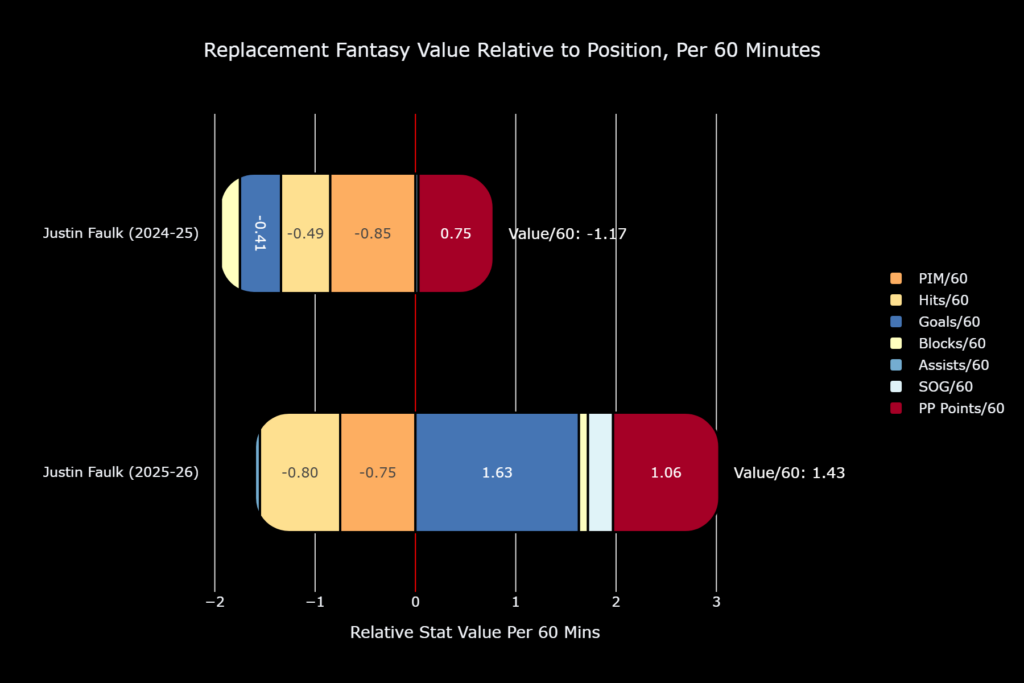
Nearly 80% of Faulk's improved fantasy output was due to the increase in goal scoring, but the fact he scored 16 goals in 78 games after scoring 17 goals in 220 games leading up to 2025-26 is the giant red flag here. Beyond the goal-scoring decline he'll face in 2026-27, there are other red flags.
Last year, the Red Wings scored 2.13 goals per 60 minutes at 5-on-5, the third-worst rate in the league. The year before, they scored 2.08 goals per 60 minutes at 5-on-5, also the third-worst rate in the league. Put it all together and Detroit has arguably the worst 5-on-5 scoring environment of all 32 teams (the Vancouver Canucks are probably worse). Faulk also had nine PPPs last year, which is nice, but he had zero with Detroit and all non-Moritz Seider Red Wings blue liners combined for eight PPPs. A loss in PP role with his new team, combined with the goal drop, is bad news for his fantasy value in 2026-27.
Alright let's move on to some of the decreases in value.
Brayden Point (Tampa Bay Lightning – C)
Whether we include face-off wins or not, on a 60-minute basis, Point had one of the five worst fantasy declines in 2025-26:
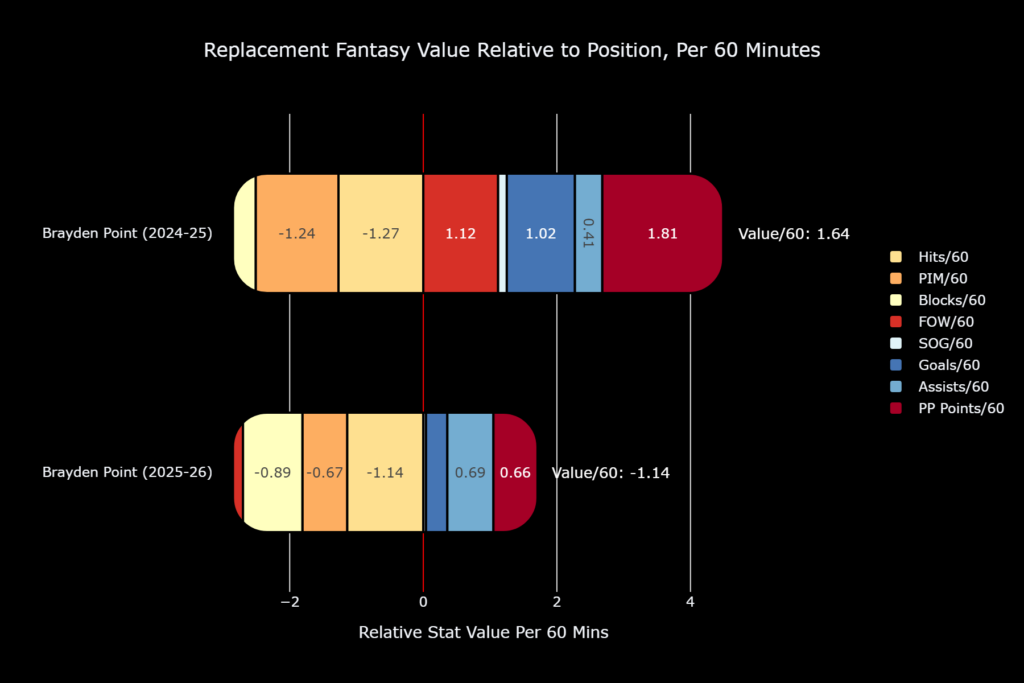
The big power-play decline stands out, but the reason why that's important is if every other category had remained the same, but his PPP value in 2025-26 held over from 2024-25, he's basically a replacement-level fantasy forward. That is the biggest issue with Point and players like him: relying on hyper-efficiency can bring great seasons, but when that efficiency disappears, there is no foundation to keep their fantasy value from plummeting. If Point isn't skating 19-20 minutes a game and shooting over 20%, he is not a good fantasy asset.
Even if his percentages rebound, we have to wonder about the ice time. He has now seen a TOI decline in two straight seasons, dropping 1:47 per game in that span. In a full season, that is nearly 150 fewer minutes of ice time which, depending on his point rate, could cost him 8-9 points in a season. Without the peripherals necessary to float his fantasy value, Point is now a very risky fantasy option.
Kent Johnson (Columbus Blue Jackets – C/RW)
Following up a breakout 2024-25 season, Johnson is In a similar vein to Point, because this is what it looks like when a player who relies on point production for multi-cat value doesn't get the point production:
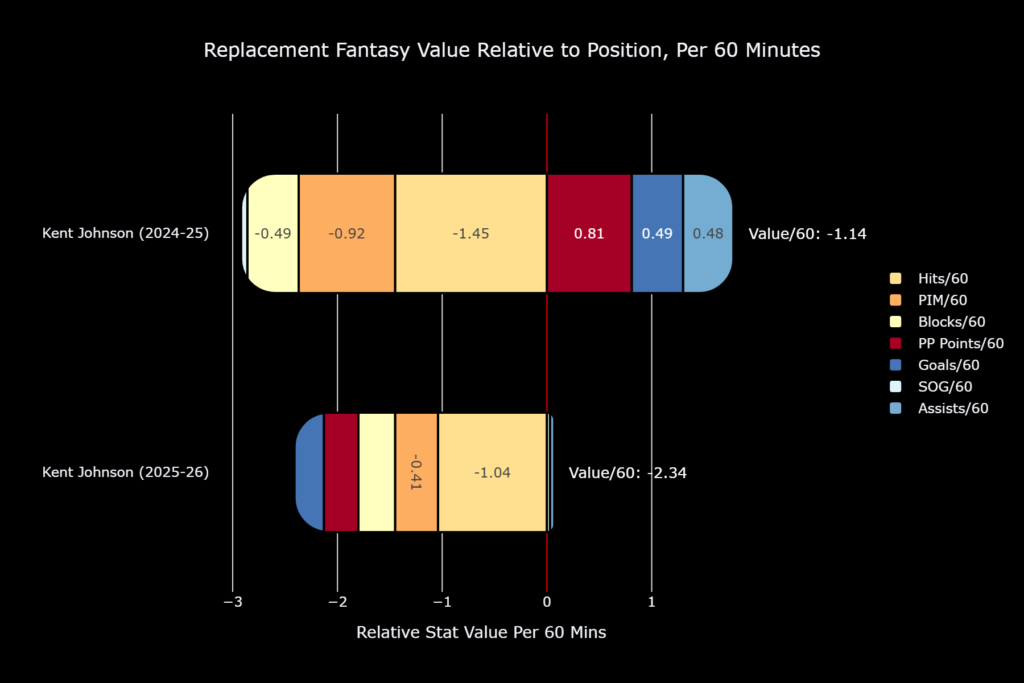
The interesting part is that despite the goal, assist, and PP declines, Johnson saw increases in value from shots, blocks, hits, and PIMs. He didn't have a positive value in any of those four peripheral categories, but he did have improved value. Skaters are almost never above average in all seven fantasy categories (only one forward last year was above average in 6/7 categories and it was Justin Brazeau), so turning a glaring weakness into a modest weakness matters.
It all comes down to the power play. If Johnson can secure the fourth-forward role on Columbus' top PP unit, he can have a significant rebound. If he doesn't secure that role, then he won't. If anyone reading this has a crystal ball and knows what Johnson's PPTOI total will be next season, let me know.
Thomas Harley (Dallas Stars)
Because we wrote about Heiskanen's massive fantasy improvement earlier, it's only right we look at the other side of the equation to see what happened with Harley:
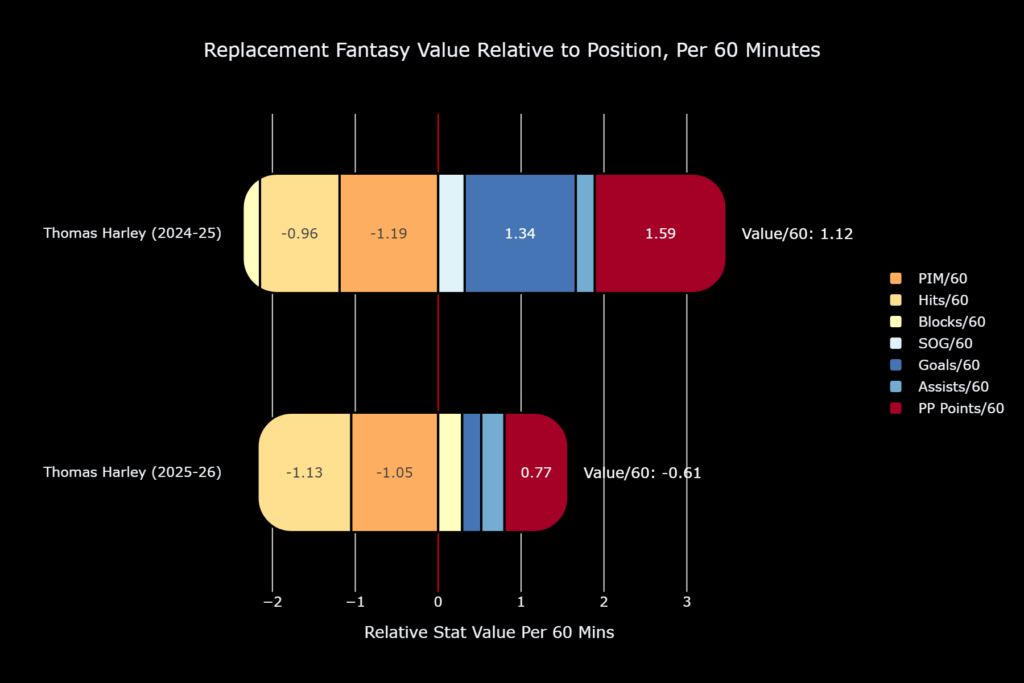
This is an instance where we have to believe in a bounce-back of some sort. After shooting over 10% at even strength in his first two full seasons, Harley's conversion rate crashed to 5.1% this past season, cutting his potential goal total in half. That difference in goal-scoring fantasy value was the difference between being a top-45 defenceman on a 60-minute basis and a top-60 defenceman.
Outside of the goals, the loss of a real chance at the top PP unit is the kick in the stomach. Just putting up 15 PPPs, which isn't a high-end total, with a goal-scoring rebound would mean he's a top-35 defenceman per 60 minutes, and probably top-25 in actual fantasy value. But if the Dallas power play is anywhere near as good as it was last year, there's no reason to move Harley to Heiskanen's spot. It means Harley can be a top-30 fantasy defenceman in overall value, but that's about as good as it will get.
Alex Vlasic (Chicago Blackhawks)
To quickly touch on a blue liner for whom I had high hopes but now those hopes are completely dashed, here's what happened to Vlasic:
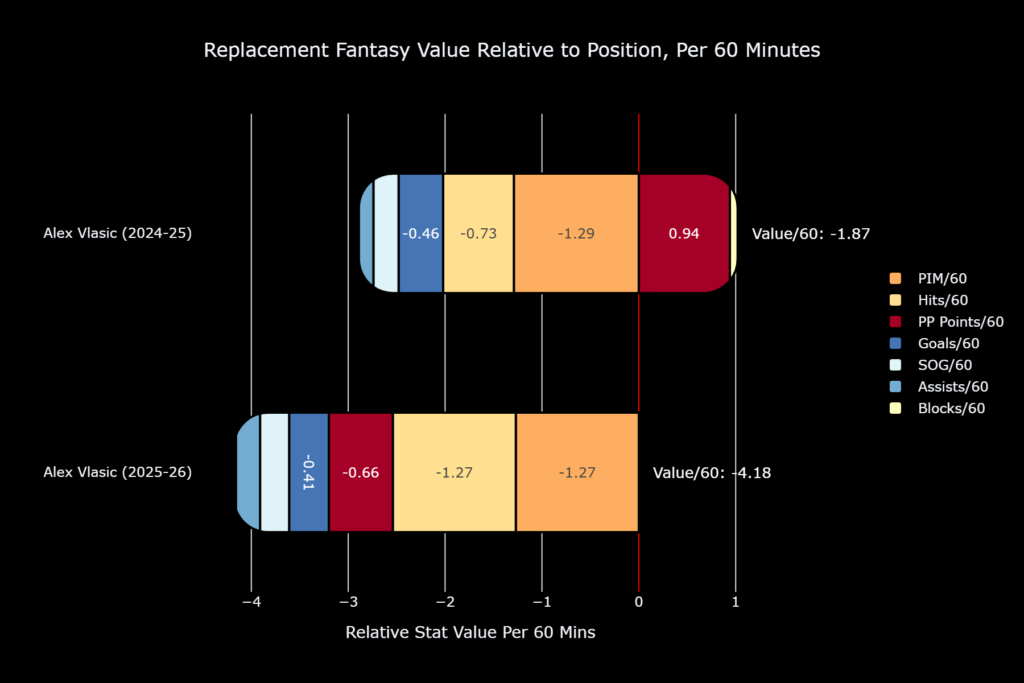
Among the 159 defencemen in our sample, Vlasic was 1 of 14 at the position to provide negative value in every category. Just looking at the 2025-26 season, the only defenceman who had worse fantasy value on a 60-minute basis than Vlasic was Cody Ceci. That is… not good company.
The reason I had faith in Vlasic is I thought he'd become a big minutes-eater as the Blackhawks improved offensively. A blue liner who can post 30 points with 100 shots, 125 blocks, and 50 hits is valuable in multi-cat formats. However, with the trade for Bowen Byram, the (hopeful) ascensions of Artyom Levshunov and Sam Rinzel, and the injury to Connor Bedard, there is not much reason to hope for any substantial fantasy improvement from Vlasic.
Related Posts


Starting Goalies







Top Skater Views
 DET
DET STL
STL CHI
CHI BOS
BOSTop Goalie Profile Views
 EDM
EDM NYR
NYR MTL
MTL WSH
WSH S.J
S.J

LINE COMBOS
| Frequency |
 CGY Players CGY Players
| |
|---|---|---|
| 17.0 | RYAN STROME MARTIN POSPISIL MATVEI GRIDIN | |
| 15.7 | AYDAR SUNIEV MORGAN FROST MATT CORONATO | |
| 11.0 | MAXIM TSYPLAKOV ADAM KLAPKA JONATHAN CASTAGNA | |
DobberHockey Podcasts

Keeping Karlsson: Short Shifts – NHL Frozen Frenzy Recap
Elan and Lewis recap the Frozen Frenzy as well as two big returns and more!
Keeping Karlsson: Delusions of Garandeur
Elan and Brian dive into the latest NHL hot streaks, cold streaks, line changes, outjuries, injuries, buy-lows and sell-highs to give you top notch tips in your fantasy hockey league

Fantasy Hockey Life: TiDy Takes Part 2
Last week, Victor Nuno and Ryan Downey broke down trades from our top tier dynasty league. This week, they consider some dynasty trades from other divisions. Have a listen! Our show is part of the Dobber Podcast Network and sponsored by Fantrax.com. Email [email protected] and ask to join our free discord. Join our Patreon at […]
Keeping Karlsson: Matchup Maximizer 2026/27 Week 3
Elan takes a look at the schedule for the upcoming weeks of NHL action and recommends players with good schedules that you should consider streaming in to win your head to head matchups.
Keeping Karlsson: Short Shifts – Sharks Looked Like Celebweenies
Elan recaps the major injuries, outjuries, game results and changed line combos that we’ve seen since Sunday’s mega-show.