

Ramblings: Finding Useful Stats for Predicting Goal and Point Production Among Forwards – August 6
Michael Clifford
2026-08-06
The Analytics Era of the NHL – or since the 2007-08 season – has seen the game adopt new ways thinking about offence and defence, new ways to evaluate performance, and new ways to predict future results. Many fans don't care about any of this, and they don't have to. In the end, any pro sport is an entertainment product, and a lot of people just want to sit on their couch, grab some snacks, and yell about how much the referees suck. It's universal.
However, if fantasy managers want to figure out what kind of production a player can really provide, it's important to understand some of the Analytics Era stats, what they mean, and how well (or not well) they can predict future production. We will do this today using tracking data from All Three Zones and player data from Evolving Hockey from the 2023-24 and 2024-25 seasons, and see what happened the following seasons. Between the tracking and standard player data, we are using 18 different (hopefully) predictive stats. All data is at 5-on-5, which excludes a lot of situations where players rack up points, but it points us in the direction of players with good puck skills, and those translate to other areas. We are limiting the sample to forwards with at least 500 overall minutes at 5-on-5 in a season and 100 tracked minutes in the same season.
We are going to split by positions because what is important to forwards and important to defencemen is not always the same thing. For today, we'll focus on the forwards.
Points
It would be easy to assume that a forward's point production from one season carries well to the next. Assumptions are a dangerous thing but, in this instance, that is not a bad one to make. Across all our stats, here is where a player's points per 60 minutes ranks by correlation to point production in the next season:
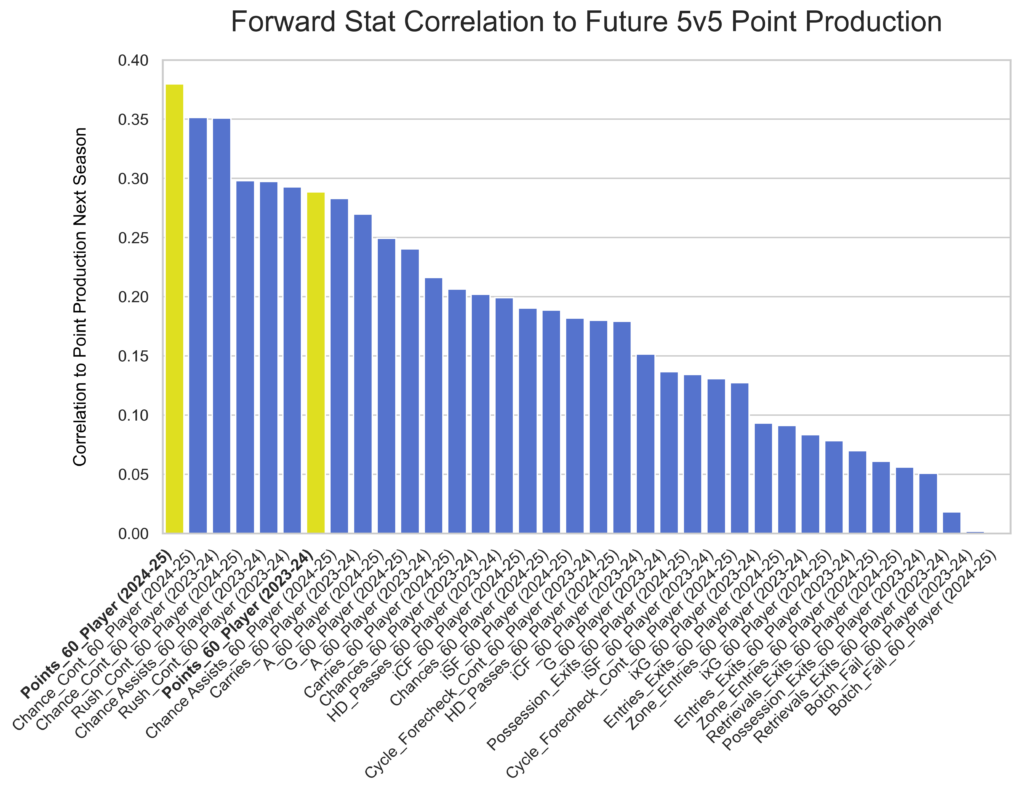
As far as hockey is concerned, getting a correlation between 0.29 and 0.39 in back-to-back seasons is not bad at all. Indeed, if we want to predict how well a forward will produce in the following campaign, seeing how they did the year before is one avenue to explore.
The only players who get points on a goal are those who have one of the final three touches on the puck. There are players who carry the puck with frequency but don't rack up points (he's a defenceman, but Philip Broberg has this problem, and I wrote about that on Tuesday), so getting involved in the offensive zone is crucial. To approximate involvement in goals, we are going to again use the tracking data to combine individual scoring chances with assists on teammate scoring chances into one stat: Chance Contributions. Here is how those Chance Contributions correlated to future point production:
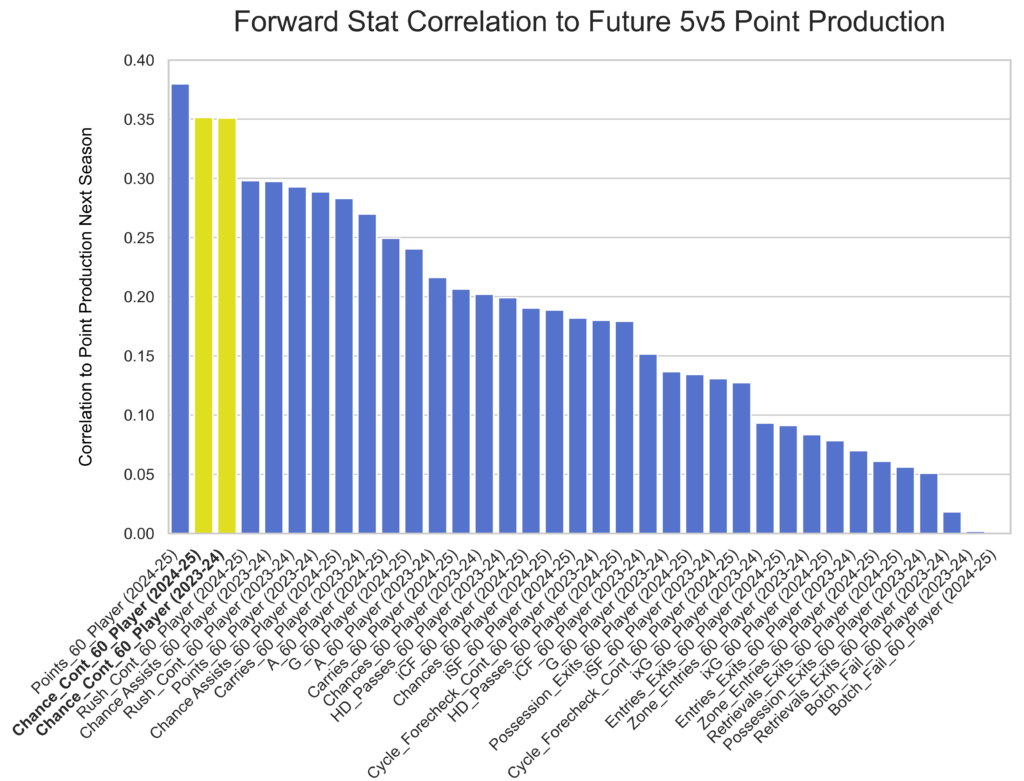
This is telling. There are a number of elite names on this list including Nathan MacKinnon, Connor McDavid, Macklin Celebrini, Leon Draisaitl, Jack Hughes, Jack Eichel, Nikita Kucherov, Auston Matthews, Alex DeBrincat, William Nylander, and Clayton Keller. It isn't much of a surprise that the elite fantasy forwards get involved in plenty of scoring chances year after year, but it's that we don't really see non-productive forwards get involved that much. We might figure that some good forwards on bad offensive teams would be anywhere near the top but that just isn't the case.
One component of the Chance Contributions we just looked at are assists on a teammate's scoring chance. A player's actual assist total is often the largest portion of their actual point production, so we might assume that assist rate in one season correlates well to point production in the next. It does, but the curious thing is that the scoring chance assists from the tracking data correlates better to future point production than a forward's actual assist rate:
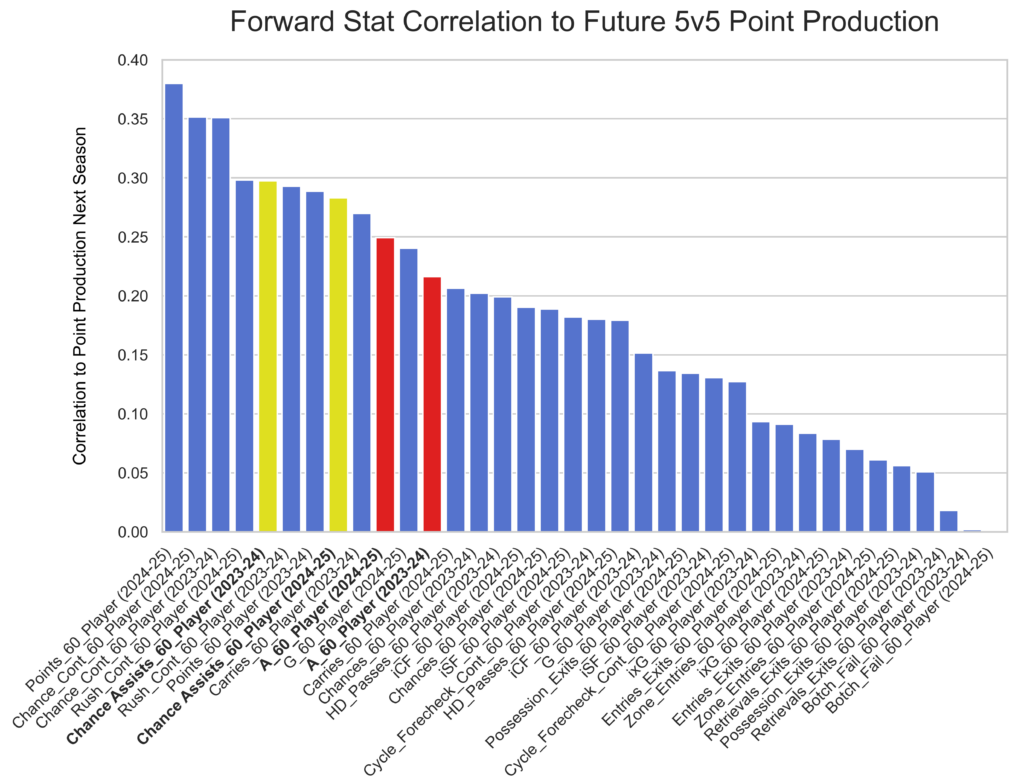
This is kind of startling, but keep in mind that a forward's assist rate can vary quite a bit because of some randomness in secondary assists. The tracking data's chance assists don't have that same kind of randomness. This type of finding is exactly why doing this kind of analysis is valuable, and why it should be done each offseason.
So far, this all makes sense, but here is where things get more interesting. Exactly how a forward generates their offence matters.
All Three Zones splits 5-on-5 offence into two categories: off the rush and off the cycle/forecheck. In my newsletter back in June, I wrote about how teams who increased their offence off the rush in 2025-26 found a lot of success, including the Stanley Cup-winning Carolina Hurricanes. Being good at both is a real path to success – Draisaitl, Hughes, Celebrini, and Kucherov are examples of this – but if we want our players producing points, we'd rather have them creating a lot off the rush (yellow) than off the cycle/forecheck (red):
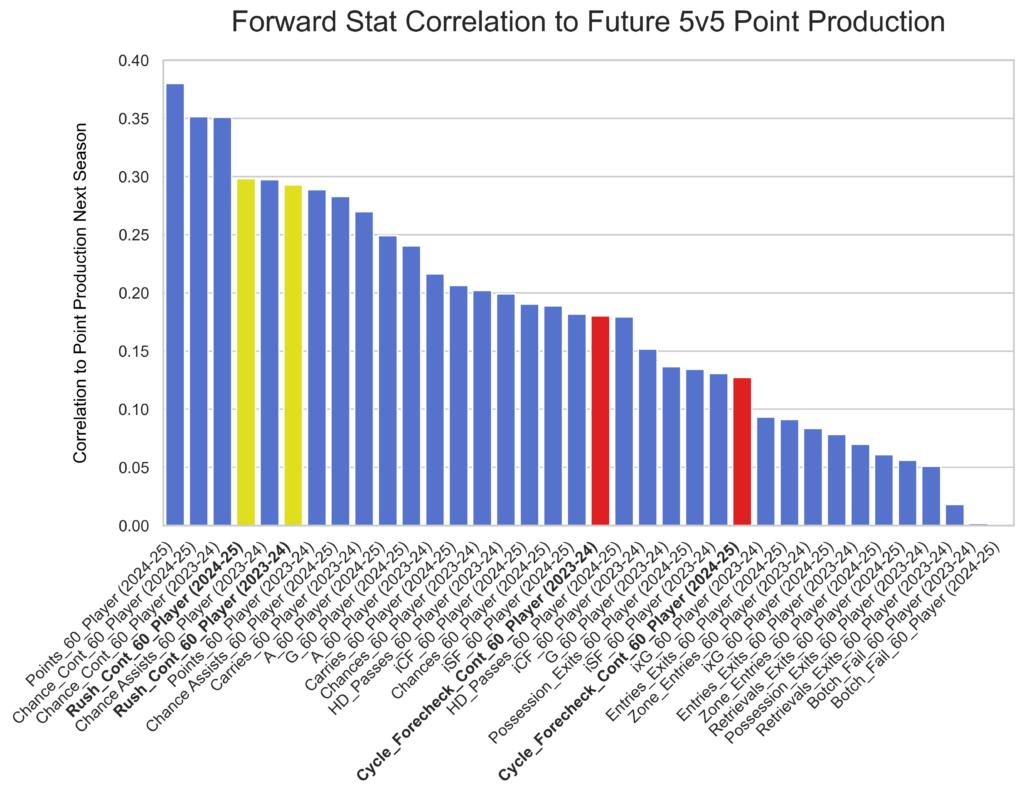
Not only did generating off the rush better correlate to future points for forwards than generating off the cycle/forecheck in each of the last two seasons, the red bar furthest to the right was the 2024-25 season with production in the 2025-26 season. It was a negligible measure, and correlated worse to point production the next year than a player's shot rate from two years ago. I will repeat that you should get you a man who can do both, but falling short of that, if we want to focus on point production, we want those counter-attacking players.
Goals
For fantasy leagues, points are one thing, but goals are something else entirely. Not only are they much rarer than most categories, but in points formats, they can be incredibly valuable. Goals include shots, so generating one automatically means generating the other, and getting two birds stoned at once is a shortcut to finding fantasy value.
Something I used to believe was that if we look for shot volume, we'll find goals. That isn't an awful way to approach things, but it's not the best way, and for that we'll return to the tracking data. We will highlight chance contributions in red, rush contributions in green, and the rate of shots on goal in black. Here is how those three things correlated to future goal scoring from 2023-24 to 2024-25 and from 2024-25 to 2025-26:
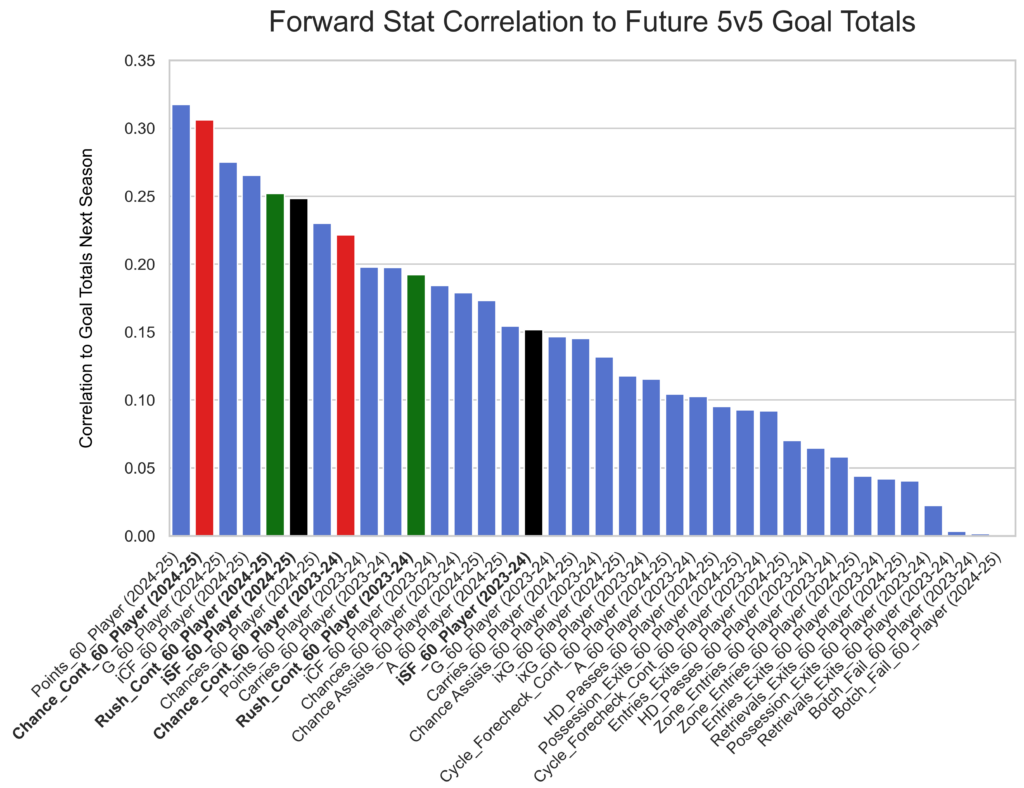
In each of the last two seasons, both scoring chance contributions and rush contributions out-performed shot volume in predicting future goals for their respective campaigns. It is an interesting development: both scoring chance and rush contributions see a big portion of their value come from assists on chances or rush shots, but the overall contributions correlate better to future goal scoring than just shots on goal. Kind of neat, actually.
But with the Analytics Era, we can adjust shot volume to create Expected Goals, which approximates shot quality. Surely, if we figure out who is creating the most expected goals, we can figure out who will create the most actual goals in the future, right? If only hockey were so obvious. Below is the future correlation to goal scoring by rate of individual expected goals:
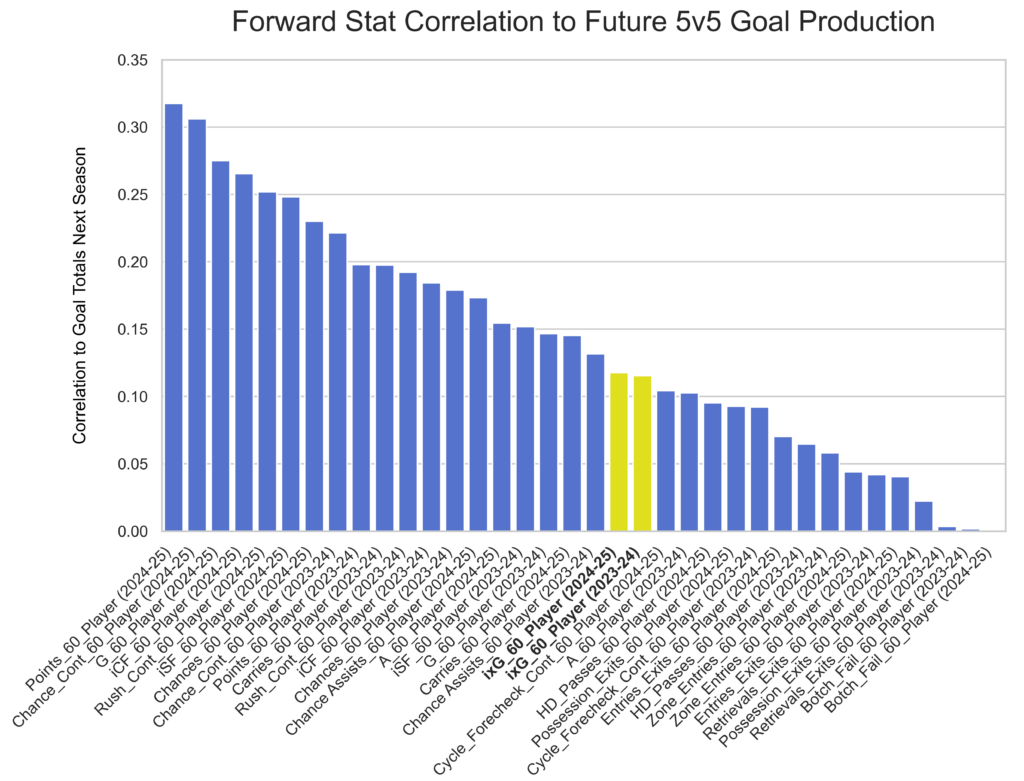
It should be noted that the NHL leaned all the way into puck-chip tracking in the 2023-24 season, and that changed expected goal values depending on the shot. This was written about by CJ Turtoro and Aaron K. Go read those analyses to see what the changes mean and why it's important.
Regardless of those changes, a forward's individual expected goals rate did not tell us much about their future goal scoring. On balance, for the two seasons we're looking at, we were better off looking at shot rate than expected goals rate, but the tracking data exceeded them both by a wide margin.
There is an interesting quirk with the actual goals, too. We might expect that a player's goal rate one season explains a big portion of their goal-scoring the following year. That was true for 2024-25 to 2025-26, but not for the prior pair of seasons:
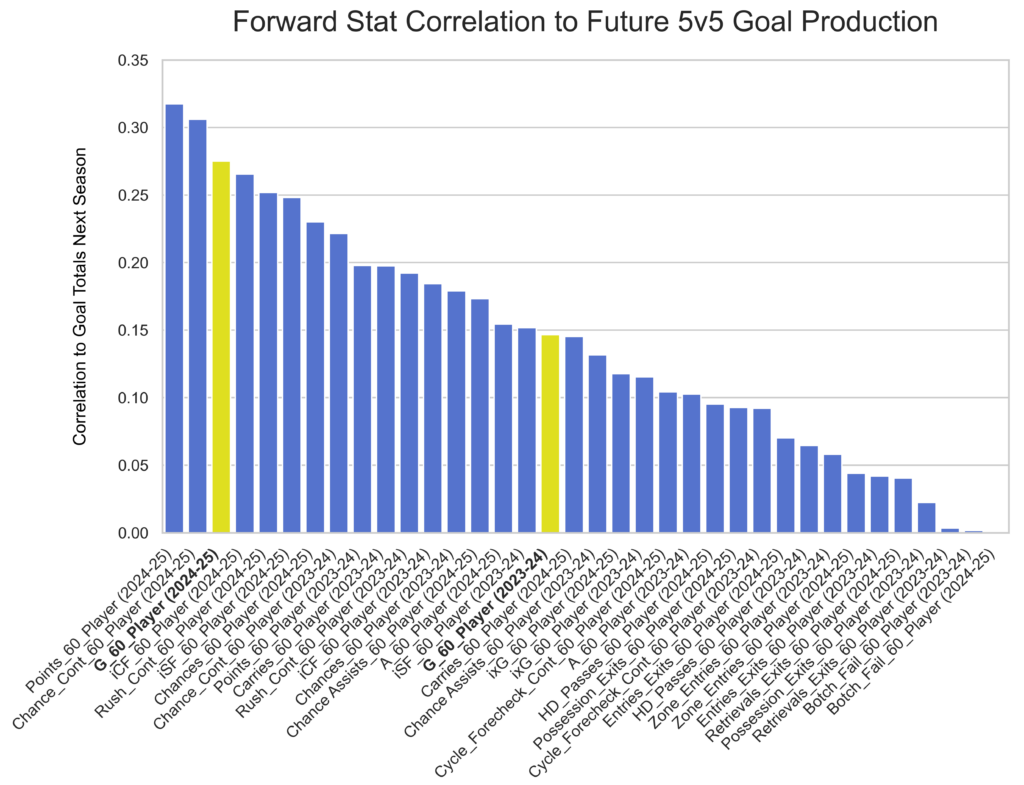
Remember that this is just 5-on-5, and there are ways to make up for a declining 5-on-5 goal total. Jake DeBrusk has seen his 5-on-5 scoring rate collapse these last two years, but he is also tied for the second-most power-play goals scored in that span. It is why his 82-game goal-scoring total over the last two years has stayed consistent. He is also one of the exceptions, and I wouldn't want to rely on my fantasy draft pick scoring 14-19 power-play goals to maintain his fantasy value.
A fantasy manager looking to find future goals and points should avoid pointing to one stat and telling themselves that's all they need to know. While a few specific tracking data points were highlighted today, there are several that have varying levels of value. It should also hammer home the idea that it's not enough to know there are other useful stats. We have to sort out what we should focus on and how much we should care about it. There are several useful stats, but some are more useful than others.
Related Posts


Starting Goalies



Top Skater Views
 S.J
S.J L.A
L.A SEA
SEA ANA
ANA


Top Goalie Profile Views
| Players | Team | |
|---|---|---|
| CARTER HART |
 VGK VGK | |
| DAN VLADAR |
 PHI PHI | |
| SERGEI MURASHOV |
 PIT PIT | |
| LOGAN THOMPSON |
 WSH WSH | |
| JOEL HOFER |
 STL STL
| |
LINE COMBOS
| Frequency |
 COL Players COL Players
| |
|---|---|---|
| 15.5 | NATHAN MACKINNON ARTTURI LEHKONEN GABRIEL LANDESKOG | |
| 10.6 | JOEL KIVIRANTA PARKER KELLY JACK DRURY | |
| 9.8 | BROCK NELSON MARTIN NECAS NAZEM KADRI | |
DobberHockey Podcasts

Fantasy Hockey Life: New Jersey Devils with James Nichols
James Nichols joins the program to discuss the New Jersey Devils. Jesse and Victor ask about pros Jack Hughes, Jesper Bratt, Nico Hischier, Timo Meier, Connor Brown, Arseni Gritsyuk, Anthony Mantha, Dougie Hamilton, Luke Hughes, Jake Allen, David Rittich, and Nico Daws. In Cat’s instincts, Cat Silverman of InGoal magazine joins to discuss prospect goalies […]
Fantasy Hockey Life: Nashville Predators with Emma Lingan
Emma Lingan joins the program to discuss the Nashville Predators

Keeping Karlsson: The 2026-27 Keeping Karlsson Breakfast Club
Don’t you forget about them! Elan and Brian remind you of at least one player on each NHL team whose name you might forget to consider at the draft table.
Fantasy Hockey Life: Tampa Bay Lightning with Erik Erlendsson
Erik Erlendsson joins the program to discuss the Tampa Bay Lightning. Jesse and Victor ask about pros Nikita Kucherov, Jake Guentzel, Brandon Hagel, Brayden Point, Anthony Cirelli, Ilya Mikheyev, Gage Goncalves, Conor Geekie, Benjamin Rautiainen, John Carlson, Victor Hedman, Charle-Edouard D’Astous, Andrei Vasilevskiy, Jonas Johansson, and Dennis Hildeby. In Cat’s instincts, Cat Silverman of InGoal […]
Fantasy Hockey Life: New York Rangers with Colin Stephenson
Colin Stephenson joins the program to discuss the New York Rangers.