

Ramblings: Merzļikins Injured; Projected Goal and Shot Increases for Quinn Hughes, Fox, Forsling, Broberg, Chabot, and Liljegren – August 21
Michael Clifford
2026-08-21
We don't get a lot of important fantasy hockey news in the middle of August, but Aaron Portzline reported that Columbus Blue Jackets goalie Elvis Merzlikins underwent shoulder surgery. The team said he'll be re-evaluated in a few weeks to see when he can return to the ice.
A few weeks from now would be right as training camp is starting, so depending on the nature of the surgery, it's not impossible that Merzļikins will get back in time for the regular season. Hold steady until we get further notice, but this is great news for Jet Greaves' fantasy value because he can rack up starts in October and maybe even lock down a full-time starting workload.
*
In my Ramblings yesterday, I started going through my projections and discussed some forwards projected to have significant increases to their goal and shot totals at even strength. Today, we'll look at the same thing but for defencemen.
The even-strength outlook does not include rookies, and it does not include empty-net situations. Those will be added a bit later once I have my first pass across all positions and strengths completed. Also, these will be refined a bit further in the coming weeks, so there will be changes, and some of them potentially significant. This is just a first glance at what my projections have spit out.
We are taking each defenceman's pro-rated 84-game goal and shot production in 2025-26 and comparing that to their 84-game projection for 2026-27. These are my personal projections using data from Evolving Hockey, All Three Zones, and Frozen Tools.
***
Be sure to grab a copy of Dobber's 2026-27 Fantasy Hockey Guide, which is available now in the Dobber Shop! It has team-by-team outlooks, a customizable draft list including projections, a breakdown of the new schedule, players to target for peripheral stats, sleeper picks in each conference, and a whole lot more. It is also updated until the start of the regular season to reflect new signings, trades, injuries, or anything else. Support what we do year-round and get a headstart on your league mates by ordering the 2026-27 Fantasy Guide in the Dobber Shop!
***
In the following graphs, the red lines are the average changes for each stat. The yellow dots represent defencemen who's projected 84-game goal and shot differentials are in the top 25% compared to last season, and the blue dots are defencemen who fall short of that mark in at least one of the stats, if not both.
Quinn Hughes (Minnesota Wild – D)
The headliner is the eldest Hughes brother whose projected jump in EV goals is nearly two full goals higher than the next-closest player. He is also projected for a substantial leap in his EV shot volume, and that puts him pretty much in a tier of his own:
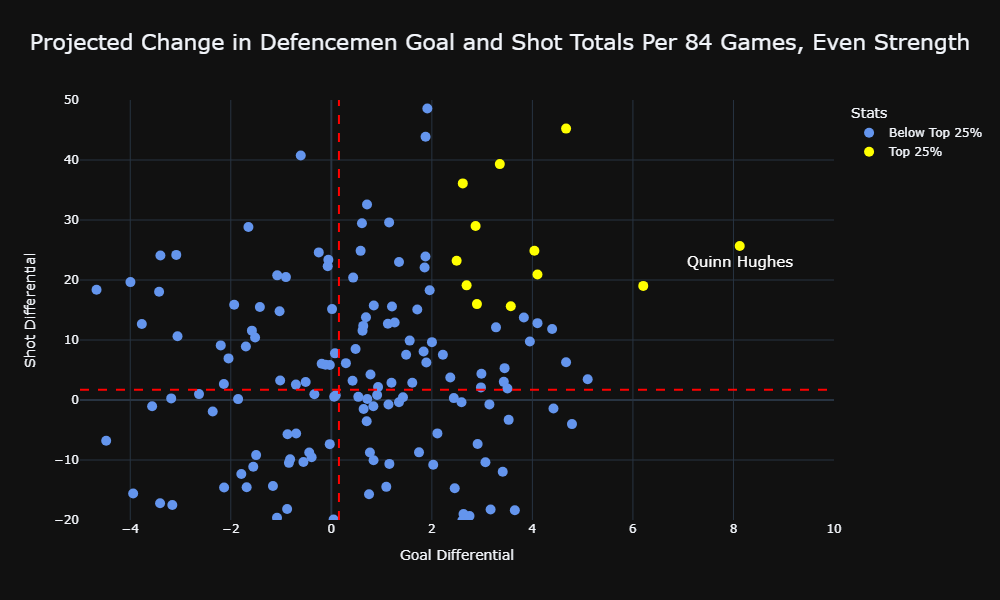
In the two seasons from 2023-2025, Hughes shot 7.7% at even strength. In 2025-26, that was more than halved, dropping all the way to 3.6%. That alone cost him six goals, so if he puts up 13 goals in 74 games rather than the seven goals he actually scored, he wouldn't be on this list. All that aside, his usage rate in Minnesota was preposterous, skating 1:33 per game more at even strength than the next-closest defenceman in the league after his trade. Even if I do have some concerns about his per-minute shot volume, skating 23-24 minutes a game at even strength alone does a lot to alleviate those concerns.
Overall, my projections have Hughes for over 60 EV points in 2026-27, a feat only accomplished once in the last 19 years (Erik Karlsson in 2022-23). Even if we pro-rated that to an 82-game schedule, he'd still crest that 60-point mark. Anytime a projection gives me something that would be a genuine outlier, I have concerns. However, my general rule is that I bet on outlier projections from outlier players, and Hughes is an outlier player both in skill and in usage. A decline in usage would be a problem, but if I had to bet on any non-Cale Makar defenceman to have a 90-point season, it's Hughes.
Adam Fox (New York Rangers – D)
Hughes is projected to have the largest increase in EV goal total, but Fox is the next guy behind him, which is kind of fitting given their comparisons throughout their careers. The added goals from Fox also come with nearly an extra 20 shots at even strength:
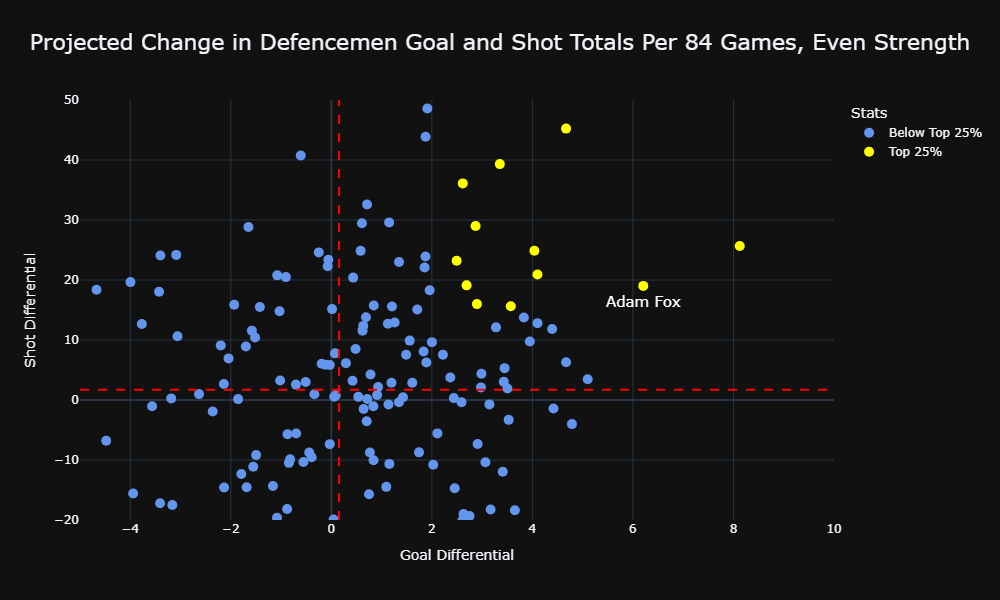
Over two seasons from 2023-2025, Fox shot 9.3% at even strength. This past season that crashed to an abysmal 3.2%. Had he shot his normal rate, he would have had 13 goals and 57 points in 55 games. He also saw his per-minute shot rate decline about 15%. Upticks in both areas is why he's projected for far more goals and shots per 84 games in 2026-27 than in 2025-26.
If my projections are anywhere near accurate for Fox, there is a real possibility he posts his first 80-point season, and that would be the case whether they were playing 82 or 84 games. The problem is staying on the ice. Top-end players need full seasons to reach their full potential, which may seem obvious, but even missing 8-10 games gives their fantasy value a sizeable haircut. All the same, there are a handful of defencemen who can genuinely push for point-per-game status, and Fox is one of them. It is just a shame he typically doesn't have stout peripherals because that dings him in multi-cat leagues.
Gustav Forsling (Florida Panthers – D)
With all the injuries the Panthers suffered last season, we can pretty much throw out their production results. We will have to compare the projections to something, though, and the projections believe Forsling's goal and shot totals will bounce back in a big way:
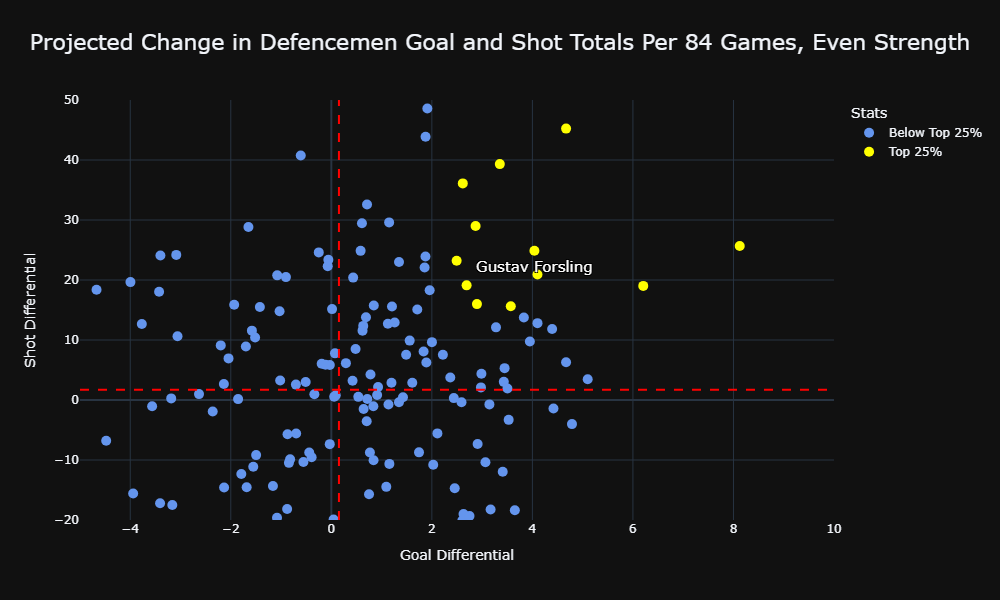
As with many Panthers last year, Forsling saw a substantial decrease in his goal and shot volume, and the projections believe those things will rebound. That isn't a big surprise given how much depth Florida has up front; no matter which of the top three lines Forsling is on the ice with, he'll be skating with current superstars or future Hall of Famers, or both. It isn't to say that Forsling will pop and put up career-best outputs or anything, but after posting 2 goals and 26 assists last year, he should be close to the 10-goal, 30-assist marks that he's capable of.
The important part here is that Forsling is still the team's top defenceman. Seth Jones will likely eat the top PP time, but Forsling will soak up the most even-strength minutes, the most short-handed minutes (not a bad thing on a team with Aleksander Barkov and Sam Reinhart), and that role security gives him some fantasy security. He can post 10 goals, 30 assists, 150 shots, and 100 blocks, and that kind of category coverage makes him a solid multi-cat fantasy asset.
Philip Broberg (St. Louis Blues – D)
A couple of weeks ago, I wrote about some traits that make Broberg an excellent real-life defenceman, a capable fantasy option, but a blue liner who will struggle to take a big leap in fantasy value. That is why it was interesting seeing him on our list with one of the biggest shot increases and a notable goal increase:
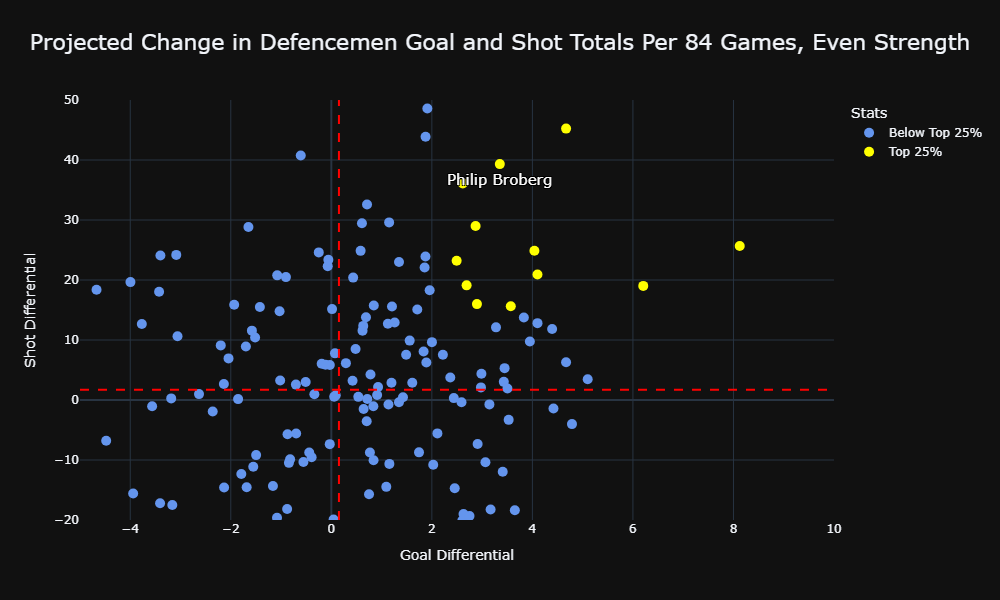
In his first full season with the Blues, Broberg managed 4.5 shots per 60 minutes at even strength. This past season, that fell to 3.1. That is a decline of 31% and getting back to that level would account for two-thirds of the projected increase. The rest of the increase comes from him surpassing the 200-game mark last year, entering his age-25 season, and a modest improvement from the Blues as a team. When we break down why the jump in shot volume is so big, it all makes sense.
This is why fantasy hockey is a fascinating endeavour. My Ramblings a couple weeks ago highlights why Broberg could struggle to take a leap in fantasy value. These projections tell another story. When I checked the Dobber Fantasy Guide, his 84-game shot pace was 118; last year his 84-game pace was for 102. The Guide thinks there will be a jump, my projections think that leap will be much bigger, so there is a bit of overlap, which is nice. He might see an uptick, but he won't be a highly impactful fantasy player until he has a regular top PP role and the Blues power play gets back anywhere close to league average.
Thomas Chabot (Ottawa Senators – D)
As with others we saw on this list, Chabot saw a substantial decline in his shot volume in 2025-26. At even strength, he managed just 4.2 shots per 60 minutes against 6.3 shots/60 the year before and 6.0 across the two seasons from 2023-2025. That decline from his two-year average is nearly 30%, and returning close to that level makes up a big chunk of his projected shot volume increase:
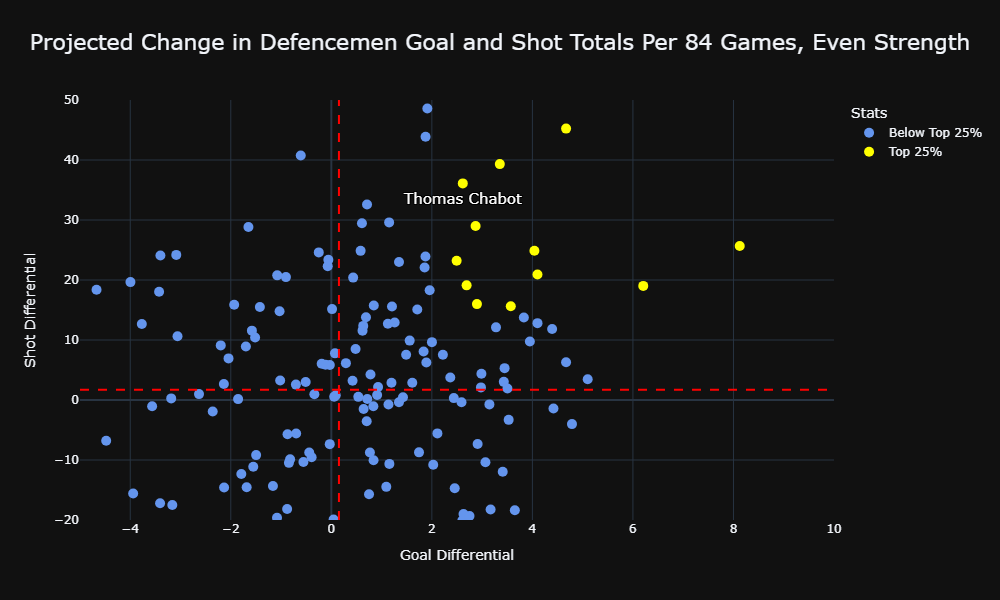
We have noted before that shot volume drops in recent seasons have been common, but compared to the two-year average from 2023-2025, shot rates from defencemen dropped about 5%. That is a far cry from the near-30% drop that Chabot endured, which is one reason for the rebound.
Heading into last season, Chabot had eight years in the NHL. In four of those years, he took fewer than 20% of Ottawa's even strength shots when was on the ice. Out of those four campaigns, he improved to somewhere between 20-24% the following season three times. The projections are betting on him once again improving from a down year, which is why he has such a large shot increase. Without a top PP role, he almost certainly won't be a 50-point defenceman, but that doesn't mean he can't be a better fantasy asset (when healthy).
Timothy Liljegren (Washington Capitals – D)
I want to quickly touch on Liljegren, because he was not a name I expected to see on our short list, but there he is:
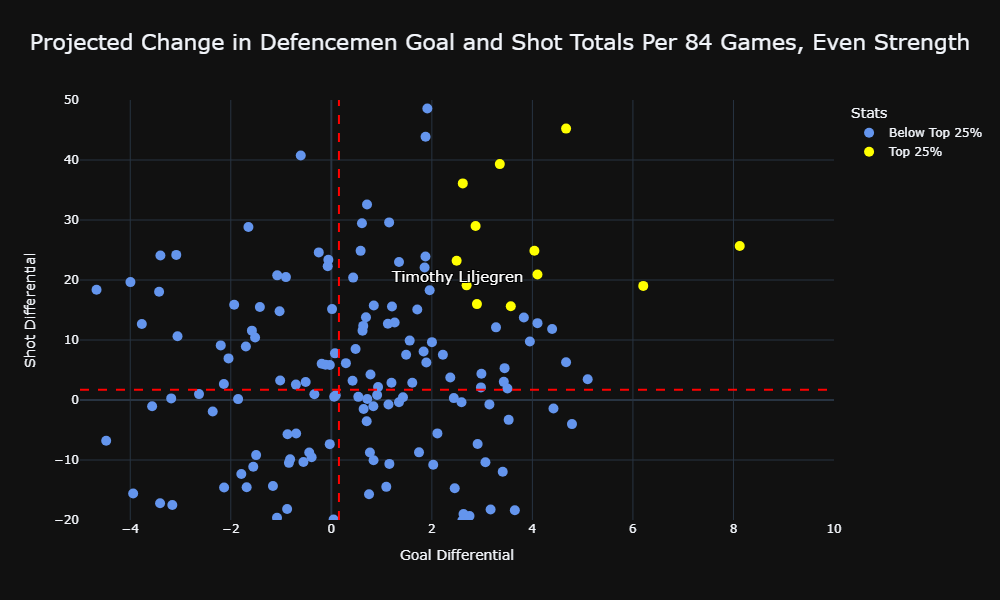
When I dug into it, a big reason for the improvement is a larger early-season role. John Carlson is gone and Rasmus Sandin's knee surgery will, at best, cause him to miss a month of games, and he may not return until early 2027. That opens a lot of minutes both at even strength and on the PK, which accounts for a big chunk of the increase.
The other reason is the Caps are projected to be a much more potent offensive team in 2026-27 than the San Jose Sharks were in 2025-26, and that opens more shooting opportunities for Liljegren. The combination of a better offensive team with more minutes early in the season is a boon for the blue liner. Even if Liljegren plays a full season, I wouldn't expect more than 30 points at the high end, but don't be surprised if he has some depth fantasy value in the first half of the season. That all changes when Sandin returns, though.
Related Posts
Starting Goalies











Top Skater Views
| Players | Team | |
|---|---|---|
| COLE PERFETTI |
 WPG WPG | |
| LUCA CAGNONI |
 S.J S.J | |
| IGOR CHERNYSHOV |
S.J | |
| TOMMY NOVAK |
 PIT PIT | |
| TRISTAN LUNEAU |
 ANA ANA
| |
Top Goalie Profile Views
| Players | Team | |
|---|---|---|
| DAN VLADAR |
 PHI PHI | |
| JOSEPH WOLL |
PHI | |
| SEBASTIAN COSSA |
 UTA UTA | |
| JAKUB DOBES |
 MTL MTL | |
| ADIN HILL |
 VGK VGK
| |
LINE COMBOS
| Frequency |
 CGY Players CGY Players
| |
|---|---|---|
| 23.2 | YEGOR SHARANGOVICH MORGAN FROST MATT CORONATO | |
| 17.7 | MATVEI GRIDIN JOEL FARABEE MIKAEL BACKLUND | |
| 13.6 | CONNOR ZARY RYAN STROME SAMUEL HONZEK | |
DobberHockey Podcasts

Keeping Karlsson: Cole, There’s No Time!
Elan and Brian cover all the action from the first week of the NHL season, and identify our earliest must-adds, can-drops, sell highs and buy lows in your fantasy hockey leagues.
Keeping Karlsson: Matchup Maximizer 2026/27 Week 2
Elan takes a look at the schedule for the upcoming weeks of NHL action and recommends players with good schedules that you should consider streaming in to win your head to head matchups.

Fantasy Hockey Life: Tidy Takes Part 1
TiDy Admiral Ryan Downey and Victor Nuno break down recent trades in the FHL Tiered Dynasty’s top division, the Lord Stanley division. Tune in to consider trades between some of the best dynasty sharks we know, including patron polls on the trades and Victor’s analysis. Have a listen! Our show is part of the Dobber […]
Keeping Karlsson: Short Shifts – I Tried to be Like Parker Kelly
Elan is joined by Ryan Downey for the premiere of season 8 of Short Shifts! — KKUPFL late registration is ongoing! We’re still filling new divisions in the world’s greatest fantasy hockey league. Details at https://www.kkupfl.com/. Join the Keeping Karlsson patron community! Patrons get access to all our perks all year round, including KKUPFL […]
Keeping Karlsson: Shabanov Ranks
Elan and Brian fly through the final preseason lines for every NHL team ahead of opening night, and share their guys to watch– or look away from– in your fantasy hockey leagues.