

The Journey: Prospects With Plenty to Prove in 2026-27, Part I
Victor Nuno
2026-10-03
Proving the Upside
Prospect evaluation is built on projection. We watch teenagers dominate junior hockey, college, or European leagues and try to imagine what those skills will eventually look like in the NHL. But eventually projection has to become production.
That’s where this group finds itself entering 2026-27. None of these players is an established NHL commodity, but all have demonstrated enough talent to create meaningful fantasy expectations. Some are arriving in professional hockey for the first time, while others have already gotten an NHL opportunity without completely establishing themselves. What they have in common is that this season should tell us considerably more about whether their upside translates into fantasy value.
Tij Iginla, Utah Mammoth
Iginla answered one major question last season. After undergoing bilateral hip surgery and losing much of 2024-25, he returned to Kelowna and was spectacular, scoring 41 goals and 90 points in only 48 games. That performance translated to a 73 pNHLe in Mason Black's model, further reinforcing that the sixth-overall pick from 2024 remains a premium offensive prospect.
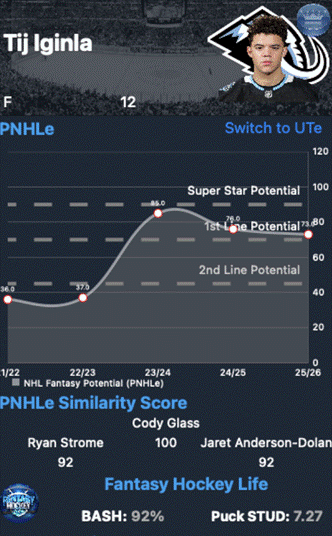
Now comes a different test. Iginla is eligible for the AHL and has very little left to prove in junior hockey. Producing against professional players is different, and this season should give us our first meaningful indication of how quickly his scoring translates. I don't think Iginla needs to become an NHL player immediately, but after last year's explosion, expectations have changed. He needs to begin showing that his upside isn't merely theoretical.
Berkly Catton, Seattle Kraken
Catton is one of the more fascinating players in this exercise because he has already spent a season in the NHL without becoming established. He played 66 games as a 19-year-old but managed only seven goals and 17 points, and the underlying results weren't much more encouraging. As the Evolving Hockey card shows, Catton ranked in just the 18th percentile offensively and 17th percentile overall, with below-replacement expected results at both even strength and on the power play. That's hardly disastrous for a teenager, but it's well below what dynasty managers ultimately expect from a player drafted eighth overall largely because of his offensive upside.
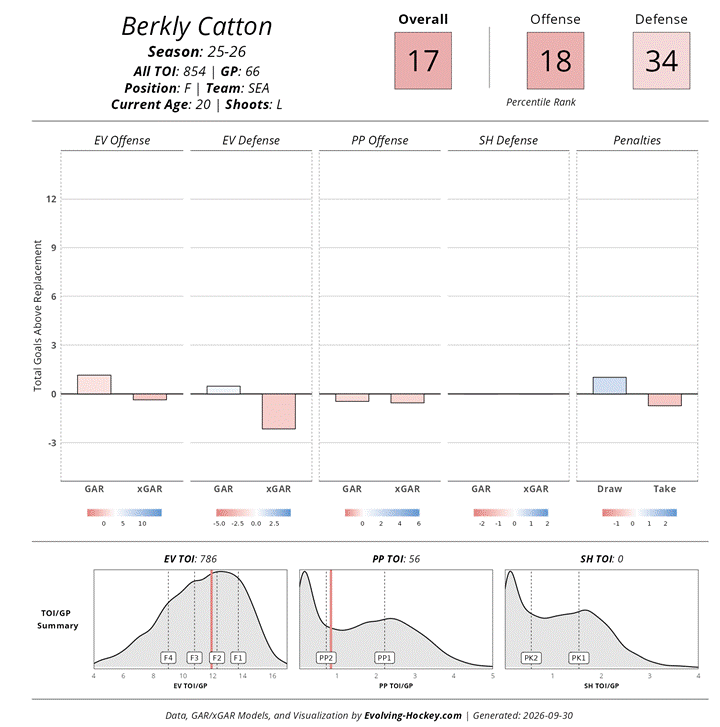
There are mitigating factors. Catton averaged roughly 12 minutes at even strength, saw limited power-play time primarily on PP2, and was learning the NHL as an undersized teenager. But now we need evidence of progression. More production would help, but I'm even more interested in whether he earns better deployment and begins driving offense underneath the box score. If the dynamic junior scorer starts emerging in those areas, last season becomes easy to forgive. If both the production and underlying numbers remain modest, we'll have to reconsider where his fantasy ceiling actually lies.
Konsta Helenius, Buffalo Sabres
Helenius has steadily eliminated questions about whether his intelligent, mature game would translate to North America. He produced 63 points in 63 AHL games last season before receiving NHL opportunities and eventually contributing during Buffalo’s playoff run. He then scored Finland’s golden goal at the World Championship. That’s a remarkable developmental year for a player who only turned 20 in May. His Fantasy Hockey Life skater card reflects that production, with strong marks for points (87th percentile), power-play involvement (96th), goals (77th) and assists (90th).
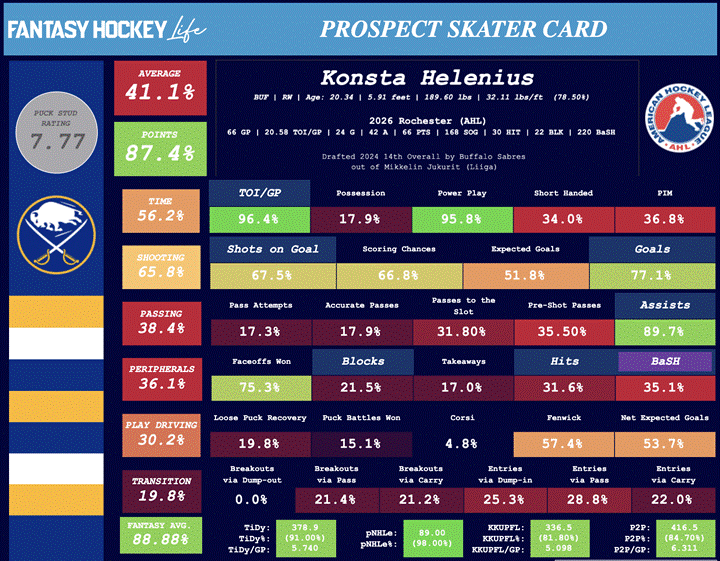
Some of the underlying metrics are less flattering. Helenius ranked in just the 30th percentile in play driving and 20th percentile in transition, while his passing metrics also lagged well behind his assist production. That adds some caution as he moves to the NHL, where creating offense will become considerably more difficult. I feel increasingly confident that Helenius is going to be a very good NHL player. I’m less certain exactly how valuable that player becomes in fantasy. Intelligence and two-way reliability can create opportunity, but dynasty managers need points. If Helenius can translate his AHL production while improving some of those underlying metrics, his value could take another major step forward.
Zayne Parekh, Calgary Flames
Few young defensemen carry more fantasy-specific expectations than Parekh. That’s understandable. His offensive instincts, puck skills and willingness to attack are exactly what we want from a dynasty defenseman. His value is already enormous relative to how little he has actually demonstrated in the NHL. That makes 2026-27 an important season, especially after a difficult 37-game NHL sample last year. Parekh’s Evolving-Hockey player card was decidedly unimpressive, ranking him in just the 25th percentile overall, 28th percentile offensively and 35th percentile defensively. His even-strength results were particularly concerning, with both his GAR and xGAR well below replacement level.
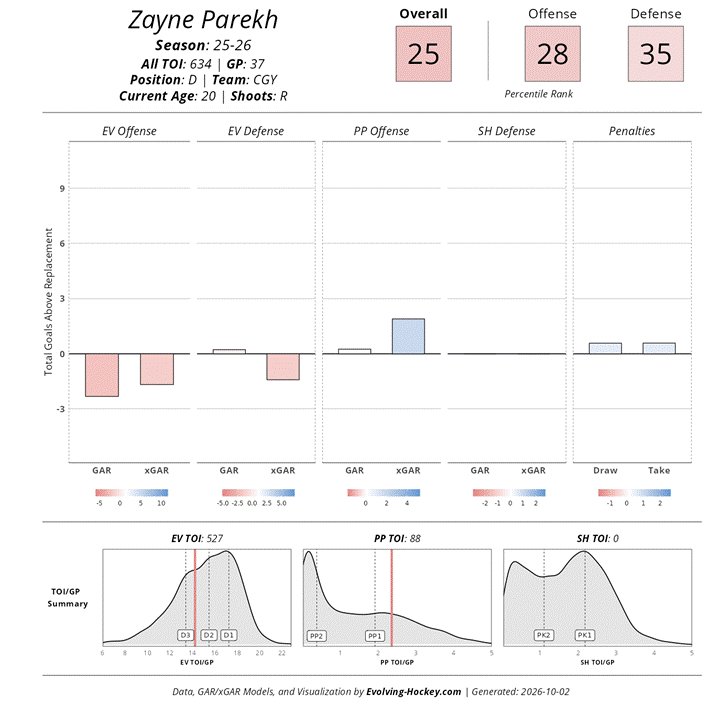
There were still encouraging signs where dynasty managers most want to see them: his power-play xGAR was strongly positive, and Calgary gave him an average of 1:17 on the man advantage. Parekh doesn’t need to become a finished defensive product, but he does need to demonstrate that his offense is special enough for Calgary to keep giving him opportunities while he learns everything else. The best fantasy defensemen don’t necessarily need to be their coaches’ safest players. They do need enough trust to earn significant minutes and power-play usage. This season should begin telling us whether Parekh can do that.
Igor Chernyshov, San Jose Sharks
Chernyshov’s development has been so impressive that the biggest problem may simply be the organization around him. Dobber ranked him second among all prospect forwards this summer, behind only Porter Martone, reflecting just how dramatically his stock has climbed. He also looked excellent alongside Macklin Celebrini during his NHL stint last season, producing 19 points in 28 games overall. His Hockey Prospecting profile reinforces the optimism: Chernyshov carries a 92% probability of becoming an NHL regular and a 42%-star probability based on his D+2 track, with his NHLe climbing from 30 in his pre-draft season to 59 in the OHL and remaining an impressive 56 during his NHL sample.
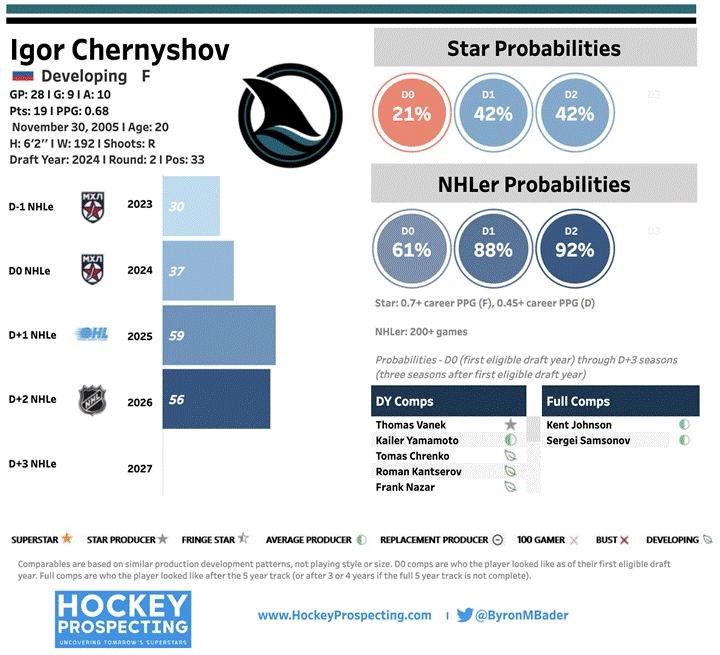
But San Jose now has Celebrini, Will Smith, Michael Misa, Ivar Stenberg and several other talented young forwards competing for premium offensive opportunities. That’s what Chernyshov needs to prove this year: that he’s not merely another excellent prospect in an elite system. His production-based comparables include Kent Johnson and Sergei Samsonov, while his developmental track resembles players such as Frank Nazar and Roman Kantserov, further illustrating the legitimate offensive upside. In another organization the pathway might be obvious. In San Jose, Chernyshov needs to turn last year’s promising glimpse alongside Celebrini into something more permanent and make himself impossible to overlook.
Jett Luchanko, Philadelphia Flyers
Luchanko’s skating and hockey intelligence have repeatedly allowed him to play above expectations. Philadelphia clearly loves the player, and his ability to process the game at speed gives him a very plausible NHL pathway. The concern is that his offensive trajectory has moved in the wrong direction. His Fantasy Hockey Life model shows his pNHLe peaking at 70 in 2023-24 before falling to 55 in 2024-25 and 46 last season, dropping him below the model’s second-line potential threshold. That’s a concerning trend for a player whose fantasy upside was already more dependent on projection than high-end production.
The fantasy question is whether enough offense comes with everything else Luchanko does well. There is a difference between becoming an excellent NHL center and becoming an excellent fantasy center, and right now his development increasingly points toward that distinction. This is a significant prove-it season. More assertiveness offensively, more production and evidence that his speed can create scoring rather than simply making him an effective transition player would go a long way toward reversing that trajectory.
Axel Sandin-Pellikka, Detroit Red Wings
Sandin-Pellikka has been one of the more exciting offensive defense prospects in hockey for several years, and his first NHL season provided some evidence that his best attributes will translate. Evolving-Hockey graded him in the 59th percentile offensively, with particularly strong even-strength xGAR, despite relatively modest minutes. The skating, puck movement and offensive instincts remain obvious, and Simon Edvinsson‘s contract holdout could provide Sandin-Pellikka an unexpected opportunity to establish a foothold in Detroit’s lineup and potentially earn more responsibility early in the season.
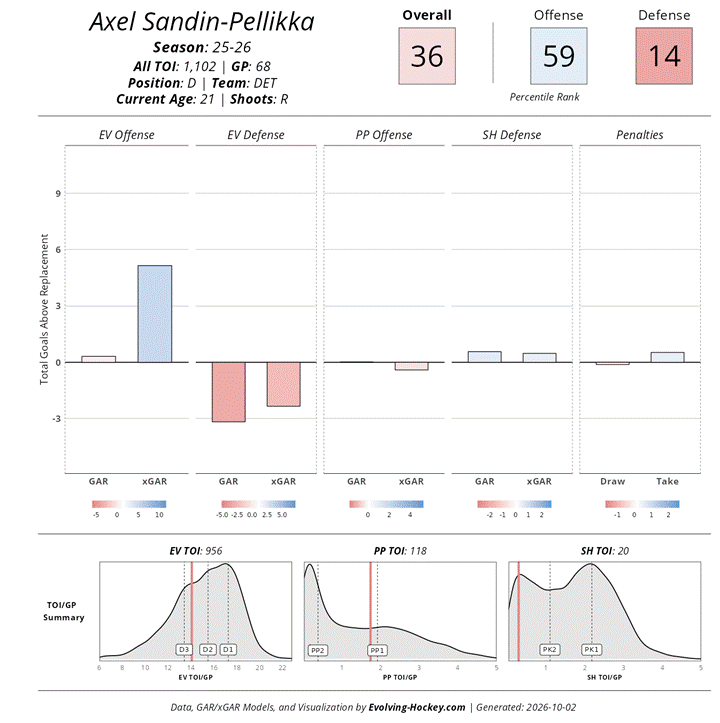
The other side of his Evolving-Hockey card illustrates how much work remains. Sandin-Pellikka ranked in just the 14th percentile defensively and 36th percentile overall, with both his even-strength defensive GAR and xGAR well below replacement level. Detroit doesn’t need him to become a shutdown defenseman, but he needs to be trustworthy enough defensively for the coaching staff to keep putting him on the ice. Fantasy managers drafted Sandin-Pellikka for his offensive ceiling and potential as a future power-play quarterback. If the Edvinsson situation creates an opening, this season gives him an excellent opportunity to show that the offense is valuable enough to keep him there.
Artyom Levshunov, Chicago Blackhawks
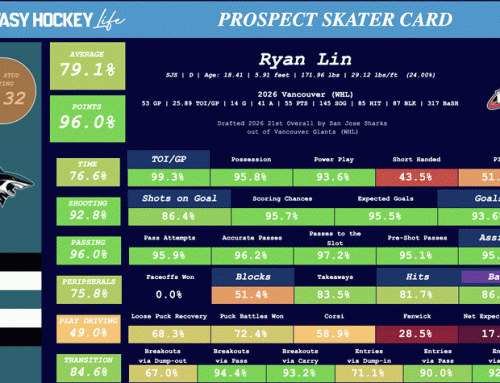
Being selected second overall creates expectations that don’t disappear simply because defensemen require patience, and Levshunov enters this season with plenty to prove. His Fantasy Hockey Life skater card shows some encouraging offensive ingredients, including an 84th-percentile scoring-chance rate, 81st-percentile expected goals and 93rd-percentile power-play involvement. He also produced 21 assists in 70 games as a 20-year-old defenseman. The physical tools, skating and puck-moving ability remain intriguing, but the overall profile was much less impressive than the pedigree might suggest.
The biggest concern is how little Levshunov drove play, ranking in just the 34th percentile overall, with poor results in puck battles, Corsi, Fenwick and net expected goals. His passing metrics were surprisingly ordinary as well, and his overall fantasy grade landed only around the 61st percentile. From a dynasty perspective, this is an important year for separating real-life value from fantasy value. Levshunov doesn’t need a massive point total, but after being drafted second overall, we need to see clearer evidence that his offensive tools can translate into the kind of production and role that will matter to fantasy managers.
Michael Hage, Montreal Canadiens
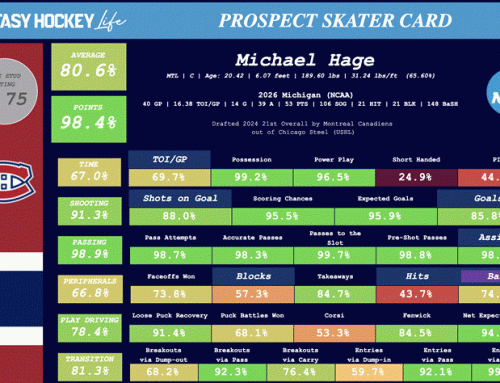
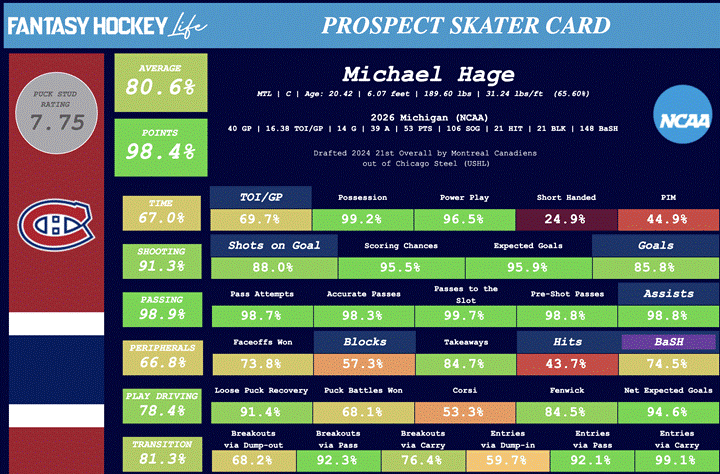
Hage’s decision to remain in college makes his 2026-27 season particularly interesting. He produced 52 points in 39 games for Michigan last season and led the World Juniors with 15 points, establishing himself as one of the more productive prospects in hockey. The Hockey Prospecting model is particularly bullish, giving Hage a 78%-star probability and 92% probability of becoming an NHL regular after his D+2 season. His NHLe has also climbed every year, from 20 to 36 to 40 and now 51, an encouraging progression for a player whose offensive ceiling continues to rise.
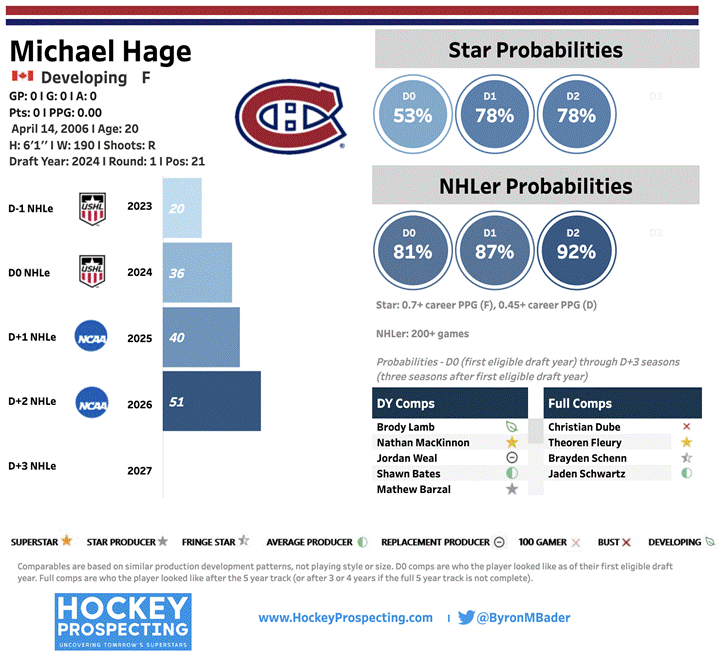
Once you’ve reached that level, simply having another good college season isn’t enough to materially increase dynasty value. Hage needs to dominate. Staying in the NCAA gives him another year to become stronger, refine his game and potentially become one of college hockey’s best players. The model even includes Nathan MacKinnon and Mathew Barzal among his draft-year developmental comparables, which speaks to the upside in his production trajectory rather than suggesting a stylistic comparison. If Hage takes another substantial step this season, Montreal could have another premium offensive prospect approaching quickly.
Carter Bear, Detroit Red Wings
Bear doesn’t have the same urgency as some players here. He’s still extremely young, and Detroit can afford to be patient. But his development has already pushed the conversation forward faster than expected, including speculation this preseason about whether he could force Detroit’s hand. His Fantasy Hockey Life profile shows just how quickly his offensive trajectory took off, with his pNHLe climbing from 11 to 63 and then 76, reaching first-line territory in his draft season. Last year’s decline to 60 is worth noting, however, particularly for a prospect whose dynasty value has risen so rapidly.
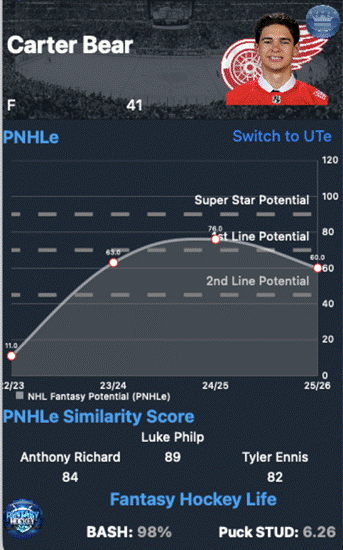
That’s what makes this season important. Bear combines skill with the type of competitiveness and forechecking ability coaches tend to trust quickly, while his 98th-percentile BASH rating adds another potentially valuable fantasy dimension. He doesn’t need to make Detroit immediately, but after his pNHLe took a step backward last season, I’d like to see the offensive trajectory turn upward again. Bear needs to show that his breakout wasn’t simply an early peak and that his offensive upside belongs in the same conversation as all of those highly translatable NHL attributes.
Thanks for reading! See you next week. For more fantasy hockey analysis, or if there's a prospect, topic or theme you'd like me to cover, follow and message me on X: @VictorNuno12.
Related Posts

Starting Goalies













Top Skater Views
 S.J
S.J VAN
VAN EDM
EDM CHI
CHITop Goalie Profile Views
 NYR
NYR STL
STL PIT
PIT UTA
UTA COL
COL

LINE COMBOS
| Frequency |
 ANA Players ANA Players
| |
|---|---|---|
| 19.1 | A.J. GREER CUTTER GAUTHIER LEO CARLSSON | |
| 17.7 | BECKETT SENNECKE ALEX KILLORN MIKAEL GRANLUND | |
| 17.0 | TIM WASHE JEFF MALOTT JUDD CAULFIELD | |
DobberHockey Podcasts

Keeping Karlsson: Short Shifts – I Tried to be Like Parker Kelly
Elan is joined by Ryan Downey for the premiere of season 8 of Short Shifts! — KKUPFL late registration is ongoing! We’re still filling new divisions in the world’s greatest fantasy hockey league. Details at https://www.kkupfl.com/. Join the Keeping Karlsson patron community! Patrons get access to all our perks all year round, including KKUPFL […]
Keeping Karlsson: Shabanov Ranks
Elan and Brian fly through the final preseason lines for every NHL team ahead of opening night, and share their guys to watch– or look away from– in your fantasy hockey leagues.

Fantasy Hockey Life: Western Conference Catchup and Mustard
Jesse and Victor are here to Catch Up on everything in the Western Conference that transpired ofter our team previews. We also have our annual spicy mustard competition – two hot takes per team. Our show is part of the Dobber Podcast Network and sponsored by Fantrax.com. Email [email protected] and ask to join our free […]
Keeping Karlsson: Matchup Maximizer 2026/27 Week 1
Elan takes a look at the schedule for the upcoming weeks of NHL action and recommends players with good schedules that you should consider streaming in to win your head to head matchups.
Fantasy Hockey Life: Dallas Stars with Taylor Newby
Taylor Newby joins the program to discuss the Dallas Stars.