

21 Fantasy Hockey Rambles
Dobber Sports
2026-10-25
Every Sunday, we share 21 Fantasy Rambles from our writers at DobberHockey. These thoughts are curated from the past week’s 'Daily Ramblings'.
Writers/Editors: Ian Gooding, Michael Clifford, Alexander MacLean, Puneet Sharma, and Dobber
___
1. Two days ahead of Sunday’s Heritage Classic against the Montreal Canadiens, the Winnipeg Jets finally took care of a Connor Hellebuyck trade. The Jets dealt the veteran goalie to the New Jersey Devils for Dawson Mercer, Alexander Command, Nico Daws, Nick Bjugstad, a 2029 second-round pick, and a 2027 seventh-round pick. Cliffy had the full Fantasy Take on this one.
From what I’ve read, opinions seem to be mixed on the trade. A Devils fan that I know seems to think that they gave up too much for a 33-year-old goalie who saw his numbers decline in 2025-26. The asking price was going to be high, even if Hellebuyck had demanded a trade. On the other hand, goaltending hasn’t been stable in New Jersey for a while, and Hellebuyck might be what they need to solidify a spot as an Eastern Conference contender. Maybe this is also a power move to entice Quinn Hughes to force his way onto the same team as his brothers. Maybe Minnesota makes a power move of their own to retain Hughes by acquiring Dylan Larkin.
I’d assume Hellebuyck needs some time to get back into game shape after missing training camp, so don’t expect him to make his Devils debut today (Saturday) against the Los Angeles Kings. However, those that have held onto Hellebuyck all this time won’t have to wait much longer. Perhaps he makes his first start for the Devils sometime next week. (oct24)
2. Artturi Lehkonen‘s goal on Friday was his ninth of the season, which tied him for third in the league entering Saturday. Lehkonen is also up to nine points over his last six games. He has been a goal-scoring machine on the MacKinnon/Necas line.
Lehkonen has been a find for those who had the foresight to draft him in the later rounds because of who his linemates could be. With nine goals in just 11 games, Lehkonen was shooting at a wildly unsustainable 52.9 SH% clip, with his shot per game total at 1.5 SOG/GP when it has traditionally been at least 2.0 SOG/GP. If he is ever moved off the top line, his value will take a major hit. In addition, he has missed at least 12 games in each of the last four seasons. For those reasons, Lehkonen could be a sell-high. (oct24)
3. My deepest league is a 20-team full keeper salary cap league. 25 rostered players. 33 minor league players. With rosters this heavy, moving up the standings can be as challenging as pushing an iceberg. On top of that, making trades that move the needle can be risky (hi to those of you from this league that happen to be reading). It goes without saying that it is nearly impossible to find difference makers on the waiver wire. Yet I was able to pry one player loose from the waiver wire last season – a player who was the most searched player on Frozen Tools last week. That player was Jack Quinn.
At the time he was dropped in this league, Quinn had seven points in 15 games, which was a 38-point full-season pace. Not terrible, but not great. This league counts all sorts of peripheral categories, and Quinn wasn’t contributing much to those areas: minus-7, under 2 SOG/GP, and under 1 HIT/GP. That could have dropped his overall league ranking, so I’m not trying to blame the previous owner for dropping him. That team finished just above me in the league standings and could have had a deeper roster than mine.
After I added him, Quinn upped his scoring pace to 44 points in 67 games, which turned out to be a 53-point pace. Quinn finished the season with his first 20-goal season and first 50-point season, increasing his shot total to over two shots per game. After a sluggish first quarter of eight points in 20 games last season, Quinn turned up the volume with 43 points in 62 games. Quinn’s success coincided with that of the Sabres, who went from perennial also-ran to Atlantic Division points leader in less than a season.
4. Quinn’s production has reached another level this season, as he has busted out of the gate with five goals and 10 points in 10 games (entering Saturday action). That success has much to do with an increase in icetime of four minutes per game, some of which is a corresponding increase in icetime from a promotion from PP2 to PP1. Quinn’s shot rate has increased even further, up from 2.3 SOG/GP last season to 2.8 SOG/GP. All great signs for sustained production.
Are there reasons to sell high on Quinn or expect a dropoff? Views on this might be mixed, although some advanced stats could raise a red flag or two. Quinn is currently riding a 17.9 SH%, which is noticeably higher than his 12% career average. In other words, bet the under on Quinn scoring 40 goals, although 30 goals seem to be within reach. Quinn is also benefitting from an 85.9 OZ%, which is set to drop even if he continues to be deployed in far more offensive-zone situations.
On the flipside, Quinn may be due for more assists. Only one of his five assists this season is a secondary assist, while he has averaged anywhere between 35-50% in this category. This could only result in a small increase, but it is worth mentioning. Quinn’s 83.3% IPP shows he is very involved when he is on the ice and not riding the coattails of superior linemates. His current line with Zach Benson and Noah Ostlund seems more promising for his long-term production than his previous line with Jason Zucker and Ryan McLeod.
All in all, I’m comfortable in holding on to Quinn, unless I receive an offer that I can’t refuse, such as a proven point-per-game player. Even if his production slows, a 60+ point full-season pace seems like a reasonable projection. Quinn will never be mistaken for a banger, but his shot total improvement and increase in power-play time should also be noted for those in multicategory leagues. (oct24)
5. There was some significant injury news on Thursday, so let’s hop right to it.
– First off, the Montreal Canadiens announced that Nick Suzuki, who hadn’t missed a game since 2019, will be out 2-4 weeks with an upper-body injury. He blocked a shot off his hand during the loss to San Jose on Tuesday night and though he finished the game, it looks like it might cost him several more. (Update: he's expected to miss 2-4 weeks due to an upper-body injury.)
Oliver Kapanen is a player to watch while Suzuki is out of the lineup (2-4 weeks, upper-body injury). Kapanen moved up the lineup to line up with Cole Caufield and Juraj Slafkovsky, also receiving reps on the top power play. Despite that prime deployment, Kapanen was held without a point on Friday and does not have a point of any kind in three games. Kapanen is still worth taking a flier on in deeper leagues. (oct24)
– On a bit of a good news/bad news front, the good news for Pittsburgh forward Ben Kindel is that his episode from the airplane earlier in the week seems as if it’s behind him. Here is what happened, according to the team:
@OtherNHLCrosby: Kindel had a vasovagal episode, which is a sudden drop in heart rate and blood pressure that reduces blood flow to the brain. They will follow strict guidelines on a plan for Kindel’s return to play
That Kindel may be able to practice as early as next week if further testing all goes well is just tremendous news.
On the bad news front, the team also announced that forward Bryan Rust will be out at least six weeks. Rust has missed at least 10 games for three straight years and it looks like he’s going to make it four.
– The Ottawa Senators provided a reasonable update on goalie Linus Ullmark:
@SunGarrioch: Ullmark has been placed on injured reserve. That means he’ll be out at least a week.
Ullmark left the game on Wednesday night with a non-contact injury, and those are always scary, but it seems like they avoided the worst and he may be back before the end of the month, and if not, early September.
– An update on San Jose Sharks forward Alex Wennberg:
@CurtisPashelka: Wennberg now considered more week to week at this point, Warsofsky says. He'll be reevaluated once the Sharks return to San Jose. Big loss.
It seems as if this would be Michael Misa‘s time to shine. For now, Mason Marchment is still getting top PP time, but Wennberg plays 20 minutes a night, and all those minutes can’t go to Macklin Celebrini. It will be interesting to see what Misa does in Wennberg’s absence. (oct23)
6. If you’re the Calgary Flames, what have you got to lose by riding the hot hand in net? That’s what Devin Cooley is right now. Cooley received his third consecutive start on Saturday, stopping 28 of 29 shots in the Flames’ 4-1 win over the Detroit Red Wings. Cooley has now won three games in a row while allowing just four total goals. It’s way too early to assume he has unseated Dustin Wolf as the Flames’ starting goalie, but I can unequivocally say that he is the best interview in the NHL.
Cooley is widely available in fantasy leagues (5% Yahoo/17% Fantrax), and the Flames play four games next week. However, all of the teams the Flames are facing are in the top 10 in scoring: Edmonton, Colorado, Toronto, and (believe it or not) Seattle. But if you are in complete control of your mind, don’t worry about those opponents and start Cooley with the same kind of confidence he is showing. It doesn’t hurt to have a lucky rabbit, either. After starting the season with five straight losses, the Flames have now won four of their last five. (oct25)
7. Wednesday night was Brady Tkachuk‘s return to Ottawa following his trade demand and subsequent offseason trade, and the Sens got some modicum of revenge with a 5-1 win. Aside from Tkachuk, the big news was that defenceman Jake Sanderson was back in the lineup for the Sens. He skated 22:36, most on the roster, and posted a pair of assists (one PP), four shots, and a block. With Sanderson back and Thomas Chabot out of the lineup, it was Carter Yakemchuk running the second PP unit.
For his part, Tkachuk scored the lone Panthers goal, totaling three shots, six PIMs, and six hits. (oct22)
8. Waiver Wire Targets
Following up on last week's waiver-wire notes, there were still a few options worth considering, along with some players to keep on your watchlist as we entered the past week. An increase in deployment could lead to more production, so even if they weren't the best adds for this week, they could provide some value down the road. (Published October 18)
Maxim Shabanov (RW) – 9% owned
Shabanov is spending most of his power-play time alongside Kirill Kaprizov, Matt Boldy and Joel Eriksson Ek, giving him exposure to Minnesota’s top offensive weapons. His even-strength deployment has been less consistent, and his 14:24 average ice time limits his overall upside. Through nine games with Minnesota, Shavanov has two goals and four assists, including four power-play points. The biggest change from last season with the Islanders has been his deployment, averaging 3:16 per game on the power play and accounting for 70.2% of the Wild’s man-advantage time. The Wild play four games this week, with three on busy nights and Sunday offering the best opportunity on a lighter slate. Shabanov is worth a look for his power-play exposure, but the limited shot volume and inconsistent even-strength role make him more of a speculative option. (oct19)
9. Ivar Stenberg (LW) – 8% owned / Igor Chernyshov (LW/RW) – 14% owned
There are a couple of San Jose Sharks worth monitoring if on your respective waiver wires, with Ivar Stenberg and Igor Chernyshov both offering some fantasy appeal depending on how their roles develop. San Jose plays four games against Toronto, Montreal, Ottawa and Boston.
Stenberg has gotten off to a hot start, recording six points (2G, 4A) through eight games. The second overall pick in the 2026 NHL Draft is already averaging 3:00 per game on the power play, giving him some appeal despite playing a middle-six role at even strength rather than alongside Macklin Celebrini and Will Smith. His early production is encouraging, his underlying numbers have been inconsistent which is natural for a rookie, and he is averaging just 1.4 shots per game. Despite the inconsistencies, If he continues to produce with the man advantage, a larger role could follow.
Chernyshov on the other hand, has two goals and two assists over the same number of games, with his deployment alongside Celebrini and Smith providing the biggest selling point. However, Chernyshov’s 25% shooting percentage and limited shot volume may be difficult to sustain. However, much like Stenberg, the opportunity to play alongside San Jose’s top offensive talent gives him some upside if his role continues to grow. Both players are speculative options, but the four-game schedule makes them worth a gamble. Stenberg has the stronger early production and power-play usage, while Chernyshov’s even-strength deployment gives him an opportunity to contribute. (oct19)
10. Jack Roslovic (C/RW) – 24% Owned
If you are looking for shots and top-line deployment, Jack Roslovic might be your man. Through nine games, he has six points and 30 shots on goal (3.3 per game), while averaging 16:48 of ice time, his second-highest mark of his career since his time in Columbus. He has also recorded points in three of his last five games. The obvious selling point is his time alongside Auston Matthews and Kirill Marchenko at even strength, with another regular combination featuring William Nylander and Matthews. His power-play role is less appealing, averaging just 1:25 per game with one power-play point. Even with John Tavares sidelined by injury, it looks as though Gavin McKenna could move into that spot. Regardless, Roslovic’s opportunity in Toronto’s top six, particularly with Matthews on the top line, is appealing. The shot volume is there, and as long as he continues to see time alongside Toronto’s top offensive talent, he has a chance to remain productive. (oct19)
11. Neal Pionk (D) – 35% owned
With Josh Morrissey currently sidelined, I’m surprised Neal Pionk‘s ownership isn’t higher. Morrissey is considered week-to-week with a wrist injury, and Pionk has taken advantage of the opportunity, recording six points (1G, 5A), 14 shots and 13 blocked shots while averaging 23:41 of ice time. His power-play usage has also increased by nearly a minute, up to 2:09 per game. The early production is certainly a bonus, and while his current scoring pace is well above expectations, the increased ice time and power-play opportunity are the bigger selling points. He has just one power-play point so far and that should change while Morrissey remains out. Of course, this opportunity won't last forever, as Morrissey will eventually return, so expectations need to be kept in check. In the meantime, Pionk has taken on the added workload and is already reaping the benefits. (oct19)
12. The defending Stanley Cup champion Carolina Hurricanes are as deep as any team in the NHL. Yet it is still a surprise to see Mark Jankowski on a six-game goal-scoring streak (just before going down to a lower body injury on October 17)). Jankowski is a secondary option for the Canes both at even strength and the power play, while he is shooting at an unsustainable 40%. The 32-year-old Jankowski is only worth adding in the absolute deepest of leagues, but credit where it is due on the recent goal scoring. (oct18)
13. Mark Stone (8-7-15 in 12 games) is probably the most high risk/high reward player in fantasy hockey. He has been above the point-per-game mark in the previous two seasons, yet he has not reached 70 games played in a season since 2018-19. It’s unfortunate to say this, but you could probably even set your watch to a Stone injury sometime this season. Enjoy the dividends while they last. Selling high for an elite player could be an option, as it’ll be hard to find a Plan B that could fill the gap. (oct18)
14. Over the summer, I did a 10-part series on the evolution of how defencemen play at the NHL level, and one part focused on the impact of offensive defencemen vs defensive defencemen on their team’s success. We see the same thing among forwards – those who share the ice with good (or great) offensive defencemen tend to find more offensive success. Just think of Adam Fantilli with Zach Werenski, Nick Suzuki with Lane Hutson, or Filip Forsberg with Roman Josi.
There are a handful of players or situations that stood out to me, so let’s go through them. Data is taken from NHL play-by-play, roster percentages are from Frozen Tools, and the viz are my own. (Published October 20)
Charlie Coyle and Zach Werenski (Columbus Blue Jackets)
Last year, Coyle spent about 44% of his even-strength time with Werenski on the ice. That isn’t a big surprise because Columbus likes to use Coyle in shutdown matchups, and Werenski is on the ice a lot both in a shutdown role or otherwise. It should come as no surprise that it not only has been more of the same this season, but to an even more severe degree:
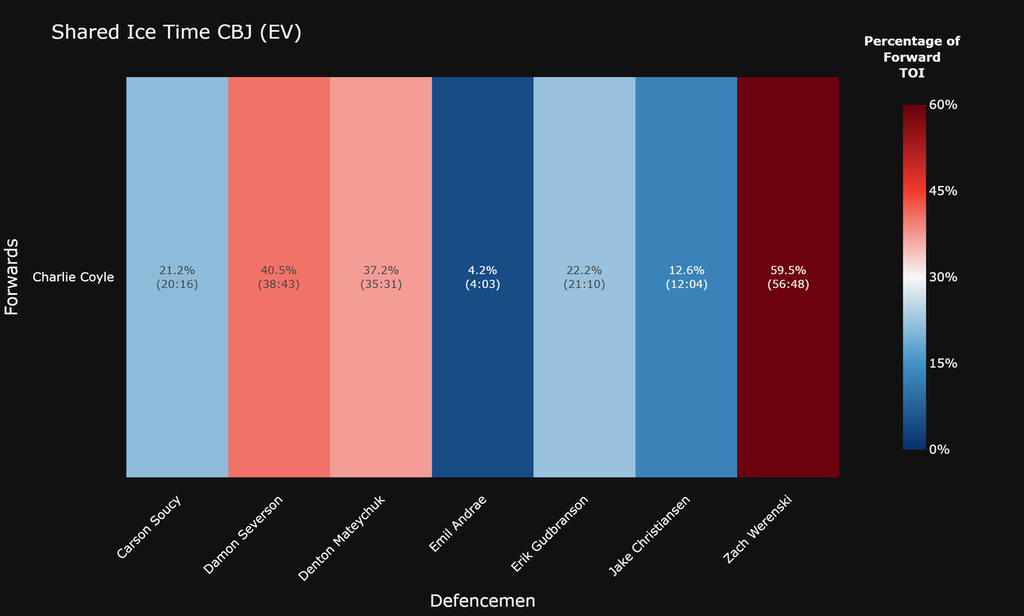
Columbus has played just seven games and has had some injuries on the blue line, so this is probably skewed more than it should be. All the same, Coyle is getting an obscene amount of ice time with Werenski right now, and he’s just 23% owned on Yahoo, 47% on Fantrax, and 51% on ESPN.
The problem is Columbus’ schedule. They have played just seven games so far, but they aren’t getting busier anytime soon: from today (October 19th) through the next four weeks, they have just 11 games on the schedule, being 1 of 10 teams with 11 or fewer games in that span; there are 12 teams who played 13 or 14 games in that span. They also have several difficult matchups in that span as those 11 games include games at home against Vegas, Colorado, Dallas, Florida, and Tampa Bay as well as road games against Carolina, Dallas, and Buffalo. Coyle’s situation has him set up for success, but a slow schedule and difficult matchups make it hard for shallow league fantasy owners to have any faith in reliable production. (oct20)
15. Alex Newhook and Lane Hutson (Montreal Canadiens)
At the top, we mentioned that Suzuki and Hutson skate together quite a bit (and they do); Hutson skating with Montreal’s top line isn’t anything new. What stands out is that Newhook has skated nearly 50% of his even-strength ice time with Hutson on the ice:
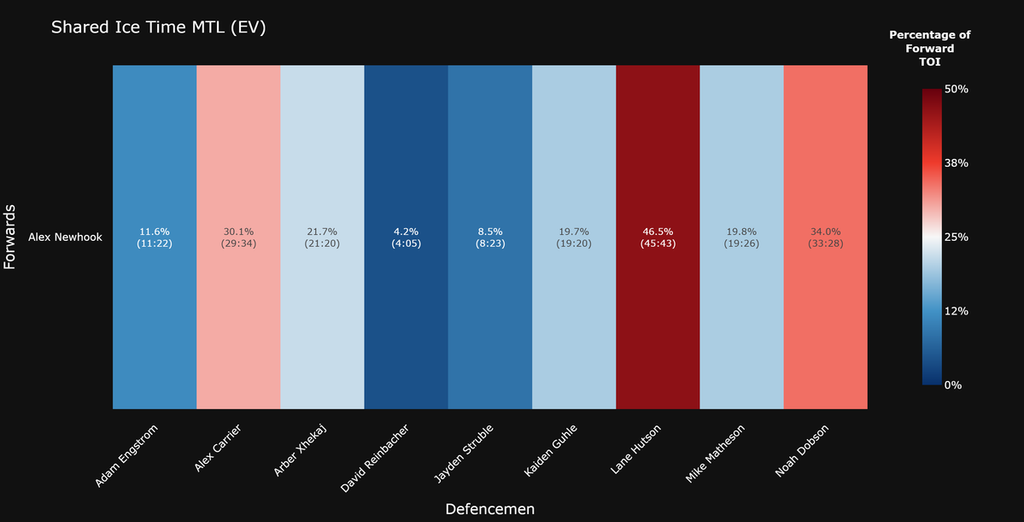
Newhook is off to a modest start with 1 goal, 3 assists, 10 shots, 7 blocks, and 7 hits in eight games. The shot volume is low, even for him, but it’s more a function of missing the net more than he should in a small sample. He should have 12-13 shots rather than 10, which adds up over a full season.
The good news is that unlike Coyle in Columbus, Newhook and the Habs have a good fantasy schedule over the next four weeks: 13 games with San Jose, Chicago, Winnipeg (x2), Toronto, and Pittsburgh among them. Newhook is currently skating 1:46 more per game than he did last year, has a lot of EVTOI with Hutson (for now, anyway), and Montreal’s schedule is reasonable over the next four weeks. He is just 2-3% owned on Yahoo and ESPN with a 30% tag on Fantrax. (oct20)
16. Depth Forwards Without Roman Josi (Nashville Predators)
We also mentioned Forsberg and Josi at the top, and while they’re getting a lot of ice time together, it’s more who isn’t getting ice time with Josi that stands out. As expected, there’s a lot of ice time with the likes of Forsberg, Ryan O’Reilly, and Steven Stamkos, but very little with names like Jack Drury, Nils Hoglander, and Ross Colton:
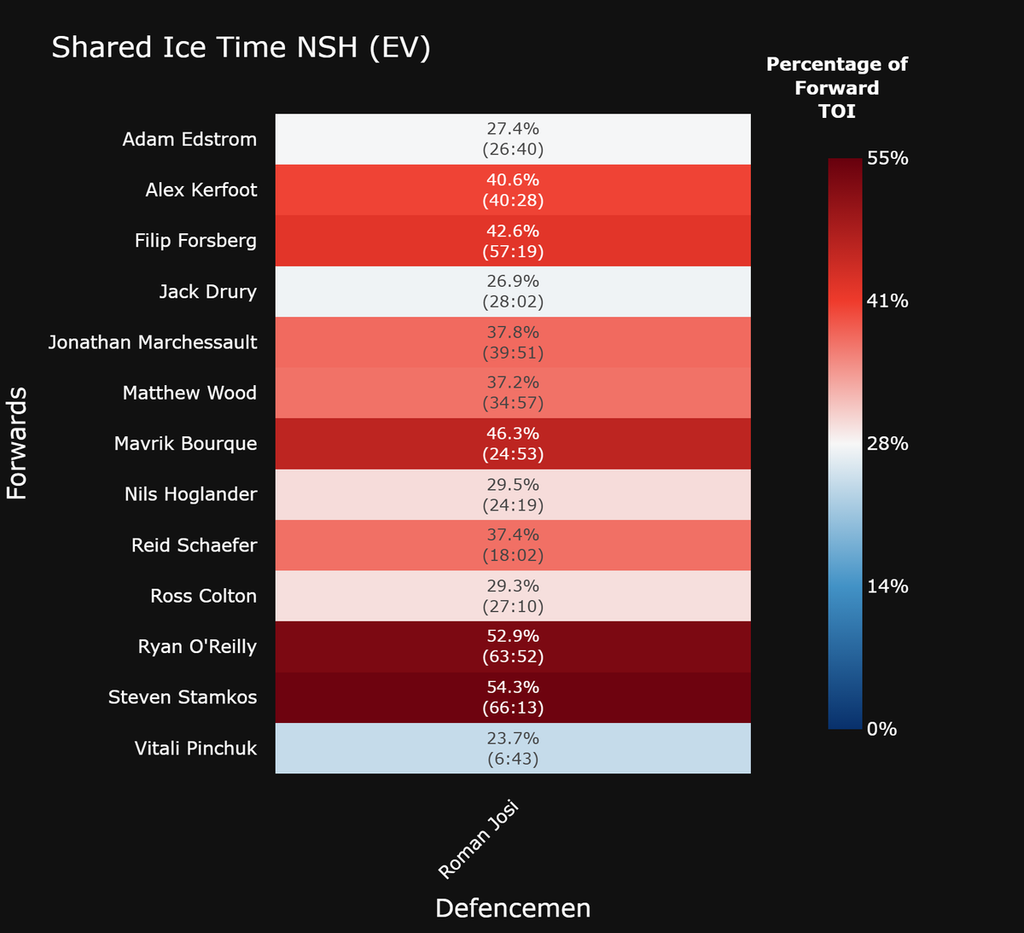
This is relevant for deep-league fantasy managers. Nashville has scored just 13 even-strength goals in eight games thus far, and Josi has been on the ice for more than half (7). The Predators also have zero defencemen on the ice for at least 52 shot attempts per 60 minutes – the league average is over 56. Nashville isn’t scoring without Josi on the ice, and the team isn’t generating many shots with anyone on the ice. Anyone hoping for a breakout from Drury or for Colton to return to the 20-goal mark is probably going to be disappointed. (oct20)
17. Every Forward with Vince Dunn (Seattle Kraken)
This may be a function with how Seattle is running their forwards: no Kraken attacker is higher than 17:17 per game in TOI and all 12 regular forwards are between 12:30 and 17:30. That is a drastic change from last season when both Chandler Stephenson and Matty Beniers averaged over 19 minutes a game, Jordan Eberle was at 18:29, and Bobby McMann skated 17:58 per game after the trade. Regardless of the cause, Dunn has been on the ice for between 33-39% of even-strength ice time for every single Kraken forward:
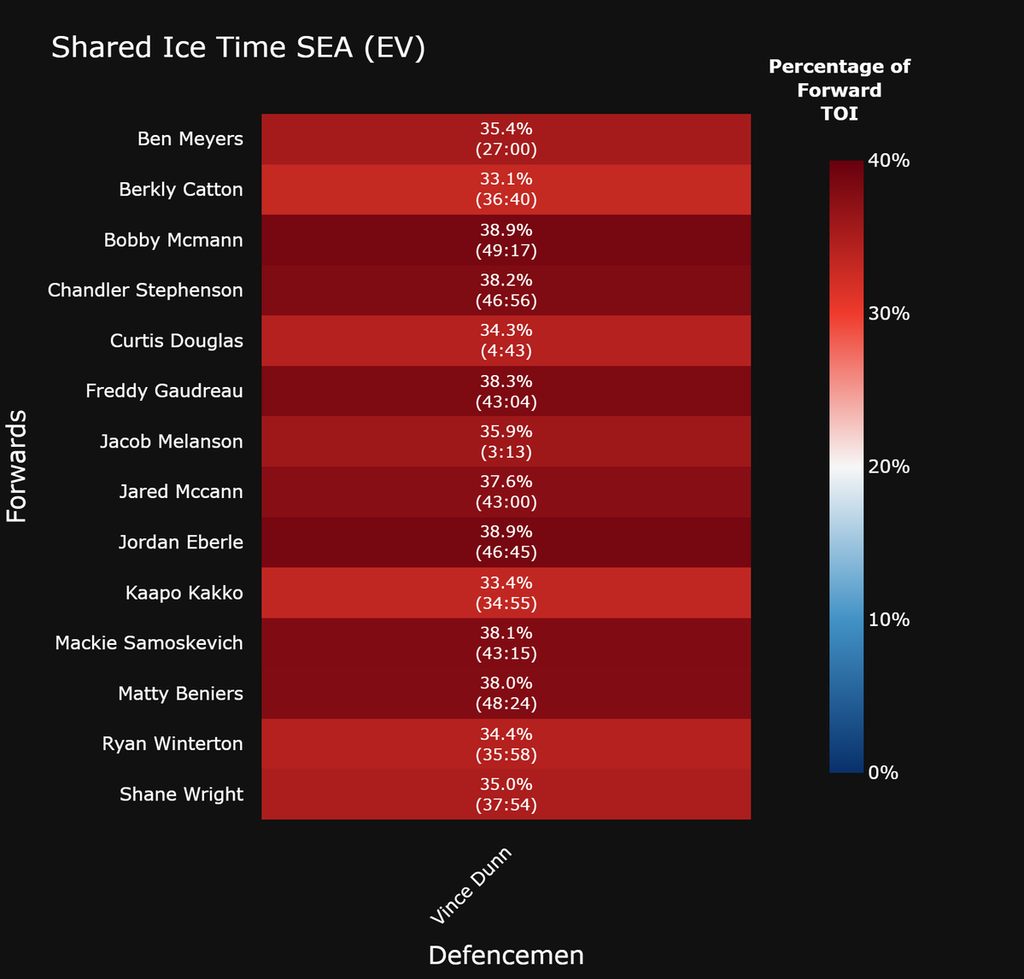
For now, it’s hard to argue with the results, because Settle is 5-3-1 in their first nine games, but the shared/spread ice time reflects their production: every regular Kraken forward has at least four points, but none have more than eight. It won’t happen, but this kind of pace means all their regular forwards post at least 35 points this year, but none post more than 75. It will be interesting to see where they end in April, but for now, all their forwards are difficult to rely on for production. (oct20)
18. Over the last couple of weeks, I have been going over ice time trends and changes in Market Share. In this instance, the term ‘Market Share’ means the percentage of a team’s shots taken by a specific player when they’re on the ice. So, if the Colorado Avalanche have taken 100 shots with Nathan MacKinnon on the ice, and he’s taken 25 of those 100 shots, his Market Share is 25%. Today, I want to combine our two ideas. Half of today’s Ramblings will cover improvements in 5-on-5 Market Share of shot attempts.
As for the other half, in his ‘Analytics Advantage‘ column back in July, Stas Pupkov showed that a good portion of a player’s full-season ice time improvement from the prior season is obvious by Game 10. Nearly half the league has reached that mark, so in using Frozen Tools, today’s Ramblings will also cover forwards with big improvements in their share of their team’s PPTOI compared to last year. We will combine that with forwards who’ve seen significant improvements in their 5-on-5 Market Share to see who is A) getting a lot more PPTOI and B) shooting a lot more at 5-on-5.
Shot data from Natural Stat Trick and all is current from the afternoon of Wednesday, October 21. Roster percentages also from Frozen Tools.
Noah Ostlund (Buffalo Sabres)
Yahoo Ownership: 3%
Fantrax Ownership: 39%
ESPN Ownership: 3%
It has been a solid start to the year for Östlund with six points in nine games, but there is room for improvement here. He is the only player in our data to at least double his share of his team’s PPTOI while also improving his 5-on-5 shot Market Share:
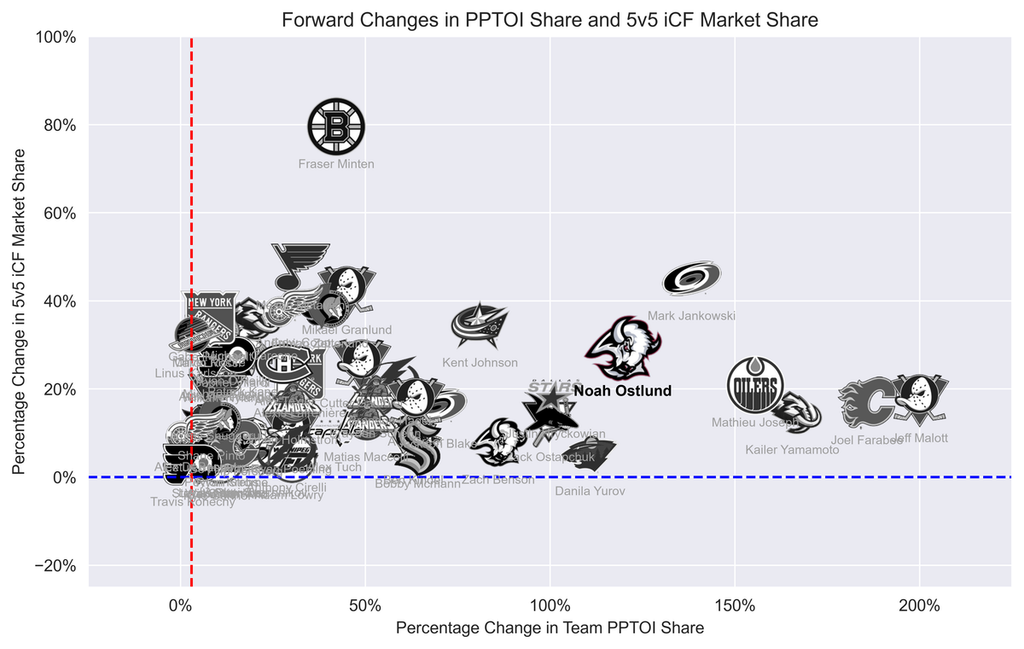
With these kinds of leaps, the improvements will come. He is currently registering a point on fewer than 43% of goals scored with him on the ice at 5-on-5, and no forward in the league last year with 1000 minutes played was under 47%, and only 3/122 of them were under 50%. His per-minute shot rate still isn’t elite, but it’s now above league average, and there are more goals on the table if he improves his shooting percentage. Just beware that beyond his shots, peripherals like blocks and hits will be low so he’s much more valuable in points-only leagues than multi-cat formats. (oct22)
19. Kent Johnson (Columbus Blue Jackets)
Yahoo Ownership: 14%
Fantrax Ownership: 49%
ESPN Ownership: 14%
There is a lot of negativity around the Blue Jackets right now, but Johnson does have four goals in eight games to start the year. He has also improved his share of the power play time from 39% to 70% as well as his shot Market Share from 21% to 28%:
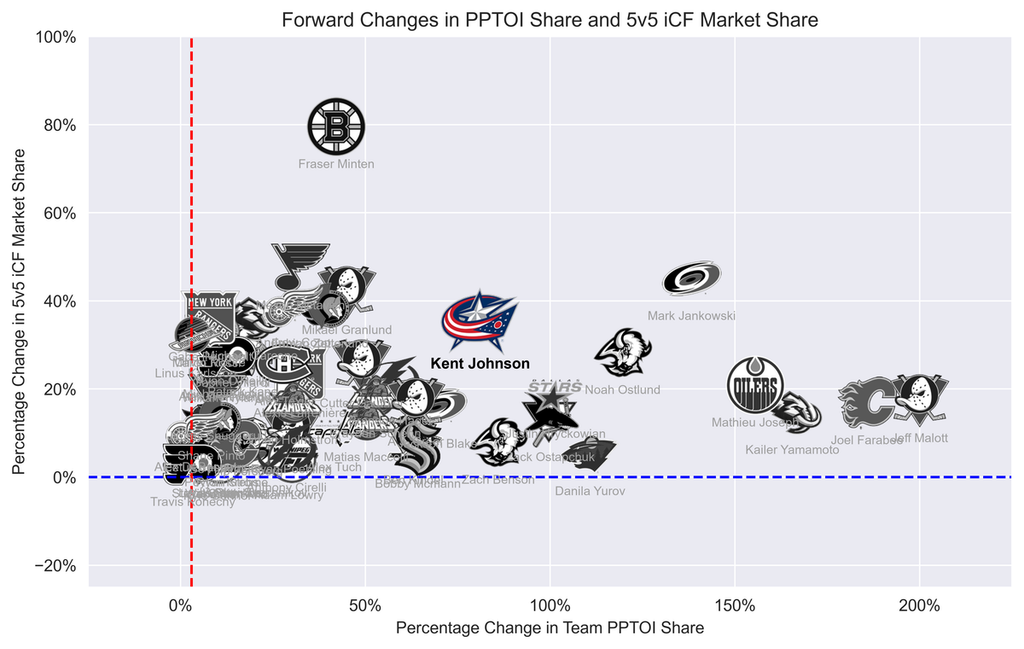
Individually, that he’s shooting 20% indicates negative regression from Johnson, but he also has just one assist. Typically, he assists on at least one-third of the goals scored with him on the ice. When the goals go down, the assists will go up, and he will find some balance. Like Östlund, though, his hits and blocks will be modest (hits will be especially low) so this is another player who will have a lot more value in points-only formats than multi-cat leagues.
The secondary concern is that Head Coach Rick Bowness looks like he’s ready to bench every single player on the roster, so who knows what each player’s role will look like three weeks from now. (oct22)
20. Fraser Minten (Boston Bruins)
Yahoo Ownership: 37%
Fantrax Ownership: 75%
ESPN Ownership: 41%
With eight points in 10 games, the Minten breakout is underway. When a young player, particularly one without elite draft pedigree, is breaking out, the question is always whether it’s ‘for real’. Well, his 5-on-5 Market Share has exploded from under 19% last year to over 33% this year to go with a modest PPTOI share increase:
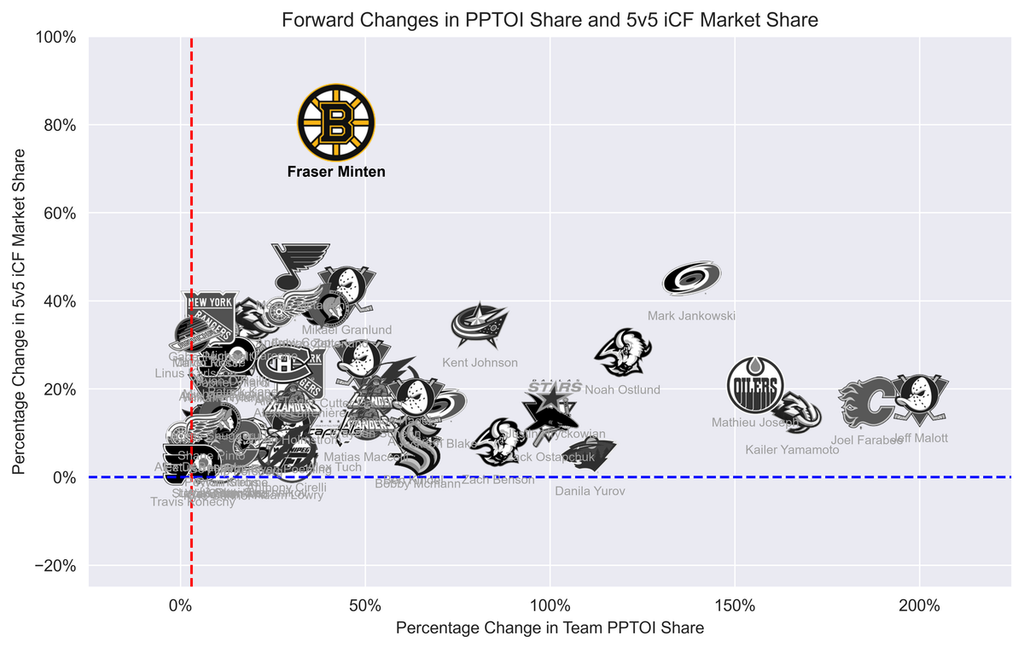
There should be doubts that he’ll remain at a Market Share of 33% as that is typically elite-shooter territory, but if he can remain anywhere over 25% then he has added an entirely new dimension to his fantasy profile. We need to see him maintain elevated shot rates in the coming months, but this is a very good start, and the final piece to the puzzle will be even more power-play ice time. He will be in very tough to push 70 points without a regular top PP role, but he is heading to be a 50-point player this season regardless of that role. Unlike the two players above, he is a guy who lays a lot of hits and can post anywhere from 40-60 blocks so there is good multi-cat value here (which is why he’s carrying a lot more ownership). (oct22)
21. Joel Farabee (Calgary Flames)
Yahoo Ownership: 4%
Fantrax Ownership: 15%
ESPN Ownership: 4%
Fantasy value from the Flames will be sparse this year, but Farabee does have five points in eight games and that’s with zero goals. He has reached a league-average Market Share rate (over 21%) and is seeing over two-thirds of Calgary’s PPTOI, giving him sizeable increases in both areas compared to last year (the PPTOI in particular):
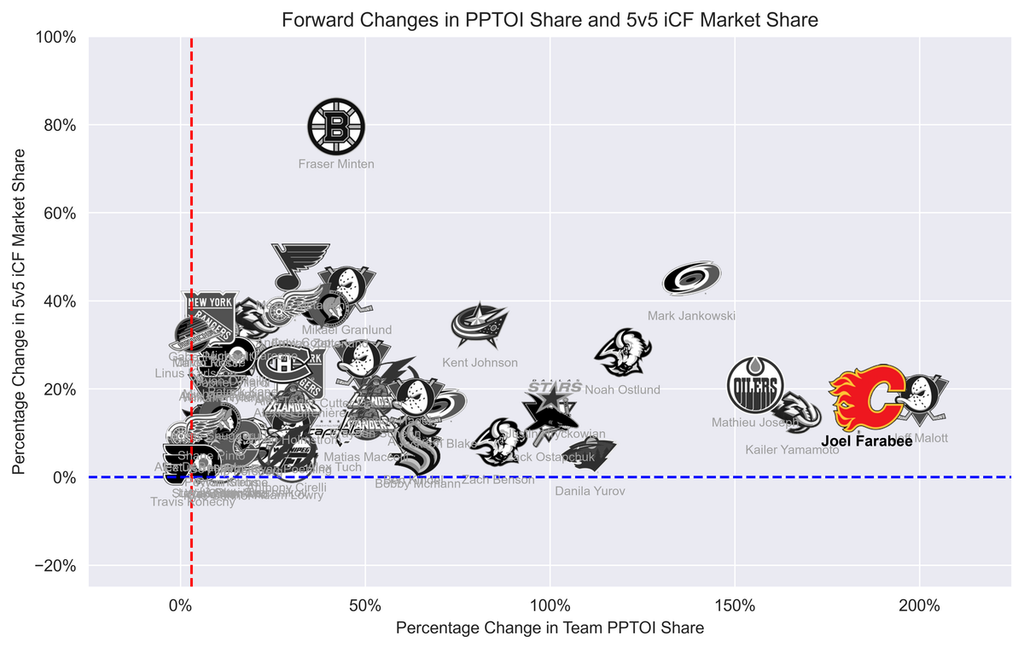
That three of his five assists have been on the power play is a good news/bad news situation. Having a substantial PPTOI increase means his three PPPs in eight games reflects his new situation, and not just pure luck. That’s the good news. The bad news is that Calgary has scored just one goal with him on the ice at 5-on-5. That is due to the team shooting under 2% in his minutes, and it won’t stay that low, so positive regression will help, but Calgary will be a low-scoring team so how high that rises is a fair question. Either way, these kinds of PP and Market Share improvements mean he’s a legitimate threat for 60 points and 200 shots. That is not nothing. (oct22)
——-
Have a good week, folks!
Thanks for continuing to support the website and if you’re bored and need a fantasy hockey fix – visit the gang in the forum here.
Related Posts

Starting Goalies













Top Skater Views
 T.B
 PHI
 N.J
 DET
Top Goalie Profile Views
 MTL
 WSH
 EDM
 MIN

LINE COMBOS
| Frequency |
 FLA Players | |
|---|---|---|
| 21.9 | MATTHEW TKACHUK BRADY TKACHUK SAM BENNETT | |
| 15.7 | COLE SCHWINDT BOKONDJI IMAMA GARNET HATHAWAY | |
| 14.9 | CARTER VERHAEGHE SAM REINHART LARS ELLER | |
DobberHockey Podcasts

Keeping Karlsson: Matchup Maximizer 2026/27 Week 5
Jeremy takes a look at the schedule for the upcoming weeks of NHL action and recommends players with good schedules that you should consider streaming in to win your head to head matchups.
Keeping Karlsson: Short Shifts – Injuries, Outjuries, and Duds
Elan talks about all the latest injuries, outjuries, big performances and duds over a tight 20 minutes in this week’s episode of Short Shifts.
Keeping Karlsson: Never Tell Me the Podz
Elan and Brian do a wellness check on the Maple Leafs, lament Chicago and Buffalo snoozers, wonder whether and which Flyers have figured it out, and pick out the Capital standing out from the crowd.

Fantasy Hockey Life: Ep 505 Prospects With Plenty to Prove Part 1
Victor and Jesse return to talk about prospects with plenty to prove. This week it’s: Tij Iginla, Berkly Catton, Konsta Helenius, Zayne Parekh, Igor Chernyshov, Jett Luchanko, Axel Sandin-Pellikka, Artyom Levshunov, Michael Hage, and Carter Bear. Have a listen! Our show is part of the Dobber Podcast Network and sponsored by Fantrax.com. Email [email protected] and […]
Keeping Karlsson: Matchup Maximizer 2026/27 Week 4
Elan takes a look at the schedule for the upcoming weeks of NHL action and recommends players with good schedules that you should consider streaming in to win your head to head matchups.