

The Journey: NCAA Prospects on the Rise in 2026–27
Victor Nuno
2026-11-28
One of my favorite early-season exercises is comparing prospects from the same draft class. Draft capital matters, but players can quickly challenge their initial evaluations. Several NCAA prospects are already outperforming their more highly regarded draft classmates this season, presenting intriguing opportunities for dynasty managers.
Of course, point production only tells part of the story. Shot generation, shooting efficiency, offensive deployment, and peripheral contributions provide valuable context when assessing the sustainability of a prospect’s performance. Identifying the players who are driving their own offensive success, rather than simply riding an early-season hot streak, can give dynasty managers an advantage before the fantasy market catches up.
This week, we’ll examine ten NCAA prospects whose performances have caught my attention.
Adam Benák, C, Western Michigan — Minnesota Wild (2025, 4th Round, 102nd Overall)
Benák has wasted little time showcasing his offensive creativity at Western Michigan, recording five goals and 16 points through 12 games. The Minnesota fourth-round selection has showcased his vision, anticipation, and playmaking ability against collegiate competition. His 11 assists highlight his ability to manipulate defenses and create opportunities for teammates, although his 22 shots represent relatively modest shooting volume. His offensive development is reflected in Hockey Prospecting’s model, with his NHLe climbing from 28 in his draft year to 39 in his D+1 season and now 60 in his D+2 campaign. His star probability has risen from 12% to 44%, while his likelihood of becoming an NHLer has increased from 35% to 78%.
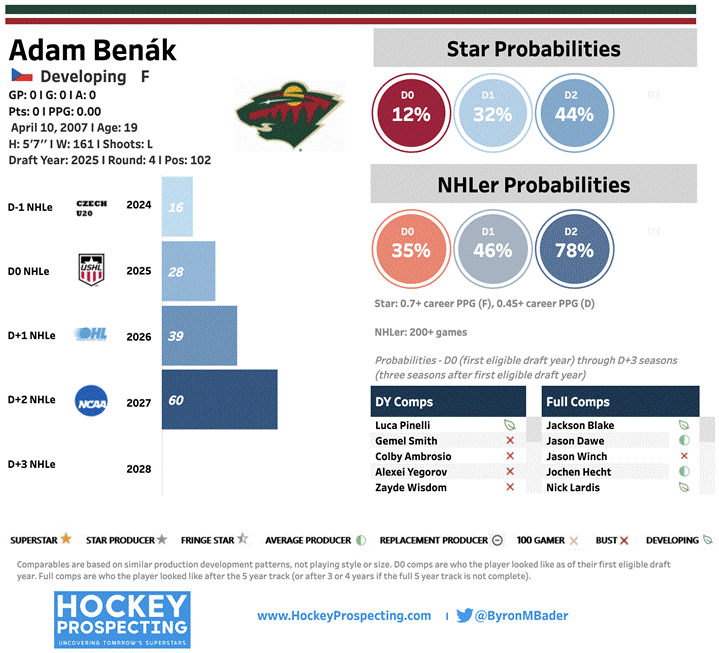
At 5-8 and 161 pounds, Benák’s size undoubtedly contributed to his draft-day slide, but producing at 1.33 points per game against older, physically mature competition is encouraging. Among his Hockey Prospecting developmental comparables are Jackson Blake and Nick Lardis, two fellow undersized forwards with considerable offensive talent. Although questions remain regarding how Benák’s game will translate to the professional level, his offensive progression across three different leagues is difficult to ignore. Minnesota may have uncovered a fourth-round gem, and he’s someone I’d be actively pursuing in dynasty formats, particularly if his acquisition cost remains tied to his draft pedigree.
Ethan Wyttenbach, F, Quinnipiac — Calgary Flames (2025, 5th Round, 144th Overall)
Wyttenbach has put together one of the more convincing late-round statistical profiles. The Calgary prospect has recorded five goals and 20 points through 13 games with Quinnipiac, accompanying that production with 39 shots. Generating three shots per game while converting at a reasonable 13% provides a solid foundation for his offensive success. His offensive trajectory is particularly impressive when examining his NHL Rank King graph, with his pNHLe increasing from 64 in his draft year to 81 last season and currently sitting at 79, comfortably within first-line potential territory. His statistical developmental comparables include Dylan Larkin, Antoine Vermette, and Colin Wilson, while his 24% BASH score and 5.88 Puck STUD rating provide additional reasons for optimism.
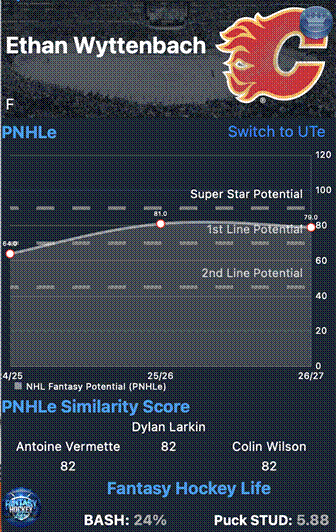
Wyttenbach’s fifth-round pedigree makes him particularly appealing from a dynasty perspective. Calgary has several more recognizable offensive prospects in its pipeline, which may help keep his acquisition cost relatively modest. While projecting Wyttenbach as a future first-line NHL forward would be premature, the discrepancy between his draft capital and statistical projection is difficult to ignore. Of the late-round prospects featured this week, Wyttenbach may offer the most attractive combination of offensive upside, sustainable production, and acquisition cost. He’s firmly on my radar.
Malcolm Spence, LW, Michigan — New York Rangers (2025, 2nd Round, 43rd Overall)
Spence has been finding the back of the net with remarkable frequency at Michigan, recording eight goals and 17 points through 13 games. The Rangers prospect brings an appealing combination of skill, competitiveness, and physical engagement, giving him several potential avenues toward NHL relevance. However, his eight goals have come on just 23 shots, resulting in an extraordinary 35% shooting percentage. While his ability to capitalize on scoring opportunities is encouraging, maintaining anything close to that finishing rate over an extended period seems unlikely. I’d like to see his individual shot generation increase as the season progresses.
Spence’s competitiveness and physical engagement could translate into meaningful peripheral production in multicategory formats. The primary question remains whether he possesses enough offensive upside to eventually secure consistent top-six deployment. Dynasty managers shouldn’t significantly elevate his offensive projection based on his current goal-scoring pace alone. If his shot generation improves as his shooting percentage normalizes, I’ll feel considerably more comfortable buying into his breakout. For now, I’m cautiously optimistic.
Jackson Smith, D, Penn State — Columbus Blue Jackets (2025, 1st Round, 14th Overall)
Smith has been exceptionally active offensively through 14 games with Penn State, recording three goals and 15 points. Averaging three shots per game is particularly impressive for a young defenseman at the collegiate level. His offensive progression is reflected in Byron Bader’s Hockey Prospecting model, with his NHLe climbing from 18 in his draft year to 28 last season and now 43 in his D+2 campaign. Even more impressive is the increase in his star probability from 60% to 93%, while his NHLer probability has reached 98%. Zach Werenski appears among his draft-year comparables, while Denton Mateychuk is his current developmental comparable.
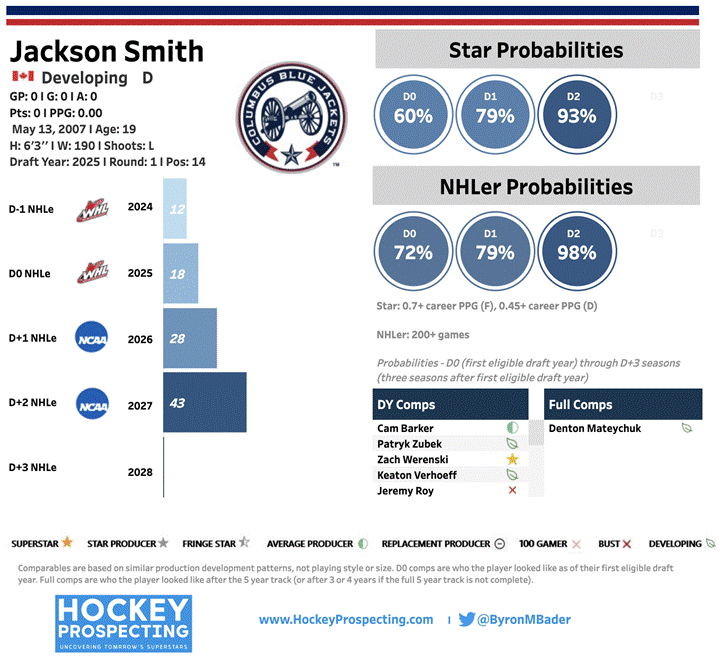
At 6-3 and 190 pounds, Smith possesses an appealing combination of size, offensive creativity, shot generation, and defensive engagement. The biggest question from a fantasy perspective may be his eventual power-play deployment, particularly with Werenski and Mateychuk already in Columbus. Nevertheless, his underlying offensive metrics and remarkable year-over-year progression suggest he could become a meaningful fantasy contributor even without top power-play responsibilities. Smith’s acquisition cost certainly won’t be cheap, but his developmental trajectory suggests he has the potential to become one of the premier fantasy defensemen from the 2025 draft class.
Drew Schock, D, Michigan — Anaheim Ducks (2025, 4th Round, 101st Overall)
Schock has been a pleasant surprise, recording five goals and 14 points through 13 games at Michigan. His underlying metrics, however, differ considerably from Smith’s. Schock has generated just 20 shots, converting at an unsustainable 25% rate. His nine assists are arguably more encouraging when evaluating his long-term offensive potential. His NHL Rank King graph illustrates a remarkable resurgence in offensive production, with his pNHLe climbing from 26 last season to 87 this season, approaching the superstar potential threshold. Interestingly, his statistical comparables of Ty Emberson, Dillon Fournier, and Sebastian Aho (the defenseman), along with his 18% BASH score and 4.35 Puck STUD rating, paint a more conservative picture of his fantasy upside.
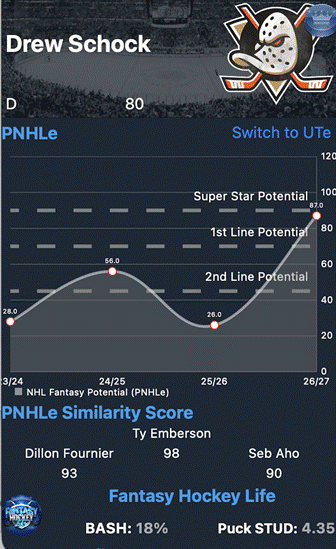
Anaheim’s impressive collection of young defensemen complicates Schock’s eventual path toward meaningful offensive deployment in the NHL. While the dramatic increase in his pNHLe is encouraging, I’d caution against placing too much emphasis on that projection given his elevated shooting percentage and relatively small sample size. I’ll be particularly interested in monitoring his power-play responsibilities and whether his playmaking production remains strong as his shooting percentage normalizes. If Schock can sustain his offensive involvement while increasing his individual shot generation, he could emerge as one of the more intriguing defensive sleepers from the 2025 draft class. For managers in deeper dynasty leagues, he’s worth a speculative investment before his acquisition cost rises.
Kristian Epperson, F, Denver — Los Angeles Kings (2025, 3rd Round, 88th Overall)
Epperson’s early collegiate production deserves more attention. Through 14 games with Denver, the Los Angeles third-round selection has recorded five goals and 14 points while generating 47 shots. His 3.4 shots per game are among the more impressive totals from this group of forwards, providing a convincing foundation for his offensive production. His nine assists also highlight a relatively balanced offensive profile. With a shooting percentage of 11%, his current goal-scoring pace appears reasonably sustainable if his shot generation persists.
His early production suggests there may be more offensive upside here than his draft position indicates, but he’ll need to demonstrate that he can consistently drive offense against stronger competition. Epperson may not generate the same excitement as several of his more highly drafted peers, but that could work to the advantage of dynasty managers looking to acquire him before his reputation catches up with his production.
Cole McKinney, C, Michigan — San Jose Sharks (2025, 2nd Round, 53rd Overall)
McKinney has recorded seven goals and 14 points through 13 games at Michigan, complementing his offensive production with an impressive 60% faceoff percentage. His offensive resurgence is reflected in Byron Bader’s Hockey Prospecting model, with his NHLe rebounding from 19 last season to a career-high 45 in his D+2 campaign. His star probability has doubled from 11% to 22%, while his NHLer probability has improved from 52% to 69%. His developmental comparables include Juraj Slafkovsky, Jack Quinn, and Seth Jarvis, offering some intriguing offensive possibilities. However, his seven goals have come on 25 shots, resulting in an elevated 28% shooting percentage that warrants some caution when projecting his current scoring pace.
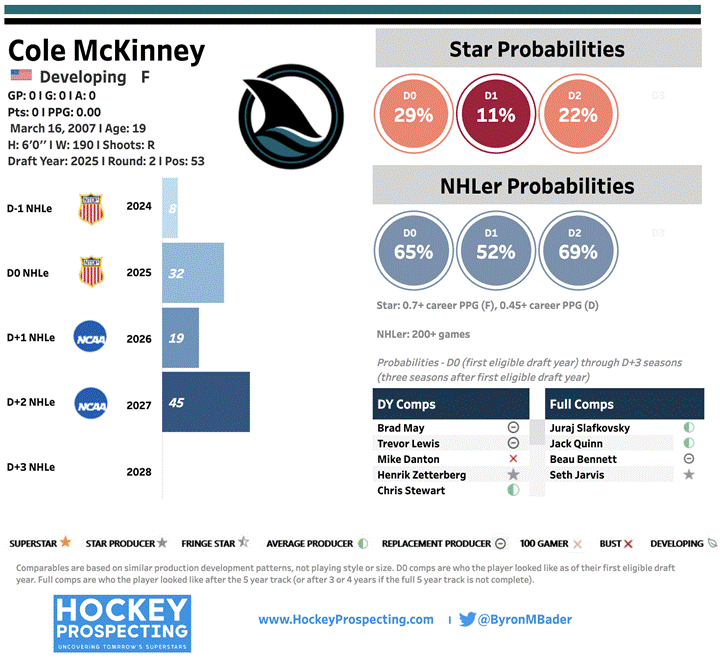
McKinney remains a prospect whose NHL projection may be more appealing than his fantasy projection. His positional awareness, faceoff ability, and responsible two-way approach should help him earn professional opportunities, although San Jose’s impressive collection of young forwards creates considerable competition for future top-six responsibilities. While his Hockey Prospecting probabilities are trending in the right direction, his star probability remains below the 29% he carried in his draft year. Managers in leagues rewarding faceoff wins should have greater interest in McKinney, while those in points-only formats may want to take a more measured approach. His offensive resurgence is encouraging, but I’d like to see sustained production and increased shot generation before significantly elevating his fantasy ceiling.
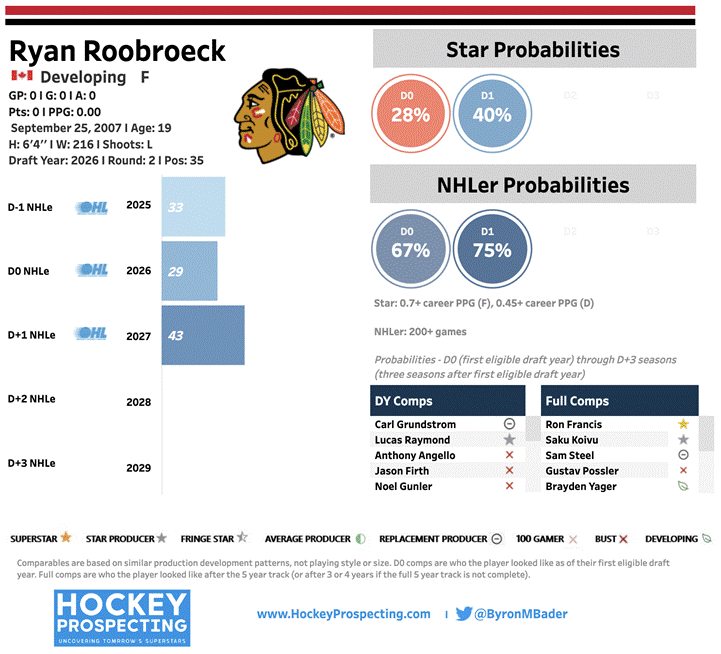
Julius Sumpf, C, Providence — Chicago Blackhawks (2025, 4th Round, 98th Overall)
Few prospects in this group have demonstrated a more pronounced discrepancy between their playmaking and goal-scoring contributions than Sumpf. The Chicago fourth-round selection has recorded one goal and 16 assists through 12 games with Providence, while winning an impressive 60% of his faceoffs. His offensive breakout is illustrated nicely by his NHL Rank King graph. After three consecutive seasons with a pNHLe between 35 and 39, Sumpf has nearly doubled last season’s mark to 66, placing him toward the upper end of second-line potential territory. His statistical comparables of Blake Pietila, Samuel Asselin, and Cameron Morrison, along with his 3.45 Puck STUD rating, offer a more conservative outlook.
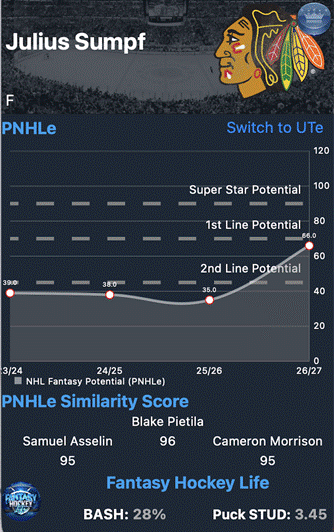
Sumpf’s fantasy appeal will depend heavily on his eventual deployment and league settings. His dramatic improvement in pNHLe represents a meaningful departure from his previously stagnant offensive trajectory, but his limited shot generation (20 shots) remains a concern. Becoming a more aggressive scoring threat would help diversify his offensive contributions and strengthen his fantasy projection. Chicago’s increasingly crowded prospect pipeline also complicates his path toward meaningful offensive deployment. Nevertheless, his combination of playmaking ability and faceoff proficiency makes him an intriguing speculative target in deeper multicategory formats. I’d like to see whether Sumpf can sustain this newfound level of production throughout the season before making a substantial adjustment to his long-term fantasy valuation.
Matous Kucharcik, F, Miami — Buffalo Sabres (2025, 4th Round, 103rd Overall)
Kucharcik may be one of the more interesting candidates for increased goal production as the season progresses. Through 14 games with Miami, the Buffalo fourth-round selection has recorded four goals and 12 points while generating 54 shots. His seven percent shooting percentage stands in stark contrast to the elevated conversion rates of several prospects featured here. Maintaining nearly four shots per game could lead to improved goal-scoring results as his finishing develops. His eight assists are equally encouraging, while his 25 penalty minutes provide some additional intrigue in formats rewarding that category.
I’m particularly interested in prospects whose individual offensive involvement may be stronger than their surface-level scoring totals suggest. Kucharcik fits that description nicely. He’s already producing nearly a point per game without relying on an elevated shooting percentage, leaving room for additional offensive growth. Buffalo’s organizational depth among young forwards introduces some uncertainty regarding his eventual NHL opportunity, but his fourth-round pedigree should keep his acquisition cost manageable. Although his ultimate offensive ceiling remains difficult to establish, there are several encouraging indicators in his early collegiate performance. Alongside Wyttenbach and Epperson, Kucharcik is someone whose shot generation I’ll be monitoring closely throughout the season. He may have another level of production in him.
Cole Reschny, C, North Dakota — Calgary Flames (2025, 1st Round, 18th Overall)
Expectations were understandably high for Reschny entering his collegiate career. The Calgary first-round selection has recorded seven goals and 13 points through 13 games at North Dakota, while winning 58% of his faceoffs. Producing at a point-per-game pace is certainly respectable, although his Hockey Prospecting profile reveals a somewhat concerning trend. His NHLe has plateaued at 38 over the past two seasons, while his star probability has progressively declined from 43% in his draft year to 25% last season and now 13%. Conversely, his NHLer probability has remained relatively stable at 82%. His developmental comparables include Zachary Benson, Tyler Toffoli, and Mikhail Grigorenko, illustrating the range of potential offensive outcomes.
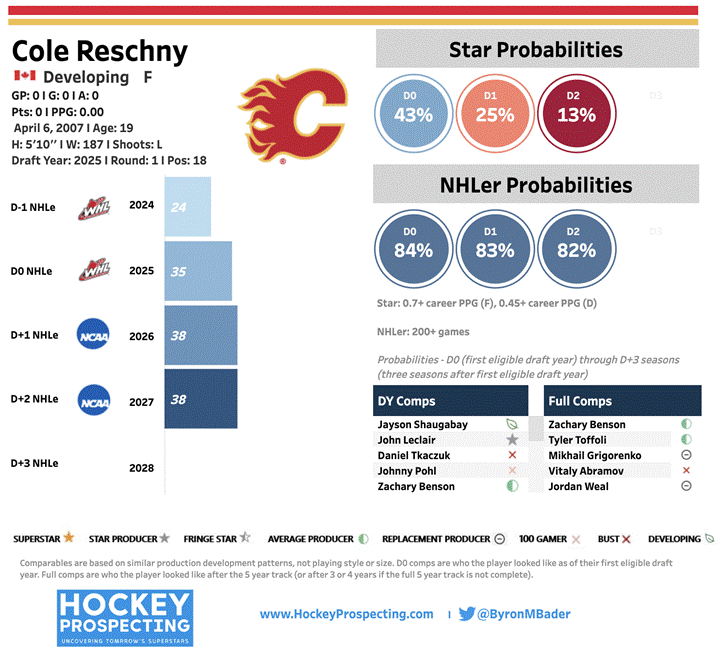
The comparison between Reschny and fellow Calgary prospect Ethan Wyttenbach is particularly interesting given their contrasting offensive trajectories. While Reschny’s hockey intelligence, offensive skill, and responsible center play give him a strong foundation for an NHL career, his declining star probability raises questions about his ultimate fantasy ceiling. This isn’t necessarily an argument for valuing Wyttenbach ahead of Reschny, but the discrepancy in their acquisition costs makes Wyttenbach particularly appealing. Reschny remains an attractive dynasty prospect, especially in formats rewarding faceoff wins. However, unlike several prospects featured this week, his offensive development appears to have plateaued rather than accelerated. Given the premium associated with his first-round pedigree, I’d like to see another meaningful step forward before investing heavily.
Final Thoughts
Wyttenbach and Benák stand out as appealing late-round investments, while Jackson Smith offers tremendous multicategory upside. Epperson and Kucharcik may be undervalued given their impressive shot generation, whereas the elevated shooting percentages of Spence, Schock, and McKinney warrant some caution.
Ultimately, finding prospects whose offensive development is outpacing their perceived fantasy value is one of the keys to building a successful dynasty roster. Several players featured this week fit that description.
Thanks for reading! See you next week. For more fantasy hockey analysis, or if there's a prospect, topic or theme you'd like me to cover, follow and message me on X: @VictorNuno12.
Related Posts
Starting Goalies



Top Skater Views
| Players | Team | |
|---|---|---|
| TOM WILSON |
 WSH | |
| JIRI KULICH |
 BUF | |
| STIAN SOLBERG |
 ANA | |
| SIMON NEMEC |
 CGY | |
| JACK QUINN |
BUF
| |
Top Goalie Profile Views
 WPG
 COL
 L.A
 MTL
LINE COMBOS
| Frequency |
 CBJ Players | |
|---|---|---|
| 22.3 | MATTHEW KNIES KENT JOHNSON LUCA DEL BEL BELLUZ | |
| 21.9 | VALERI NICHUSHKIN ADAM FANTILLI CHARLIE COYLE | |
| 14.0 | JACK WILLIAMS COLE SILLINGER SEAN MONAHAN | |
DobberHockey Podcasts

Keeping Karlsson: Short Shifts – Thanksgiving Episode
Ryan Downey romps through the league after a busy Wednesday night of NHL action on this Thanksgiving episode of Short Shifts.
Keeping Karlsson: Dylan Goes Québectric
Elan and Brian serve up their instant takes on the live-breaking Dylan Larkin deal; also, IR stashes gone wrong, a mess of new injuries, and everyone puts up numbers against Anaheim.

Fantasy Hockey Life: Scout’s Tout
On today’s Scout’s Tout, Jesse and Victor give reports on draft eligibles: Landon DuPont, Dima Zhilkin, Nazar Privalov, Sergei Skvortsov, Carter Meyer, Sammy Nelson, and Diego Gutierrez. Then we turn to Michael Misa, JP Hurlbert, Ryan Brown, Viggo Bjorck, Xavier Villeneuve, and Michael Hage. FHL Scout reports by: Sasha, Kara, Tomer, Mike M, and Kendrick, […]
Keeping Karlsson: Matchup Maximizer 2026/27 Week 9
Elan takes a look at the schedule for the upcoming weeks of NHL action and recommends players with good schedules that you should consider streaming in to win your head to head matchups.
Keeping Karlsson: Short Shifts – Bedard’s Injury Fallout and Crazy Goalie Results
Elan and Lewis cover all the big fantasy news since last Sunday’s mega-show including a big time injury and some crazy goalie results.