

Frozen Tools Forensics: Breakout and Regression Candidates in the Atlantic Division Including Verhaeghe, Guentzel, Geekie, and More
Chris Kane
2025-07-25
This week we are wrapping up our division reviews and identifying candidates to bounce back and candidates to avoid on draft day. We have already reviewed the Pacific, Central, and Metro Divisions, so today we move on to the Atlantic.
As a reminder here is a little context setting from the original article.
In order to make this process a bit more concrete we are going to focus on three stats from the Dobber Reports: five on five team shooting percentage (5on5 S%), individual points percentage (IPP), and individual shooting percentage (S%). These are certainly not the end-all-be-all of player evaluation but do tend to flag players who are likely to see a different point pace in the future.
Before jumping into the players, let's do a quick refresher on what these stats tell us. We use team shooting percentage to get an idea of how many points are being scored while a player is on the ice and stick to 5-on-5 because that is the largest game state for players. Power-play points count just the same on the score sheet so we could look at that as well, but in the interest of cutting down our data points we are going to focus on even the strength number here. IPP, which we will sometimes refer to as a player's points participation number, is how often a player is getting a point on a goal that is scored while they are on the ice. Finally, shooting percentage is just that: what percentage of a player's shots are going into the net?
With all of these stats, it is important to take them into context. Not just what would an average player do, but how does this number compare to their career numbers? In order to do that I grabbed the same data points for the 2024-25 season and am comparing them to each player's recent career average. Broadly speaking, and barring alterations in the player's situation (changing teams, sudden promotion to a top line etc.) we would expect these numbers to return that career average.
For our first group we are looking at players whose underlying numbers were lower than their recent career averages. Generally speaking we might expect these numbers to revert back to those averages and therefore those players to have a bit more production in the future.
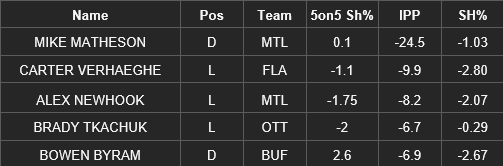
Mike Matheson's 32-point pace was a huge step back from his 62-point season the year before. Yes, participating in about half as many goals scored while he was on the ice was part of it. Just as big was losing the power-play time. He went from 28 power-play points in 23-24 to 10 in 24-25. If that IPP was closer to his recent history he puts up maybe 45 points but losing that power-play time puts a giant cap on his ceiling. With Noah Dobson now in the picture he is likely drops to third on the depth chart putting some of his overall time and second power-play duties in jeopardy. All things considered here, a 40-point pace next season might be a success.
Carter Verhaeghe is another one who saw a big points dip. He put up 54 in 24-25 after consecutive 75ish point seasons. He played about the same amount of total time, maintained his shot rates, and for the most part it looks like the culprit is low percentages across the board. The one concern is power-play time. On the season it looks like he only lost a few percentage points, but after March 3rd he was not getting top unit deployment, seeing only about 25% of the team's total time. While that certainly contributed to a slightly lower point totals the primary concern is that losing that role might cancel out any rebounds from those other percentages in 25-26.
Alex Newhook was not really relevant in just about any fantasy format in 24-25. He is on this list though, and had a 50-point pace season in 23-24 so maybe he might be in the future? Unfortunately, the answer is 'probably not'. The reason Newhook managed that 50-point pace in 23-24 came down to three things: a career high shooting percentage, almost 17 minutes a night overall, and top power-play deployment. A big part of that deployment was due to injuries. Fast forward to 24-25: players are healthy, the Canadians add Patrik Laine and, surprise surprise, Newhook is back to 15 minutes a night with 35% of the power-play time. Could he have hit a 40-point pace in 24-25 with some better luck? Maybe (but probably only a 35-point pace). But with top level reinforcements arriving in Montreal at every turn here better deployment seems quite unlikely.
Brady Tkachuk's 62-point pace was his lowest in four seasons. While it is true that he lost about a minute a night overall (which may have contributed to minimal decreases in shot and hit rates), it looks like just about all of that came down to variance. Brady's season could easily have been close to an 80-point pace. 25-26 should see a return to stronger point production to go along with his elite peripheral contributions.
Bowen Byram makes the list even though his team shooting percentage was actually a little too high. The kind of wild thing is that his personal 7.4 shooting percentage was the lowest of any season where he has actually scored a goal. In the three seasons prior to 24-25 he averaged 13% shooting as a defenseman. In that context, 7.4% seems pretty bad. He doesn't shoot much, which is kind of an issue, but he very easily could have added four or five goals to his total and broken the 40-point barrier for the first time.
On the flip side we also have some players whose underlying numbers were a bit higher than we expected, meaning that their production might not be the most sustainable.
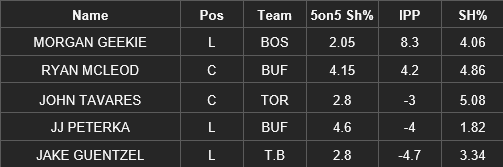
Morgan Geekie broke out in a big way in 24-25, particularly at the end of the season, scoring 11 goals in his final 14 games. From February on, he averaged almost 19 minutes of total ice time, playing predominantly on the top line, and put up 31 points in 29 games. Unfortunately, his career high 61-point full season pace also came with some dramatically inflated percentages. If all of these percentages were in line with his past career numbers, he might have put up a 45(ish)-point pace. Now we might expect some of those numbers to increase a bit spending time with David Pastrnak, and if Geekie gets to be there all season that would be good news, but he was there in 24-25 pretty consistently starting in November. Looking back at that February stretch, where he was getting his highest ice time (and where he put up 31 points in 29 games) we see him with 18 goals in those 29 games thanks to shooting 31%. Even if he shot at his previous career high (13%) he drops to seven goals. Over 29 games that drops his point pace to 55. Unless something dramatic changes (consistent top power play would really help), the range of reasonable paces seems to be between 45 and 55 points.
It is much the same story with Ryan McLeod. His 55 points marks a career high, but from January 9th on he had 33 points in 35 games (a full-season pace of 75 points). Exactly like Geekie, a big part of that was his own high shooting percentage, which if he returned to his previous career high would have resulted in about a 60-point full season pace over that stretch. Across the full season his production seems to be worth closer to a 40-point pace than 55. As with Geekie though we want to give him some credit for increasing his time on ice later in the season. If he were to get that 18-plus minutes a night that he was getting at the end of the season, 55 points does start to seem a bit more reasonable, particularly if he gets the top power-play time, which he did a few times after March. I think he maybe has a slightly higher range than Geekie, but like Geekie, he is going to need things to break right (more power-play time, more shots, high shooting percentage etc.) to improve on what he did in 24-25.
John Tavares' story is a pretty simple one. He shot almost 20% and put up nearly a point-per-game season. If he shot closer to his recent career averages he would have been closer to a 65-point pace, which is right in line with his 23-24 season. While he still maintained his overall ice time, his 2.7 shots per game was essentially the lowest of his career. Still decent for sure, but if he wants to put up more than 65 points in '25-26 he will need to bring that rate back up.
JJ Peterka broke out with a pretty 72-point pace over 77 games. The problem is that his team shooting percentage at 5-on-5 was over 14%. That is enormous. That amounts to something like 30 more goals than expected being scored while he was on the ice. All things being closer to his career averages and we are talking closer to a 55-point pace. As much as Peterka is an exciting young player, moving to a system with more exciting young players, we might want to be a little bit more cautious on draft day. Players often take a minute to adjust to a new system, and expectations were likely already going to be a bit inflated based on his 24-25 performance.
Jake Guentzel is a bit of an odd one. He was actually a little less involved in the scoring than we might have expected, but both his personal and team shooting percentages were higher than expected. Big picture he moved to a new team, got good deployment, but the vibes are that he kind of disappointed. In reality he did put up about ten fewer points (pace wise) than 23-24, but he has been bouncing around the 80- to 90-point pace range for years so he still was well within his usual range. The interesting point is that this somewhat 'disappointing' season was actually a bit better than we maybe should have expected. If his underlying numbers were more in line with his recent career averages, we would have seen something a little closer to a 74-point pace. He is in a new environment so there really isn't anything to say that these new numbers won't continue at least in some fashion, but he did also drop his shot rates, which is a little worrying. A 75-point, 2.5-shots-per-game player is certainly a different kind of asset than one capable of 90 points and 3.5 shots per game, which Guentzel has been in recent seasons.
That is all for this week.
Do your part to support organizations working to make hockey for everyone.
Related Posts

Starting Goalies



Top Skater Views
| Players | Team | |
|---|---|---|
| ROOPE HINTZ |
 DAL DAL | |
| ALEX LAFERRIERE |
 L.A L.A | |
| LUKE HUGHES |
 N.J N.J | |
| OWEN TIPPETT |
 PHI PHI | |
| KEVIN FIALA |
L.A
| |
Top Goalie Profile Views
 WSH
WSH CBJ
CBJ MIN
MIN UTA
UTA

LINE COMBOS
| Frequency |
 CGY Players CGY Players
| |
|---|---|---|
| 21.5 | MATVEI GRIDIN MORGAN FROST MATT CORONATO | |
| 21.4 | JOEL FARABEE BLAKE COLEMAN MIKAEL BACKLUND | |
| 16.2 | YEGOR SHARANGOVICH ADAM KLAPKA RORY KERINS | |
DobberHockey Podcasts

Keeping Karlsson: The 2026-27 Keeping Karlsson Breakfast Club
Don’t you forget about them! Elan and Brian remind you of at least one player on each NHL team whose name you might forget to consider at the draft table.

Fantasy Hockey Life: Tampa Bay Lightning with Erik Erlendsson
Erik Erlendsson joins the program to discuss the Tampa Bay Lightning. Jesse and Victor ask about pros Nikita Kucherov, Jake Guentzel, Brandon Hagel, Brayden Point, Anthony Cirelli, Ilya Mikheyev, Gage Goncalves, Conor Geekie, Benjamin Rautiainen, John Carlson, Victor Hedman, Charle-Edouard D’Astous, Andrei Vasilevskiy, Jonas Johansson, and Dennis Hildeby. In Cat’s instincts, Cat Silverman of InGoal […]
Fantasy Hockey Life: New York Rangers with Colin Stephenson
Colin Stephenson joins the program to discuss the New York Rangers.
Keeping Karlsson: Matchup Maximizer Schedule Deep Dive
Elan is joined by the Keeping Karlsson Accountability Czar Trev to take a deep dive into the NHL schedule for next season and how it should affect our drafting decisions.
Fantasy Hockey Life: Carolina Hurricanes with Ryan Henkel
Ryan Henkel joins the program to discuss the Carolina Hurricanes. Jesse and Victor ask about pros Sebastian Aho, Seth Jarvis, Andrei Svechnikov, Nikolaj Ehlers, Jackson Blake, Logan Stankoven, Jordan Staal, Bradly Nadeau, Felix Unger Sorum, Shayne Gostisbehere, K’Andre Miller, Alexander Nikishin, Sean Walker, Brandon Bussi, and Pyotr Kochetkov. In Cat’s instincts, Cat Silverman of InGoal […]