

Frozen Tools Forensics: Regression and Rebound Candidates in the Central Division Including Nyquist, Rossi, Josi, Parayko, Turcotte, and More
Chris Kane
2025-07-11
This week we are returning to our division reviews and identifying candidates to bounce back and candidates to avoid on draft day. We have already reviewed the Pacific Division, so today we move on to the Central.
As a reminder here is a little context setting from the original article.
In order to make this process a bit more concrete we are going to focus on three stats from the Dobber Reports; 5-on-5 team shooting percentage (5on5 S%), individual points percentage (IPP), and individual shooting percentage (SH%). These are certainly not the end-all, be-all of player evaluation but do tend to flag players who are likely to see a different point pace in the future.
Before jumping into the players, let's do a quick refresher on what these stats tell us. We use team shooting percentage to get an idea of how many points are being scored while a player is on the ice. We use 5-on-5 because that is the largest game state for players. Power-play points count just the same on the score sheet so we could look at that as well, but in the interest of cutting down our data points we are going to focus on even the strength number here. IPP, which we will sometimes refer to as a player's points participation number, is how often a player is getting a point on a goal that is scored while they are on the ice. Finally, shooting percentage is just the standard: what percent of a player's shots are going into the net?
With all of these stats, though, it is important to take them into context. Not just what would an average player do, but how does this number compare to their career numbers? In order to do that I grabbed the same data points for the 2024-25 season and am comparing them to each player's recent career average. Broadly speaking and barring changes in the player's situation (changing teams, sudden promotion to a top line etc.) we would expect these numbers to return that career average.
For our first group we are looking at players whose underlying numbers in question were lower than their recent career averages. Generally speaking, we might expect these numbers to revert back to those averages and therefore those players to have a bit more production in the future.
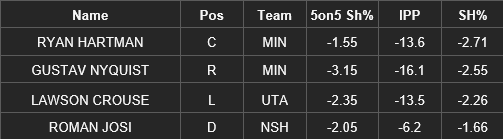
Ryan Hartman saw dips across the board this year, not just in his underlying numbers but in most of his stats. He lost time on ice, playing less than 15 minutes a night for the first time since 2019-20, and only put up a 31-point pace. His shot rates per game stayed reasonably similar so that didn't end up being a problem, but basically everything else is. Some of it likely has to do with the emergence of Marco Rossi taking up a bunch of the top-6 deployment, but some of it is clearly variance. He saw lower than expected shooting percentages, and IPP. The challenge is that while everything was low, it wasn't incredibly low, and he wasn't getting enough total time on ice, or power-play time to really help make up the difference. Even if all things went a little closer to usual I am guessing he would have put up closer to a 40- to 45-point pace. Still down from his recent three seasons ranging 50-65 points. If he can get consistent access to Matt Boldy or Kirill Kaprizov, maybe he gets back to 50 points, but otherwise I don't see enough here to be really meaningful with a bounce-back alone.
Gustav Nyquist is an interesting case. He has been in so many situations and on so many teams the last several years. 24-25 was always likely going to be a drop off after 23-24. Nashville brought in a bunch of big names that were likely going to disrupt his top line/top power play deployment. It did to the tune of dropping from a 76-point pace to a 29-point pace. He also lost a minute of total time on ice, almost a minute and a half on the power play, and half of a shot per game. This seems to be setting up to be another Hartman, that even with a bounce back, Nyquist wouldn't be relevant, and yet I think he could have been. I think that given some more usual variance he would have been closer to a 55- to 60-point player. He actually only has one season in the prior five that falls significantly below that range (a 43-point pace in 22-23). Obviously changing teams again makes him a big question mark going into 25-26, and while I don't think he will be a hot commodity on draft day, certainly keep an eye on him in the early going to see if things click a little better for him in Winnipeg than they did in 24-25.
Lawson Crouse makes the cut here mostly because his numbers stand out and not because he was particularly fantasy relevant in 24-25. He still had strong hit numbers, so if that is helpful in your format there is something, but everything else dropped. He has had some value in the past as a 40- to 45-point player with decent shot rates, and good hit numbers. In 24-25 he had an 18-point pace and 1.6 shots per game, neither of which were helpful. The problem is that even with friendly variance I don't think he makes it back there. He lost over three minutes per game on average, down below 14 minutes a night, which is just going to crush his ability to put up shots and points. I think he may be a casualty of the improved roster in Utah. He has had value when getting decent deployment, so definitely watch early Utah lines, but if he continues this low time on ice, hitting is probably the only thing he sustains.
Roman Josi is 35, dealing with some health issues, and put up his lowest point pace in the last four seasons. I am here to tell you please don't let him fall too far in your draft. Nashville as whole was hit by some nasty variance, and word is he is doing very well and should be fine for the 25-26 season. Even better if we account for some of that variance Josi could still have put up in the point-per-game range. Sure, maybe he drops a few spots because he is 35 years old and he has to slow down at some point, has a recent health concern, and a Nashville question mark, but don't let him fall too far.
Unfortunately, we also have some players whose underlying numbers were a bit higher than we expected, meaning that their production might not be the most sustainable.
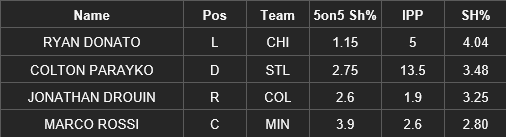
Ryan Donato should surprise no one on this list. He had a huge breakout and finished with a 62-point pace after a career of putting up 30-37 point paces. He even put up a point per game after January 18th. Yes, getting over 16 minutes a night on average (and 18 to 20 by the end of the season) was a big part of his point increase. Unfortunately, so was a career high 17% shooting percentage. If that had been a bit closer to his career average, he is only a 50-point player. Now clearly getting to play with better players at even strength and in particular getting to play on the top power-play can increase a player's shooting percentage naturally, but this is very much a wait and see situation. It is probably wise to let someone else draft Donato as a 65 plus point player.
Colton Parayko was found money for managers in '25-'26. He put up a 46-point pace to go along with very solid peripherals. Unfortunately nothing changed to suggest that this career high point pace might be legitimate. He shot 12%, almost double his previous career high, and got in on way more goals that he usually does, both at even strength and on the power-play. Parayko's peripherals will likely still remain excellent so draft him if you want those, but a 30-point player is much more likely in 25-26.
Jonathan Drouin can't seem to settle. In Montreal he had two sub-3% shooting seasons, and then in Colorado he has a 15% and a 19.6%. Even if he is a 15% shooter in Long Island, he is closer to a 65-point player. The big draw moving to the Islanders is top power-play time. Each season where he has gotten in the 60% range of the team's power-play time he has put up around 20 power-play points. That is a good place to start, and does provide some optimism that he can do it again. The problem is that he hasn't been super consistent outside of that, struggling without access to top talent at even strength. Free agent signings often get a little bump on draft day, with that top-of-mind influence, but I might wait on him.
I am prepared to give Marco Rossi a bit of a pass here. Yes, his shooting percentage was high, but this is only his second full season. This isn't like Donato where we have a long track record of being sub-40 points and then a change in deployment and some fortune rockets him up the scoring ranks. Rossi jumped 20 points with a 20% increase in his share of the team's power-play, and getting top line deployment with Kaprizov. He is also only 23 to Donato's 29. To be truly valuable in most fantasy formats he also needs to increase his shot rate, eclipsing at least 2.0 would be helpful to say the least. Overall though I am not knocking him down too much and would be willing to buy near that 60-point pace.
That is all for this week.
Do your part to support organizations working to make hockey for everyone.
Related Posts

Starting Goalies



Top Skater Views
| Players | Team | |
|---|---|---|
| ROOPE HINTZ |
 DAL DAL | |
| ALEX LAFERRIERE |
 L.A L.A | |
| LUKE HUGHES |
 N.J N.J | |
| OWEN TIPPETT |
 PHI PHI | |
| KEVIN FIALA |
L.A
| |
Top Goalie Profile Views
 WSH
WSH CBJ
CBJ MIN
MIN UTA
UTA

LINE COMBOS
| Frequency |
 VGK Players VGK Players
| |
|---|---|---|
| 11.5 | COLE SMITH NIC DOWD BRAEDEN BOWMAN | |
| 11.0 | MARK STONE JACK EICHEL PAVEL DOROFEYEV | |
| 8.2 | REILLY SMITH COLTON SISSONS TOMAS HERTL | |
DobberHockey Podcasts

Keeping Karlsson: The 2026-27 Keeping Karlsson Breakfast Club
Don’t you forget about them! Elan and Brian remind you of at least one player on each NHL team whose name you might forget to consider at the draft table.

Fantasy Hockey Life: Tampa Bay Lightning with Erik Erlendsson
Erik Erlendsson joins the program to discuss the Tampa Bay Lightning. Jesse and Victor ask about pros Nikita Kucherov, Jake Guentzel, Brandon Hagel, Brayden Point, Anthony Cirelli, Ilya Mikheyev, Gage Goncalves, Conor Geekie, Benjamin Rautiainen, John Carlson, Victor Hedman, Charle-Edouard D’Astous, Andrei Vasilevskiy, Jonas Johansson, and Dennis Hildeby. In Cat’s instincts, Cat Silverman of InGoal […]
Fantasy Hockey Life: New York Rangers with Colin Stephenson
Colin Stephenson joins the program to discuss the New York Rangers.
Keeping Karlsson: Matchup Maximizer Schedule Deep Dive
Elan is joined by the Keeping Karlsson Accountability Czar Trev to take a deep dive into the NHL schedule for next season and how it should affect our drafting decisions.
Fantasy Hockey Life: Carolina Hurricanes with Ryan Henkel
Ryan Henkel joins the program to discuss the Carolina Hurricanes. Jesse and Victor ask about pros Sebastian Aho, Seth Jarvis, Andrei Svechnikov, Nikolaj Ehlers, Jackson Blake, Logan Stankoven, Jordan Staal, Bradly Nadeau, Felix Unger Sorum, Shayne Gostisbehere, K’Andre Miller, Alexander Nikishin, Sean Walker, Brandon Bussi, and Pyotr Kochetkov. In Cat’s instincts, Cat Silverman of InGoal […]