

The Journey: NCAA Mid-Season Leaders
Victor Nuno
2026-01-24
Welcome back to The Journey, where we track how prospect development curves translate into real fantasy relevance. The NCAA is often a slower-burning environment than the CHL, but mid-season trends can be extremely revealing, especially when equivalency models begin to spike for draft-plus-one and draft-plus-two players. This year's college crop has produced a mix of expected risers, legitimate breakouts, and a few rebound stories that dynasty managers should be paying close attention to.
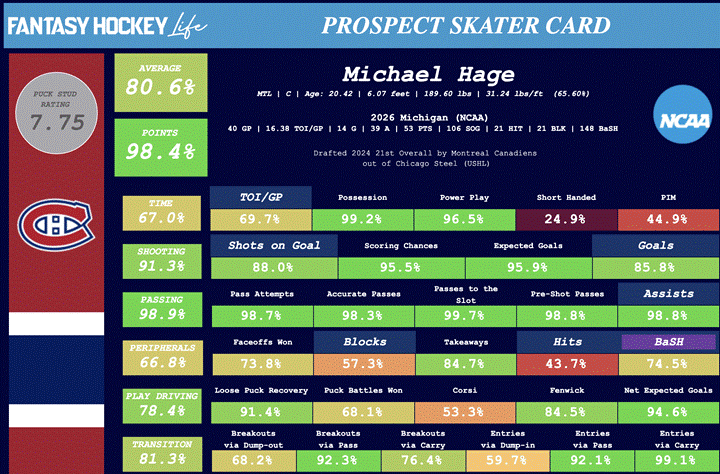
Several notable names already fit this theme, including Max Plante, Cole Hutson, Porter Martone, Michael Hage, William Horcoff, and Václav Nestrašil, but they were recently covered in articles focused on the Under 20 World Junior Championship (U20WJC) and will not be revisited here. Below are the NCAA prospects whose production and developmental trajectories have shifted most meaningfully at the midway point of the season.
Ethan Wyttenbach – LW/RW, Calgary Flames
Wyttenbach has emerged as a legitimate offensive contributor, combining pace with opportunistic finishing and a growing ability to attack off the rush. His transition from the USHL to the NCAA has been outstanding, and he has clearly been one of the standouts this season for Quinnipiac. That on-ice progression is backed by the data, with his pNHLe rising from 64 to 74, a meaningful jump that reflects both improved scoring impact and a stronger projection signal. While he may not profile as a primary offensive driver long term, his current trajectory supports a middle-six complementary role with real upside in deeper fantasy formats.
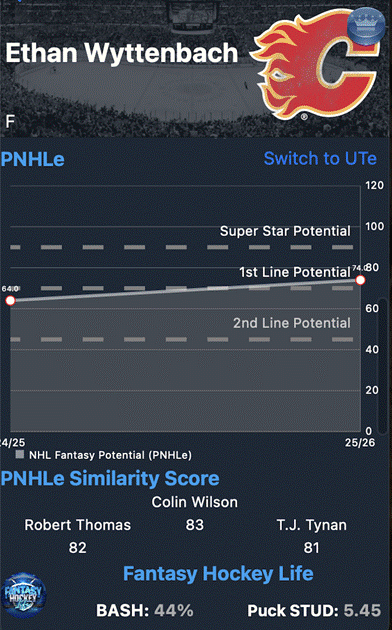
There is still a need to keep expectations grounded. The stylistic comparison to Robert Thomas is likely a stretch given Wyttenbach's more linear offensive profile and limited high-end playmaking ceiling. A Colin Wilson-type outcome feels like a much more realistic floor, a useful, versatile middle-six forward who contributes secondary scoring and transition value without becoming a true fantasy centerpiece. If his skating continues to translate and his scoring touch holds at higher levels, he has a path to steady NHL utility, but his long-term fantasy appeal is likely to peak in depth formats rather than as a core asset.
Keaton Verhoeff – D, Draft Eligible
For a draft-minus-one defenseman, Verhoeff's production is encouraging, especially given his role and minutes. He shows confidence moving pucks and joining the rush when opportunities present themselves, and his early offensive instincts are translating against much older competition. As an extremely young 17-year-old who does not turn 18 until late June, what he is doing right now is legitimately impressive. Logging meaningful minutes on a competitive North Dakota team and holding a depth role at the U20WJC at that age puts him well ahead of the normal developmental curve.
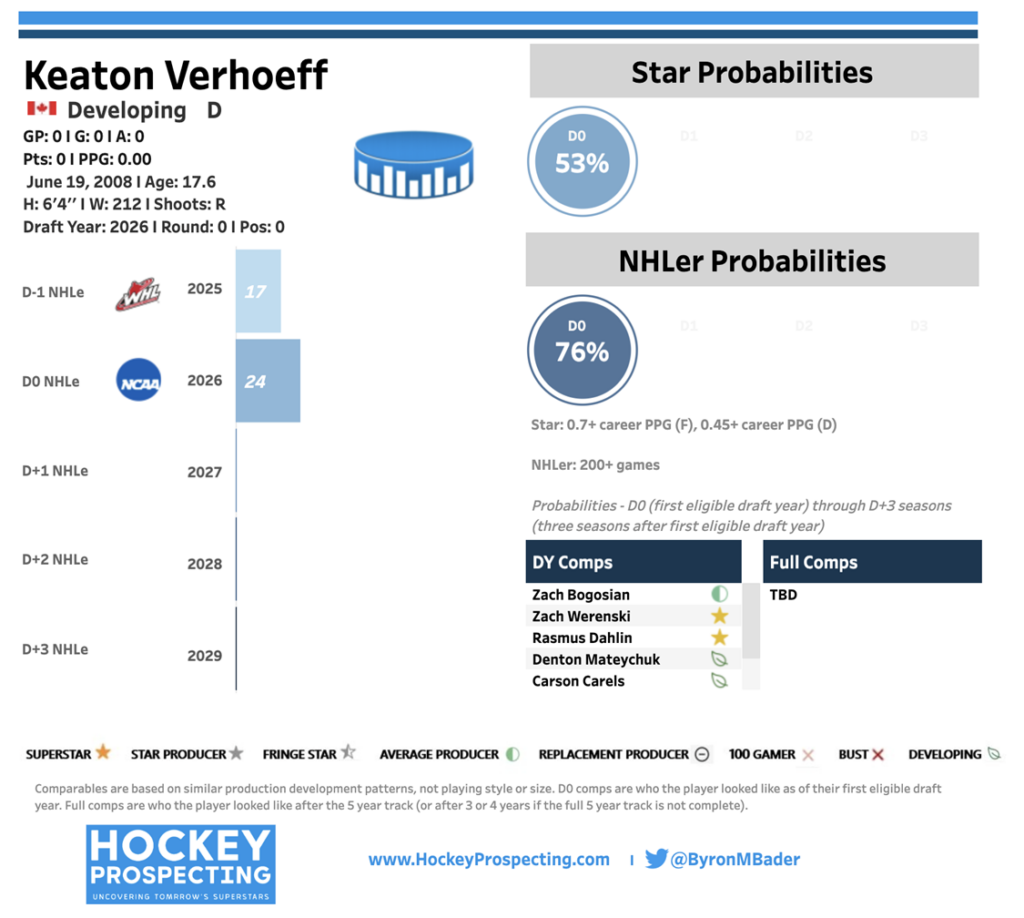
The underlying indicators are even more eye-opening. His Hockey Prospecting star probability sits at an incredible 53%, and his early comparables include names like Zach Werenski and Rasmus Dahlin, which underscores just how rare his projection signal is for a player this young. The offensive ceiling is still unclear and it is far too early to assume true number-one defenseman outcomes, but the early blend of production, usage, and age-adjusted data points to massive long-term potential. If he happens to slide on draft day, he's someone you might want to trade up for.
Jayson Shaugabay – C, Tampa Bay Lightning
Shaugabay's late-blooming production surge has been one of the more surprising developments in the NCAA this season. Now over a point-per-game at Minnesota Duluth, he is playing with noticeably more confidence and assertiveness, finding ways to contribute offensively both off the rush and through sustained zone pressure. His Fantasy Hockey Life skater card backs that up, showing strong play-driving and transition impact, which helps explain why his scoring rate has spiked despite modest deployment. At draft plus three, the margin for error is slim, but this level of output at least forces him back onto the radar.
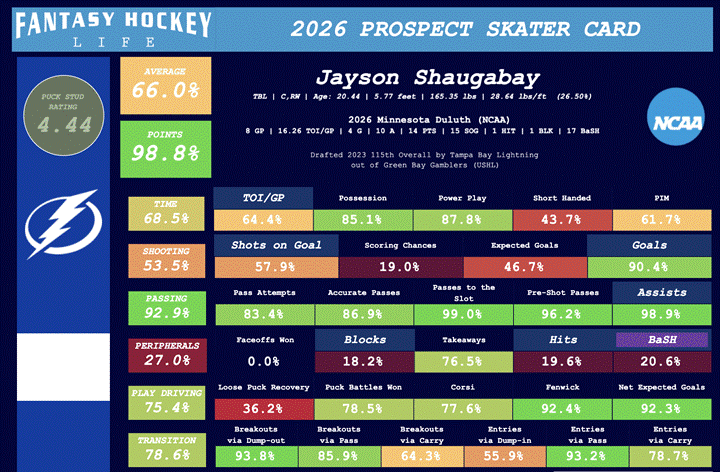
There are still meaningful limitations in his profile. He struggles with loose puck recoveries and offers very little physical engagement, which is not surprising given his 5-9 frame. That lack of puck-battle leverage and defensive bite caps how much trust he is likely to earn at the professional level. As a result, his projection still leans toward a depth scoring role rather than a sustainable middle-six outcome. Long term, he profiles as a fringe asset with niche upside in deep formats, someone worth monitoring closely this year but not yet a priority target unless the play-driving gains translate cleanly to pro competition.
Justin Poirier – RW, Carolina Hurricanes
Poirier's scoring profile continues to be driven by his shot, which remains his most translatable and bankable skill. He consistently finds ways to get attempts off quickly and from dangerous areas, and that trait carried over cleanly in a fantastic first season at Maine after standing out in the QMJHL. His 1.2 points-per-game pace as a draft plus two forward underscores just how well his goal-scoring instincts are translating against older competition, and his pNHLe continuing to hover around 80 reinforces that this is not just a surface-level heater. He is also exceptionally young for his draft class, born just 11 days before the cutoff for 2026 eligibility, which adds meaningful context to his production curve. If he had been part of the 2026 draft class, he very likely would have gone significantly higher than 156th overall.
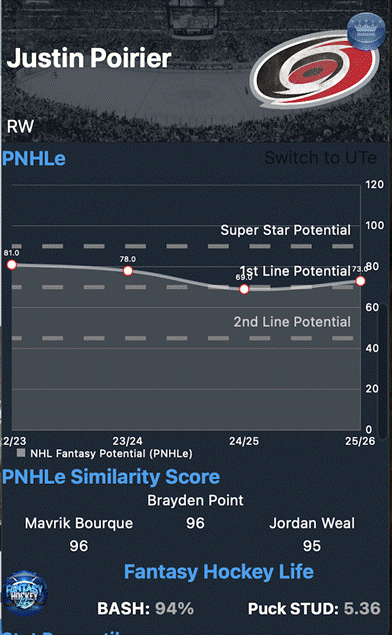
There are still clear limitations in his overall profile. The playmaking and defensive engagement lag behind his finishing, and his 5-8 frame continues to cap how much margin for error he has at higher levels. That size constraint will make it harder for him to earn consistent five-on-five trust unless his off-puck game and puck support improve. While it is unrealistic to project Brayden Point-level outcomes, a Mavrik Bourque-type offensive impact is not out of the question if enough of the complementary pieces come along.
Cole Reschny – C/LW, Calgary Flames
Reschny has quietly put together a strong offensive season, and his transition from the WHL to the NCAA has looked remarkably seamless. Now a standout at North Dakota, he is producing over a point-per-game pace at draft plus one, driven by smart positioning, strong off-puck timing, and consistently making himself available as a secondary option in scoring areas. His game is built more on intelligence and structure than flash, but he supports play extremely well, finds soft spots in coverage, and scales his production without needing to dominate possession. The underlying projection data reinforces that this is not just a situational spike, as his Hockey Prospecting star probability has climbed to 67%, a very strong signal for a player at this stage.
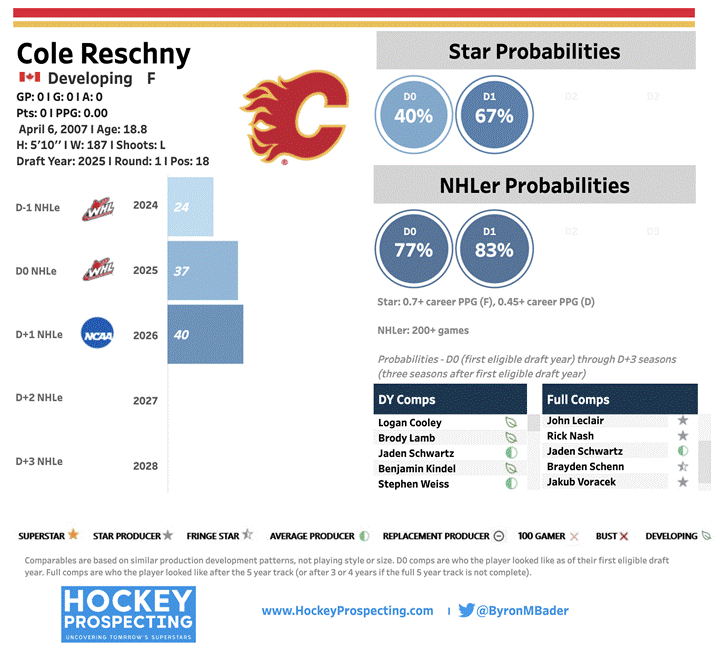
While he may never profile as a true primary offensive driver, his toolkit supports a clean middle-six projection with meaningful offensive utility. His early comparables in Hockey Prospecting include Rick Nash and Jakub Voracek, underscore the strength of his age-adjusted production curve, even if those outcomes represent upper-bound scenarios rather than expectations. More realistically, he looks like the type of forward who can complement higher-end linemates, contribute steady secondary scoring, and add value through responsible two-way play.
Charlie Cerrato – C, Carolina Hurricanes
Cerrato has taken a clear step forward offensively, showing improved confidence, stronger involvement in play creation, and more consistent translation of his puck skills and processing. This is his second straight season over a point-per-game, and that level of sustained production can no longer be ignored. His Fantasy Hockey Life skater card reinforces the breakout, highlighting how effective he can be as a play driver and in generating net expected goals. The production spike feels earned rather than situational, and he is re-establishing himself as a legitimate prospect worth tracking closely.
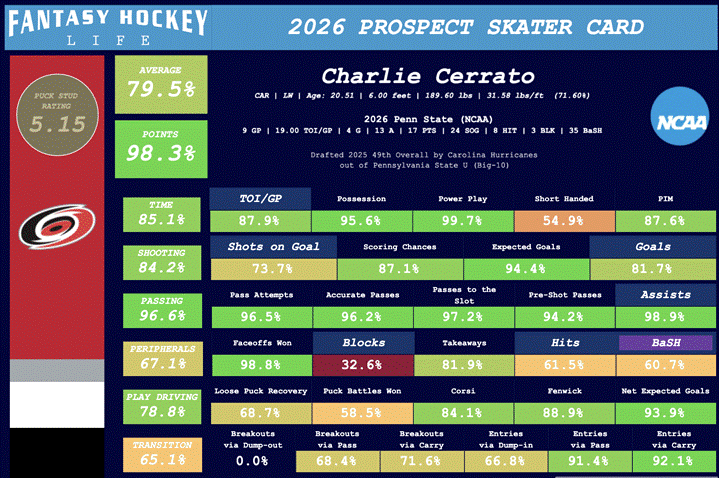
There are still development gaps that temper the ceiling. His transition data is mixed, with some strong indicators alongside clear inefficiencies, and he continues to struggle with puck battles and loose puck recoveries. Those weaknesses limit how much trust he is likely to earn at higher levels unless his off-puck engagement and physical competitiveness improve. That said, the offensive signal is now strong enough that he profiles as more than just a long-shot. He looks like a viable middle-six upside swing in deeper formats, with his long-term value tied to whether his play-driving gains can hold up against faster, more physical pro competition.
Charlie Stramel – C/RW, Minnesota Wild
Stramel's resurgence has been one of the more notable rebound stories in the NCAA this season. Once considered a top prospect, his development stalled badly at Wisconsin, but his move to Michigan State has clearly reset his trajectory. Now well over a point per game at draft plus three, he is producing with far more purpose, confidence, and physical engagement than he showed in prior years. This is his first season above a point-per-game pace since his Bantam days, which underscores just how dramatic the turnaround has been. The production spike feels earned, driven by more assertive puck touches, better net-front presence, and a simplified north-south game that finally matches his physical tools.
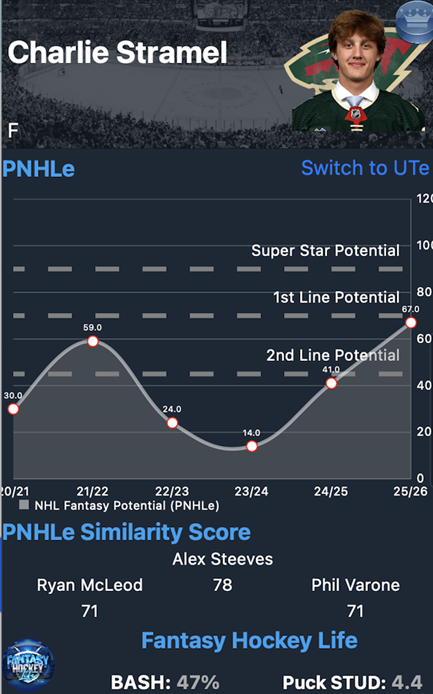
The underlying projection data supports the eye test. His pNHLe has rebounded all the way up to 67 after sitting at just 14 two seasons ago, a massive swing that puts him back on the prospect radar in a meaningful way. While true star upside still looks unlikely, he is rebuilding his profile as a functional NHL player with a realistic middle-six or bottom-six power forward outcome. His value will be better in deeper formats, especially in leagues that reward hits, goals, or peripheral contributions. Given how far his stock had fallen, it may genuinely be time to jump back on the bandwagon before the market fully catches up to his revival.
Dean Letourneau – C/RW, Boston Bruins
Letourneau has taken a noticeable step forward in both confidence and offensive involvement, and the raw production jump is impossible to ignore. After making the massive leap straight from high school to the NCAA, his freshman season went about as rough as expected, managing just three assists in 36 games. That transition was always going to be brutal, and the early struggles scared off a lot of managers. This season, though, he has rebounded in a major way, producing at a point-per-game pace through 20 games, with far more assertive puck touches, better off-puck timing, and more consistent involvement in scoring sequences. His Fantasy Hockey Life skater card backs that up, showing his play-driving metrics moving from outright awful to fairly good, a meaningful signal that the improvement is structural rather than just a hot streak.
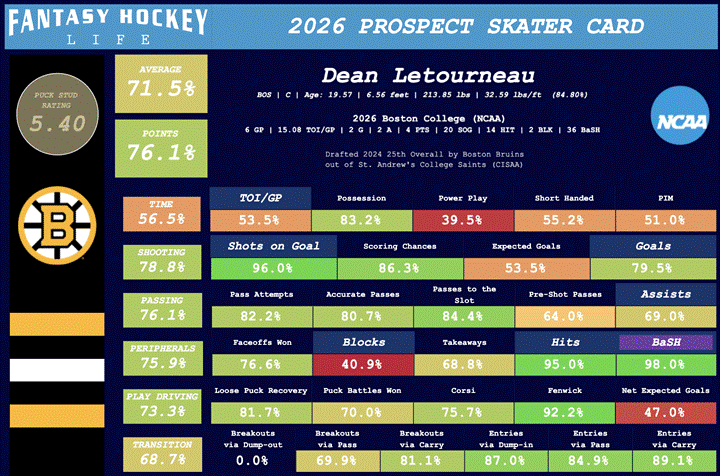
From a projection standpoint, this is exactly the kind of second-year correction you want to see from a long-horizon prospect. His 6-7 frame and all-around talent still give him a massive developmental ceiling, and the fact that he shoots a ton and throws a lot of hits adds another layer of fantasy appeal. If those tendencies carry over, he could become a true peripheral-category monster in banger and multi-cat formats. If anyone was scared off after his freshman season, this is a clear window to reacquire him before the market fully resets. He is still very much in the "bet on traits plus trajectory" tier, but his current arc makes him a name worth revisiting aggressively in deeper dynasty formats rather than just passively tracking.
Final Thoughts
The NCAA is one of the most difficult leagues in the world to score in, which makes mid-season production surges especially meaningful. Players who have meaningfully raised their scoring rates by this point in the year deserve real attention, as those jumps often reflect genuine developmental progress rather than simple variance. In many cases, these kinds of in-season breakouts should prompt dynasty managers to re-evaluate earlier assumptions and adjust prospect valuations before the market fully catches up.
Thanks for reading! See you next week.
For more fantasy hockey analysis, or if there's a prospect, topic, or theme you'd like me to cover, follow and message me on X: https://x.com/VictorNuno12
Related Posts

Starting Goalies



Top Skater Views
| Players | Team | |
|---|---|---|
| ROOPE HINTZ |
 DAL DAL | |
| ALEX LAFERRIERE |
 L.A L.A | |
| LUKE HUGHES |
 N.J N.J | |
| OWEN TIPPETT |
 PHI PHI | |
| KEVIN FIALA |
L.A
| |
Top Goalie Profile Views
 WSH
WSH CBJ
CBJ UTA
UTA


LINE COMBOS
| Frequency |
 MIN Players MIN Players
| |
|---|---|---|
| 20.7 | MATS ZUCCARELLO KIRILL KAPRIZOV RYAN HARTMAN | |
| 19.9 | MICHAEL MCCARRON MARCUS JOHANSSON MATT BOLDY | |
| 12.9 | DANILA YUROV YAKOV TRENIN VLADIMIR TARASENKO | |
DobberHockey Podcasts

Keeping Karlsson: The 2026-27 Keeping Karlsson Breakfast Club
Don’t you forget about them! Elan and Brian remind you of at least one player on each NHL team whose name you might forget to consider at the draft table.

Fantasy Hockey Life: Tampa Bay Lightning with Erik Erlendsson
Erik Erlendsson joins the program to discuss the Tampa Bay Lightning. Jesse and Victor ask about pros Nikita Kucherov, Jake Guentzel, Brandon Hagel, Brayden Point, Anthony Cirelli, Ilya Mikheyev, Gage Goncalves, Conor Geekie, Benjamin Rautiainen, John Carlson, Victor Hedman, Charle-Edouard D’Astous, Andrei Vasilevskiy, Jonas Johansson, and Dennis Hildeby. In Cat’s instincts, Cat Silverman of InGoal […]
Fantasy Hockey Life: New York Rangers with Colin Stephenson
Colin Stephenson joins the program to discuss the New York Rangers.
Keeping Karlsson: Matchup Maximizer Schedule Deep Dive
Elan is joined by the Keeping Karlsson Accountability Czar Trev to take a deep dive into the NHL schedule for next season and how it should affect our drafting decisions.
Fantasy Hockey Life: Carolina Hurricanes with Ryan Henkel
Ryan Henkel joins the program to discuss the Carolina Hurricanes. Jesse and Victor ask about pros Sebastian Aho, Seth Jarvis, Andrei Svechnikov, Nikolaj Ehlers, Jackson Blake, Logan Stankoven, Jordan Staal, Bradly Nadeau, Felix Unger Sorum, Shayne Gostisbehere, K’Andre Miller, Alexander Nikishin, Sean Walker, Brandon Bussi, and Pyotr Kochetkov. In Cat’s instincts, Cat Silverman of InGoal […]