

Ramblings: Fantasy Trade Deadline Targets in Smith, Kyrou, Holmstrom, Clarke, Mintyukov, and More – February 27
Michael Clifford
2026-02-27
The NHL Trade Deadline is a week from today, but many fantasy trade deadlines are either this week or next. With those deadlines looming, fantasy managers making a championship push will want to bolster their rosters. Below are 9 skaters – from top-of-the-lineup options to depth pieces – to target at this deadline.
We are going to use a lot of data from Frozen Tools, including the Schedule Planner and Ice Time Reports. We will also use tracking data from All Three Zones with additional player/team data from Evolving Hockey.
On the following graphs, the blue and red lines are the league average for each stat at each position. Data is current as of Thursday, February 26th.
Will Smith (San Jose Sharks)
Smith is going to be a hard player to trade for in keeper/dynasty formats, and for good reason. When we take into account a variety of tracking stats like scoring chance assists per 60 minutes at 5-on-5 (SCA/60, or the rate at which a player assists on a teammate's scoring chance), carried entry percentage (how often a player carries the puck in on a zone entry), and points per 60 minutes, the comparable forwards to Smith this season is a very impressive list:
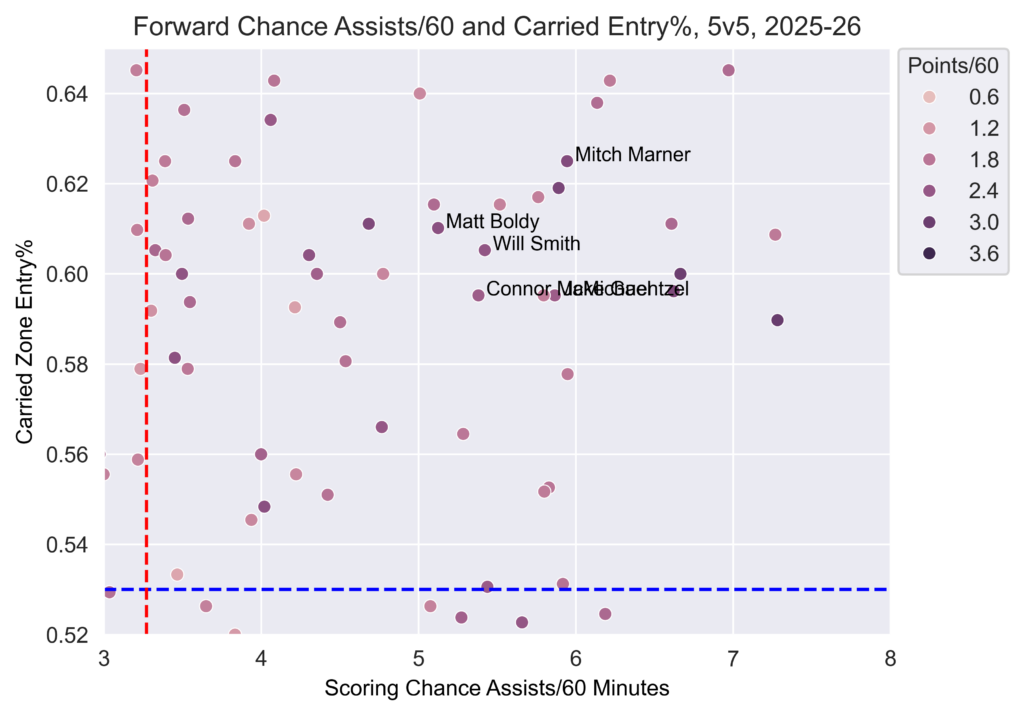
The overlapped names are Jake Guentzel and Connor McMichael. The other names are Matt Boldy and Mitch Marner. Three of those players are bona fide star wingers both in real life and in fantasy, and McMichael has been one of the more promising young players in the league over the last couple of seasons. By playmaking, carried zone entries, and point production at 5-on-5, Smith stacks up well to them all.
An important note here is San Jose's rest-of-season schedule. From here on out, the Sharks have the most games remaining (26), are tied for the second-most home games (14), tied for the fifth-most games on light days (9), have the third-easiest schedule by opponent points percentage (.530), and their remaining opponents are giving up the most goals per game. From a fantasy perspective, the Sharks might have the best remaining schedule of any team in the league.
The crux, of course, is that Smith skates a lot of his minutes next to Macklin Celebrini. If he were to be moved down the lineup to skate with Alex Wennberg or Michael Misa, the equation changes drastically. However, Smith is next to Celebrini coming out of the break and they've been a constant duo over the last calendar year.
Beckett Sennecke (Anaheim Ducks)
It isn't often that a rookie should be targeted for the stretch run of a fantasy season, especially when they aren't considered super-elite prospects like Celebrini or Connor Bedard. All the same, we cannot ignore what Sennecke has done in his first season because he has already inserted himself among some of the most productive wingers in the league. Below is a graph that has comparable forwards to Sennecke by scoring chance contributions per 60 minutes at 5-on-5 (SCC/60, or the chance assists plus individual chances), total zone entries/60 at 5-on-5, and points per 60 minutes at 5-on-5:
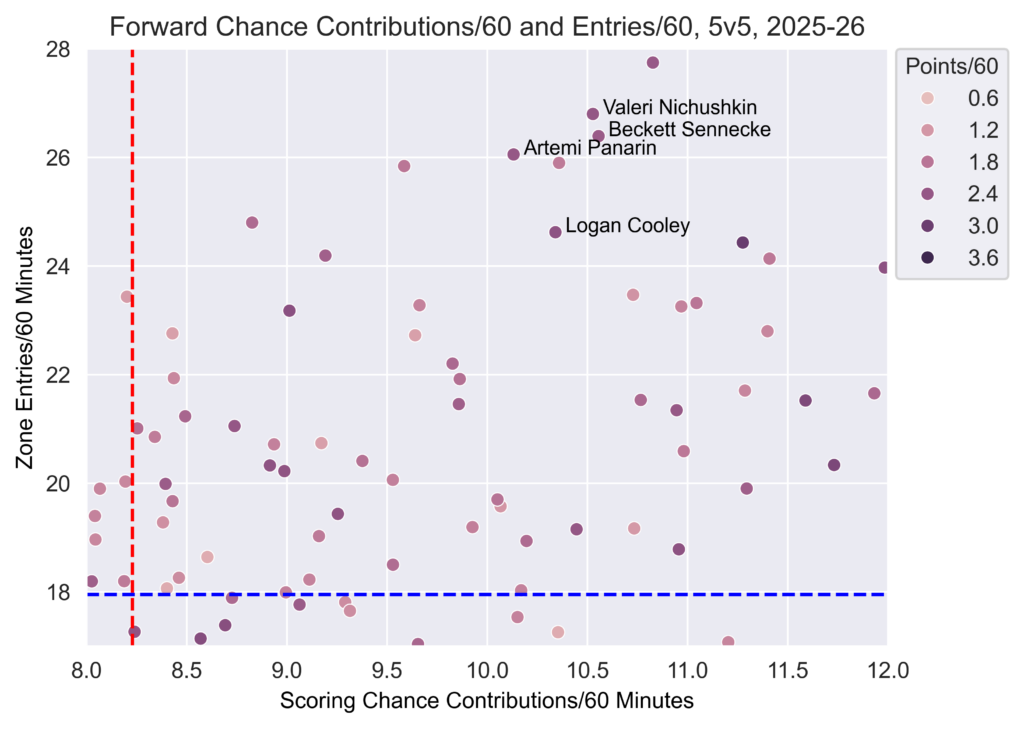
Whenever you're in a group with Valeri Nichushkin, Artemi Panarin, and Logan Cooley, it's a good start. Crucially, in the 10 games leading to the Olympic break, Sennecke was second among Anaheim forwards by share of power play time (72.2%), first by even-strength ice time share (31.4%), and second by overall ice time (19:43). In Anaheim's first game after the break, he was third by even-strength ice time behind Alex Killorn and Mason McTavish.
With 25 games from here on out, the Ducks are tied for the second-most games remaining, have the second-easiest schedule by opponent points percentage, and have the most games left on light days (13). Sennecke is now one of Anaheim's top wingers and if he remains that for the final two months, the team's schedule plus his performance are the ingredients for a big 25-game stretch. That he can push for 2.5 shots and 1.0 hits per game means stellar peripheral contributions, too.
Collin Graf (San Jose Sharks)
San Jose played a lot of the post-Christmas stretch without Will Smith, and they acquired Kiefer Sherwood via trade, but from Christmas until the Olympic break, Graf had the second-largest even-strength ice time share among Sharks wingers. Even with Smith and Sherwood ahead of him now, he would be fourth. That is a top-6 role, and he's one of their key contributors on the penalty kill, too. A secondary PP role, a primary SH role, and a second-line even-strength role means about 16 minutes per game in ice time. He can put up 0.66 blocks and 1.0 hits per game with those roles and that amount of ice time, so fantasy managers in deeper multi-cat leagues will want to scour the waiver wire; as mentioned in the section on Smith, there is a tremendous schedule ahead for the Sharks.
Jordan Kyrou (St. Louis Blues)
It is understandably difficult to rely on the Blues to do anything positive offensively, but that they got both Robert Thomas and Dylan Holloway back from injury should help. Despite Kyrou's struggles this season, there is still a lot of good work under the hood. Looking again at the rate of chance assists, while adding rate of zone entries and rate of shots (all at 5-on-5), here are the comparable names to Kyrou this season:
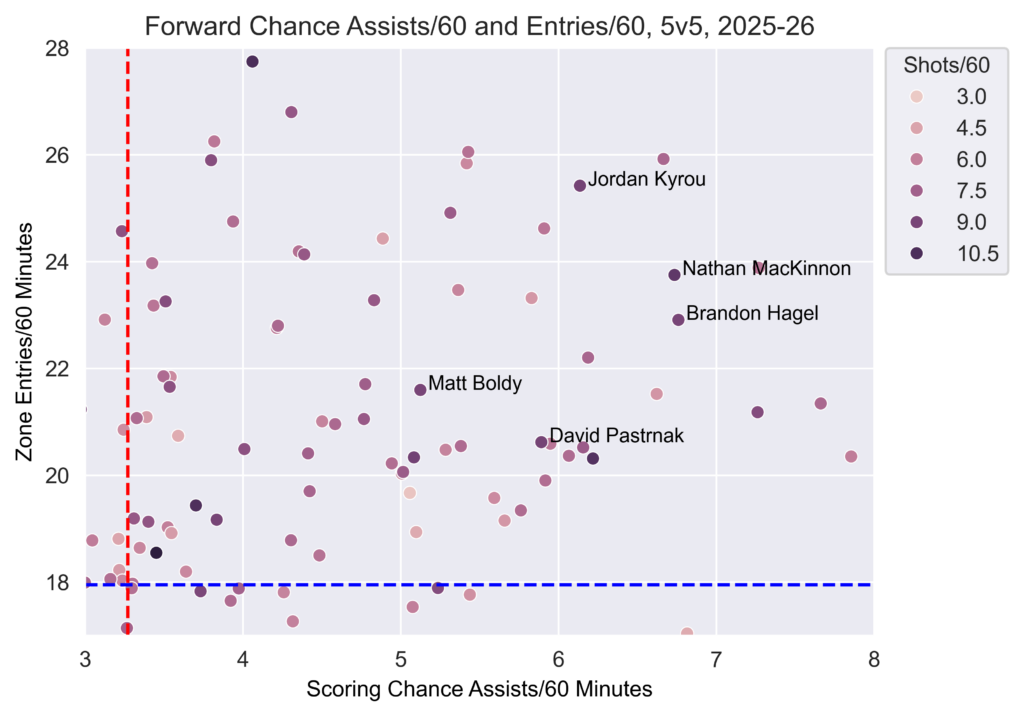
In three key offensive categories, Kyrou compares to Nathan MacKinnon, Brandon Hagel, Matt Boldy, and David Pastrnak. It is hard to be in better company as a winger outside the absolute elite tier like Nikita Kucherov and Kirill Kaprizov.
The Blues don't have a particularly easy schedule the rest of the way, but it's not a brutal one, and half their games (12/24) are on light days. Even on stacked championship-calibre fantasy rosters, there is a lot of room for Kyrou to make a big impact down the stretch. And if he's somehow traded to a high-scoring playoff team? All the better.
Aliaksei Protas (Washington Capitals)
The one big problem facing Protas is Washington refuses to use him on the power play and that will always cap his production upside. However, leading up to the Olympic break, he was by far their most-used forward at even strength (34.3% of the EVTOI share with Dylan Strome at 31% the next-closest). Add in a prime short-handed role, and he was often skating 19-20 minutes a game. A lot of that stretch was without Tom Wilson, and that matters, but Protas was still their most-used forward at even strength leading up to the Wilson injury.
What also matters is what Protas does with the puck. When looking at comparable forwards at 5-on-5 by contributions off the cycle+forecheck (assists and shots on the cycle or forecheck), zone entries, and individual expected goals, the list is impressive:
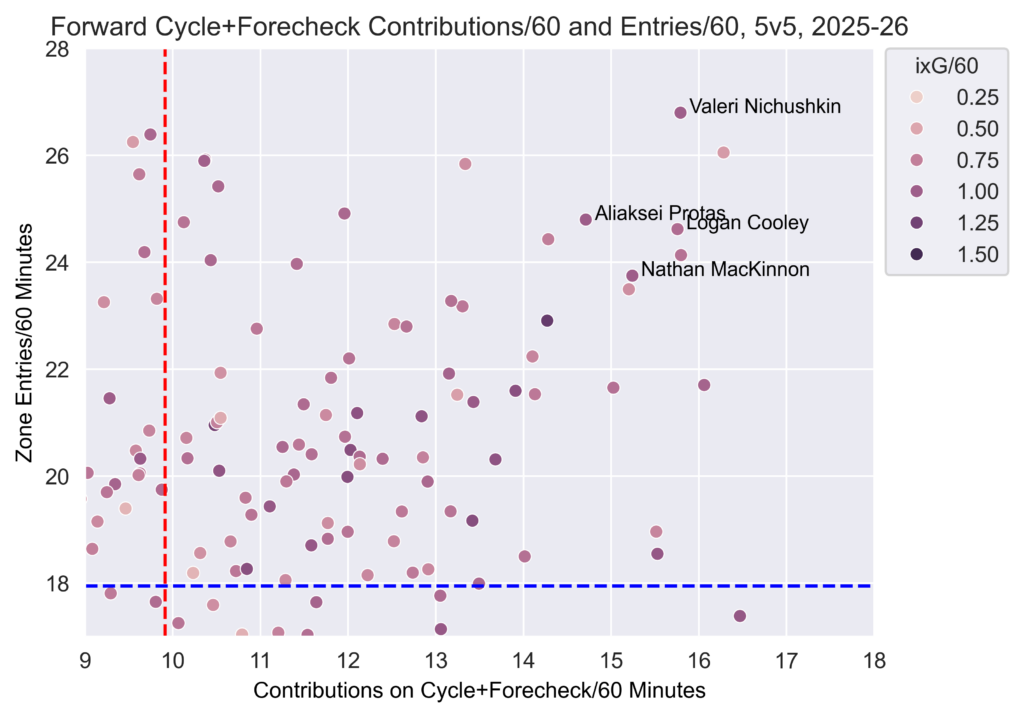
Again, we have a pair of top Colorado forwards plus Cooley, all of which are great names to see.
Protas' secondary problem is the Capitals have just 22 games left, tied for the fewest in the league. They don't have a particularly difficult nor easy schedule, so that's not a concern, but there's not a lot of runway left for him. All the same, the Caps are healthy, pushing for the playoffs, and he's a key figure for their forward group. At any rate, he should be cheap to acquire.
Simon Holmstrom (New York Islanders)
There are a couple of measures in the tracking data to evaluate how well (or poorly) a player exits their zone. One is botched defensive zone retrievals – or how often a player screws up when their opponent dumps the puck in – and failed zone exits, or how often a player has a chance to get the puck out and doesn't. Being able to keep those percentages low helps their team create more possessions and (often) more goals.
Not that the New York Islanders are a bastion of high-end offence, but Holmstrom has been one of the most efficient forwards in the NHL this season in everything but scoring. When we look at his percentage of zone entries carried in, his combined percentage of botched defensive zone retrievals and failed zone exits, and how many shots he needs for every expected goal created, the comparable list is impressive:
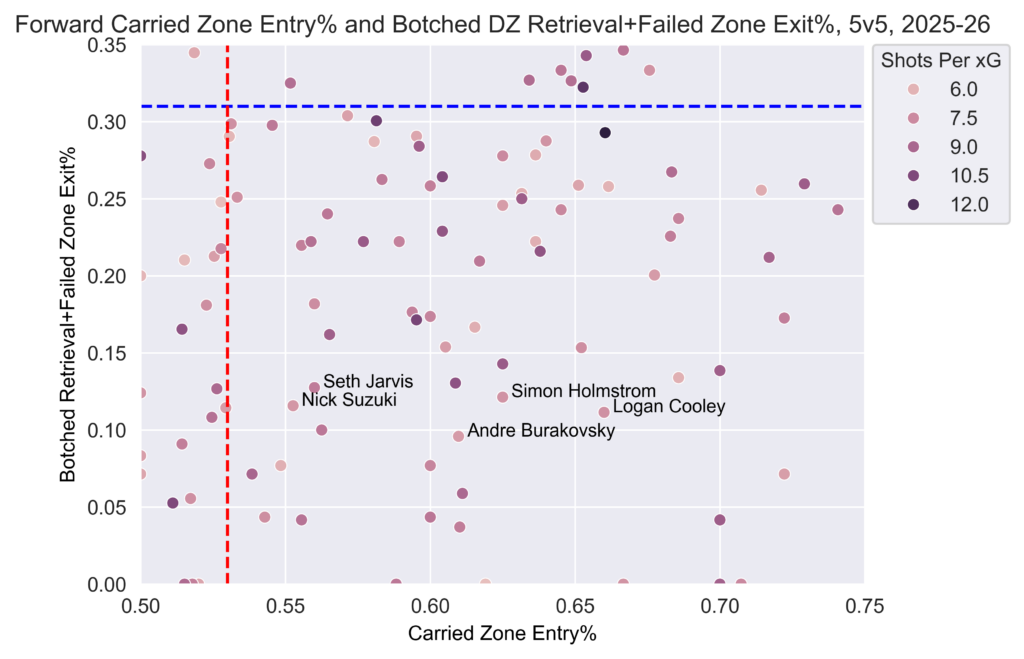
Holmstrom has been strong at not messing up in his own end and getting the puck into the offensive zone with control. And, despite low shot rates, he creates good quality on the few shots he does take. The Islanders are in a playoff chase, and the likes of Jonathan Drouin, Anthony Duclair, and Max Shabanov have been unreliable. The Islanders' remaining opponents are giving up the third-most goals against per game, Holmstrom saw his role grow heading into the Olympic break, and he's currently in a top power-play role. He doesn't hit much, so that hurts his banger value, but he is on pace for over 50 blocks and has a schedule that should help him produce some points.
Adam Fox (New York Rangers)
Understandably, there should be reticence about acquiring a player whose team traded their top offensive forward before the Olympic break and whose team went into that Olympic break 26th in goals per minute. The interesting part about Fox is that he hasn't needed Panarin to be productive at 5-on-5. Since the start of the 2024-25 season:
- Fox with Panarin on the ice: 1.84 points per 60 minutes
- Fox without Panarin on the ice: 1.37 points per 60 minutes
There is clearly a gap when he had Panarin skating ahead of him, but 1.37 points per 60 minutes at 5-on-5 over the last two seasons would still be 12th in the league among defencemen (minimum of 1000 minutes), and ahead of names like Victor Hedman, Shea Theodore, Josh Morrissey and Charlie McAvoy. Even without the star winger, Fox can be very productive.
The real problem comes with the power play as the loss of Panarin there will undoubtedly hurt the team. But there's a difference between 'the loss of Panarin will hurt Fox's production' and 'the loss of Panarin will make Fox unplayable in most fantasy formats'. Do not be surprised if Fox still posts 16-20 points over the final 24 games.
Brandt Clarke (Los Angeles Kings)
By remaining opponents' points percentage, the Los Angeles Kings have the easiest schedule from here on out. Those opponents are also giving up the fourth-most goals against per game. They lost Kevin Fiala, but gained Panarin, so there is an upgrade up front as well.
There is also what Clarke can do with Panarin as a left winger. On the season, when looking at the rate of chance assists, the rate of shots, and the rate of carried zone entries, Clarke compares well across the league:
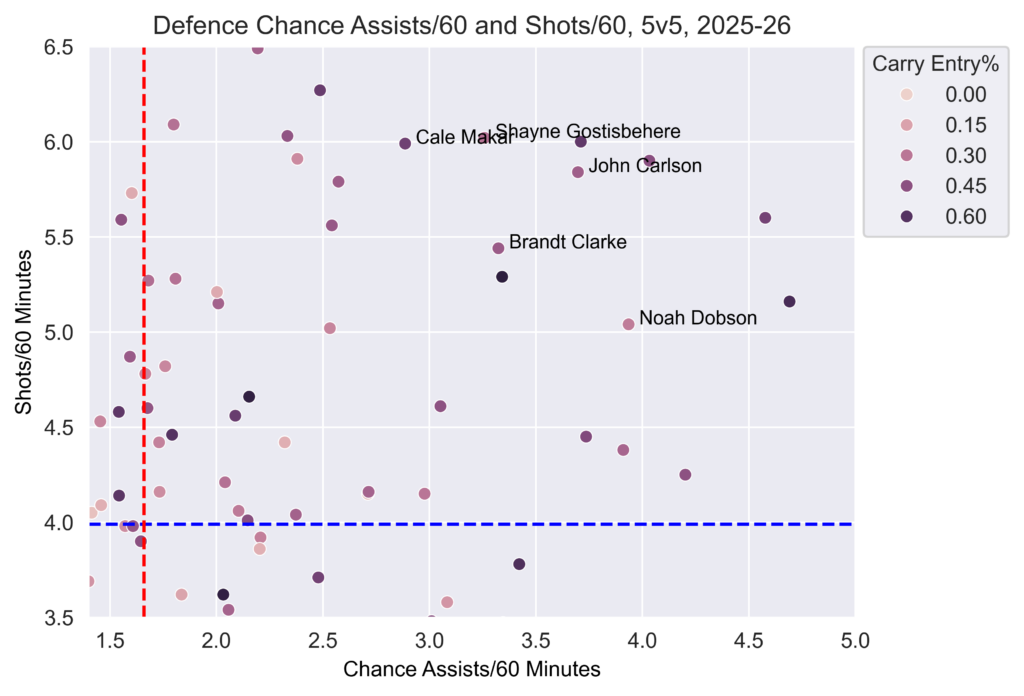
When I see a blue liner who shoots more than Noah Dobson and also assists on more scoring chances than Cale Makar, my ears perk up a little bit.
Importantly, Clarke took over the top PP role before the Olympic break hit, earning over two-thirds of the available power-play time over Los Angeles' last 15 games before that break. In their first game with Panarin on the roster, Los Angeles went 1-for-1 on the power play and Clarke had a power-play assist. That he can flirt with 2.0 shots and 2.0 blocks per game, even with a lack of hits, gives him solid multi-cat value as well.
Pavel Mintyukov (Anaheim Ducks)
This isn't intended as a backhanded compliment, but there's almost nothing that stands out about his profile so far this season. Below is a graph that will show the comparable names to his contributions off the rush, his points per 60 minutes, and his shots per expected goal rates, which are his best attributes this year:
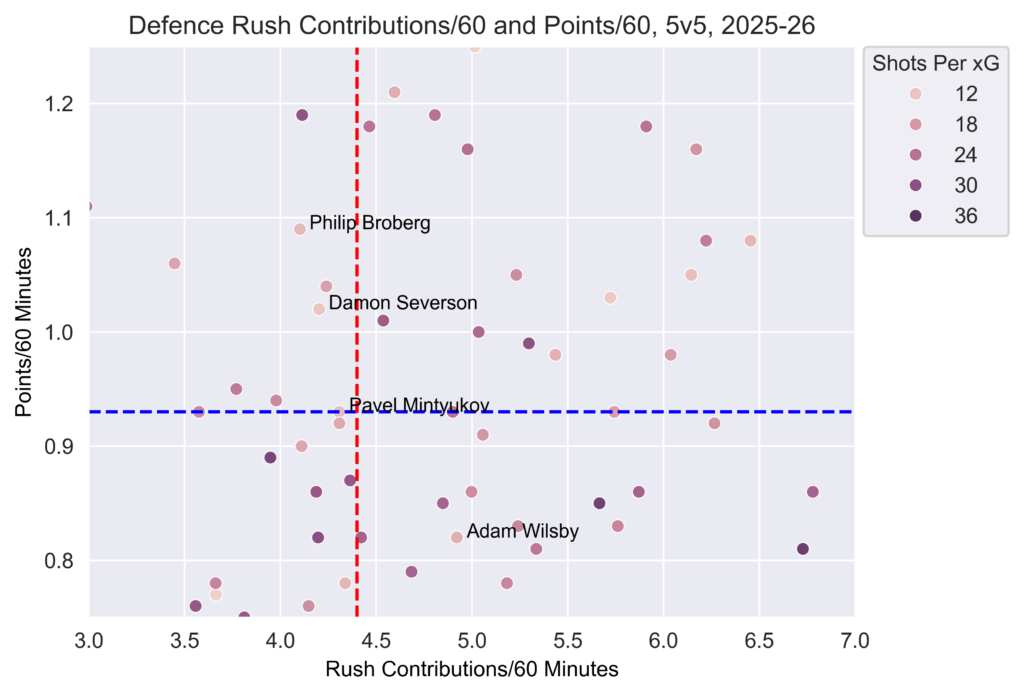
In fairness, there is very little that is outright bad about his profile; there is just nothing that sticks out as great as we saw with Clarke or with some of the forwards.
What is important is that in the 15 games heading into the Olympic break, he had earned the secondary power-play role (37% of the PPTOI share), was the number-3 defenceman at even strength (31.6% of the ESTOI share), and was their most-used defenceman on the penalty kill (57.7% of the SHTOI share). That all led to him skating nearly 21 minutes a night across all three phases, and he had the second-most minutes on Anaheim's blue line in their first game back. On a team that is now healthy with the firepower that the Ducks possess, just being an average defenceman skating 20-21 minutes a night is valuable. He won't put up great peripherals, but he can be solid across the board outside of his hit totals. And, as mentioned in the section on Sennecke, the Ducks have a great rest-of-season fantasy schedule.
One Comment
Leave A Comment
You must be logged in to post a comment.
Related Posts

Starting Goalies













Top Skater Views
 VGK
VGK BUF
BUF NYR
NYR MIN
MIN S.J
S.JTop Goalie Profile Views
 FLA
FLA OTT
OTT

LINE COMBOS
| Frequency |
 EDM Players EDM Players
| |
|---|---|---|
| 31.0 | VASILY PODKOLZIN CONNOR MCDAVID LEON DRAISAITL | |
| 20.1 | KASPERI KAPANEN FILIP HALLANDER JASON DICKINSON | |
| 19.9 | OWEN MICHAELS MATHIEU JOSEPH ALEX FORMENTON | |
DobberHockey Podcasts

Keeping Karlsson: Delusions of Garandeur
Elan and Brian dive into the latest NHL hot streaks, cold streaks, line changes, outjuries, injuries, buy-lows and sell-highs to give you top notch tips in your fantasy hockey league

Fantasy Hockey Life: TiDy Takes Part 2
Last week, Victor Nuno and Ryan Downey broke down trades from our top tier dynasty league. This week, they consider some dynasty trades from other divisions. Have a listen! Our show is part of the Dobber Podcast Network and sponsored by Fantrax.com. Email [email protected] and ask to join our free discord. Join our Patreon at […]
Keeping Karlsson: Matchup Maximizer 2026/27 Week 3
Elan takes a look at the schedule for the upcoming weeks of NHL action and recommends players with good schedules that you should consider streaming in to win your head to head matchups.
Keeping Karlsson: Short Shifts – Sharks Looked Like Celebweenies
Elan recaps the major injuries, outjuries, game results and changed line combos that we’ve seen since Sunday’s mega-show.
Keeping Karlsson: Cole, There’s No Time!
Elan and Brian cover all the action from the first week of the NHL season, and identify our earliest must-adds, can-drops, sell highs and buy lows in your fantasy hockey leagues.
I love stats but fail to see why stats were given for players who won’t change teams. Zero in on the guys known to be available and leave everyone else alone.
And players like Thomas or Kyrou are unlikely to be moved at the trade deadline, more likely in the off-season when more teams would be interested.
It’s frustrating to have to weed through guys just to find the ones who are actually available.