

21 Fantasy Hockey Rambles
Dobber Sports
2026-05-31
Every Sunday, we share 21 Fantasy Rambles from our writers at DobberHockey. These thoughts are curated from the past week’s 'Daily Ramblings'.
Writers/Editors: Ian Gooding, Michael Clifford, Alexander MacLean, Puneet Sharma, and Dobber
___
1. We are four weeks away from the 2026 NHL Entry Draft, but we are only one day away from the release of the 2026 Dobber Hockey Prospects Report! It is available for pre-order now in the Dobber Shop.
Not only does it include a fantasy-centric profile of potential 2026 draftees, but also an in-depth look at each team's prospect pool, including expected arrival time, near-term outlooks, and more. Help support the Dobber Prospects team and get all the information you need on both current and future prospects by ordering a copy of the Dobber Prospects Report, available on June 1st.
2. The Carolina Hurricanes are headed to the Stanley Cup Final, where they will face the Vegas Golden Knights. Game 1 is set for Tuesday night in Carolina.
The unit of Taylor Hall, Logan Stankoven, and Jackson Blake may not have been the Hurricanes’ top line in the regular season, but it is definitely their top line in the playoffs. In terms of team playoff scoring, these players are currently 1-2-3 on the Canes (Hall 16 PTS, Blake 15 PTS, Stankoven 12 PTS). Hall is currently tied for third in playoff scoring in the league, behind only Mitch Marner and Jack Eichel.
Meanwhile, not only has Frederik Andersen made it through three rounds, but he also appears to be a Conn Smythe favorite. (may30)
3. Doing the math, the Canadiens averaged a meager 18 shots per game in the five-game series. The way this series was trending, a Game 5 loss seemed inevitable. In fact, at one point in the game, every Habs player was on the Frozen Tools Cold List.
The most prominent Canadiens cold streaks were as follows:
Oliver Kapanen – 0 PTS in 17 GP, dating back to the regular season, so 0 PTS in 7 GP in playoffs
Noah Dobson – 0 PTS in 10 GP, just 1 PT in 13 GP in playoffs (his fantasy value has fallen since being traded to Montreal)
Kirby Dach – 0 PTS in 9 GP
Nick Suzuki, Juraj Slafkovsky, and Alex Newhook – 0 PTS in 4 GP
I don’t mean to pile on the Habs. They took a major step forward this season but ran out of gas against the relentless tight-checking puck possession game of the Canes. Remember that Montreal survived two 7-game series in the first two rounds while Carolina barely broke a sweat with two 4-game sweeps. In four years, the Canadiens have gone from bottoming out to the conference final. The core of Caufield, Suzuki, Slafkovsky, Demidov, and Hutson has a very bright future. (may30)
4. It seems like the Zero G concept applies not only to fantasy goalies, but also real-life goalies in the Stanley Cup Playoffs. After all, the four starting goalies for the teams that made it to the conference finals are Andersen, Jakub Dobes, Scott Wedgewood, and Carter Hart.
That doesn’t necessarily mean that Zero G is the recipe to win a Stanley Cup. For all we know, goalies like Andrei Vasilevskiy and Jake Oettinger could be back in the conference finals next season. However, a serviceable goalie seems to be enough to win a Stanley Cup in the modern 32-team NHL. That goalie in 2025-26 will either be Hart or Andersen. (may30)
5. Today, I’m featuring the best goalies that I added from the waiver wire this season. Call them my Zero G options if you will. The first two goalies listed helped me win a championship, while the third goalie was on a team that finished second.
Lyon was drafted in 3 percent of Yahoo leagues (even though I rostered him in a Fantrax league, where I don’t see those numbers available). He was the veteran free agent addition expected to back up Ukko-Pekka Luukkonen while giving Devon Levi more seasoning in the AHL.
I added Lyon just after Christmas after a solid run of six wins in seven games with a 2.14 GAA and .924 SV% over that span. Lyon was a major part of the Sabres’ sudden emergence, which made him a legitimate fantasy option. Unfortunately, Lyon was placed on IR shortly after with a lower-body injury, missing about a month of action. Once he returned, Lyon continued his successful run of play with five consecutive quality starts before the Olympic break. Lyon regressed during the fourth quarter, which gave the net back to Luukkonen for the start of the playoffs. The Sabres then flipped between Luukkonen and Lyon throughout the playoffs.
Lyon has one more year left on his contract at $1.5 million. Not only does he have UPL to battle for starts, but third-stringer Colten Ellis is also under contract for one more year. Then there’s Levi, who may be ready for a full-time NHL spot. As much as Lyon was a steady, reliable goalie option for about half the season last season, he’s probably back to being a Zero G option next season due to a potentially crowded Sabres’ goaltending situation. Don’t be surprised if you’re adding him to your team from the waiver wire again, though.
[Follow the link for more…] (may30)
6. News out of the World Championships as Canada and the USA were facing off in the quarter-final. Canada (and Edmonton Oilers) defenceman Evan Bouchard took a high hit from Team USA defenceman Ryan Lindgren which forced Bouchard to leave the game. Lindgren was assessed a 5-minute major and was ejected from the contest. That is just not great news for Bouchard. Frank Seravalli noted on Twitter that Bouchard took a hard hit during the Oilers’ postseason run and had post-concussion symptoms. A hit like this just a month later is not ideal, but we’ll wait until we get more information about Bouchard’s health.
7. The Colorado Avalanche iced the best lineup they could on paper, with Nathan MacKinnon in the lineup, and Mackenzie Blackwood in net last Tuesday. Mackinnon played over 22 minutes which wasn’t out of line with his usual ice time, while Blackwood and his big contract got the start for the Avs in what turned out to be the final game of their season, even though Scott Wedgewood had the better numbers and had started the majority of the playoff games to this point. Blackwood stood tall, making some incredible saves, but it wasn’t enough as Colorado’s offence didn’t show up in the 2-0 loss to the Vegas Golden Knights, who registered the series sweep.
Cale Makar quite obviously was passing up open shots (pardon the pun) that Vegas was giving him because they know his injury has taken that part of his game away. Hopefully he can make a full recovery this summer. (may27)
8. Evgeni Malkin re-signed with the Penguins yesterday, inking a deal with a $5.5 million cap hit, that goes up to $9 million with performance bonuses.
Malkin showed last season that he was still an elite creator on offence, and that’s what we need him for in fantasy as well. Even at 39 he’s worth rostering in all but the shallowest of leagues.
That leaves Pittsburgh $37 million to fill out both goalie slots and two or three more forwards. They have the cap space and the incentive to go big-game hunting this year, and that might be a way to pry a bigger cap hit player out for a smaller return. Perhaps Hintz out of Dallas or one of Colorado’s middle-six forwards. (may27)
9. In working to update the Cap League Goalie Rankings, it was a bit of a surprise to see Jakub Dobes at the top of the list. I get used to consistently seeing the same name at number one, and for a couple of years it was Logan Thompson, and then it was Dustin Wolf. With their new contracts though, it pushes them down the list. That makes room for Dobes to jump into the spotlight as a full and productive starter with another year remaining on his contract with a $965K cap hit. (may27)
10. It’s stories like Dobes’ that make goalies decent options to sit on in deep prospect dynasty leagues, as the payoff can be immense, and if you grab a few guys at 22 or 23 years old, you might not even have to wait that long either. After top first, second, and maybe even third tier of skater prospects are picked over, you’re unlikely to even come up with someone who plays irregularly on the 4th line, and that’s not the kind of upside you want on your farm system. For the deeper leagues where you get to that level of prospect, owning more goalie prospects gives you a better chance of actually having a meaningful contributor (or useful trade bait) pop up. Fourth-string goalies are only one or two injuries and a stretch of bad play from one other goalie away from playing meaningful NHL games. One of those little philosophy tweaks you can look at when assessing your farm systems. (may27)
11. Back to the cap league rankings, it was also fascinating to see both Colorado goalies listed as tier 1 options. It harkens back to the Linus Ullmark and Jeremy Swayman tandem from the 2022-2023 Bruins team. Both fantastic goalies, both on relatively decent contracts, and the team in front of them so solid that they were going to rack up enough wins that even in only 40 starts they would be relevant in every kind of league.
In Boston, Linus Ullmark eventually had to get pushed out because Swayman was growing into the role of an everyday starter. Mackenzie Blackwood is already in his prime and doesn’t have quite the same ceiling as Swayman. However, the writing nonetheless appears to be on the wall for Scott Wedgewood, as the career backup is signed to only a one-year extension, which would time things well for top prospect Ilya Nabokov to spend a year in the AHL and then move up to the Avalanche for the fall of 2027. (may27)
12. The Buffalo Sabres are going to be fascinating to watch this summer after their trip to the second round. They have two goalies in the top-32 by our Salary Cap League Rankings, in addition to Colten Ellis who probably deserves more playing time as well. That means we could see some kind of goalie move from Buffalo to move at least one out, though I do also wonder about them as maybe the second-best landing spot for Connor Hellebuyck after Carolina. That would likely mean sending out two goalies in a very busy summer.
It’s a position where it sounds like it’s better to have too many goalies rather than not enough, but the problems from having one too many goalies seem often to have more of a bite to them. Buffalo could also look to improve their top-six (especially dependant on Alex Tuch‘s free agency decision), and solidifying their bottom pairing would be ideal as well.
If Tuch and Benson both re-sign, then Buffalo is looking at some cap trouble as well, which might make an Ukko-Pekka Lukkonen deal more likely. With a deep prospect cupboard and most of their picks remaining, there’s kindling here for a fiery offseason. (may27)
13. One of the other interesting UFA stories comes from Darren Raddysh, and we have all heard enough about how he came out of nowhere just in time for his big pay day. Well, at this point it’s very possible that the big contract doesn’t come in Tampa Bay, meaning he heads out for greener pastures.
In the meantime, we don’t know exactly what level of play Victor Hedman is going to return at next season (assuming and hoping he has been able to properly manage his mental health struggles in order to be back on the ice). All of that could lead to a sizeable void on the blueline in Tampa.
Behind Raddysh’s 70 points, no other Bolts defenceman reached the 30-point mark this season. Charle-Edouard D’Astous and J.J. Moser each had 29, while Hedman put up 17 in 33 games. If 35-year-old Hedman can’t go at full strength and/or for a full season, then someone is going to have to mop up the points. The last time Tampa Bay had their top offensive defenceman pace for less than 60 points in a full season was a full decade ago in 2015-16 [have to qualify it in that way because of the Covid years]. Between Hedman, Raddysh, and Sergachev, there has been a 60-point floor and an 85-point ceiling for the top Dman in Tampa for a decade. (may27)
14. With Hedman looking to pass the torch, who might take it up? Well, D’Astous and Moser look like the best internal candidates. Neither has much of a history of power play production, but the big contract and the bigger career year point towards Moser. However, D’Astous did receive more PP time this past season, which shows where the lean is with the current roster and coach. Looking down the depth chart, there just aren’t any other names that look like they have any chance of stepping into that role this year or next, which would mean that we could be looking at a big production jump from one of Moser or D’Astous if Raddysh and Hedman are suddenly out of (or less in) the picture. There could be an external acquisition too, but it feels less likely due to the number of contracts the Bolts already have signed.
Moser is also playing over at the World Championship going on right now, and as of the May 26 games he had four points in five games for Switzerland. Perhaps this leads into some added confidence with the puck for next season. (may27)
15. In talking with a few managers in my fantasy leagues this past week, the conversation came up toward players who nobody really had pegged for exceeding this projected production this past NHL season. The kind of players where, if you rostered them, you probably had a much better shot at pushing for a title. For context, I didn’t win any of my leagues this year. That’s a step back from last season, where I managed to win at least one, but it also made this exercise a bit more interesting from a hindsight angle. There were plenty of players who outperformed expectations across the league, but for this series I am narrowing it down to the names that actually came up in those discussions. I may expand it in future pieces and add a few more names as I go. For the baseline, I used the NHL Fantasy Hockey Projections released in October 2025 as the reference point for expected production.
Mark Scheifele – 103 points (Projected: 81)
Coming into the year, Scheifele was projected for 81 points, which already represented strong fantasy value based on previous seasons totals, but he comfortably cleared that mark with 103 points in 82 games while finishing above a point-per-game pace for the fourth straight full season. The biggest thing Scheifele provided was stability. He produced across the entire 82 game schedule, stayed healthy, and remained locked alongside teammate Kyle Connor. At even strength alone, Scheifele and Connor combined for 37 points together, while the power play remained extremely productive with the duo factoring into nine power-play points together. The chemistry was obvious all year and Winnipeg leaned heavily on that combination offensively especially with how rocky the Jets season went. Whiel his PDO was at 1021, it was actually lower than the previous two season’s. Scheifele has continued to show that he remains one of the safer high-end fantasy centers in the league despite regularly being drafted outside the true elite tier at the position. Sometimes fantasy managers overthink aging curves and regression concerns when the better approach is simply trusting a proven production profile. Players with stable deployment, established chemistry, and consistent offensive usage can still outperform expectations while providing an extremely reliable fantasy floor. (may25)
16. Evan Bouchard – 95 points (Projected: 86)
Evan Bouchard entered the season with already massive expectations after back-to-back high-end offensive years, but he still managed to outperform them. Projected for 86 points, Bouchard finished with 95 points in 82 games. Norris Trophy debates are probably going to keep going all summer over whether he should have been nominated, but the production speaks for itself. Bouchard finished with 95 points, comfortably ahead of the next highest scoring defenseman, Zach Werenski, who had 81 points in 75 games compared to Bouchard playing all 82. Durability also continues to be one of the more underrated parts of Bouchard’s fantasy value. Since playing his first full NHL season, he has only missed two games total in five season, which adds another layer of reliability on top of the elite offensive production. Bouchard finished with 74 assists, 221 shots, 33 power-play points, and over 24 minutes per night. His power-play production was massive with 31 of his 33 PPP tied directly to Edmonton’s top unit and he produced 43 even-strength points alongside Leon Draisaitl alone. I for one did not get a chance a drafting Bouchard in any of my leagues but I sure wish I did. (may25)
17. Macklin Celebrini – 115 Points (Projected: 83)
Celebrini was coming into the season with already high expectations after a strong rookie season, but I think we can all agree that a 115-point breakout in his sophomore season after a 63-point rookie season was very impressive. He was projected for 83 points but he blew that out of the water by 32 points which made him one of the biggest fantasy value picks of the year. The biggest difference in Celebrini’s profile was how quickly San Jose’s young core developed around him. Will Smith emerged as his clear top offensive running mate, factoring into 48 of Celebrini’s even-strength points, while Tyler Toffoli, William Eklund, Collin Graf, and Igor Chernyshov all contributed to a much deeper offensive environment than what San Jose iced during his rookie year. Will Smith ultimately landed with 59 points on the season, Celebrini had 56 more points than Smith. Any fantasy manager who drafted Celebrini likely landed a league-winning cornerstone because the workload, deployment, shot volume, and elite offensive talent, all of which aligned perfectly. (may25)
18. Nick Schmaltz – 74 Points (Projected: 60)
Nick Schmaltz has quietly been one of the more underrated fantasy producers over the last several seasons, but this year he pushed beyond his usual 58–60-point production and delivered a career-best 74-point campaign in his 10th NHL career season. Schmaltz rewarded fantasy managers who likely waited on center depth with strong top-line production while continuing to fly under the radar compared to bigger fantasy names. His linemate Clayton Keller remained the constant driving force, factoring into 48 of Schmaltz’s even-strength points, but the additions and development around them elevated the entire offensive ecosystem. Although JJ Peterka brought another transition threat into the top six his struggles gave Schmaltz the upper hand. Dylan Guenther and Logan Cooley gave Utah a much more dangerous power-play structure than previous years and Schmaltz consistently played in offensive situations and benefited from one of the league’s more productive top units. He also hit his highest career SOG with 202 averaging roughly averaged 2.5 shots per game, but his S% climbed back up to 16.3% after dropping to 10.8% the previous season. Some of that rebound was expected considering his career finishing ability, but the environment also mattered. His line with Keller and Lawson Crouse dominated territorially, while his power-play production stabilized with 20 PPP. If you drafted him, you likely landed one of the better value centers in middle rounds because he provided steady point production across the entire season with only one cold stretch with zero points in eight games during the month of November. (may25)
19. In last week’s Ramblings, we reviewed how peripheral production is changing across the league, focusing specifically on shots, hits, blocks, and penalty minutes among forwards:
- We started by seeing how rates have been changing over the last five seasons on a 60-minute basis, and also the percentage of a forward’s overall peripherals coming from each category.
- We moved to the level of individual forwards to see how overall totals have changed in each category.
Today, we’re repeating that process but moving to defence. That means we’re starting with league-wide data to see how peripheral rates have changed among blue liners over the last five seasons and then evaluating how much of each peripheral stat is responsible for overall peripheral production.
Again, we are using data from Evolving Hockey. We are going to start by focusing on all-strengths play and then seeing if there’s anything different when we look at just 5-on-5 play. As we did with forwards, when discussing penalty minutes, we are including just 2-minute and 5-minute penalties, leaving aside 10-minute misconducts.
Defencemen, like forwards, have seen their overall rates of peripheral production decline by varying levels across the last 4-5 years. The difference for defencemen is there is a huge decline in two of the four categories (Hits and Blocks) with a noticeable decline in shot rate:
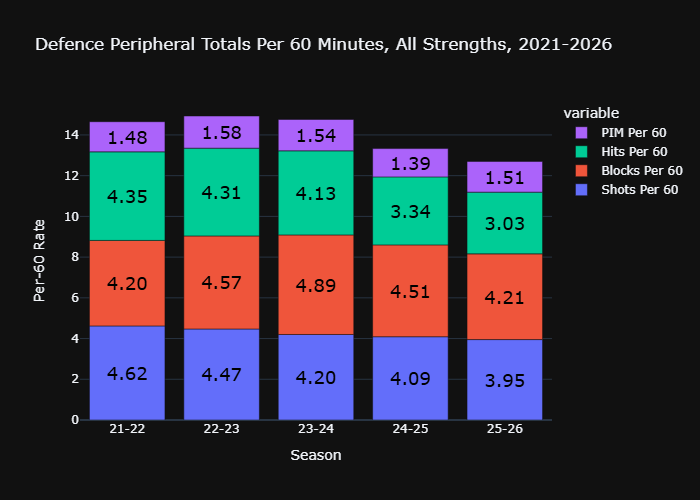
Just since the 2023-24 season, the rate of hits among defencemen is down nearly 27% while the rate of blocks is down nearly 14%. To put those drops into context, forwards saw their hit rates increase since 2023-24 while the block rate dropped just over 4%. The declines in hits and blocks for blue liners have been substantial, and that greatly alters their fantasy values. Where defencemen used to be a source of hits that lagged
forwards just a bit, the hit rates are now considerably less. Their hits and blocks rates have declined in a significant way as league has shifted to more mobile defencemen throughout the three pairs.
Funny enough, there isn’t that much of a drop in shot rate. The 60-minute rate has declined by 6% over the last two seasons, but the rate among forwards declined nearly 10% in the same stretch. In an environment where per-game shot totals have declined by over 8%, the fact that defencemen haven’t seen a larger shot decline is notable. Again, this likely ties into their being more mobile up-and-down the roster than they were just a few years ago, but it is noteworthy all the same.
The 60-minute rates are one thing, but how much each peripheral stat is responsible for a defenceman’s overall peripheral output is another. Adding the hit, block, shot, and PIM totals together, and then dividing each of the individual peripheral totals by that overall total, here is the share of each of the four stats by the average defenceman:
[Follow the link for more…] (may26)
20. In Tuesday’s Ramblings, we went over the changing rates of peripherals produced by defencemen, focusing on hits, blocks, shots, and penalty minutes. We covered the evolving 60-minute rates as well as the changing percentage shares of a player’s individual peripheral profile. For example, what percentage of hits/blocks/shots/PIMs are only shots, or only hits, and so on.
Today, we’re staying with peripheral changes among defencemen but shifting the focus to the actual totals. The final numbers produced in each category are what determine a player’s fantasy value, so while 60-minute rates and percentages can tell us the value of the peripherals, the overall total numbers give us the targets we should aim for.
The data is from Evolving Hockey and this is at all strengths. To begin, let’s start with the big change we saw in Tuesday’s write-up, and that’s the drop in hits:
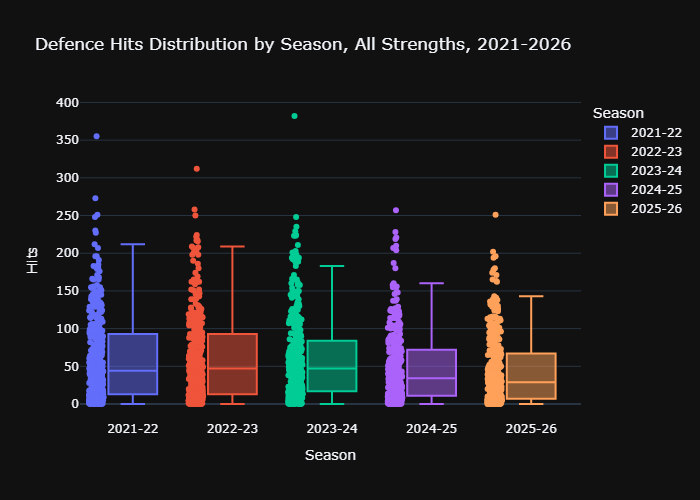
For anyone who forgot what these kinds of graphs show us, they give us the totals of a specific stat within certain limits. For example, it shows us what a 75th percentile total is, what the median total is (the middle of the individual totals), and so on. The line we’ll start with is the highest horizontal line in each plot, which is the ‘whisker’ outside of the box. This whisker line (called the ‘upper fence’) shows the limit for outliers. In other words, any dots above the whisker line are considered outliers. In 2023-24, that line was at 183 hits:
[Follow the link for more…] (may28)
21. Over the last couple of weeks, these Ramblings have covered changing shot, hit, block, and penalty minute rates across the league. We went through:
- Changes among forwards in 60-minute rates of those four stats.
- Changes among individual forwards in the end-of-season totals of the four peripheral stats.
- Changes for defencemen in 60-minute rates of the four peripheral stats.
- Changes for individual defencemen in the end-of-season totals of the four peripheral stats.
Now that we’ve gone over the changes across the league at each position, as well as the improvements or declines of individual totals, we can wrap things up by looking at the top peripheral performers.
We are going to use per-game averages for shot, hit, block, and PIM totals because that’s what determines fantasy performance. We are also going to compare the per-game averages to the league average of the specific stat being discussed to illuminate how well (or poorly) a player performed relative to that league average. So, if all the league’s defencemen average 1.0 shots per game, and Darnell Nurse averages 2.0 shots per game, then his relative shot performance is 100% above league average. Conversely, if Lian Bichsel averages 0.5 shots per game, then he is -50% below league average. We add the percentages of the four stats together to give us our top peripheral performers.
In the first graph, the highest peripheral performers start on the left, and value decreases as we go to the right. Remember, as we have done the previous few Ramblings, when discussing penalty minutes, we are including only 2-minute minors and 5-minute majors.
Data is from Evolving Hockey and we are going to limit our sample to players who played at least 41 games. Today’s Ramblings will focus on forwards, so let’s get going:
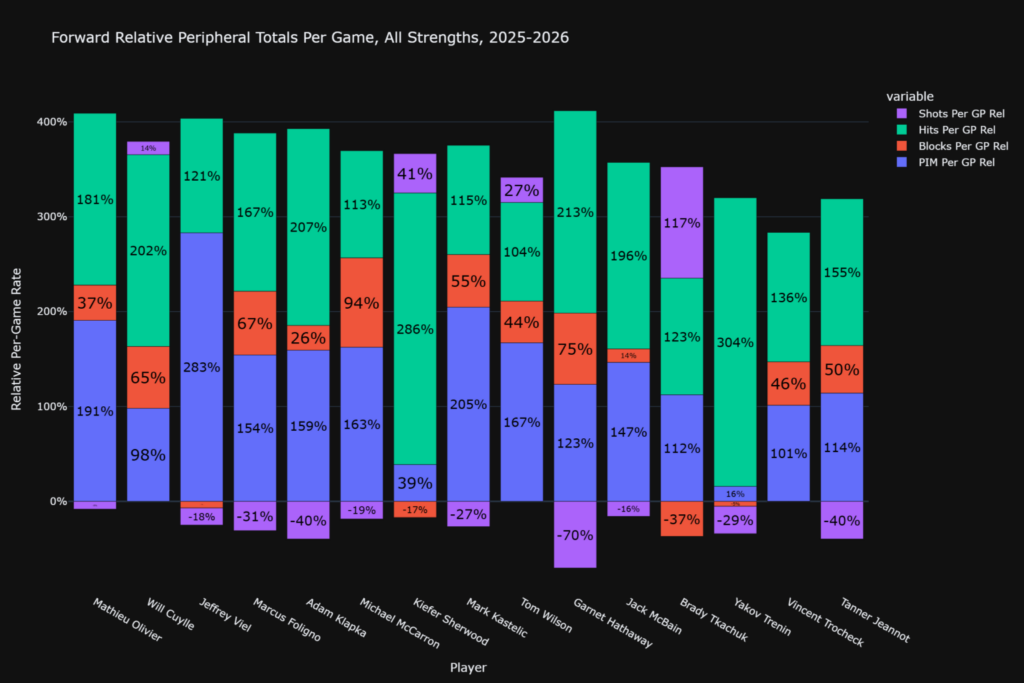
The first thing that stands out is just how much the top peripheral forwards rely on hits and PIMs. These are the top-15 peripheral forwards on a per-game basis, and not a single one of them have a hit-per-game rate under 100% relative to the league average.
[Follow the link for more…] (may29)
—
Have a good week, folks!
Thanks for continuing to support the website and if you’re bored and need a fantasy hockey fix – visit the gang in the forum here.
Related Posts
Starting Goalies













Top Skater Views
 VGK
VGK BUF
BUF NYR
NYR MIN
MIN S.J
S.JTop Goalie Profile Views
 FLA
FLA OTT
OTT
LINE COMBOS
| Frequency |
 NYI Players NYI Players
| |
|---|---|---|
| 22.1 | BRAYDEN SCHENN CALUM RITCHIE VICTOR EKLUND | |
| 19.8 | KYLE PALMIERI BO HORVAT EMIL HEINEMAN | |
| 13.6 | ONDREJ PALAT JEAN-GABRIEL PAGEAU ANTHONY DUCLAIR | |
DobberHockey Podcasts

Keeping Karlsson: Delusions of Garandeur
Elan and Brian dive into the latest NHL hot streaks, cold streaks, line changes, outjuries, injuries, buy-lows and sell-highs to give you top notch tips in your fantasy hockey league

Fantasy Hockey Life: TiDy Takes Part 2
Last week, Victor Nuno and Ryan Downey broke down trades from our top tier dynasty league. This week, they consider some dynasty trades from other divisions. Have a listen! Our show is part of the Dobber Podcast Network and sponsored by Fantrax.com. Email [email protected] and ask to join our free discord. Join our Patreon at […]
Keeping Karlsson: Matchup Maximizer 2026/27 Week 3
Elan takes a look at the schedule for the upcoming weeks of NHL action and recommends players with good schedules that you should consider streaming in to win your head to head matchups.
Keeping Karlsson: Short Shifts – Sharks Looked Like Celebweenies
Elan recaps the major injuries, outjuries, game results and changed line combos that we’ve seen since Sunday’s mega-show.
Keeping Karlsson: Cole, There’s No Time!
Elan and Brian cover all the action from the first week of the NHL season, and identify our earliest must-adds, can-drops, sell highs and buy lows in your fantasy hockey leagues.