

Ramblings: Brady in Florida; Free Agent Analysis on John Carlson, Rasmus Andersson, Jacob Trouba, John Klingberg, and Mario Ferraro – June 23
Michael Clifford
2026-06-23
The big news from the weekend was the Ottawa Senators trading Brady Tkachuk to the Florida Panthers for three first-round picks and a second-round pick. Ian broke down the trade here.
The point Ian made about ice time in Florida is probably the important one here. Because Florida had so many injuries in 2025-26, it is hard to gauge what it will look like, but in Brad Marchand's 10-game stretch with the Panthers late in the 2024-25 season, no Florida forward averaged 20 minutes a game (per Frozen Tools). This is not a team concerned with racking up a 120-point regular season – they are a team concerned with hoisting another Stanley Cup. It wouldn't be the least bit surprising to see Aleksander Barkov and Sam Reinhart around the 20-minute mark, and the rest of the top-9 forwards in the 15- to 18-minute range.
It isn't a huge deal for Brady. He tallied nearly a point per game in 2025-26 and that was while skating a shade under 17 minutes. If he's skating 17 minutes on the top line with Barkov or on the second line with his brother, along with top PP time, there's no reason to think he can't be close to a point per game again.
This seems to hurt Carter Verhaeghe the most. His fantasy value is, how the French say, 'Le Cooked'. He now has to contend with Brady and Marchand for 5-on-5 ice time and is probably, at best, sixth on the forward depth chart for PPTOI.
*
The 2026 Entry Draft is just a few days away, so fantasy managers looking to catch up on all they need to know about this year’s prospects should check out Dobber’s 2026 Fantasy Hockey Prospects Report!
*
With the Toronto Maple Leafs pulling off a sign-and-trade to add defenceman Darren Raddysh to their roster (I wrote about that here), this year's group of free-agent defencemen thinned out quite a bit. There are still several names that have, and could have, significant fantasy relevance, so let's go through this year's group of top free-agent rearguards and what their future team, and fantasy managers, could get.
Last week, we covered forwards both at the high end and further down the list. Data will be from Evolving Hockey or Frozen Tools, with tracking data from All Three Zones, unless otherwise indicated. When discussing fantasy value for defencemen, we assume a multi-cat league with goals, assists, power-play points, shots, hits, blocks, and penalty minutes.
Carlson is currently 36 years old but turns 37 years old in January. The chief concern with regards to his play is if, and how much, age will start affecting his play. Any team signing him won't have to go long term, but if the age decline hits, it can hit very hard, and very fast, making even a 2- or 3-year contract an albatross.
To this point, though, Carlson hasn't shown many signs of slowing down. His 2.19 points per 60 minutes in 2025-26 was his highest rate since 2021-22, and 36% higher than his three-year average. A big part of that was shooting a career-best 9.2%, but even if he shot at half that rate, his points rate would still have been 20% above his three-year average.
The reason Carlson was so productive is because he's a genuinely great playmaking defenceman. When looking at three 5-on-5 tracking stats spanning the last two seasons – assists off the rush, assists off the cycle/forecheck, and assists on teammate scoring chances – he isn't quite in the Quinn Hughes/Cale Makar tier, but he's not that far behind:
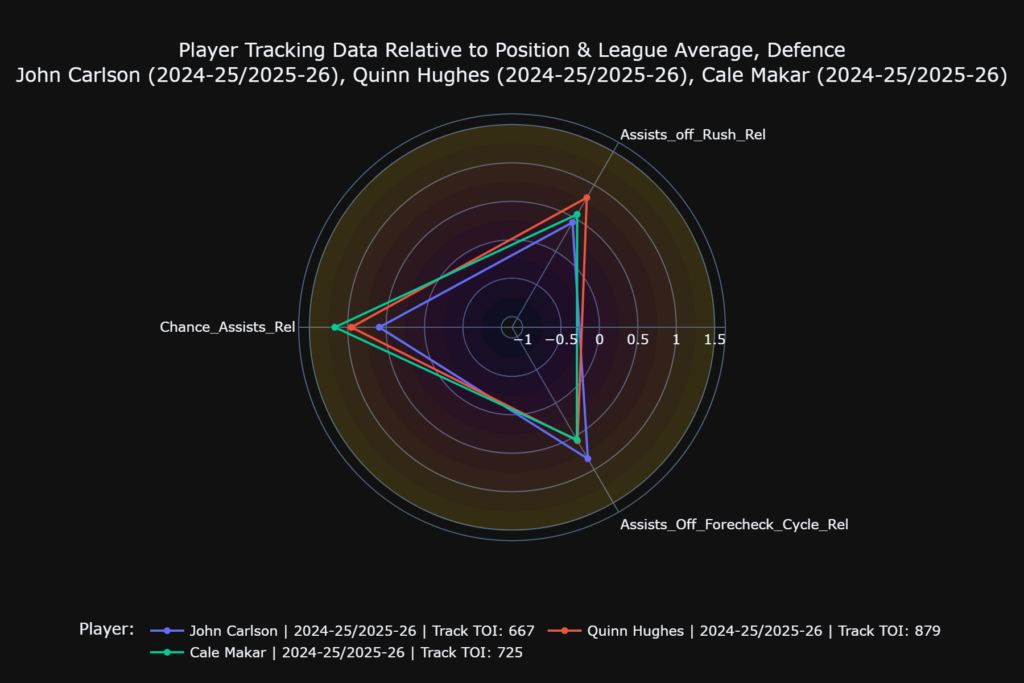
Over these last two campaigns, Carlson ranks third among all defencemen by assists per 60 minutes at 5-on-5, trailing only Rasmus Dahlin and Lane Hutson. If Carlson can retain this level of playmaking, any team that signs him gets one of the best passing blue liners in the league.
Carlson has holes in his fantasy value with modest penalty minute totals and going from 75 hits per 82 games from 2021-2024 to 41 hits per 82 games over the last two years. However, he is a perennial 10-goal, 40-assist threat who can elevate the scoring of his forwards. His fantasy upside depends on where he signs, but any team signing him should immediately be better offensively.
If we want to compare apples to apples, then the playmaking that Andersson brings is a clear step down from what Carlson can do:
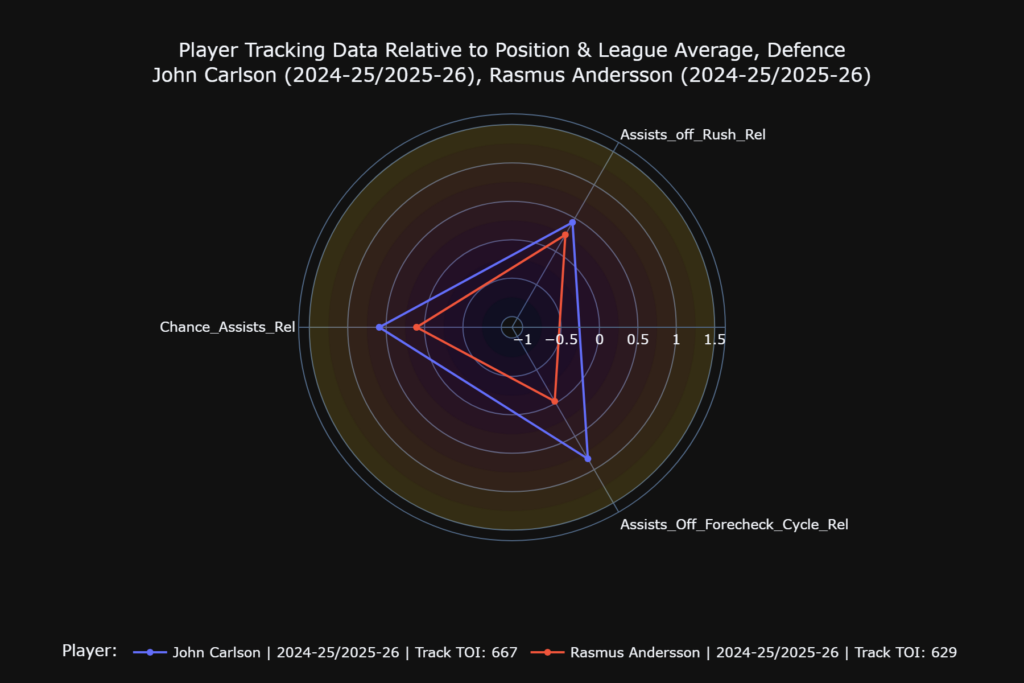
Putting part of the blame on a lacklustre Calgary Flames roster where Andersson spent most of his career is fine, but even in 2021-22, when Andersson was running Calgary's top PP unit and the Flames finished sixth in the league in goals per minute, the blue liner topped out at 50 points. That season saw him post a career-best 1.61 points per 60 minutes, which was Carlson's three-year average from 2022-2025. Andersson's good-but-not-great production over the last few years is partly because of his team, and also partly because Andersson is a good-not-great offensive defenceman.
The other problem is Andersson's goal scoring. Not that it's bad – his 48 goals over the last four seasons are tied for 10th among all defencemen – but that he shot 9.6% in 2025-26, a career-high mark. If all his other fantasy stats remained the same, but he shoots 6.2% and scores 11 goals, his fantasy value drops over 20% and pushes him from a fringe top-20 fantasy defenceman to a fringe top-35 fantasy defenceman. That he puts up solid-but-not-great power-play point totals, and is a big drag on hits, gives him uneven fantasy value.
Whatever people think of Andersson defensively, the reality about his offence is that he isn't great at elevating the scoring of his teammates. Wherever he lands, if he skates 23-24 minutes a game and has meaningful PP minutes, he can be a 10-goal, 30-assist defenceman with solid overall peripherals, but he won't be a big boon those around him, and fantasy managers should temper expectations about his upside no matter his landing spot.
Trouba is a fascinating player. One of my long-held beliefs was that the player he was earlier in his career in Winnipeg was not the same he was in New York as he was asked to play a much more defence-first game. There may have been some truth to that as Trouba's 2025-26, a full season in Anaheim, saw him post a 5-on-5 points rate of 1.07, which was 30% higher than his average over his last three years in New York (0.82). It wasn't just the team, either, because the Rangers scored 2.64 goals per 60 minutes at 5-on-5 over Trouba's final three seasons, higher than what Anaheim managed this past year (2.61). He figured in on more goals than usual with a 43% goal participation rate, but even at 35%, he still clears his three-year points rate.
Trouba's problem is he became reliant on goals and assists for fantasy value. If we compare his 2025-26 fantasy output to the 2023-24 campaign, his last full season with the Rangers, we clearly see how his value for blocks, hits, and PIMs all took a step back, and in the case of PIMs, endured a monster decline:
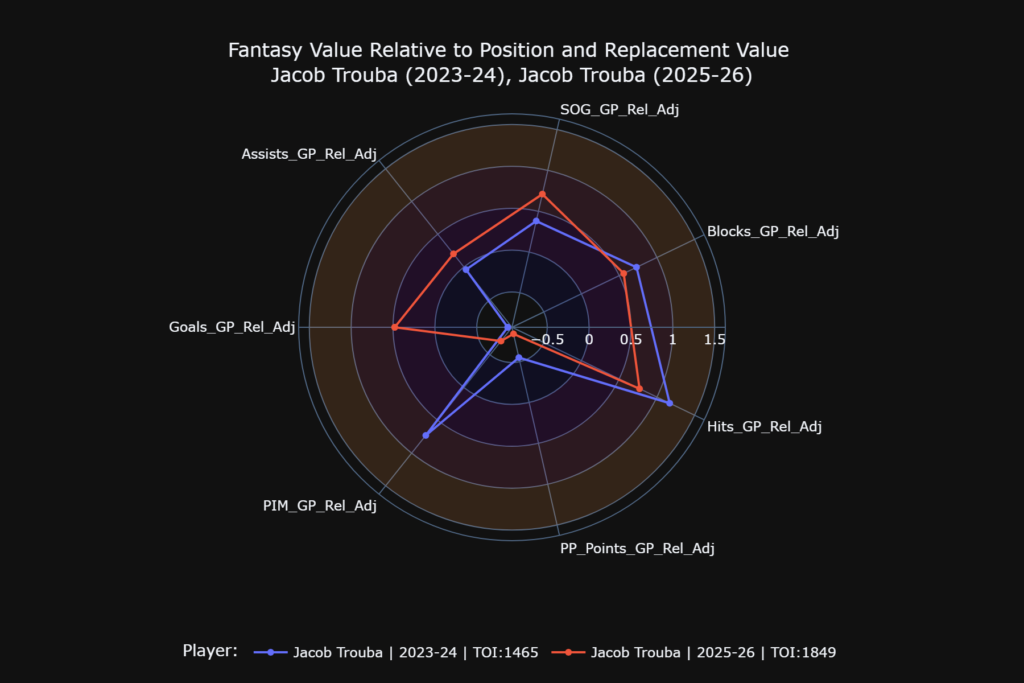
Therein lies the problem. Trouba shot 6% in 2025-26, his highest rate since his rookie season, and more than double his three-year average. If he shoots half that rate, and scores five goals instead of 10, Trouba would lose about one-third of his fantasy value. The decline in fantasy value for hits, blocks, and PIMs hurt him a lot, and he was saved by that shooting percentage.
This makes Trouba a very difficult fantasy option to pin down. Even with an offensive resurgence, his 5-on-5 points rate was closer to league average than it was to a top-25 blue liner. If his shooting percentage declines and those peripherals don't rebound, he drops from a starting defenceman in 12-team multi-cat formats (assuming four defencemen start) to a bench role, or perhaps even waiver wire. And if this offensive turnaround was a dead-cat bounce? Well…
There are two things true of Klingberg right now:
- He still has some juice offensively and can elevate the 5-on-5 offence of the forwards in front of him.
- He is so poor defensively that he cannot be trusted with heavy minutes.
As for the first part, let's peek at the same three playmaking tracking stats (5-on-5 assists off rush, assists off forecheck/cycle, and assists on teammate scoring chances) we reviewed with Carlson for Klingberg's last two seasons:
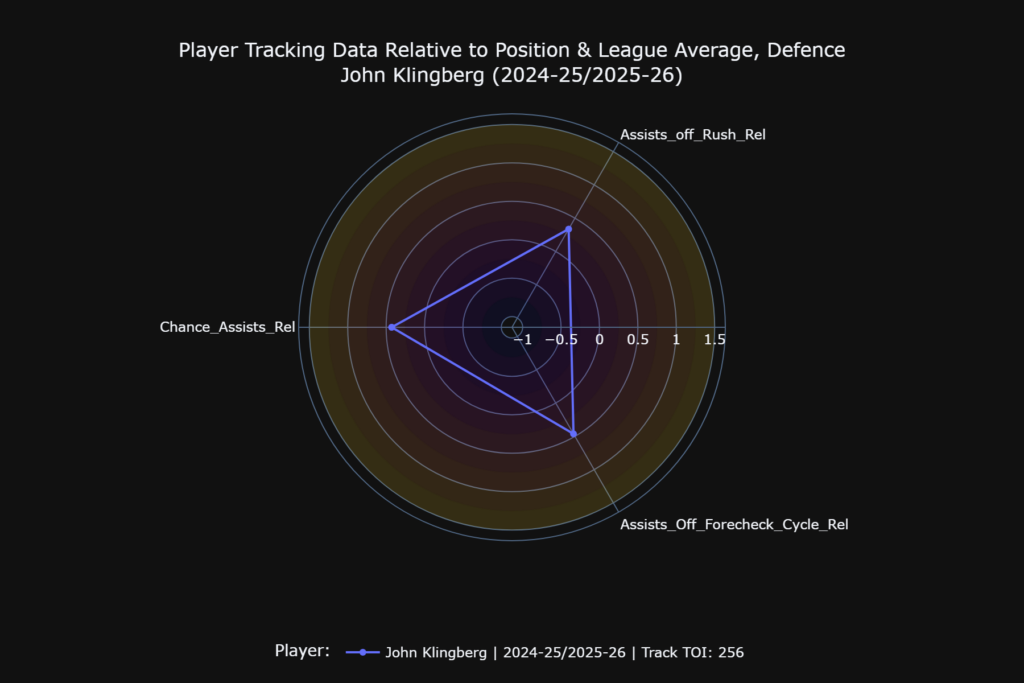
The sample size isn't big, but his assists per 60 minutes at 5-on-5 over the two seasons (0.86) are tied with Josh Morrissey and higher than Mikhail Sergachev (0.81). That gives some credence to the small-sample playmaking tracking. Though the San Jose Sharks' power play struggled to score with Klingberg running things, that kind of playmaking should be able to help some second PP units, or even top PP units, across the league.
As for the second part, there's a reason Klingberg skated 35.3% of San Jose's even-strength ice time through the end of February (second among Sharks defencemen) but dropped to 32.8% from March 1st onward (fourth among Sharks defencemen. He is 33 years old (34 years old in August) and with his lengthy injury history, he just cannot defend well enough to justify heavy minutes. That is a problem for his fantasy value wherever he lands because it'll suppress his peripherals, which are meagre anyway. He is still a player who can boost the scoring of his teammates, but at this stage of his career, Klingberg's value to fantasy managers is what he can do for those around him, and not what he can do for himself.
Just to quickly mention Ferraro, there are three 5-on-5 zone exit tracking stats that I focus on:
- Zone Exits – How often a player is responsible for getting the puck out
- Zone Exits with Possession – Self-explanatory
- Botch+Fail Percentage: The combined rate of how often a player either botches a defensive zone retrieval or fails to exit the defensive zone when given the chance.
Looking at those three zone-exit metrics, here is how Ferraro's last two seasons stack up to Rasmus Andersson:
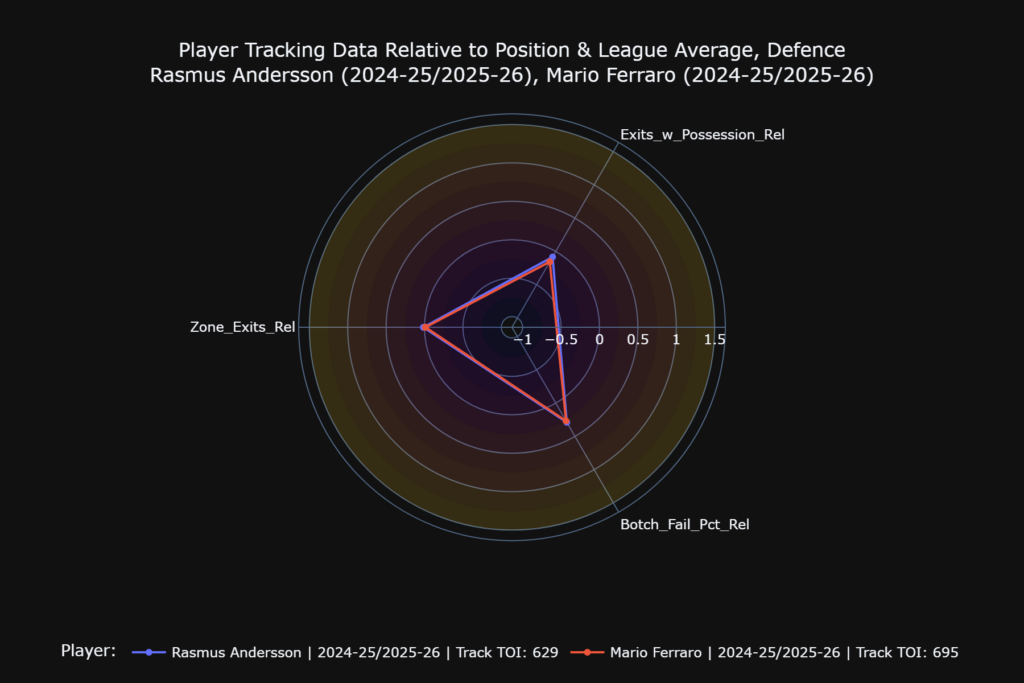
In fairness, Andersson does other things better offensively than Ferraro, but when it comes to getting the puck out of the zone regularly and with control, they are pretty similar. Not that Ferraro will have a big positive offensive impact wherever he signs, but he's not as bad as his point totals indicate. It would be interesting to see what kind of production he can have on a better offensive team because the San Jose Sharks have not finished above league average by 5-on-5 scoring in any season of Ferraro's career. What if he goes to play on the second pair in Buffalo or Dallas? With the blocks and hits he can provide, his landing spot is something to keep an eye on.
Related Posts
Starting Goalies







Top Skater Views
 DET
DET STL
STL CHI
CHI BOS
BOSTop Goalie Profile Views
 EDM
EDM NYR
NYR MTL
MTL S.J
S.J WSH
WSH

LINE COMBOS
| Frequency |
 CGY Players CGY Players
| |
|---|---|---|
| 17.0 | RYAN STROME MARTIN POSPISIL MATVEI GRIDIN | |
| 15.7 | AYDAR SUNIEV MORGAN FROST MATT CORONATO | |
| 11.0 | MAXIM TSYPLAKOV ADAM KLAPKA JONATHAN CASTAGNA | |
DobberHockey Podcasts

Keeping Karlsson: Short Shifts – NHL Frozen Frenzy Recap
Elan and Lewis recap the Frozen Frenzy as well as two big returns and more!
Keeping Karlsson: Delusions of Garandeur
Elan and Brian dive into the latest NHL hot streaks, cold streaks, line changes, outjuries, injuries, buy-lows and sell-highs to give you top notch tips in your fantasy hockey league

Fantasy Hockey Life: TiDy Takes Part 2
Last week, Victor Nuno and Ryan Downey broke down trades from our top tier dynasty league. This week, they consider some dynasty trades from other divisions. Have a listen! Our show is part of the Dobber Podcast Network and sponsored by Fantrax.com. Email [email protected] and ask to join our free discord. Join our Patreon at […]
Keeping Karlsson: Matchup Maximizer 2026/27 Week 3
Elan takes a look at the schedule for the upcoming weeks of NHL action and recommends players with good schedules that you should consider streaming in to win your head to head matchups.
Keeping Karlsson: Short Shifts – Sharks Looked Like Celebweenies
Elan recaps the major injuries, outjuries, game results and changed line combos that we’ve seen since Sunday’s mega-show.