

Ramblings: Free Agent Frenzy Eve; Thoughts on the Peterka and McTavish Trades – June 30
Michael Clifford
2026-06-30
The NHL's free agency period starts tomorrow, and while teams and players aren't engaged in talks prior to the official opening of free agency (I type that while winking so hard I give myself a headache), there are usually a lot of key signings fantasy managers need to stay on top of. The team here at Dobber Hockey will have you guys covered as there will be break downs all day long of the major signings with big fantasy hockey ramifications. Throughout the day, our section on NHL Moves will be updated through the day with our thoughts on what the signings mean for the teams and players.
To get a head start on what to expect, a few of my Ramblings this month have covered the more important names in the free agent mix. Some of them have already signed (or re-signed), but most are heading to market:
- Top forwards like Boone Jenner and Anthony Mantha.
- Other notable forwards like Mason Marchment, Mats Zuccarello, and Eeli Tolvanen.
- Top defencemen like Rasmus Andersson and John Carlson.
- Other notable defencemen like Nick Blankenburg, Ryan Shea, and Logan Stanley.
Where those guys land will determine their fantasy value, and impact players around them, so that's where the updates in the NHL Moves section come in handy.
*
The Florida Panthers had to rebuild their goalie tandem, and that rebuild started on Monday night as they trade for Vegas Golden Knights netminder Akira Schmid. I wrote about the trade here.
*
There were a couple of big trades to take place over the weekend. The first saw J.J. Peterka be traded to the Boston Bruins and the second was Mason McTavish being moved to the St. Louis Blues. Ian had his take on both those trades: the Peterka swap was covered here and the McTavish deal was discussed here. I wanted to offer my thoughts on the deals.
The important point Ian raised when he wrote about Peterka was his power-play usage in Utah. He skated just 42% of the power play time for the Mammoth, which was sixth among their forwards. The trio of Clayton Keller, Dylan Guenther, and Nick Schmaltz were top PP staples while Logan Cooley, Barrett Hayton, and Peterka each had their turn as the fourth forward. The year before, Peterka led the Buffalo Sabres with 63.9% of the PP ice time. Compounding the problem was that Utah's second PP unit scored 36% less on a per-minute basis than the top unit. That disparity in scoring combined with the loss in overall ice time is why Peterka's PP production dropped so much.
The second crucial point Ian raised was Peterka's point rate. In his only season with Utah, he managed 2.1 points per 60 minutes at 5-on-5. Across his three full seasons with Buffalo, he tallied 2.1 points per 60 minutes at 5-on-5. His production at that strength was the same as his three-year average, so, again, it's the power play that mattered.
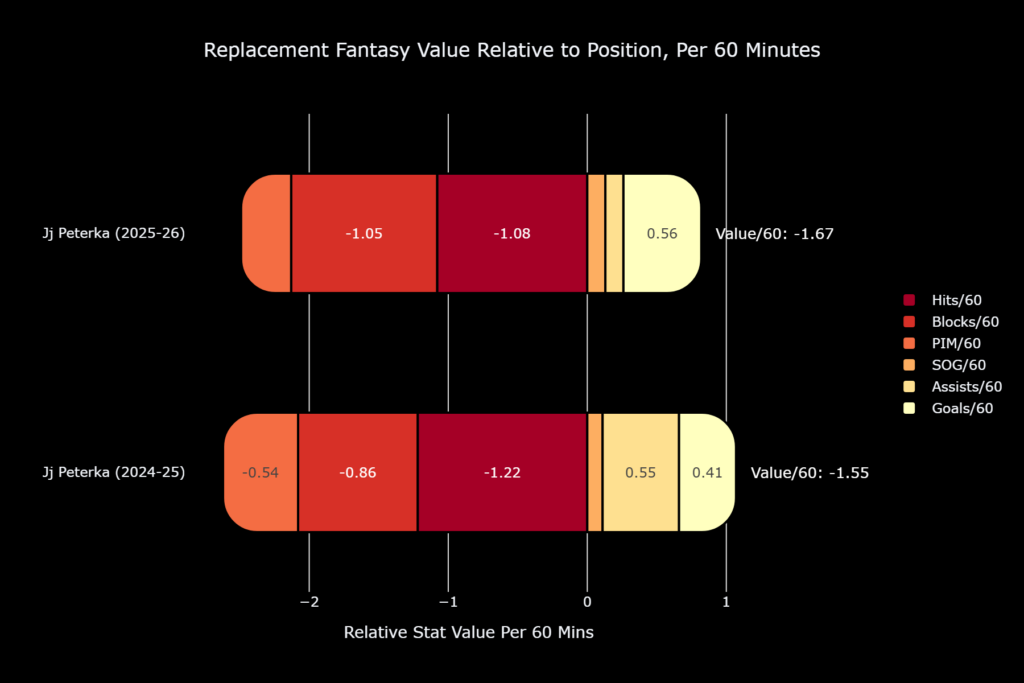
This becomes very obvious when we see his fantasy value breakdown. Using goals, assists, shots, hits, blocks, and penalty minutes on a 60-minute basis, Peterka's replacement fantasy value relative to other forwards in 2025-26 was nearly identical to what it was in 2024-25:
However, if we add power-play points to the mix, that is where the disparity becomes obvious, as his fantasy value was twice as high in 2024-25 compared to 2025-26:
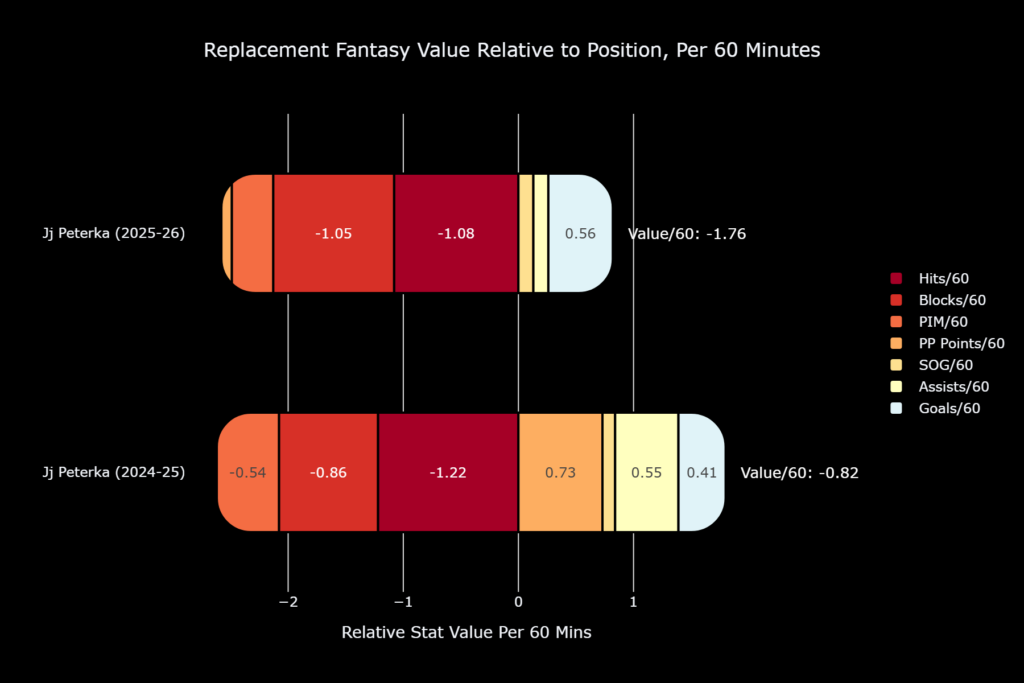
This disparity is why it's important that Peterka still managed 2.1 points per 60 minutes at 5-on-5. He spent half his ice time without at least one of Clayton Keller or Dylan Guenther on his wing (per Natural Stat Trick), so he proved he can still be productive even without a star offensive player on his line. Now that Peterka's in Boston, we would love to see him play 75% of his ice time with David Pastrnak, but even if he spends half the season on the second line with the likes of Casey Mittelstadt, Pavel Zacha, or Morgan Geekie, he can still be productive.
It all comes down to whether gets top PP time, and I don't think it's a sure thing. The Bruins' PP consists of Pastrňák, Geekie, Zacha, and Elias Lindholm. Replacing Lindholm makes sense, but it would also take one of the two centres off the power play. Teams like to have two centres on the power play, preferably of opposite handedness to take faceoffs on their strong side, and to have a backup in case one centre gets kicked out of the faceoff for some kind of violation. We just saw the Carolina Hurricanes' power play find a lot of success by having Jordan Staal on the top unit for the faceoff, and then he'd change for Nikolaj Ehlers when he had a chance. Maybe Boston tries the same thing as Carolina, maybe they replace Lindholm with Peterka and have Geekie take faceoffs on his strong side (which he's done in the past), or maybe Peterka replaces Geekie and Boston keeps their two centres. Or maybe Peterka just winds up on the second PP unit for most of the season.
I'm not convinced that Peterka is a staple of Boston's top man advantage quintet all season. He will assuredly get a crack at it, and maybe they score well enough that he stays, whatever its composition, but I'm not sure of it, or even close to sure. And as we just saw with Utah, that usage matters a lot, being the difference between 20 power-play points or five PPPs. The good news is that coming off a down year, I imagine Peterka is a lot cheaper at the draft table than he was a year ago.
Before getting to his fantasy profile, the primary issue with McTavish's fantasy value isn't his offence, it's his defence. Regardless of the public model we look at, he is anywhere from below-average to outright-bad defensively. Unless a player is both an offensive dynamo and a veteran with a long track record (someone like Mark Scheifele or Erik Karlsson), NHL coaches are very hesitant to give bad defensive players a lot of minutes. As other players passed him on the depth chart and his defensive game struggled, that's what happened to McTavish in Anaheim as the Ducks dropped his even-strength TOI share from 28.1% in 2024-25 to 26.1% in 2025-26. It cost him over a minute per game in EVTOI and kept him on the third line for a big chunk of the season. In St. Louis, he'll be no better than the second-line centre behind Robert Thomas, and if McTavish shows poor defensive results again, he could easily be moved down the lineup for Pius Suter.
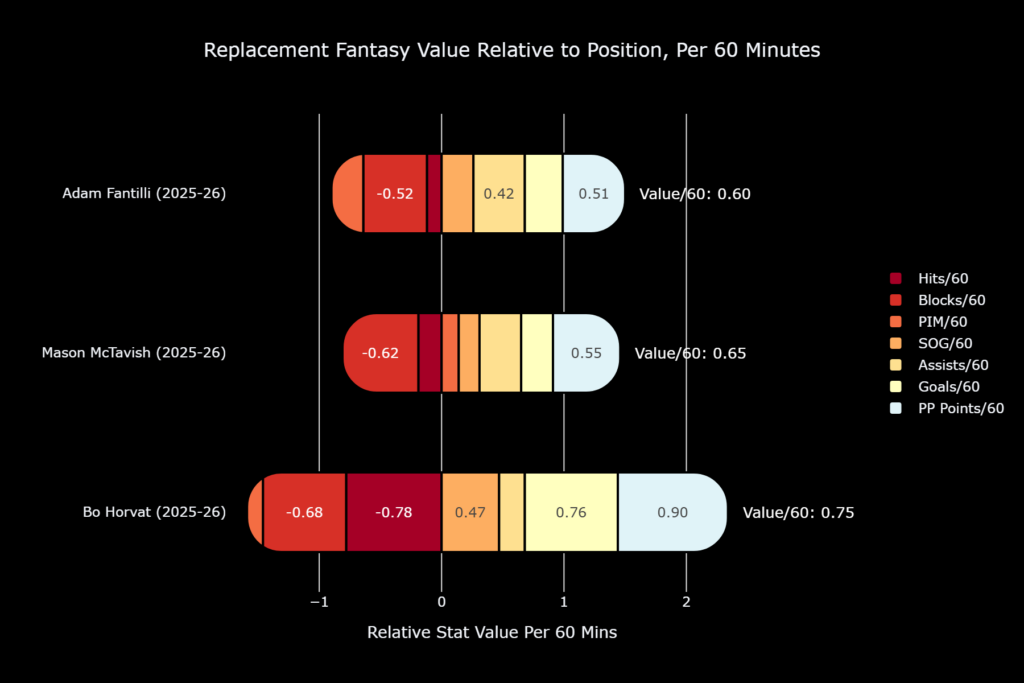
Here is the good news: McTavish's 2025-26 fantasy production was not as bad as it seemed on the surface. If we look on a 60-minute basis using the same stats we used for Peterka, McTavish landed somewhere between Bo Horvat and Adam Fantilli:
And, despite the ice time, McTavish's fantasy value was just fine on a per-game basis. Among players with at least 41 games played, he was on the fringes of the top-150 forwards, and similar to a guy who had 82-game paces of 30 goals, 35 assists, and 207 shots:
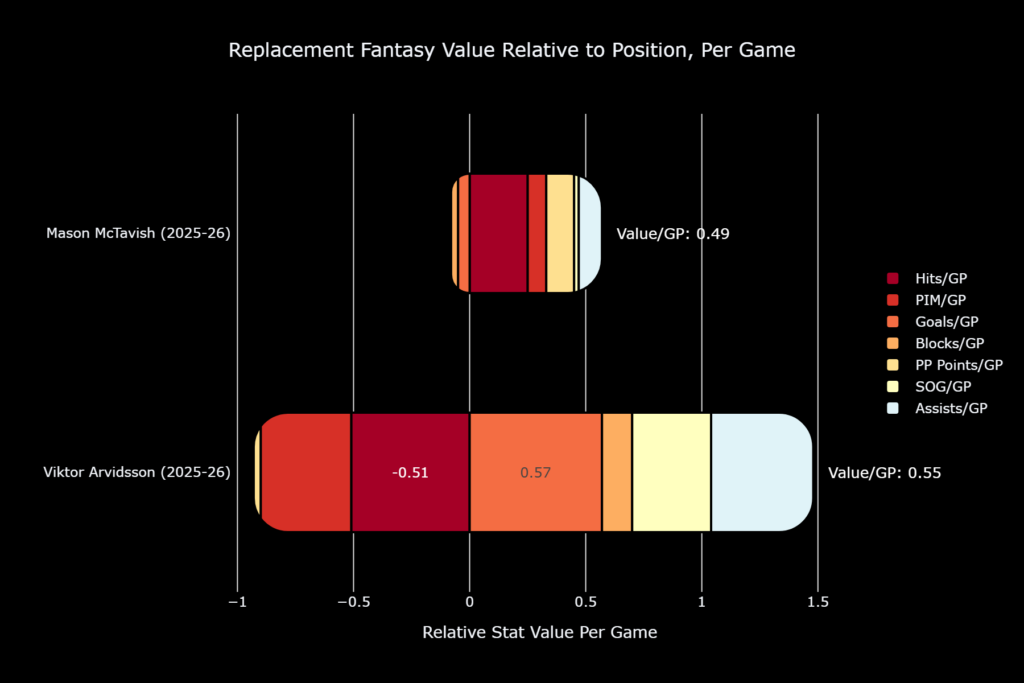
McTavish took a step back in 2025-26 on a per-game basis, but he was still roster-able in anything but shallow fantasy formats, and being productive despite a reduced role works in his favour.
Assuming McTavish gets a second-line role, the concern is his line mates. The Blues traded Jordan Kyrou, and Jimmy Snuggerud seems to have found a home next to Thomas. Unless Pavel Buchnevich turns the clock back 3-4 years, it leaves just Dylan Holloway as a high-end scoring winger for McTavish to play with. If, for whatever reason, Holloway doesn't end up on McTavish's line (he skates the top line, he skates the third line, or he's injured), then McTavish doesn't have much offence to skate with. Then there is the St. Louis blue line, which really struggled to move the puck last season, and might not get a lot better next season thanks to the addition of Brandon Carlo.
Whatever we think of McTavish's value in real-life NHL terms, I don't have major concerns that he'll be a useful fantasy option in 2026-27. I have fewer questions about him than I do about the team that surrounds him, which presents us with a big problem. It is conceivable that McTavish improves his skills, adds 1:30-2:00 per game in ice time, gets a regular turn on the top PP unit, and his fantasy needle doesn't move significantly because the Blues don't have much offensive depth. St. Louis is a much worse offensive environment than Anaheim, especially for anyone not skating with Robert Thomas, so this is a case where the player's skills and usage improve, but the downgrade in his surroundings is enough to negate that a big portion of that improvement. His fantasy value should increase, but if the team treads water offensively, that increase won't be as much as we'd hope for.
Related Posts
Starting Goalies












Top Skater Views
| Players | Team | |
|---|---|---|
| JACK QUINN |
 BUF | |
| MASON MCTAVISH |
 STL | |
| T.J. HUGHES |
 COL | |
| QUINTON BYFIELD |
 L.A | |
| FRASER MINTEN |
 BOS | |
Top Goalie Profile Views
| Players | Team | |
|---|---|---|
| JACOB FOWLER |
 MTL | |
| SERGEI MURASHOV |
 PIT | |
| DYLAN GARAND |
 NYR | |
| JET GREAVES |
 CBJ | |
| CARTER HART |
 VGK | |
LINE COMBOS
| Frequency |
PIT Players
| |
|---|---|---|
| 25.6 | BRYAN RUST RICKARD RAKELL SIDNEY CROSBY | |
| 20.1 | NICK ROBERTSON ANDREI KUZMENKO BEN KINDEL | |
| 20.1 | TOMMY NOVAK EVGENI MALKIN VILLE KOIVUNEN | |
DobberHockey Podcasts

Keeping Karlsson: Never Tell Me the Podz
Elan and Brian do a wellness check on the Maple Leafs, lament Chicago and Buffalo snoozers, wonder whether and which Flyers have figured it out, and pick out the Capital standing out from the crowd.

Fantasy Hockey Life: Ep 505 Prospects With Plenty to Prove Part 1
Victor and Jesse return to talk about prospects with plenty to prove. This week it’s: Tij Iginla, Berkly Catton, Konsta Helenius, Zayne Parekh, Igor Chernyshov, Jett Luchanko, Axel Sandin-Pellikka, Artyom Levshunov, Michael Hage, and Carter Bear. Have a listen! Our show is part of the Dobber Podcast Network and sponsored by Fantrax.com. Email [email protected] and […]
Keeping Karlsson: Matchup Maximizer 2026/27 Week 4
Elan takes a look at the schedule for the upcoming weeks of NHL action and recommends players with good schedules that you should consider streaming in to win your head to head matchups.
Keeping Karlsson: Short Shifts – NHL Frozen Frenzy Recap
Elan and Lewis recap the Frozen Frenzy as well as two big returns and more!
Keeping Karlsson: Delusions of Garandeur
Elan and Brian dive into the latest NHL hot streaks, cold streaks, line changes, outjuries, injuries, buy-lows and sell-highs to give you top notch tips in your fantasy hockey league