

21 Fantasy Hockey Rambles
Dobber Sports
2026-07-12
Every Sunday, we share 21 Fantasy Rambles from our writers at DobberHockey. These thoughts are curated from the past week’s 'Daily Ramblings'.
Writers/Editors: Ian Gooding, Michael Clifford, Alexander MacLean, Puneet Sharma, and Dobber
___
1. Fantasy Hockey Implications of the Ducks Matching Leo Carlsson‘s Offer Sheet
From a fantasy perspective, Anaheim matching the offer sheet for Carlsson is a major win for anyone invested in him long‑term – provided it’s not a salary-cap league, of course. In that case, his value has plummeted based on the cap hit alone, says Ian Gooding.
Carlsson averaged 19 minutes per game last season, but with his cap hit now elevated, teams often respond by increasing deployment to match the financial commitment. Expect Carlsson to be treated like a true 1C—regularly over 20 minutes per night, more PP1 stability, and continued offensive‑zone usage (63.8 OZ%). That alone raises both his floor and ceiling.
It also positions him to smooth out the dramatic split between his early‑season production and the rest of the year. Over his first 21 games, Carlsson posted 11 goals and 28 points (1.33 PTS/GP), a borderline elite pace. Over his final 49 games, he dropped to 18 goals and 39 points (0.80 PTS/GP). Increased responsibility and more consistent deployment should help him stabilize somewhere between those two extremes, making him a strong breakout candidate in points‑only and a rising asset in multi‑cat formats.
The next fantasy‑relevant domino is Cutter Gauthier. He cannot be signed to an offer sheet, but Anaheim must still negotiate from a place where they cannot afford to lose him. Gauthier led the Ducks in goals (41) and points (69) last season, and he projects as a high‑volume shooter (3.8 SOG/GP) with multi‑cat upside. Gauthier is also only 22 years old and will likely command over $10 million per season.
If Anaheim needs to clear space to finalize Gauthier’s deal, fantasy managers should monitor potential veteran cap‑dump candidates. Alex Killorn and Frank Vatrano are the most obvious names, but even larger contracts like Chris Kreider or Mikael Granlund shouldn’t be dismissed if Anaheim decides to reshape its roster. In the case of sub-0.5 PT/GP players Killorn and Vatrano, the Ducks will probably have to add a sweetener to the deal like a draft pick or a prospect. (july11)
2. For the Flyers, Carlsson staying in Anaheim keeps their center problem unsolved—and that matters for fantasy because Philadelphia’s forward production is heavily dependent on who drives their top line. Ideally, they would acquire a true 1C. Those don’t grow on trees, as teams would much rather keep their own first-line centers. Adam Fantilli, picked one spot after Carlsson in the 2023 draft, is an RFA center who has not been signed. Maybe the Flyers turn their attention to Fantilli. I can’t see why the Blue Jackets wouldn’t match, though.
One question is whether Dylan Larkin would expand his limited list of acceptable destinations to include Philadelphia. If not, the Flyers may pivot to a high‑end 2C who can still elevate their wingers’ fantasy value. Elias Pettersson is on the trade block, but Rick Tocchet’s lukewarm history with him in Vancouver complicates that fit. Until the Flyers resolve their center situation, projections for players like Owen Tippett, Travis Konecny, and Tyson Foerster remain volatile. Trevor Zegras is the closest that the Flyers have to a true #1 center, but his career production to this point has been too inconsistent while he has never even scored at a 70-point pace in any one season. (july11)
3. Adds Alexander MacLean: I’ll quickly chime in with my two-cents on the Leo Carlsson contract, and that’s first off that I have been noting for a couple of years now that this big jump in contracts was coming, along with how valuable those long term deals were going to be that were signed. Especially the eight year contracts signed in the last year or two.
When Leo Carlsson‘s $18M deal expires in 2031 and he’s looking for a raise, the Carolina Hurricanes will still have Seth Jarvis, Jackson Blake, and Logan Stankoven under contract for a combined $18.5M. Carolina got ahead of these things, but Anaheim didn’t. Those of you planning ahead are going to be in an excellent spot in cap leagues moving forward. Those of you still waiting for RFAs to sign might be in tough to suddenly find some extra cap space.
Calsson’s deal comes in at a little over 17% of next season’s cap, while the cap percentage for some of the league’s stars in the last decade on longer term deals have peaked around 15%, including Connor McDavid‘s initial $12.5 Million deal, and Matthews’ $13.25 Million cap hit. Both of those were very rosterable, but part of that is because owners knew they were getting a top-10 fantasy player. Carlsson is probably a top-25 or 30 option heading into the season, but top-10 production from him would likely be seen as a big win.
If you want to look for reasons why Carlsson can be a top-10 player, you don’t have to look very hard. He started off the year with 28 points in 21 games, finished the season at about a point-per-game, and is heading into year-four right at the 200-game mark. He spent all of last season carrying around Troy Terry with an injured hip, and a 34-year-old Chris Kreider. Carlsson’s underlying numbers all seem relatively stable, though a touch low if anything – indicating he probably should have finished the year around an 85-point pace rather than 78. With the added golden-boy status that the new contract brings, Carlsson should be viewed in drafts and offseason trades as at least an 85-point player entering next season, with a very realistic shot of finishing somewhere around 100 points. (july8)
4. Meanwhile, Pavel Mintyukov's five year, $7.4 million AAV extension is a bet on upside more than current production. The 21-year-old has shown flashes of being a dynamic puck mover with offensive instincts and the ability to transition the puck efficiently, but his defensive game remains a work in progress. Those flashes were more evident early in his career, and consistency has been a point of contention. The timing of the deal is what stands out most. With the Leo Carlsson offer sheet, Anaheim appears to be getting ahead of any future offer sheets before costs climb even higher than they are. If the Ducks ultimately match Carlsson's offer sheet, they'll be committing a combined $25.4 million annually to just Carlsson and Mintyukov alone. It's another sign that Anaheim's cap picture is becoming much tighter by the day. (july6)
5. Fantasy Hockey Implications of the Connor Bedard Injury
Bedard’s expected month‑long absence following left‑shoulder surgery is a major fantasy storyline. While the injury occurred during a training session and affects his “other” shoulder—not the right shoulder he injured last year—it still delays the breakout momentum many managers were banking on. Bedard remains a top‑tier asset in all formats, but missing the opening month shifts early‑season draft strategy, lineup planning, and streaming opportunities across Chicago’s roster.
For the Blackhawks, Bedard’s absence is a significant blow to their attempt to be more competitive after acquiring Bowen Byram for the fourth overall pick in the draft. From a fantasy standpoint, Byram’s early value takes a hit without Bedard driving offense and generating high‑danger touches. His PP1 upside remains intact, but the ceiling is temporarily lower until Bedard returns. (july11)
6. The biggest fantasy ripple with the Bedard injury comes at center. Frank Nazar and Anton Frondell are the two candidates to take over as Chicago’s temporary 1C. Both should see meaningful bumps in ice time and usage. Nazar is the more likely option due to experience, making him a short‑term streaming target in deeper leagues. Frondell, however, is the more intriguing upside play. He posted nine points in 12 games late last season and earned time on the top power play—rare for a 19‑year‑old. If he lands the 1C role, he becomes an immediate sleeper with legitimate breakout potential during Bedard’s absence.
Roman Kantserov is another name fantasy managers should monitor closely. The blue‑chip winger could debut this fall, and while his long‑term value is tied to eventually playing with Bedard, even a temporary role next to Nazar or Frondell could make him a speculative add. They aren’t Bedard‑level play drivers, but they’re capable enough to give Kantserov a runway to produce.
Ryan Donato also enters the fantasy conversation. His versatility across forward positions makes him a candidate to move up the lineup. Donato averaged under 15 minutes per game last season, but Bedard’s injury creates a window where he could finally see top‑six deployment. In deeper leagues, he’s a watchlist name.
Oliver Moore, who averaged under 13 minutes per game as a rookie, could slide into a 3C role and see a modest bump in usage. He’s not an immediate fantasy add, but he becomes relevant in dynasty formats if his minutes climb.
The key fantasy takeaway: Bedard is only expected to miss about a month, but Chicago’s roster is young and fluid. Any forward who seizes this opportunity—Nazar, Frondell, Kantserov, Donato, or Moore—could hold onto an elevated role even after Bedard returns. Early‑season streaming from Chicago’s top six could pay off for managers willing to act quickly. (july11)
7. The Utah Mammoth matched the offer-sheet to which the New Jersey Devils signed centre Barrett Hayton. A matched offer sheet also precludes a trade of Hayton, so he will be around the Mammoth for at least one more full season. (july9)
8. Yegor Chinakhov signed a three-year extension with the Pittsburgh Penguins carrying a $6.25 million AAV after taking a significant step forward this season. He brings plenty of offensive upside and production last season which makes him a worthwhile gamble for Pittsburgh. If this year's breakout proves to be sustainable, the Penguins could end up with one of the better value contracts among scoring wingers. The three-year term also works well for both sides, giving Pittsburgh cost certainty while allowing Chinakhov another opportunity to cash in if he continues on this trajectory. (july6)
9. The Penguins also took care of another piece of business, signing goaltender Arturs Silovs to a short team one-year contract at a cap hit of $2.8M avoiding arbitration. It’s a nice deal for both the Penguins and Silovs who should have a clear spot with the Penguins as part of a tandem with either Sergei Murashov or Joel Blomqvist. I would suspect that Silovs will likely get the higher end of starts to begin the season. (july6)
10. Claude Giroux re-signed in Ottawa Tuesday, on a bonus-laden deal with a $2 Million cap hit for one year. The 38-year-old has paced for 50 points each of the last two seasons, and we can expect more of the same from him this year. He’s still valuable in leagues where FOWs from the wings matter, but aside from that, he’s a fringe fantasy name at this point in his career. (july8)
11. My 24-Team Cap Dynasty League (the WHL) is drafting next week, so I figured I would do a mock draft for it, as I try to pencil out who will be left for me at pick #20.
Pick 1 – Gavin McKenna (LW) – TOR
With the top pick, the GM has noted that he’s likely to keep it and select McKenna. Tough to fault him with the safe selection, and one that likely helps his current two-year compete window where he stumbled last year with Connor McDavid and now has him for two more seasons at a reasonable number. McKenna is the safest bet to produce at the NHL level this year.
Pick 2 – Ivar Stenberg (LW) – SJS
The Macklin Celebrini owner isn’t going to have to think about this pick too hard, selecting the other top player in the draft, and Celenrini’s future running mate.
Pick 3 – Viggo Bjorck (C) – WPG
The team in our league who is most in the middle of rebuilding is likely going to take the highest offensive upside player, and that is likely Bjorck at this point. He dominated at WPG development camp, and could even be in the NHL as a second line center this season.
Pick 4 – Caleb Malhotra (C) – VAN
Malhotra’s story at the draft may have been more about the family reuinion, but he is still very deserving of a top-five selection. He may need a little bit more development time before being ready for the NHL after a successful season in Brantford, but the scoring upside is there along with the defensive awareness and maybe some potential for peripherals. Our WHL team selecting here is resetting a little, and received this pick for a couple of veterans including Artemi Panarin. Malhotra likely rounds out the top-four for most leagues though, as fantasy GMs are more wary of defencemen, and this is where the forward tier drops off.
Pick 5 – Chase Reid (D) – SEA
I could see the team selecting here debating a few different options on D or a reach for a forward, but ultimately selecting the player who was viewed as the top Dman in the class, has one of the highest offensive upsides, and joins a club without much in the way of roadblocks to ice time or power play deployment sounds pretty straightforward. This team is also resetting a little, and has the cupboards stocked at forward, without a crown jewel on the minors blueline (due to trades) despite a few D selections in recent years. (july8)
12. Pick 6 – Keaton Verhoeff (D) – SJS
I don’t have a great sense of this GM’s draft tendencies as they joined last summer without too many picks, but if this one isn’t over-thought, then Verhoeff is likely the second Dman off the board due to his upside in San Jose. He may need to be brought along more purposefully, so the wait time could be a little longer to hit that upside.
Pick 7 – Wyatt Cullen (LW) – NSH
I think that our GM here leads forward compared to the couple of higher-drafted defencemen available, which is more so an indication that this is a fantasy draft compared to anything else. Cullen has some high upside, and seems to be similar to Beckett Sennecke from last year in that he hit a huge growth spurt the last two years (five-foot-five to six-foot-one in two years) to build on top of a very skilled player. Obviously Sennecke’s puck skills and height are above that of Cullen’s but the parallels are there.
Pick 8 – Daxon Rudolph (D) – BUF
Our GM who picks at #3 also owns the #8 pick, and he never does anything halfway. Rebuilding the blue line should be in order here after moving out some of his recently drafted rearguards for high upside forwards in deals over the last year. Rudolph could contest with Reid for the highest offensive upside in the draft, it just might take longer for him to get there with the road block named Rasmus Dahlin in front of him and some work to be done on his defensive awareness.
Pick 9 – Carson Carels (D) – CGY
This GM has been a safe drafter in previous years, and I expect him to stick to that and select the top remaining player here in Carels, who still provides some excellent upside on top of his high floor.
Pick 10 – Oscar Hemming (LW) – CBJ
Another GM who joined the league last year, and no big draft history to pull from, but overall his team has plenty of young Dmen and is lacking quite a bit at LW, which would make Hemming the natural pick. Hemming should also have a quicker transition to the NHL, coming as a bigger bodied player from the NCAA, and into a Columbus lineup that looks like it may continue to have a few holes in it over the coming seasons. (july8)
13. Pick 11 – Alberts Smits (D) – NYR
This GM often follows the NHL draft to a tee, selecting the highest remaining player from the NHL draft board. It has worked out fairly well for him in the past, and based on my research, the NHL draft list is above average at predicting NHL success when compared with other public scout draft lists.
Pick 12 – Tynan Lawrence (C) – STL
The same GM at number four has #12 here too thanks to a deal with yours truly (which was a three-team deal where I acquired Shayne Gostisbehere for my own first next year, and another second round pick, and #12 was the intermediate piece). He is a GM that really plays for elite pieces and upside, and the best piece under both of those columns is Tynan Lawrence. He might be farther down my draft list, but many in the public sphere see a lot of potential despite the slow transition to the NCAA.
Pick 13 – Mathis Preston (C) – ANA
The team who took Reid at #5 is back on the clock here, and after one high-level Dman, I would expect a forward to follow. Mathis Preston feels like a fit, based on both upside, and this GM’s ties to BC. Preston’s upside might be as high or higher than the rest of the forwards available, but his floor might be a little lower after an injury-plagued season.
Pick 14 – Nikita Klepov (RW) – ANA
Klepov was one of the strongest scorers in the OHL, and this GM doesn’t shy away from Russians as he already owns Alex Ovechkin, Matvei Michkov, and Ivan Demidov. Betting on Klepov’s upside feels like a great fit at this spot. This also highlights how much fire power Anaheim is going to have up front very soon, as they are constantly drafting high upside players.
Pick 15 – Adam Novotny (LW) – VAN
This is again our BC GM from #5 and #13. There is now a wide range of players who could be selected here, so it’s tricky to really pick at this stage. A lot of the upsides are similar, so I could see a team (especially this one who is constantly looking to compete) to look at Novotny’s very limited competition in front of him, and think that there could be a more immediate path to impactful minutes with the Canucks, making him a worthwhile pick here, a little earlier than his 28th overall slot in the NHL draft.
Pick 16 – Ethan Belchetz (LW) – UTA
Opinions on Belchetz vary, and while most think he has a floor as an NHLer it seems like he could end up anywhere from a second-line player like Lawson Crouse, or a mildly productive fourth liner. His size does mean his floor is higher than some, but the upside isn’t quite as high. The odds he hits heights similar or higher to many of the remaining players is much higher, which makes him a reasonable bet in this range.
Pick 17 – Alexander Command (C) – NJD
Command is another higher floor player, who might even be one of the best bets in this range to make his NHL debut as early as this year. He plays a responsible NHL-ready game, and the Devils need some help in their bottom six, especially at center.
Pick 18 – J.P. Hurlbert (RW) – DET
Another high-upside winger available in this range, Hurlbert thrived in the WHL where he could showcase his offence, and is off to Michigan in the NCAA this coming season who is loading up for another championship run. It’s possible that if he thrives there too, that he could be one and done at the NCAA level and see a few NHL games at the end of the season for a Wings team that likely won’t be playoff bound.
Pick 19 – Oliver Suvanto (C) – WSH
Washington has done very well at the draft table over the last few years, and the European players who come over as polished two-way players at the top of their draft class but without the same high scoring numbers as others in the draft class often get overlooked, but the offence was just suppressed because they were playing against men as 17-year-olds. This could be the case for Suvanto too, who lit up the U-18 circuit as a 16-year-old, but then saw his numbers stunted when he made the jump to Liiga. He is somehow both a safe pick and an upside swing at the same time.
Pick 20 – Elton Hermansson (RW) – LAK
With my first pick at #20, Hermansson would be my pick as he’s currently the top remaining player on my updated list at #18. He’s a skilled player with swagger who has already played against men, showing that his skills aren’t just from being able to pull them off against less-experienced defencemen. There are a few players I like in this range though, so I wouldn’t be against trading down a few spots, but the forwards will continue to go quickly here as there aren’t many defensemen left worth selecting either. (july8)
14. With most NHL rosters largely set particularly on the backend, I thought it's a good time to project each team's power play quarterback heading into the season. Some clubs have obvious answers, while others have legitimate battles that could carry into the season, but that's what makes this exercise interesting. This week, I'll break down the Eastern Conference before shifting my focus to the Western Conference next week.
Eastern Conference
Rasmus Dahlin – Buffalo Sabres
Buffalo's offense runs through Rasmus Dahlin from the blue line, and he is the unquestioned quarterback of the top power play. Even during stretches where the Sabres have struggled offensively, Dahlin has consistently produced because of his heavy workload in every situation. Unless an injury changes the equation, there is virtually no competition for his role. Dahlin remains a locked-in No. 1 defenseman capable of posting another 70+ point season while contributing heavily on the power play. His combination of opportunity, talent, and ice time gives him a safe fantasy floor among NHL defensemen.
John Carlson – Tampa Bay Lightning
I initially had Victor Hedman in this spot after the Darren Raddysh move to Toronto and with all the rumors with Carolina getting first dibs on Carlsson it almost seemed as if Tampa was going back to the well with Hedman. Well, since then Carlsson signed with the Lightning and now enters the season as the favorite to claim full control of one of the most dangerous power plays alongside Nikita Kucherov, Jake Guentzel, Brandon Hagel and Brayden Point. As things stand today, Carlsson projects as the clear No. 1 quarterback and should continue to produce reliable fantasy value thanks to his role on one of the league's premier man-advantage units.
Lane Hutson – Montreal Canadiens
Lane Hutson wasted little time proving he belongs as Montreal's power-play quarterback. There isn't another defenseman in the organization who possesses his combination of skill and offensive instincts, making his hold on the top unit extremely secure. Hutson is well outside of the top-five when it comes to power-play production and yet he posted 78 points this past season. One can only assume he will hit well north of the 20 powerplay points he hit his past season. Continued development from this young Canadiens' forward group, Hutson has legitimate potential as one of the NHL's premier offensive defensemen. (july6)
15. Charlie McAvoy – Boston Bruins
Charlie McAvoy fantasy upside isn't quite as high as some of the names on this list but he is an excellent all-around defenseman who logs massive minutes in every situation. McAvoy had his best season from a production standpoint with 11 goals and 50 assists in 69 games, putting him at a 72-point pace. The Burins added JJ Peterka to the lineup hoping to add some more firepower to the lineup. While a massive offensive breakout feels unlikely, McAvoy remains a dependable fantasy option who should provide solid production across multiple categories while benefiting from consistent top-unit power-play usage.
Jake Sanderson – Ottawa Senators
After breaking out with 58 points two seasons ago, Jake Sanderson followed it up with 54 points in just 67 games this past season. Over a full 82-game schedule, that production translates to a 66-point pace, which would have been a new career high. With Brady Tkachuk no longer in the picture, Ottawa's top power-play unit will need to generate more offense to help replace that production. That creates even more opportunity for Sanderson to drive the attack from the blue line and continue building on his already impressive fantasy value.
Moritz Seider – Detroit Red Wings
Moritz Seider took another step forward offensively setting career highs with 10 goals, 60 points, 187 shots on goal, and 3:12 of average power-play ice time per game. He was Detroit's clear-cut offensive defenseman, finishing 20 points ahead of the next-highest scoring blueliner, Justin Faulk (40). The gap was even more noticeable on the power play, where Seider produced 28 points compared to just nine from Faulk. While players like Simon Edvinsson and Axel Sandin-Pellikka may eventually push for additional offensive opportunities, Seider remains firmly in control of the top unit heading into the season. The Dylan Larkin dilemma may alter the overall equation in Detroit but that should not affect Seiders spot on the top unit. (july6)
16. Seth Jones – Florida Panthers
Florida already possesses one of the league's deepest rosters, and Jones gives them another experienced puck-moving defenseman capable of handling the responsibilities of running the first power play. The Panthers have historically relied on their forwards to drive offense, meaning Jones doesn't need to force plays to remain productive. Instead, he'll benefit from distributing the puck to one of the NHL's most dangerous collections of finishers. His fantasy ceiling may not rival his peak seasons in Chicago or Columbus simply based on how many stars are on this team, but his role on an elite team should keep him firmly relevant.
Darren Raddysh – Toronto Maple Leafs
John Chyka revamped nearly half of this Toronto Maple Leafs roster, but the top power-play looks relatively the same aside from one addition, Darren Raddysh. He developed into an effective puck mover in Tampa Bay and has the offensive instincts to keep elite finishers like Auston Matthews and William Nylander in scoring positions. He doesn't need to drive the offense himself. His role is to move pucks efficiently, avoid costly mistakes, and take advantage of his heavy shot when opportunities arise after scoring 10 power-play goals last season. Toronto signed Raddysh with the expectation that he'll get every opportunity to lock down the top unit.
Shayne Gostisbehere/Alexander Nikishin – Carolina Hurricanes
As things stand, Carolina's top power-play quarterback appears to be either Shayne Gostisbehere or Alexander Nikishin. Gostisbehere handled most of the work last season, averaging 3:10 of power-play ice time per game, while Nikishin saw a more limited 1:26. The Hurricanes were heavily linked to John Carlson before talks fizzled. Until there's more clarity, expect Gostisbehere to open the season on the top unit, though a more balanced split with Nikishin remains a realistic possibility as the season unfolds. (july6)
17. Erik Karlsson – Pittsburgh Penguins
Erik Karlsson remains Pittsburgh's most dangerous offensive defenseman and should once again quarterback the Penguins' top power-play unit. As long as Sidney Crosby and Evgeni Malkin remain healthy, Karlsson will have no shortage of elite finishers to distribute the puck and Karlsson's offensive workload isn't likely to change. A healthy Karlsson is still capable of producing among the league leaders in power-play points by a defenseman, making him a valuable fantasy option despite the Penguins' aging roster.
Jamie Drysdale – Philadelphia Flyers
The battle for the Flyers’ top power-play quarterback is still fairly unsettled, but Jamie Drysdale has a slight early edge. He finally logged a near full season, appearing in 78 games and finishing with just 34 points, including nine on the power play. He also led all Philadelphia defensemen in power-play usage at 2:19 per game. The next closest was Travis Sanheim at 1:06, and he managed just three power-play points all year. Outside of Drysdale, no one on the blue line has really stepped forward, and the gap behind him is not significant enough to call it locked in. For now, Drysdale looks like the default option on the top unit for the Philadelphia Flyers.
Jakob Chychrun – Washington Capitals
Jakob Chychrun enters the season as Washington's projected No. 1 power-play quarterback after thriving in his first year with the Capitals. His ability to threaten from the point forces penalty killers to respect his shot, creating more room for the forwards to operate. While his role appears secure heading into the season, one name worth monitoring isCole Hutson. Washington's highly skilled prospect possesses dynamic offensive abilities and projects as the organization's power-play quarterback of the future. It may not happen immediately, but if Hutson adapts quickly to the NHL, the Capitals could eventually give him an opportunity to run the first unit. For now, however, Chychrun remains the clear fantasy option. (july6)
18. Zach Werenski – Columbus Blue Jackets
Zach Werenski is coming off back-to-back career offensive seasons of his career and remains the clear driver of Columbus’ power play. He controls everything from the blue line, using his skating, vision, and puck distribution to set up finishers like Adam Fantilli, Kirill Marchenko, and newly added Valeri Nichushkin. No other defenseman on the roster is realistically pushing him for that role. Even with his recent trade rumors, Werenski’s usage and offensive ceiling remain stable, and his fantasy value continues to sit in the elite tier among defensemen.
Matthew Schaefer – New York Islanders
Mathew Schaefer wasted no time making an impact in his rookie season, finishing with 59 points and 18 on the power play while averaging 3:19 in man-advantage usage. He quickly established himself as one of the most complete defense prospects to enter the league in recent years, and backing that up with a Calder Trophy win only reinforced the upside in his game. Despite Noah Dobson‘s departure, the Islanders didn’t miss a beat on the top unit, with Schaefer stepping in and taking control of that role. There will be natural growing pains, but the offensive ceiling is obvious.
Dougie Hamilton/Luke Hughes – New Jersey Devils
This is one of the more intriguing situations to watch. Dougie Hamilton remains one of the league's better offensive defensemen when healthy and enters the season as the favorite to retain the top power-play role. However, Luke Hughes continues to develop into exactly the type of dynamic offensive defenseman who could eventually take over. I see Hamilton likely starting the season on the first unit, but this is one of the few teams where a midseason changing of the guard would not be surprising.
Adam Fox – New York Rangers
The Rangers look a lot different than they did just a few months ago with both Artemi Panarin and Vincent Trocheck no longer in the lineup. Despite those significant changes, Adam Fox remains the unquestioned quarterback of New York's top power-play unit and one of the NHL's elite offensive defensemen. His role is as secure as any blueliner in the league, and he should continue to be a dependable source of assists and power-play production regardless of the new-look forward group. (july6)
19. Last week was very busy as we saw a handful of significant trades, plus we had free agent frenzy. To catch up on any major move you may have missed, be sure to check out the fantasy hockey analysis in our ‘Fantasy Take‘ section. Those contributions come from all of the Dobber editors, not just myself.
Today, let’s go through these changes one last time, focusing on specific trades or signings we’ve seen this offseason that are of great interest from a fantasy perspective. This is all subject to change, of course, pending further trades/signings or injuries.
Pavel Dorofeyev (New York Rangers)
My initial skepticism over the Rangers acquiring and extending Dorofeyev was that Dorofeyev was a shooter, not a playmaker, and the Rangers were lacking puck-movers on the blue line to help make up that deficit. However, they added Sean Durzi, who has had a couple of tough years driven by injuries but is typically a very good puck-mover, and Marcus Pettersson, who was a decent puck-mover a few years ago but saw things decline in Vancouver. If those two play to the level they’re capable of, the Rangers might now have puck movers across all three defence pairs, and that matters a lot.
The other exciting part is Dorofeyev’s potential role. Over his final 25 games last season, Alexis Lafreniere skated nearly 19 minutes per appearance. If Dorofeyev assumes the role that Laf had late in 2025-26, it could add 60-90 seconds per game in ice time. It would go a long way to keeping Dorofeyev as a 30-goal, 60-point forward, and give him genuine 40-goal, 70-point upside. How the Rangers decide to deploy their wingers will tell the story, but the potential is there for Dorofeyev to have a career year.
[Follow the link for more…] (july7)
20. Catching players whose fantasy value is on the upswing is important when draft season rolls around. There are instances where a player has inflated value because of some good luck, but fantasy value tends to stay consistent from one season to the next. There are always exceptions, but if we see a player with rising value, we should tend to believe the improvement and then look to discredit it, rather than dismissing the improvement it then looking for reasons to believe.
Today, we’ll look at some forwards whose fantasy value increased in 2025-26 compared to 2024-25 on a 60-minute basis, then we’ll try to figure out if there’s a reason to discount their season. We are going to use goals, assists, power-play points (PPP), shots, hits, blocks, penalty minutes (PIM), and face-off wins (FOW) as our fantasy categories, unless otherwise indicated. These values are all relative to replacement-level production (roughly the value of a top waiver wire option in a 14-team league where 13 forwards are rostered on each team) and among forwards only.
Stats for evaluation courtesy of Evolving Hockey or Natural Stat Trick. We are only including players who played at least 41 games in each of the last two seasons, and the positional designations are from Yahoo.
Trevor Zegras (Philadelphia Flyers – C)
There were reasons to believe that Zegras would be better in Philadelphia than his last couple of years with the Anaheim Ducks, and he rewarded those who kept the faith with a big rebound effort. Of the eight fantasy stats we’re evaluating, he increased his value in five of them:
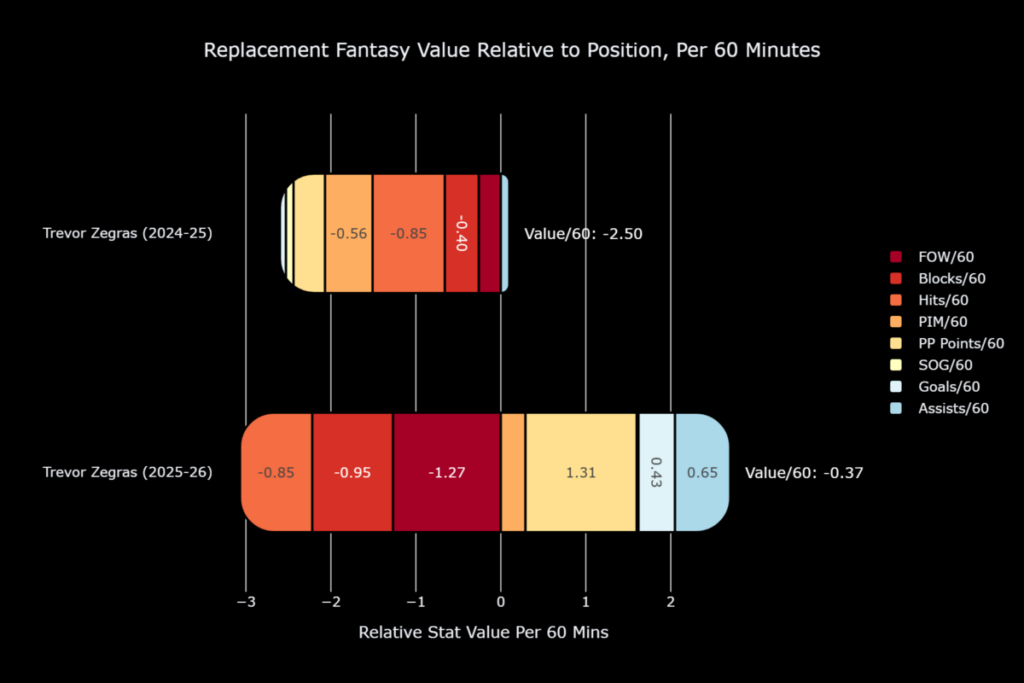
It is notable that of the three categories Zegras saw a decline in value, the largest belonged to face-off wins. That means in fantasy leagues where face-off wins aren’t counted, his improvement was even larger.
Is there cause for concern? Not as it relates to the underlying indicators:
- Zegras’ individual points percentage, or the rate he garnered a point when the Flyers scored a goal with him on the ice, was under 69%. It was his lowest rate of any season where he’s played at least 50 games, so he didn’t figure in on a higher-than-expected share of the goals.
- The Flyers shot 11.6% with him on the ice at 5-on-5, which was his highest rate of the four years where he managed at least 50 appearances. That might be a cause for concern, but that wasn’t even a top-50 rate among all forwards. Additionally, he registered a point on 64.4% of 5-on-5 goals against a three-year average of 75.2%. If the team had shot 10% with him on the ice, but he registers a point on 75% of the goals with him on the ice, he posts 38 points at 5-on-5, the same number he actually posted. In other words, negative regression in one area could easily be washed out by positive regression in another.
- He did shoot 15.6% individually, a career-best rate. However, if he shot 12.5%, he still would have a 60-minute increase in fantasy value for his goals scored, and instead of having the 12th-largest overall fantasy value increase, he has the 19th-largest. Even with a normal shooting percentage, he still would be one of our biggest risers.
Put it all together and there should be optimism that Zegras can maintain roughly this level of fantasy production.
[Follow the link for more…] (july9)
21. In yesterday’s Ramblings (just above), we reviewed forwards who saw a fantasy value increase in 2025-26 compared to 2024-25 on a 60-minute basis. Today, we’ll do the same but avert our gaze to defencemen.
As with the forwards, the fantasy value demonstrated here is relative only to others at the same position, and relative to a replacement-level player (a top waiver-wire option in a 14-team league with six defencemen per roster). Because we’re only evaluating blue liners, we are excluding face-off wins from the analysis, focusing solely on goals, assists, power-play points (PPP), shots, hits, blocks, and penalty minutes (PIM).
Brock Faber (Minnesota Wild)
Sometimes, when a team adds a defenceman who supplants another on the top power-play unit, the former PP quarterback sees their fantasy value suffer. That wasn’t the case for Faber, who posted 36 points in 48 games after Quinn Hughes made his Wild debut, and Faber had his fantasy value rates increase nearly across the board:
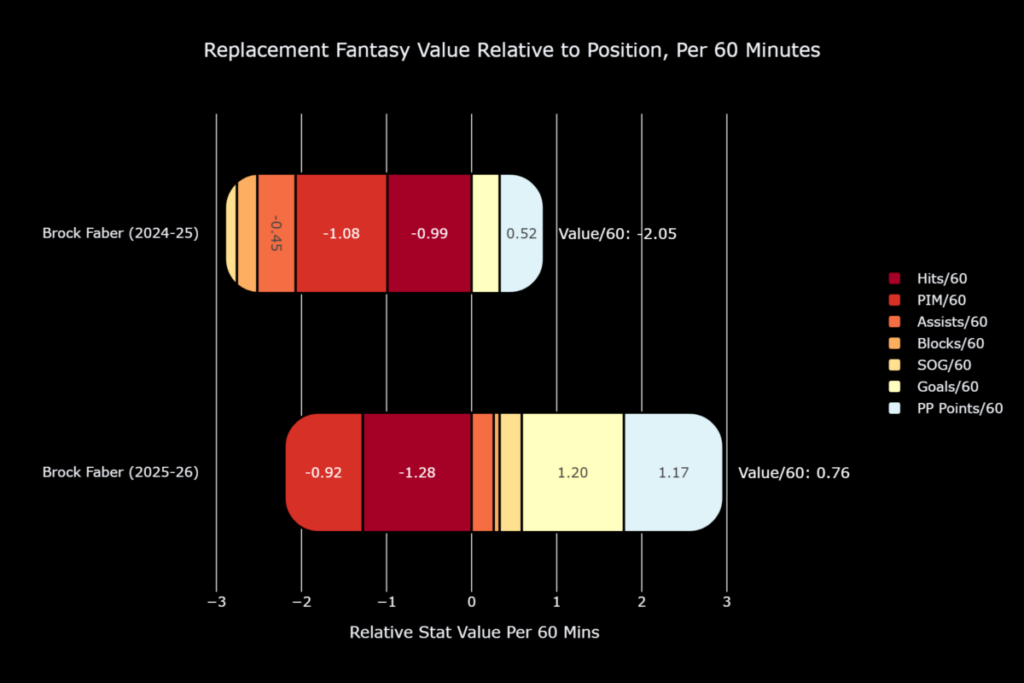
It is important to note that Faber still posted seven power-play points in 48 games with Hughes in the lineup. In an 82-game season, that is about 12 PPPs, not far off the 13.5 PPPs per 82 games he averaged across the prior two seasons. The team shot 30% on the power play with Faber on the ice in those 48 games, but even if he posts 3-4 PPPs in that span, his fantasy value increase among defencemen is still inside the top-10.
Losing a top PP role isn’t ideal, but a rising tide does lift all boats; from 2023-2026, the Vancouver Canucks shot 11.5% at 5-on-5 when Filip Hronek was on the ice with Hughes and 8.8% without Hughes. It is very plausible that the Wild scores 50% more often when Faber is on the ice with Hughes, or more, and that kind of increase can greatly help offset the loss in PP role (as we saw). There is every reason to believe that Faber comes close to, or exceeds, his 51-point performance from last year. In fantasy terms, think of him as Devon Toews from 2-3 years ago.
[Follow the link for more…] (july10)
***
Reminder: Dobber's 2026 Fantasy Hockey Prospects Report is available in the Dobber Shop! Both Dobber and the Prospects team highlight the prospects you need to know. It has an in-depth look at each team's current prospect pipeline and estimated arrivals for their top, young (hopeful) stars. Head on over to the Dobber Shop and grab a copy of the Prospects Report!
***
Have a good week, folks!
Thanks for continuing to support the website and if you’re bored and need a fantasy hockey fix – visit the gang in the forum here.
Related Posts
Starting Goalies









Top Skater Views
 SEA
SEA S.J
S.J DET
DET
Top Goalie Profile Views
| Players | Team | |
|---|---|---|
| DYLAN GARAND |
 NYR NYR | |
| JACOB FOWLER |
 MTL MTL | |
| IGOR SHESTERKIN |
NYR | |
| JOEL HOFER |
 STL STL | |
| SERGEI MURASHOV |
 PIT PIT
| |
LINE COMBOS
| Frequency |
 VGK Players VGK Players
| |
|---|---|---|
| 24.4 | MARK STONE JACK EICHEL IVAN BARBASHEV | |
| 21.3 | MITCH MARNER WILLIAM KARLSSON BRETT HOWDEN | |
| 15.4 | RAPHAEL LAVOIE TOMAS HERTL TREVOR CONNELLY | |
DobberHockey Podcasts

Fantasy Hockey Life: TiDy Takes Part 2
Last week, Victor Nuno and Ryan Downey broke down trades from our top tier dynasty league. This week, they consider some dynasty trades from other divisions. Have a listen! Our show is part of the Dobber Podcast Network and sponsored by Fantrax.com. Email [email protected] and ask to join our free discord. Join our Patreon at […]

Keeping Karlsson: Matchup Maximizer 2026/27 Week 3
Elan takes a look at the schedule for the upcoming weeks of NHL action and recommends players with good schedules that you should consider streaming in to win your head to head matchups.
Keeping Karlsson: Short Shifts – Sharks Looked Like Celebweenies
Elan recaps the major injuries, outjuries, game results and changed line combos that we’ve seen since Sunday’s mega-show.
Keeping Karlsson: Cole, There’s No Time!
Elan and Brian cover all the action from the first week of the NHL season, and identify our earliest must-adds, can-drops, sell highs and buy lows in your fantasy hockey leagues.
Keeping Karlsson: Matchup Maximizer 2026/27 Week 2
Elan takes a look at the schedule for the upcoming weeks of NHL action and recommends players with good schedules that you should consider streaming in to win your head to head matchups.