

Ramblings: Evaluating Fantasy Declines from Theodore, Ekblad, Parayko, Weegar, Walman, Hamilton, and Power – July 16
Michael Clifford
2026-07-16
Work continues on Dobber's 2026-27 Fantasy Hockey Guide, which is available now for pre-order in the Dobber Shop. This edition will include players projections, team-by-team outlooks, call-ups/rookies to monitor, category-specific draft targets, and whole lot more. The best part is because it is a digital edition, it is constantly updated right until the start of the regular season due to injuries, trades, role changes, or anything of the sort. Get a headstart on your league mates and help support what we do year-round by pre-ordering your copy today!
*
The New Jersey Devils signed winger Anthony Mantha to a two-year deal worth $4.75-million per season, as reported by Elliotte Friedman. Alex had his take on the trade here.
Mantha is coming off a career year and has all the tools – shooting, playmaking, size – to be a 30-goal, 60-point winger. It was the first time he put it all together, but the tools are still there, and he's now going to a team with a very talented top-6 group.
As with all secondary scorers, the crux is the power play. All of Nico Hischier, Jack Hughes, and Jesper Bratt will be top PP fixtures. Mantha is in the mix with names like Timo Meier, Dawson Mercer, and even Connor Brown. If Mantha stays healthy – last year was the first time he played at least 75 games since 2017-18 – he can be a 25-goal, 50-point guy as he's moved between PP units, but I am not expecting him to repeat his career-best output.
*
Over my last few Ramblings, we have gone over some declines in fantasy value on a 60-minute basis last season compared to the year before. We have reviewed:
- Forwards who increased their value.
- Forwards who decreased their value.
- Defencemen who increased their value.
Today, we'll finish off our skaters by covering defencemen with less fantasy value in 2025-26 than in 2024-25.
As always, these evaluations are made by relating production to other defencemen, and to a replacement-level fantasy blue liner. In this instance, replacement-level is the average production for roughly the 85th most valuable fantasy blue liner, or the top waiver wire option in a 14-team league. We are only including defencemen who played at least 41 games in both seasons, giving us 159 blue liners to sift through. The fantasy stats used are goals, assists, power-play points, shots, hits, blocks, and penalty minutes (PIM).
Data is from Evolving Hockey or Natural Stat Trick, unless otherwise indicated. Remember that this is all evaluated on a 60-minute rate to help put everyone on equal footing.
Shea Theodore (Vegas Golden Knights)
The largest decline in our sample was Theodore, and it wasn't even close as his 60-minute fantasy value drop was 27% more than the next-closest player. Anyone who had Theodore on their roster knows where things went wrong, and it also shows how one stat can affect so much:
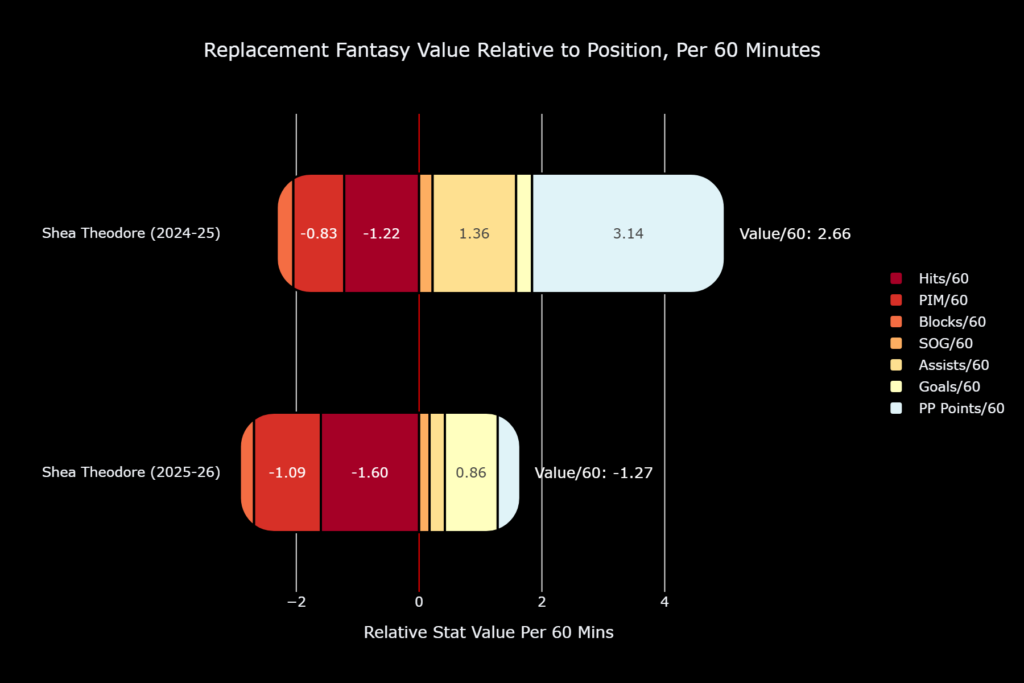
Losing the top PP role in Vegas as the team moved to a five-forward unit is what killed Theodore's fantasy output; roughly 70% the total drop came from the decline in power-play points. If he had the same PP output as the year before, and everything else stayed the same, he goes from a fringe top-80 defenceman to a fringe top-30 defenceman. However, it wouldn't stay the same as he would have added a lot of assists, so losing that PP role was the difference between being a top-80 defenceman or a top-25 defenceman.
The good news is that Pavel Dorofeyev was traded to the New York Rangers and no one was really brought in to replace him. It isn't hard to see the remaining four forwards from last year's vaunted power play return to that role and Theodore being the quarterback. That puts a 50-point season back on the menu for him, but there is a gnawing feeling in my stomach that Vegas brought Victor Olofsson back into the fold for the specific reason of having a shoot-first left-handed winger to replace Dorofeyev.
Aaron Ekblad (Florida Panthers)
As with Theodore, the drop in power-play production was a big reason for Ekblad having one of the largest declines in fantasy value, as his slide in PP value accounted for 54% of his fantasy value slide overall:
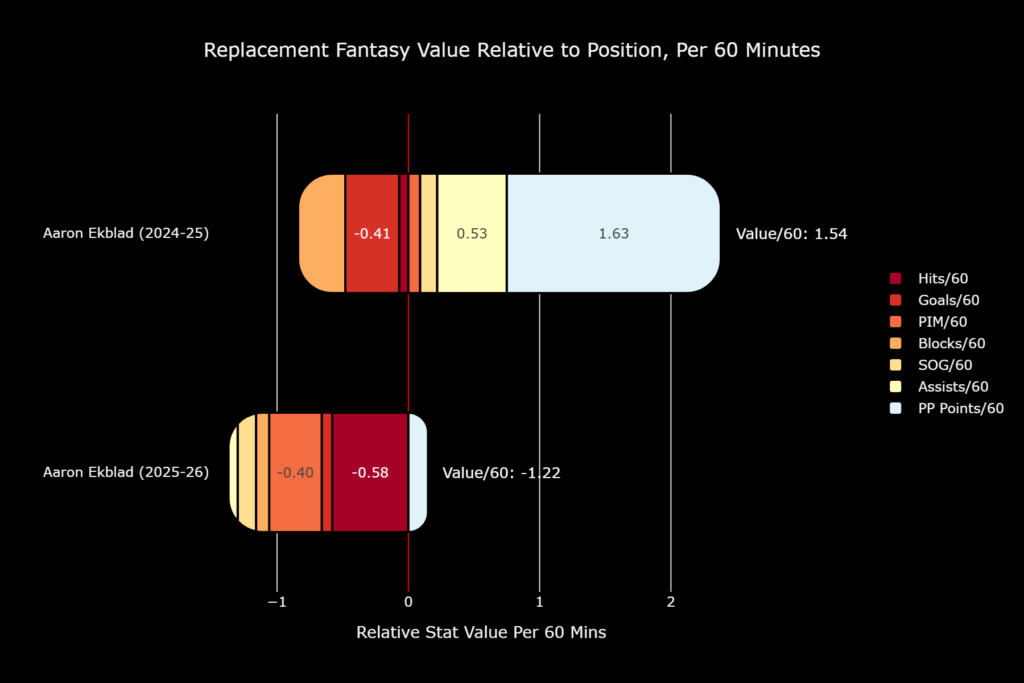
This will not get better in 2026-27. Anything can happen, but Seth Jones will be the first choice to be the top PP quarterback. If things don't work out with Jones, the Panthers have experimented with the five-forward PP setup in the past. With all their forward depth, we can envision them using Aleksander Barkov or Sam Reinhart on the blue line. My assumption is that if Ekblad gets any meaningful top PP usage, the team has suffered a slew of injures as they did last year.
Ekblad should see a rebound in 5-on-5 production with all of Florida's (healthy) offensive firepower, but the PP value is gone. He is also not someone who puts up massive peripherals, and his shots per game have declined in each of the last four years, with 2025-26 being less than half the rate (1.35) it was in 2022-23 (3.04). This is not a player I would expect to produce more than 40 points.
Colton Parayko (St. Louis Blues)
Many Blues skaters had down years, and Parayko was certainly one of them as he saw declines in six of the seven fantasy categories with the one exception being a small increase in block value:
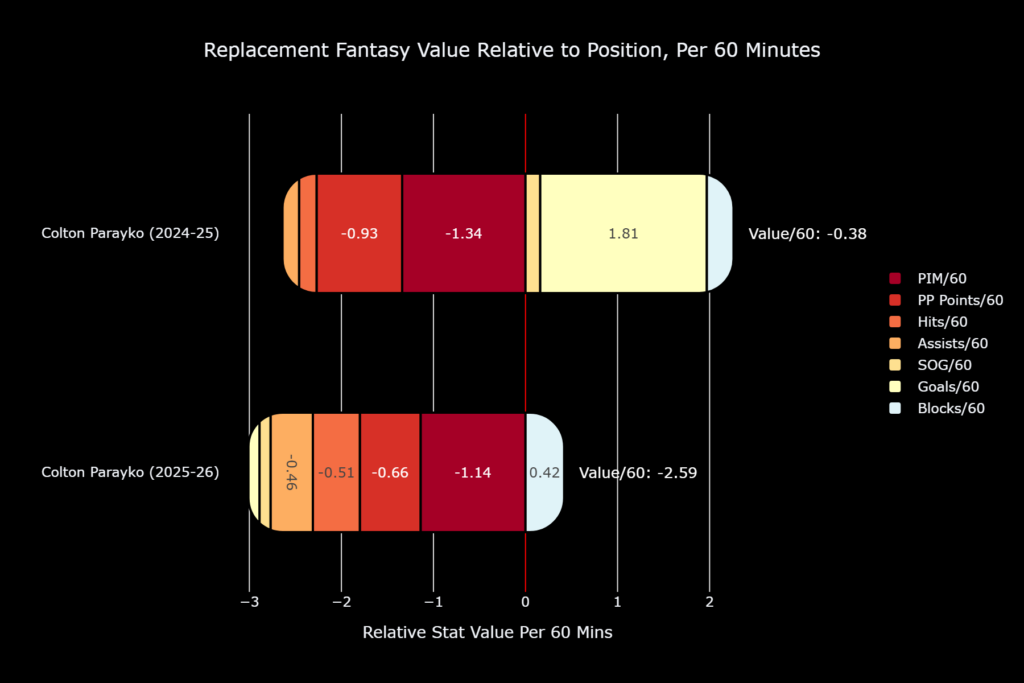
Although Parayko had a lot of declines, it's of course the goals that were the problem. He was coming off a year where he shot 12.8% after never having shot above 6.5% in any prior season. That predictable crash came and resulted in just four goals in over 1700 minutes of ice time. That accounted for 87% of his overall decline in fantasy value.
Parayko turned 33 years old back in May and skated just 22:12 this past season, a five-year low. He still has good multi-cat value, being capable of 10 goals, 20 assists, 120 shots, 25 PIMs, 180 blocks, and 100 hits. However, he is at an age where performance decline is an ongoing concern, Philip Broberg is now the team's top defenceman, and Logan Mailloux got a big role late in the season. Parayko can still produce the stat line written above, but that's the most we can hope for at this point.
MacKenzie Weegar (Utah Mammoth)
Six weeks ago, I wrote about how Weegar's season was disappointing for fantasy managers, but how his peripheral production was actually pretty good. That is crystallized here as we see Weegar's 60-minute fantasy value decline is almost entirely from the drop in power-play production:
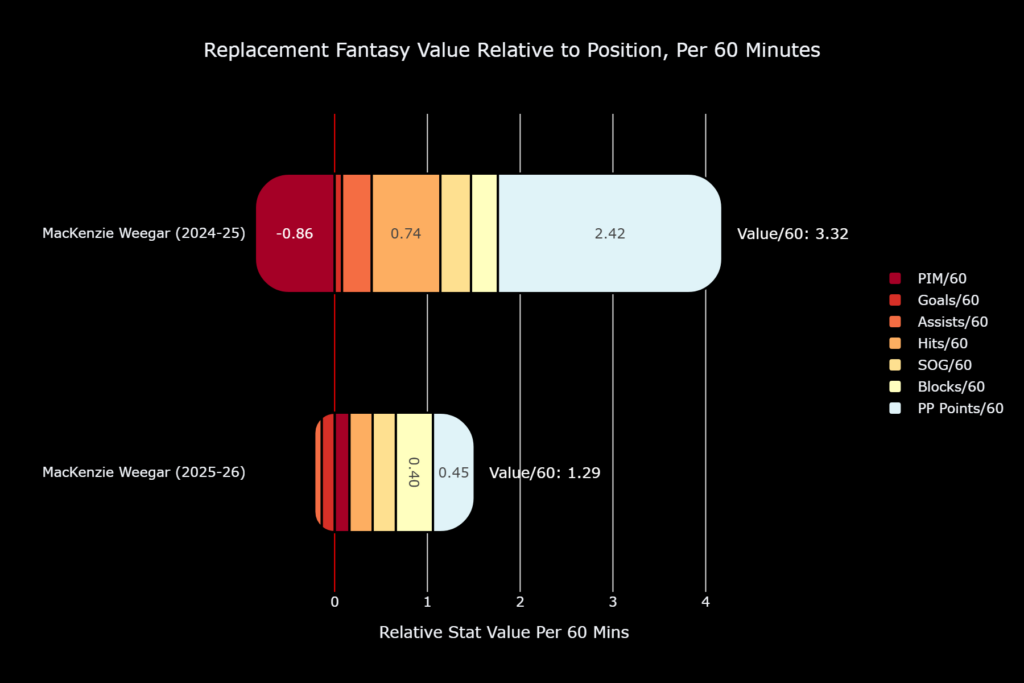
This is where reiterating that these evaluations being on a 60-minute basis matters. A lot of value from top fantasy players is entwined with a lot of ice time, and Weegar lost 1:42 per game in 2025-26, and 3:42 per game in Utah when compared to his role with the Calgary Flames. He doesn't produce hits and blocks at an elite per-minute rate, but a very good per-minute rate, and that was typically elevated by eating a lot of minutes. His TOI per game going from a low-end number-1 defenceman in Calgary to a mid-tier number-3 defenceman in Utah. The good news is that with Sean Durzi and Ian Cole moving on from the organization, the top guys like Weegar and Mikhail Sergachev could very well see a TOI boost.
Weegar is very unlikely to earn top PP minutes in Utah, but that's fine, honestly. In his 19 games with Utah, he produced 1.09 points per 60 minutes at 5-on-5. That would be a fringe top-50 mark in the league, but that's (hopefully) with top-pair minutes and a healthy dose of peripherals. He might lose his PP production, but he can still be a 35-point defenceman without it.
Jake Walman (Edmonton Oilers)
More than anything, Walman's inability to stay on the ice is a big problem now. He has averaged just 61 games per season over the last four years and has yet to play more than 65 games in any season. That is too much time missed to be a reliable fantasy option.
Despite a substantial rise in goal-scoring value, Walman saw the 12th-largest drop in 60-minute fantasy value last season:
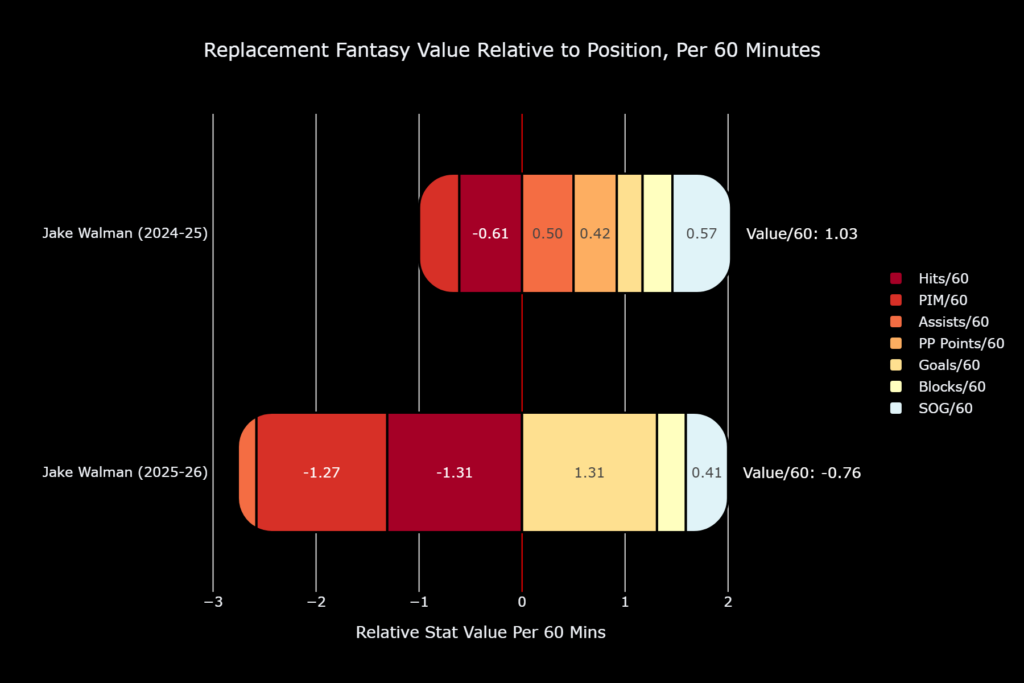
The big issue was a decline in hits and PIMs, as those drops accounted for nearly 90% of the overall drop. That is a bit of a good news/bad news situation, though. It isn't great to see those drops, but his PIMs per 60 minutes were nearly half the rate of the year before and less than one-third his three-year rate. His rate of hits was also the lowest of his career. In a season where he was fighting injuries, maybe he was reticent to be his usual physical self. A healthy Walman should see a rebound in those areas.
Darnell Nurse's trade to the San Jose Sharks cements Walman as a second-pair defenceman, and that means adding up to 1:30 per game in even-strength ice time. That should only help his peripherals rebound further, making Walman a nice bounce-back candidate in multi-cat formats.
Dougie Hamilton (New Jersey Devils)
What really hurt Hamilton's fantasy value was a drop in assists as he managed four fewer total assists compared to the year before despite nearly 400 extra minutes. Add that to a decade-low shot rate, and we get this fantasy value decline:
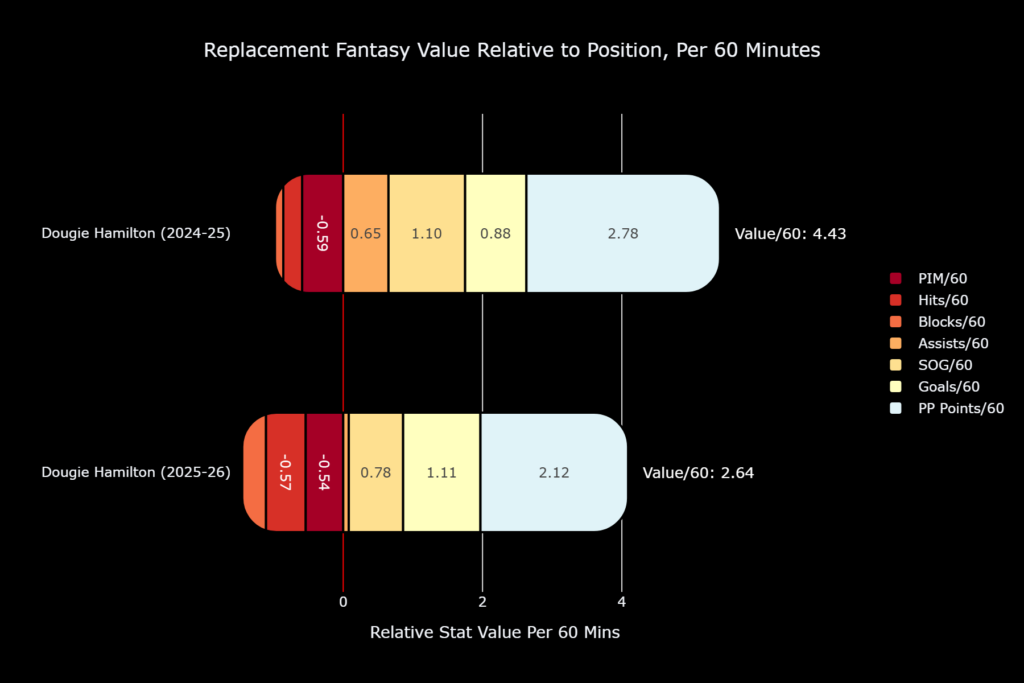
The good news is that there's a clear indicator of a rebound and that's on-ice shooting percentage. In 2025-26, the Devils shot 6.88% with Hamilton on the ice at 5-on-5. He had a similarly low rate back in 2023-24 and that rebounded to 10.3% in 2024-25. Across the four seasons from 2021-2025, New Jersey shot 9.3% with Dougie patrolling the blue line at 5-on-5. He also registered a point on just 35.6% of goals with him on the ice, a four-year low after three straight seasons above 40%. With more normal rates, he could have threatened 50 points last year.
The bad news is that thanks to underperformance and injuries elsewhere, Hamilton got a regular turn on the top PP unit. It is clear that the team wants to turn the keys over to Luke Hughes, and if the PP avoids falling on its face, Hamilton could see a sharp PP production decline. He likely rebounds at 5-on-5, but all those gains will be washed out by losing PPTOI and that puts his fantasy value in peril.
Owen Power (Buffalo Sabres)
This is a case where we have to separate real-life values from fantasy values. To me, 2025-26 was Power's best season in the NHL, but it was also arguably his worst fantasy performance. He failed to reach 30 points for the first time, fell under 100 blocks for the first time in three years, and that gives us this chart below:
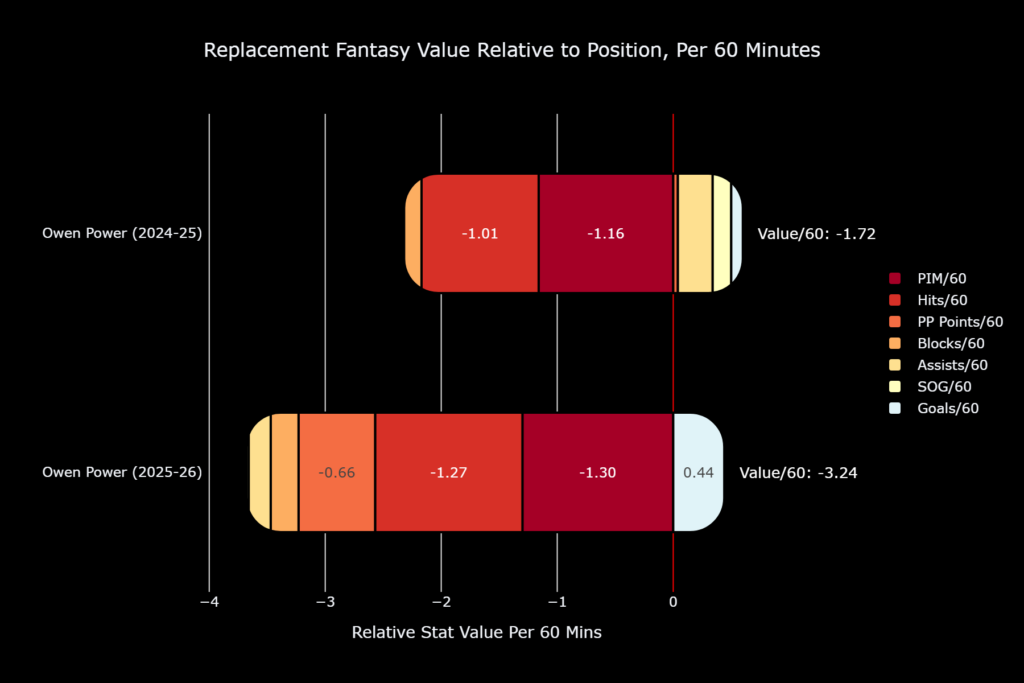
The only area where Power provided positive production was in his goal scoring, so that's something. It should also be said that he's just now entering his prime production years (check out Stas Pupkov's recent article on aging curves), the Sabres have finally ascended as a franchise, and the trade of Bowen Byram opens a lot of minutes for Power whenever Rasmus Dahlin is off the ice.
There shouldn't be much consternation around Power's drop in fantasy value. He likely pushes above 22 minutes a game next season, has progressed nicely in real life, and has a very good offensive team around him. There should be a rebound. The consternation should be that he won't come close to reaching his fantasy upside as long as Dahlin is on the team, and Dahlin is signed for six more years. Again, this is an instance where the value Power brings to the Sabres vastly out-strips the value he brings to fantasy managers.
Related Posts

Starting Goalies



Top Skater Views
 VGK
VGK MIN
MIN STL
STL DET
DET


Top Goalie Profile Views
| Players | Team | |
|---|---|---|
| DYLAN GARAND |
 NYR NYR | |
| JACOB FOWLER |
 MTL MTL | |
| DEVON LEVI |
 EDM EDM | |
| JOSHUA RAVENSBERGEN |
 S.J S.J | |
| NICO DAWS |
 N.J N.J
| |
LINE COMBOS
| Frequency |
S.J Players
| |
|---|---|---|
| 22.6 | WILL SMITH IGOR CHERNYSHOV MACKLIN CELEBRINI | |
| 20.9 | ALEXANDER WENNBERG TYLER TOFFOLI MASON MARCHMENT | |
| 16.4 | IVAR STENBERG KIEFER SHERWOOD MICHAEL MISA | |
DobberHockey Podcasts

Keeping Karlsson: Delusions of Garandeur
Elan and Brian dive into the latest NHL hot streaks, cold streaks, line changes, outjuries, injuries, buy-lows and sell-highs to give you top notch tips in your fantasy hockey league

Fantasy Hockey Life: TiDy Takes Part 2
Last week, Victor Nuno and Ryan Downey broke down trades from our top tier dynasty league. This week, they consider some dynasty trades from other divisions. Have a listen! Our show is part of the Dobber Podcast Network and sponsored by Fantrax.com. Email [email protected] and ask to join our free discord. Join our Patreon at […]
Keeping Karlsson: Matchup Maximizer 2026/27 Week 3
Elan takes a look at the schedule for the upcoming weeks of NHL action and recommends players with good schedules that you should consider streaming in to win your head to head matchups.
Keeping Karlsson: Short Shifts – Sharks Looked Like Celebweenies
Elan recaps the major injuries, outjuries, game results and changed line combos that we’ve seen since Sunday’s mega-show.
Keeping Karlsson: Cole, There’s No Time!
Elan and Brian cover all the action from the first week of the NHL season, and identify our earliest must-adds, can-drops, sell highs and buy lows in your fantasy hockey leagues.