

Ramblings: Top Peripheral Performers Among Defencemen, Including Zadorov, Manson, Weegar, Xhekaj, Walker, and Pionk – June 2
Michael Clifford
2026-06-02
Most end-of-season player and management interviews when a team is eliminated from the playoffs are of little interest. We get some variations of the GM saying they want to improve the team, players saying they want to get a bit better, and not much else. The injury information can be valuable, but that's about it.
That is what made Montreal's end-of-season press conference different. Forward Brendan Gallagher, who was healthy scratched at the end of the season and often in the playoffs, made it clear that he had played his last season with Montreal:
There doesn't seem to be any genuine animosity here, though what players, coaches, and GMs really think is infrequently certain, but it's easy to understand his frustration given his tenure with the Habs and how it ended. He will finish his career with Montreal 89 games shy of 1000 regular season contests, and has two Conference Final and one Cup Final appearance on the résumé. Wherever he ends up, his new team will get a hell of a leader.
*
We got a trade on Monday, as infrequent as they are at this time of year, as the Tampa Bay Lightning acquired the signing rights to Jack Pridham from the Chicago Blackhawks in exchange for a third-round pick next year. Pridham just won the Memorial Cup with Kitchener and was a third-round pick in 2024. You can read his Dobber Prospects profile here.
*
The Vancouver Canucks hired Manny Malhotra to be their new Head Coach. I wrote more about it here.
*
The 2026 Dobber Prospects Fantasy Report is now available in the Dobber Shop! Not only does it have extensive coverage of all the prospects fantasy managers need to know for the 2026 Draft, but a dive into each NHL team’s prospect pool, who can be a fantasy difference-maker, and when they can (or will) be impactful. For all the fantasy-related information you need on the next wave of fantasy hockey stars, head to the Dobber Shop to order a copy of the Prospects Report.
*
In Friday's Ramblings, we went over some of the top forward peripheral producers for the 2025-26 season. This includes shot, block, hit, and PIM totals, keeping in mind that when discussing PIM totals, we include just 2-minute and 5-minute penalties. We are also including only players who played at least half the season, or 41 games.
Today, we're going to finish off our run of Ramblings covering peripherals by reviewing some of the top producers among defencemen for the 2025-26 season. We are calculating the per-game rate of the four stats mentioned, and then how their rates compare to the league average rates for blue liners. So, if all rearguards average 1.0 shots per game, and Shayne Gostisbehere averages 2.0 shots per game, he is 100% above the league average, relatively speaking.
Here are the top-15 per-game peripheral producers of the 2025-26 season among defencemen:
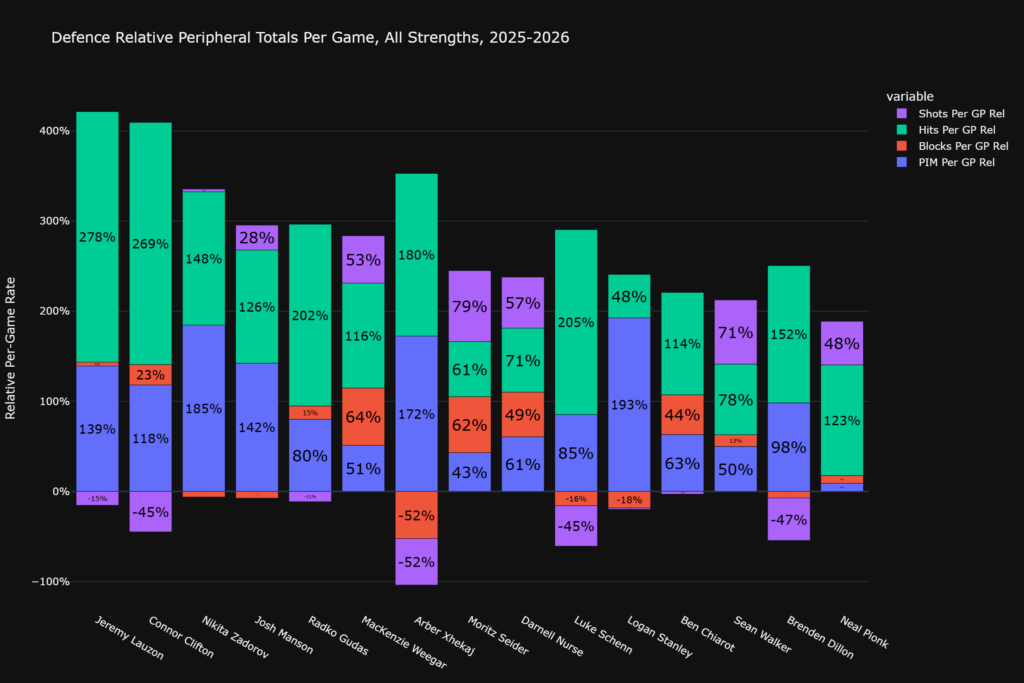
As we saw with the forwards, a huge chunk of peripheral value from the top defencemen come from their hit totals. When we reviewed how peripheral totals have changed at that position over the last five seasons, totals that we would consider outliers back in 2023-24 were basically anything around (or over) 185 hits. In 2025-26, that total was around (or over) 143 hits. With the huge decline in hit totals we've seen in recent seasons, defencemen who can still provide high hit totals on a per-game basis become much more valuable.
The additional importance placed on hit volume is why the two highest per-game peripheral producers, Jeremy Lauzon and Connor Clifton, also have the highest percentage of hits per game relative to the league average in that chart; Lauzon put up 3.7 hits per game and Clifton managed 3.6. In a season where the league average rate of hits per game fell under 1.0, those guys putting up that kind of hit volume is a massive edge – they just need to stay in the lineup as Lauzon played 68 games and Clifton just 50.
Let's focus on some individual blue liners from the graph above.
Nikita Zadorov (Boston Bruins)
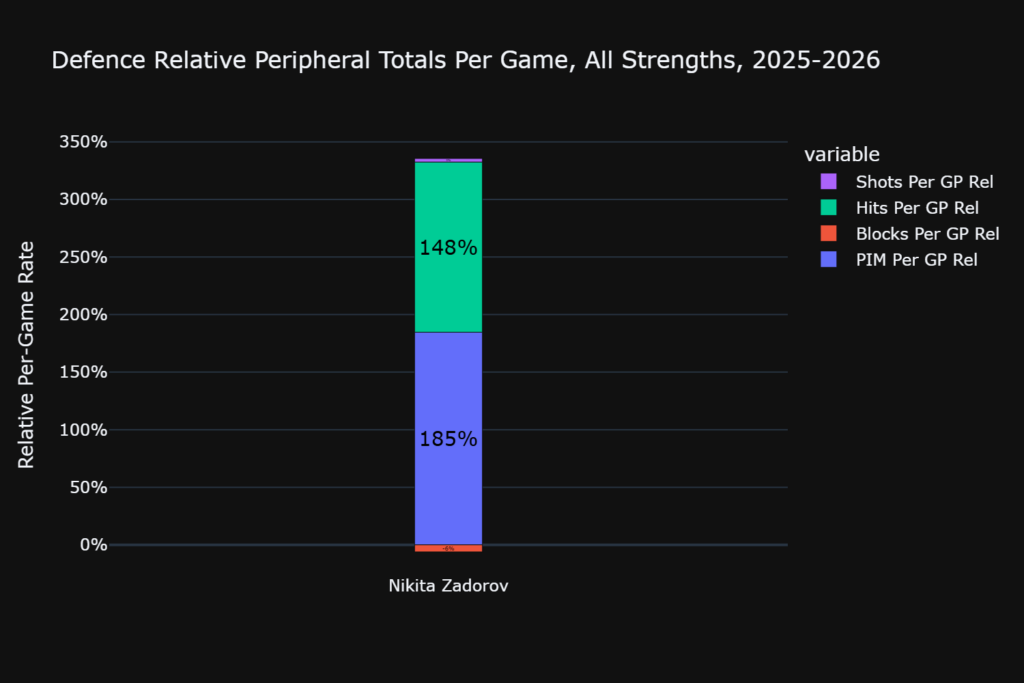
One of the more physical players in the league, Zadorov's last three seasons have seen him average 146 PIMs (including 10-minute misconducts) and 205 hits per 82 games. Considering the league averages for defencemen in that span are 93 hits and 43 PIMs per 82 games, he is a monster performer in those two categories, specifically.
There is also a lot of consistency to his game as he's managed between 2.3-2.7 hits and 1.6-1.9 PIMs per game in each of the last three campaigns, so he's not putting up a monster number and then incurring a big decline as we saw with a couple of the forwards. That kind of safety net is not something we encounter very much in fantasy hockey. Being consistent, while adding over 20 points,100 shots, and 100 blocks a season, makes him one of the more impactful multi-cat fantasy defencemen in the league.
Josh Manson (Colorado Avalanche)
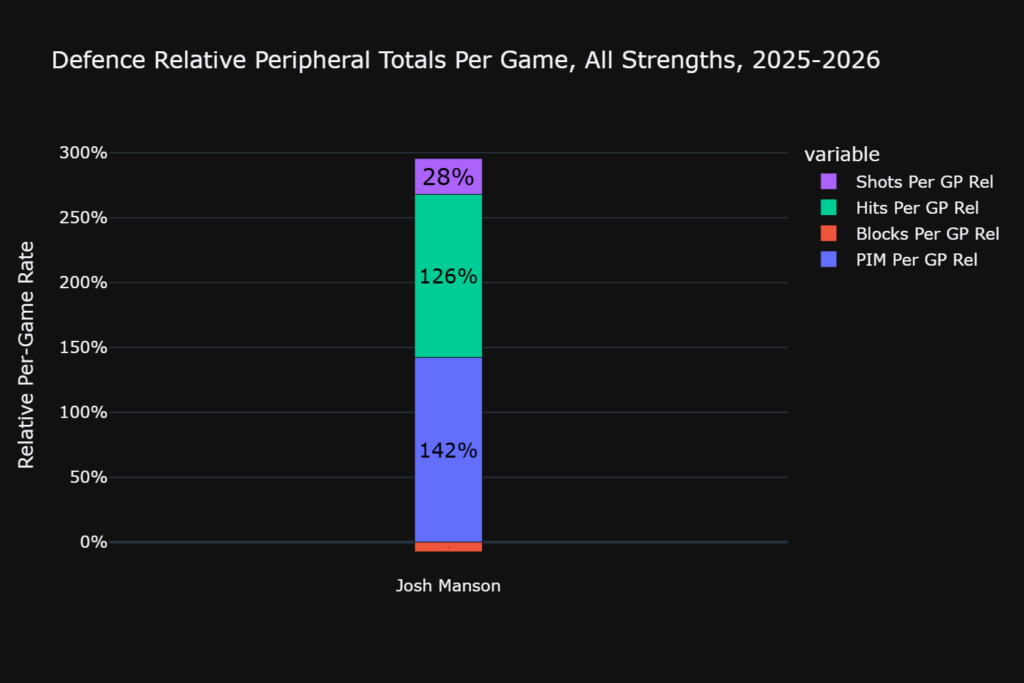
One thing that I've discussed before is the concept of 'market share of shots', or Mkt%. That tells us the percentage of a team's shots taken by an individual player. So, if a player is on the ice for 500 of their team's shots in a season, and that player takes 100 of those 500 shots, their Mkt% is 20%. We do that to see which players might have low shot totals because of the team around them and not because the player is reticent to shoot the puck, or which players have high shot totals because the team itself takes a lot of shots.
Notice in that graph how Manson got a decent chunk of peripheral fantasy value from his shot volume. Here is the kicker: his Mkt% this season was 17.3%, a four-year low. What happened was Colorado landed 31.5 shots per 60 minutes when he was on the ice compared to 27.5 shots per 60 minutes across the prior three seasons. This isn't a case where Manson has unlocked some special shooting talent, it's that the Avalanche were an offensive juggernaut, especially at even strength. Something to keep in mind for a bottom-pair defenceman who turns 35 years old in October.
MacKenzie Weegar (Utah Mammoth)

Anyone who drafted Weegar this season unquestionably got burned. Compared to 2024-25, his per-game declines were: -40% in points, -14% in shots, -23% in hits, and -6% in blocks. There were a lot of PIMs, and that's nice, but everything else declined or outright cratered.
The upside is that even with all the declines, the rise in PIMs helped offset some of that peripheral loss, and that made him the sixth-most valuable per-game peripheral producer among blue liners. If you drafted him in a multi-cat league, you got burned, but it wasn't unsalvageable… unless you were in a league that counts plus/minus, in which case, uh, that sucks.
We do have to be a bit cautious with Weegar. He didn't have much power-play production last year, but on the Mammoth, he won't get top PP time unless Mikhail Sergachev is injured, so the days of hoping for 15-25 PPPs are a thing of the past. Also, he was technically Utah's number-2 defenceman by overall ice time after the trade from Calgary, but Utah also gives their second and third pairs 17-19 minutes a game. So, despite being the number-2 Mammoth blue liner, he lost 2:42 per game in ice time, and that led to big declines in his per-game peripheral production. He is now on a better team, so he should put up more even-strength points, but without top PP time and with a lot less overall ice time, Weegar's best fantasy days are behind him.
Arber Xhekaj (Montreal Canadiens)
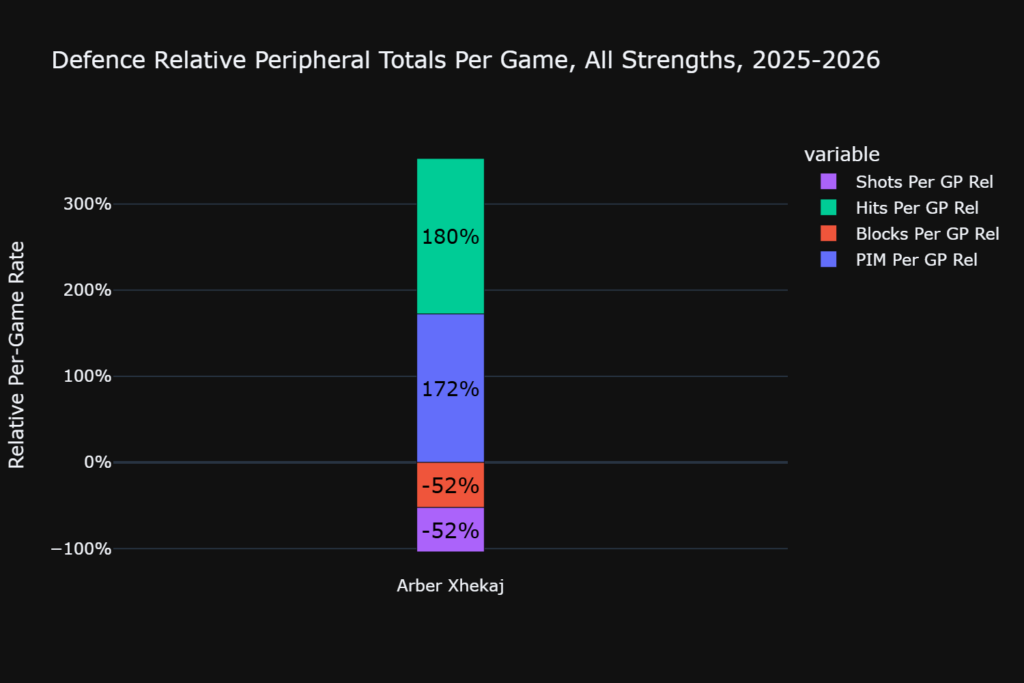
We will mention Xhekaj here for two reasons.
The first reason is the Zadorov-esque hit and PIM rates that Xhekaj provides. He managed 2.7 hits and 1.8 PIMs per game this past season, both slight increases from the year before. He wasn't always in the lineup, but he has played 135 games across the prior two regular seasons for the Canadiens, so it's not as if he was a consistent healthy scratch. Xhekaj also put up that hit and PIM volume skating just 11:25 per game. He could probably exceed 3.0 hits per game with 15-16 minutes a night, as he did in his rookie season.
The second reason is that Xhekaj is a restricted free agent this summer. As things stand, Montreal has six defencemen signed for the 2026-27 season, and they have David Reinbacher (and to a lesser extent Adam Engstrom) pushing for a roster spot. Xhekaj is a fan-favourite and he has a great story to end up where he is, but it's a wonder if Montreal decides it's time to move on. He could very well end up on a young/rebuilding team like San Jose or Vancouver, which could mean a bigger role. Keep an eye on what happens with Xhekaj this summer because in the right spot, he could end up a peripheral monster.
Sean Walker (Carolina Hurricanes)
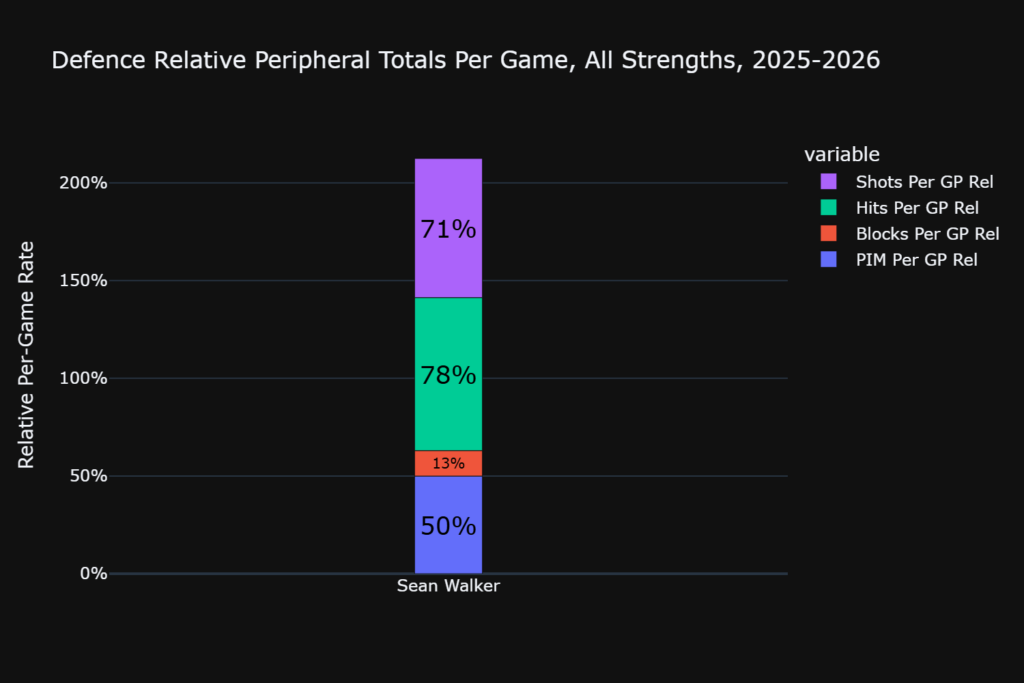
As Walker prepares for the Stanley Cup Final, it's worth highlighting that he was one of three defencemen in the league who managed at least 30 points with 2.0 shots, 1.5 blocks, and 1.5 hits per game (the others were Moritz Seider and Jacob Trouba). Walker made huge across-the-board improvements in all his peripheral categories, including a jump in PIM totals of nearly 30%. Anyone who bought in early on Walker's 2025-26 season was handsomely rewarded.
We do have to exercise a bit of caution here. Carolina is a great team and that should help keep Walker a 30-point-ish blue liner. However, the biggest reason for his peripheral jump was a massive ice-time jump thanks to the injury to Jaccob Slavin. From Slavin's injury in early October until Slavin became a 22-minute defenceman again in mid-January, Walker averaged 23:37 per game. Once Slavin returned to his normal TOI levels, Walker's next 20 games saw his ice-time rate fall to 20:23 per game, losing over three minutes per game in TOI. That is still a big improvement for Walker from the season before (16:50), but there is a huge difference between skating 23-24 minutes a game and 20-21 minutes a game. That might go down even further depending on Alex Nikishin's development, too.
Neal Pionk (Winnipeg Jets)
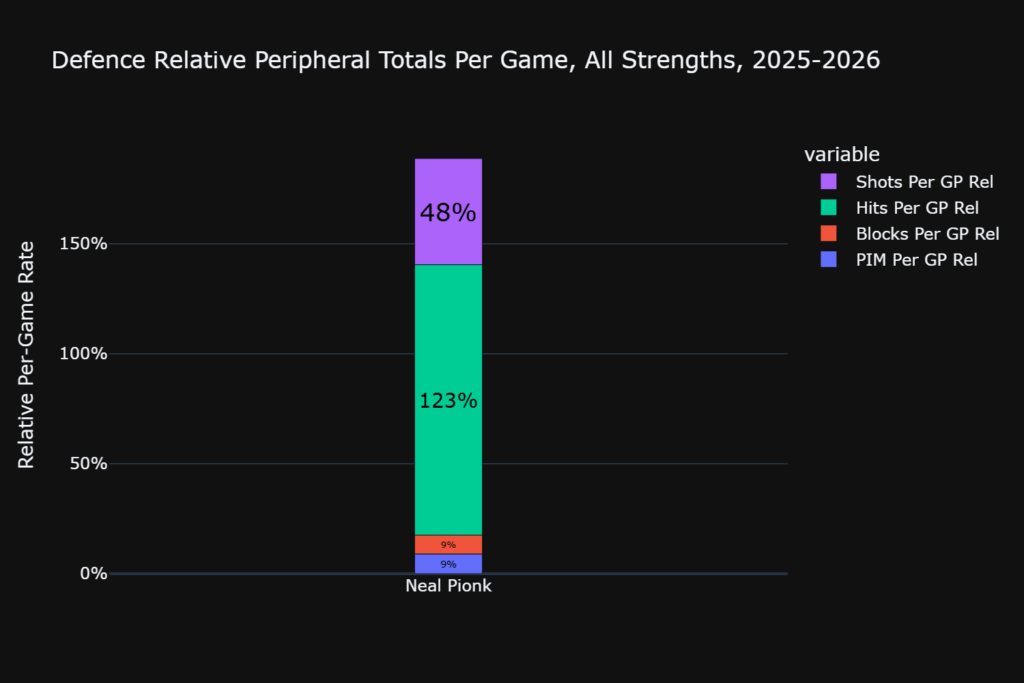
Pionk is worth highlighting because it was a very tough season for the Jets, and Pionk missing over 30 games made it an even tougher season for his fantasy value. However, that it was such a tough season for the Jets, and because Pionk missed so much time, it could be easy to overlook that he saw very good peripheral improvement:
- PIMs per game up 14%
- Shots per game up 7%
- Blocks per game up less than 1%
- Hits per game up 32%
Marginal increases in shots and blocks, a good increase in PIMs, and a huge increase in hits. There wasn't much point production – and that was the case for anyone not on the top PP unit – but there was a lot of peripheral production.
We should keep in mind that players can only block or hit if they don't have the puck, so it's not necessarily a great sign for Pionk (or the Jets) that he saw these increases. All the same, fantasy managers have relied upon his across-the-board peripheral production for years, and despite the 31 missed games, he did it again in 2025-26. Keep that in mind when your fantasy drafts roll around in August or September.
Related Posts

Starting Goalies













Top Skater Views
 BUF
BUF BOS
BOS STL
STL CHI
CHI DET
DETTop Goalie Profile Views
 MTL
MTL NYR
NYR WSH
WSH COL
COL
LINE COMBOS
| Frequency |
 EDM Players EDM Players
| |
|---|---|---|
| 31.7 | VASILY PODKOLZIN CONNOR MCDAVID LEON DRAISAITL | |
| 16.5 | OWEN MICHAELS MATHIEU JOSEPH ALEX FORMENTON | |
| 8.9 | KASPERI KAPANEN FILIP HALLANDER TRENT FREDERIC | |
DobberHockey Podcasts

Keeping Karlsson: Short Shifts – NHL Frozen Frenzy Recap
Elan and Lewis recap the Frozen Frenzy as well as two big returns and more!
Keeping Karlsson: Delusions of Garandeur
Elan and Brian dive into the latest NHL hot streaks, cold streaks, line changes, outjuries, injuries, buy-lows and sell-highs to give you top notch tips in your fantasy hockey league

Fantasy Hockey Life: TiDy Takes Part 2
Last week, Victor Nuno and Ryan Downey broke down trades from our top tier dynasty league. This week, they consider some dynasty trades from other divisions. Have a listen! Our show is part of the Dobber Podcast Network and sponsored by Fantrax.com. Email [email protected] and ask to join our free discord. Join our Patreon at […]
Keeping Karlsson: Matchup Maximizer 2026/27 Week 3
Elan takes a look at the schedule for the upcoming weeks of NHL action and recommends players with good schedules that you should consider streaming in to win your head to head matchups.
Keeping Karlsson: Short Shifts – Sharks Looked Like Celebweenies
Elan recaps the major injuries, outjuries, game results and changed line combos that we’ve seen since Sunday’s mega-show.