

Frozen Tools Forensics: Positive and Negative Regression Candidates Including DeBrusk, Byfield, Andersson, Kakko, and More
Chris Kane
2026-07-24
Today we are kicking off a mini-series focusing on helping us make smarter player decisions at the draft table. It is not enough to know how a player performed in the previous season, but we need to try to determine whether that level of performance was reasonable or unsustainable. We will go division by division and highlight some players who might be poised to bounce back, and some players who it might be better to avoid. To start us off, we will be reviewing players from the Pacific Division.
In order to make this process a bit more concrete we are going to focus on three stats from the Dobber Reports; five on five team shooting percentage (5on5 S%), individual points percentage (IPP), and individual shooting percentage (S%). These are certainly not the end-all, be-all of player evaluation but do tend to flag players who are likely to see a different point pace in the future.
Before jumping into the players, let's do a quick refresher on what these stats tell us. We use team shooting percentage to get an idea of a team's shot conversion rate while a player is on the ice. We use five on five because that is the largest game state for players. Power-play points count just the same on the score sheet so we could look at that as well, but in the interest of cutting down our data points we are going to focus on even the strength number here. IPP, which we will sometimes refer to as a player's points participation number, is how often a player is getting a point on a goal that is scored while they are on the ice. Finally, shooting percentage is just the standard: what percent of a player's shots are going into the net?
With all of these stats, it is important to take them into context. Not just what would an average player do, but how does this number compare to their career numbers? To do that I grabbed the same data points for the 2025-26 season and am comparing them to each player's recent career average. Broadly speaking, and barring changes in the player's situation (changing teams, sudden promotion to a top line etc.) we would expect these numbers to approach that career average.
For our first group we are looking at players whose underlying numbers in question were lower than their recent career averages. Generally speaking, we might expect these numbers to revert back to those averages and therefore those players to have a bit more production in the future.
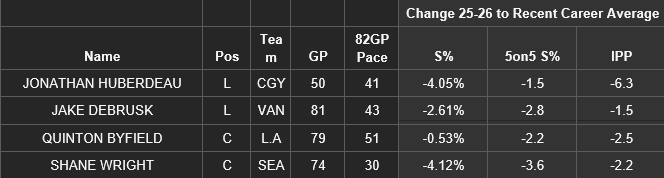
Going in order here, Jonathan Huberdeau had a decent start to the season and then missed a bunch of time. The number that really stands out for Huberdeau here is his shooting percentage, but there is a little more to it. Huberdeau's recent career average is buoyed by an 18 percent rate in 24-25, which was the highest of his career. Generally, he is about a 12 percent shooter, which is what he was in 25-26. Unfortunately, I don't think there is a wealth of missing goals that Huberdeau might be able to unlock in 26-27. His IPP is definitely low though. He usually participates on 65-75 percent of the goals scored while he is on the ice and last season he was down at 58 percent. There is definitely an opportunity for a rebound there. It is a similar story with his team five on five shooting percentage; a bit too low. Huberdeau had managed between 53 and 63 points the three years prior to 25-26. Some rebounding percentages might increase his 41-point pace to that low 50's mark again.
Jake DeBrusk's 43-point pace did not make him all that fantasy relevant. The good news is there are some indications that he deserved a bit better. The bad news is I am still not sure how relevant he would have been. The biggest disappointment was his team shooting percentage. He was almost three percent below his usual. In the grand scheme of things that difference could have added 8-10 points to his total (assuming the team had scored at a more typical pace, and he had participated on an expected amount of them). The problem is that given the issues in Vancouver right now, there is no guarantee that number is going to rebound. DeBrusk put up almost three shots per game, played almost 17 minutes a night, and totaled 24 power-play points in 25-26. That should have been enough to be fantasy relevant, but it just wasn't. If things break right for Vancouver maybe he can break 50 points, but that seems like a bit of a long shot.
Quinton Byfield has already come up recently. He saw a nice bump in deployment in the playoffs and is an option to replace the retiring Anze Kopitar. It feels a little like we have heard all this before, but hopefully next year is the year. Add to that the fact that all his underlying numbers were a touch low in 25-26, while producing a 51 point pace and there is definitely some room for optimism here for Byfield going into 26-27.
Shane Wright is an interesting discussion, given his short career thus far it is fair to wonder which of his seasons is the outlier. He had a 46-point pace in 24-25, but after three scratches in November he put up a 56-point pace to finish off the season. Unfortunately (and partially why he is on this list here) there was some unsustainability in those numbers. He had a high personal and five on five shooting percentage, which fell back down in 25-26. There seemed ample opportunity for him to grow and potentially earn that 56-point pace, but his time on ice actually decreased between 24-25 and 25-26 to under 14 minutes a night. Things don't seem to be great for him with the Seattle Kraken right now and he has apparently requested a trade so while the data here suggested he could be a bounce back candidate, context indicates that is pretty unlikely unless he is moved or receives some unexpected change in deployment.
Unfortunately, we also have some players whose underlying numbers were a bit higher than we expected, meaning that their production might not be the most sustainable.
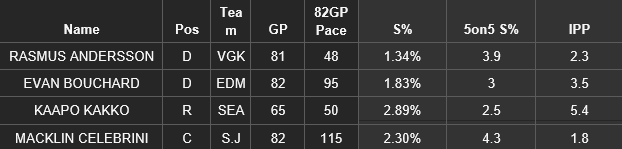
Rasmus Andersson put up a 48-point pace across two teams in 25-26. It isn't exactly clear how much of his deployment in Calgary was really a showcase for a trade, but he started with over 50 percent of the team's power play, over 24 minutes of ice time, and 30 points in 48 games. In Vegas he dropped to 24 percent of the power-play time, 21 minutes of overall ice time, and a 42-point pace. Overall, it was a 48-point pace, and the indications are he didn't quite earn all of that production. Add to that the fact that he is now on a new team and his opportunity is going to be significantly less than it was in Calgary. The last time he played 21 minutes and had a reasonable shooting percentage he put up a 31 point pace, and that was with 50 percent of the power play. He maybe maintains something closer to 40, but expecting a 50-point pace might be a mistake on draft day.
Evan Bouchard is a bit of an interesting case. Yes, the 95-point pace seems a bit high. If we compare his season under the hood, his personal and team shooting percentages are a bit higher than recent average. That average is really brought down by 24-25 though because in 23-24 he put up very similar numbers and finished with an 83-point pace. It is not entirely clear that 24-25 wasn't the outlier and the 85- to 95-point Bouchard is the real Bouchard. While assuming 95 might be a mistake, point per game does seem reasonable.
Kaapo Kaako ended with a 50-point pace and had a pretty miserable start to the season, so it is a little surprising to see him on this list. He had three points over his first 14 games after returning from injury. Starting December 16th though he put up a 60-point pace through the remaining 51 games. The challenge was definitely his shooting though. In that period he only managed 59 shots highlighted by a stretch from March 17 to April 15th where he put up 4 shots over 15 games. He somehow managed 13 points though in that stretch. He had a strong end to the 24-25 season as well after getting traded from the Rangers so hopefully we get a see a full season from Kakko in 26-27. That being said a 50-point pace is likely the max we should expect unless he gets additional top line, top power play kind of deployment.
I included Macklin Celebrini for completion's sake, but he is sort of the anti-Wright here. We have a very small sample to compare to, so yes compared to his rookie 74-point pace season his 115-point pace season looks a little too good to be true. It is safe to ignore those warnings though. Celebrini is a superstar. He might not put up 115 points every season, but let's give him a few seasons to establish himself before trying to nitpick his production.
That is all for this week.
Do your part to support organizations working to make hockey for everyone.
Related Posts
Starting Goalies













Top Skater Views
 T.B
 OTT


Top Goalie Profile Views
| Players | Team | |
|---|---|---|
| NICO DAWS |
 WPG | |
| CONNOR HELLEBUYCK |
 N.J | |
| DEVON LEVI |
 EDM | |
| STUART SKINNER |
WPG | |
| JACOB FOWLER |
 MTL | |
LINE COMBOS
| Frequency |
 FLA Players | |
|---|---|---|
| 21.9 | MATTHEW TKACHUK BRADY TKACHUK SAM BENNETT | |
| 15.7 | COLE SCHWINDT BOKONDJI IMAMA GARNET HATHAWAY | |
| 14.9 | CARTER VERHAEGHE SAM REINHART LARS ELLER | |
DobberHockey Podcasts

Keeping Karlsson: Matchup Maximizer 2026/27 Week 5
Jeremy takes a look at the schedule for the upcoming weeks of NHL action and recommends players with good schedules that you should consider streaming in to win your head to head matchups.
Keeping Karlsson: Short Shifts – Injuries, Outjuries, and Duds
Elan talks about all the latest injuries, outjuries, big performances and duds over a tight 20 minutes in this week’s episode of Short Shifts.
Keeping Karlsson: Never Tell Me the Podz
Elan and Brian do a wellness check on the Maple Leafs, lament Chicago and Buffalo snoozers, wonder whether and which Flyers have figured it out, and pick out the Capital standing out from the crowd.

Fantasy Hockey Life: Ep 505 Prospects With Plenty to Prove Part 1
Victor and Jesse return to talk about prospects with plenty to prove. This week it’s: Tij Iginla, Berkly Catton, Konsta Helenius, Zayne Parekh, Igor Chernyshov, Jett Luchanko, Axel Sandin-Pellikka, Artyom Levshunov, Michael Hage, and Carter Bear. Have a listen! Our show is part of the Dobber Podcast Network and sponsored by Fantrax.com. Email [email protected] and […]
Keeping Karlsson: Matchup Maximizer 2026/27 Week 4
Elan takes a look at the schedule for the upcoming weeks of NHL action and recommends players with good schedules that you should consider streaming in to win your head to head matchups.