

21 Fantasy Hockey Rambles
Dobber Sports
2026-08-30
Every Sunday, we share 21 Fantasy Rambles from our writers at DobberHockey. These thoughts are curated from the past week’s 'Daily Ramblings'.
Writers/Editors: Ian Gooding, Michael Clifford, Alexander MacLean, Puneet Sharma, and Dobber
___
DobberHockey’s 2026-27 Fantasy Hockey Guide is now available in the Dobber Shop! Team-by-team overviews updated through to the start of the regular season to reflect injuries, trades, or other pertinent information.
The French version, le Guide des Poolers, is also available. You can pre-order it here.
___
1. As expected, Cale Makar has received his gigantic extension from the Colorado Avalanche. Makar and the Avalanche have agreed to an eight-year extension with a $20.4 million AAV – the largest contract in NHL history by AAV. Considering Makar’s value as arguably the league’s top defenseman, it should come as no surprise that he is now the league’s highest-paid player. Salary cap leaguers will have one season to adjust their rosters, with Makar about to earn $9 million on the final year of his current deal. A $11 million raise will be a sizeable jump for salary cap fantasy teams to manage. (aug29)
2. Although it has already been rumored for much of the offseason, Connor Hellebuyck made his trade request public on Thursday. One hint that the Jets have already been shopping Hellebuyck was the July 1 signing of Stuart Skinner, whose fantasy value should increase with this news.
It’s possible that the Jets receive a tandem-type goalie in a Hellebuyck trade, which is something to look out for. Buffalo seems to make sense as one destination, with Ukko-Pekka Luukkonen and 1-2 young forwards a possible return. Other US-based teams could also be in the mix, although I’ll predict that it won’t be Florida – the salary cap inherently prevents superteams from being formed unless certain players are willing to take a major discount. Hellebuyck is now 33, so I expect a decent return but not a massive haul for the Jets. (aug29)
Fantasy Take: Skinner Signs in Winnipeg
3. Last week I brought up several forwards that I needed to decide on in one of my keeper leagues, which you can read about here and here. Many of these forwards were waiver-wire pickups during the season and what I’d consider supporting pieces. True bubble keepers, so to speak.
Today it’s all about defensemen and goalies. These players vary in terms of fantasy interest, but they might bring something to the table in some league out there.
Injuries are a part of rostering Chabot, a Certified Band-Aid Boy. Over his last five seasons, Chabot has missed at least 14 games four times. That means you’ll have to factor in injury time missed, which is what the Fantasy Guide does when projecting Chabot’s point total. Chabot can comfortably score at a 45-point pace, but injuries could result in something closer to 35 points.
Chabot was once the defenseman on the Senators’ top power play, but now that role belongs to Jake Sanderson. Chabot will now have to compete with Jordan Spence and Carter Yakemchuk for a spot on the second unit. Chabot probably remains there based on experience, but his fantasy value already seems to be on the decline.
Despite the downward trend, Chabot is only 29 years old. That means he still has time to shake the injury label. An increase in shots back to over 2.0 SOG/GP could help a little with his offensive totals, but that might be offset by a high 5-on-5 shooting percentage of 13.0%.
I think there’s still something left with Chabot. However, the cost to keep him in this league far surpasses what his expected production will be.
The Canucks’ first-round pick in 2023, Willander finished his 2025-26 rookie campaign with 21 points in 70 games. The Canucks also used him on the power play – at times even the top power play. Willander didn’t stand out with that opportunity, scoring just three power-play points. For the upcoming season, he is likely behind Filip Hronek and Zeev Buium on the power-play pecking order.
The Canucks have high hopes for Willander. As a former first-round pick, Willander was drafted for his two-way ability. He posted decent but not outstanding offensive numbers in the NCAA, scoring 49 points in 77 games with Boston University. He struggled defensively in his first NHL season, finishing with a minus-23 while facing what was considered average competition. Willander is only 21, so the Canucks will likely show plenty of patience with him.
Willander may improve a bit offensively in his second NHL season. However, the projections simply don’t show enough of a jump for me to focus on retaining him. Overall, one challenge with evaluating defensemen picked in the first round is whether they can hold their own in fantasy leagues; in other words, if their real-life value will be higher than their fantasy value. In that sense, the jury is probably still out on where Willander fits in. (aug29)
[Follow the link for more…]
4. It is Bubble Keeper Week here at Dobber Hockey! For anyone new to the site, every offseason we dedicate an entire week to those end-of-the-roster decisions that managers in keeper leagues have to make. They can be agonizing decisions because we know that one wrong choice can mean the difference between being a perennial contender or having to rebuild in a few years. That is why we do this Bubble Keeper Week, and hopefully we can get on the right side of things.
Today, we head back to the Dobber Forums for more keeper queries.
Our first question comes from Forum user ‘Smurf54’ and is from a very stacked roster in a 12-team league:
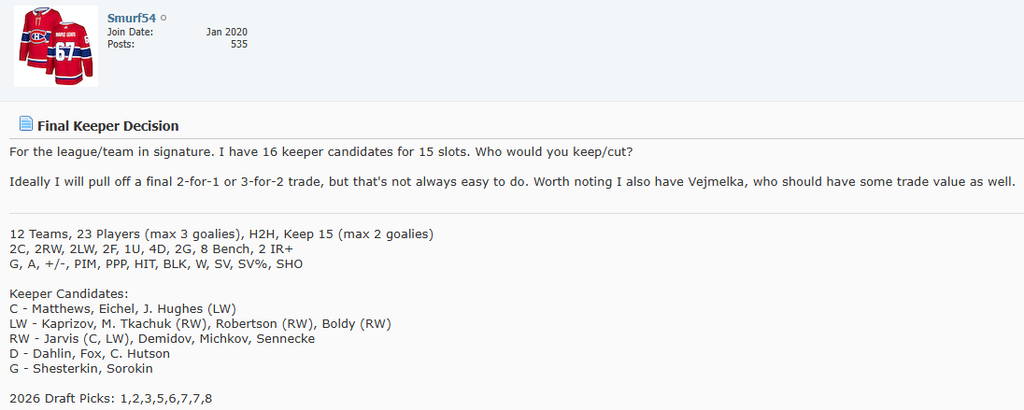
There are 15 keeper slots. These are the automatic keepers:
- Auston Matthews
- Jack Eichel
- Jack Hughes
- Kirill Kaprizov
- Matthew Tkachuk
- Jason Robertson
- Matt Boldy
- Ivan Demidov
- Rasmus Dahlin
- Adam Fox
- Igor Shesterkin
- Ilya Sorokin
This gives us three slots to fill. In this format, each of centre, left wing, and right wing are already covered by keepers. Also, either eight or nine forwards can start on a given night, and eight are kept. For me, that means the first keeper is Cole Hutson. With so many elite forwards already on the roster, getting a third defenceman is much more important than a ninth forward, and it isn’t as if Hutson is a slouch. The Washington Capitals generally have their secondary PP defenceman skate over 50% of the PPTOI, so even if Hutson is behind Jakob Chychrun on the PP depth chart, he is still looking at upwards of 200 PP minutes this season. On a team that should be as good offensively as the Caps should be, Hutson has immediate 50-point upside, and that’s valuable as a third defenceman. It leaves us with Matvei Michkov, Seth Jarvis, and Beckett Sennecke, and one of them has to be dropped.
Pro-rated to 84 games apiece, the Dobber Fantasy Guide has Jarvis projected for 72 points, Sennecke for 70, and Michkov for 69. If we assume they have similar production this year, it comes down to peripherals, and that pushes me to Sennecke. Prior to Sennecke in 2025-26, the last rookie to post 60 points, 60 PIMs, and 190 shots in a season was Evgeni Malkin in 2006-07 (per NHL.com). Sennecke also had 97 hits, which is 35 more than Michkov has had in his two seasons combined (62). I am not saying that Sennecke is a Malkin-type winger, but progression from this high of a starting point will make Sennecke one of the most valuable multi-cat wingers in fantasy very soon.
It is now Michkov and Jarvis left, and I would take Michkov. If Jarvis were healthy, which he’s not because a shoulder surgery will cause him to miss anywhere from 1-3 months of the season, then it would be a real discussion. The injury to Jarvis means Michkov should have more fantasy value this year, so we are looking at 2027-28 and beyond, which makes me favour Michkov more. So, my final answer is keeping the 12 listed above plus Hutson, Sennecke, and Michkov. If you want Jarvis, given his injury, you’ll probably be able to draft him in the first round anyway. (aug28)
5. The next keeper question is from user ‘rooneypoo’ and it has quite a bit of detail:
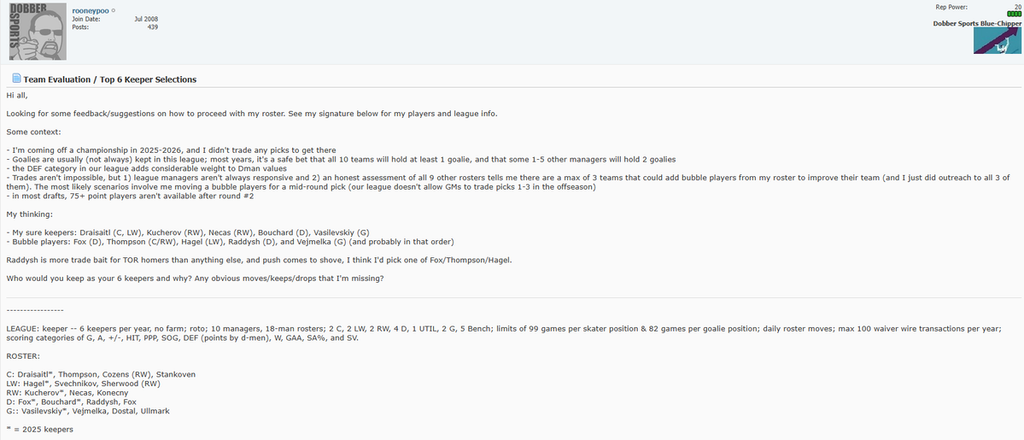
To quickly sum the highlights:
- It is a 10-team multi-cat league without blocks, six players are kept per team, and anywhere from 10-15 goalies will be kept across the league.
- A separate category for points from defencemen gives them extra value.
- A smaller league keeps more teams in the mix so trading for players using futures is difficult.
- They start six forwards (2 C, 2RW, 2LW) and four defencemen.
- This manager is holding onto Leon Draisaitl (C/LW), Nikita Kucherov (RW), Martin Necas (RW), Evan Bouchard (D), and Andrei Vasilevskiy (G).
- The final keeper is between Tage Thompson (C/RW), Brandon Hagel (LW), Adam Fox (D), Darren Raddysh (D), and Karel Vejmelka (G).
Out of the gate, this type of format hurts Fox. He doesn’t shoot much, has never reached 50 hits, and his only real peripheral value comes from blocks, which aren’t counted. Both the Dobber Fantasy Guide and my personal projections have Fox out-producing Raddysh, but Raddysh will put up far more shots and will probably double his hits. Of the two defencemen, I lean Raddysh over Fox.
Then we get to the forwards. With Necas and Kucherov being kept, Thompson would have to play centre (or used in the utility) when all three are playing on the same night. Precluding positions, the only real advantage Hagel has over Thompson is in penalty minutes; goals, assists, hits, power-play points, and shots are all close or tip heavily to Thompson’s favour. Hagel has never had a season with at least 3.0 shots per game, 70 hits, or 15 power-play points – Thompson has reached each of those marks in each of the last three years. Between the two forwards, it’s Thompson.
There is a good case for keeping Vejmelka. He is on a likely playoff team and will get a heavy starting workload. If this were a 14-team league, I would probably keep him, but in a 10-team league, a similarly valued goalie can probably be drafted in the first few rounds. That is not true of Thompson; guys like Dylan Guenther or Cutter Gauthier will not be on the board.
To me, this comes down to Raddysh or Thompson. If a 2-for-1 trade can be made for an elite skater, I would do that. I lean Thompson just for a bit of security – we know what we’re getting from him. There are more question marks around Raddysh just because of Thompson’s longer track record and Raddysh changing teams. My answer is Tage, but either he or Raddysh are fine. (aug28)
6. Our third question is from Forum user ‘VicGeneral’ and it’s my favourite type of question – it isn’t about making a good choice, but a least-bad choice in a points-only league:
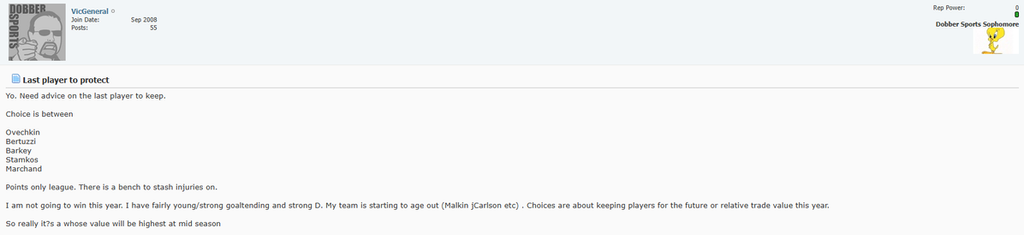
This is a team looking towards a rebuild and trying to recoup trade value during the season. If that’s the case, I am excluding Denver Barkey (he won’t have much) and Alex Ovechkin (age and diminished role). I do like Tyler Bertuzzi and he should be considered, but he won’t have Connor Bedard for at least a month and there’s no telling what will happen after that.
Brad Marchand had a great season when he was healthy, but he did that shooting nearly 20% (prior three-year average of 12.5%) with 20 power-play points in 52 games. The Dobber Fantasy Guide has Marchand on the second PP unit, I think he’ll be on the second PP unit, and that means we should expect 10-15 PPPs rather than 25(ish). Even on what should be a great Florida Panthers team, Marchand’s upside is 70 points. That is his upside, not the expectation.
Steven Stamkos had a great year last year, but shot 20.4%, a career-high. He has typically been around 15% in his later years, and that would cost him about 11 goals, and would have made him a 55-point player in 2025-26. His first year with Nashville saw him post 53 points. If he can’t maintain his high shooting percentage, I would not expect more than 60 points from him.
The issue is we found out that Marchand had offseason surgery and the latest update from George Richards at Florida Hockey Now makes it seem like he’ll miss the start of the season. We just saw last year how Florida very much took its time to bring back injured players because they are focused on a Stanley Cup, not a great regular season. Also, even in a campaign where Florida saw so many significant injuries to so many forwards, Marchand skated 17:44 per game, his lowest in over a decade. Considering Marchand’s (likely) games missed, reduced role, and move to the second PP unit, I lean Stamkos over Marchand here. (aug28)
7. Our final query of the day comes from user ‘Kessel’s Hotdogs!!!’, which is a fantastic name:

It is a 10-team multi-cat league with 2 C, 2 RW, 2 LW, 4 D, and 2G on the starting roster. They are keeping Connor Bedard (C), Evan Bouchard (D), and Igor Shesterkin (G). It leaves us with three forwards and two defencemen to pick from.
One automatic keeper is Dylan Guenther. His 82-game averages over the last two years are 37 goals, 36 assists, 245 shots, 66 hits, 39 blocks, and 29 PPPs. That is pretty good multi-cat coverage from a guy who just turned 23 years old in April and entering his prime. He is also multi-wing eligible on Yahoo.
The two defencemen I’m keeping are Jake Sanderson and Jackson LaCombe. The third potential keeper is Noah Dobson, but he’s on a team with Lane Hutson, so he’s shut out of the top PP role. Sanderson is basically Dobson but with a top PP role, so Sanderson is the choice there. Then it comes to LaCombe and Dobson, and LaCombe is staring down 25 minutes a game with top PP time. Even if Dobson is a better peripheral producer on a per-minute basis, the volume from LaCombe will at least make it close, and he has a higher point production upside. Again, the two defence choices are Sanderson and LaCombe.
This is where the roster composition matters. Every player kept so far is 25 years or younger (LaCombe turns 26 in January). Additionally, Bedard is going to miss at least a month and there are no truly super-elite keeper forwards – there are no Nathan MacKinnon, Nikita Kucherov, or Macklin Celebrini-types here. Maybe this fantasy roster will contend, but in a 10-team league, I suspect it won’t. I would be looking beyond this season.
For that reason, my next keeper is Carlsson. He should have similar production to Dylan Larkin (barring a Larkin trade to a high-end destination) and is eight years younger. Carlsson lacks blocks and hits but should more than make up for it elsewhere and has 100-point potential down the road.
Then it’s down to Marner, Guentzel and Holloway. My first instinct is to seek out a trade. Try to make a 2-for-1 including two of those guys for a truly elite player on the younger side. Maybe you can get Celebrini for Marner and Guentzel, and perhaps settle for someone like Jack Hughes or Matt Boldy.
I would lean Marner over Guentzel because Marner is three years younger. In a couple of years when this fantasy roster is truly ready to contend, I have more faith in Marner still being a point-per-game player.
I do think there’s an argument for Holloway. If he can stay healthy, he should push for 30 goals, 70 points, 220 shots, 180 hits, and 60 blocks. That is great multi-cat coverage, and his age (25 in September) lines up better with the rest of the roster. Also, none of the other keepers are physical players, and keeping Marner over Holloway means chasing hits all season long.
My final answer is to keep Marner because you can probably draft Holloway in the first couple of rounds whereas Marner might be the first skater taken in the draft. Then, if your team isn’t contending at the mid-point of the season, you can trade Marner (and whatever else) for a great keeper. (aug28)
8. Bubble Keeper Week rolls on here at Dobber Hockey. Today, we head back to the Dobber Forums to find fantasy managers looking for a bit of help with their final keeper decisions.
Alex Laferriere vs. Peyton Krebs vs. Bobby Brink vs. Fedor Svechkov
For our first question of the day, we go to Forum user ‘lusshouse’ whose team was a contender for years but is now on the downswing. They have four to pick from in a points-only format:
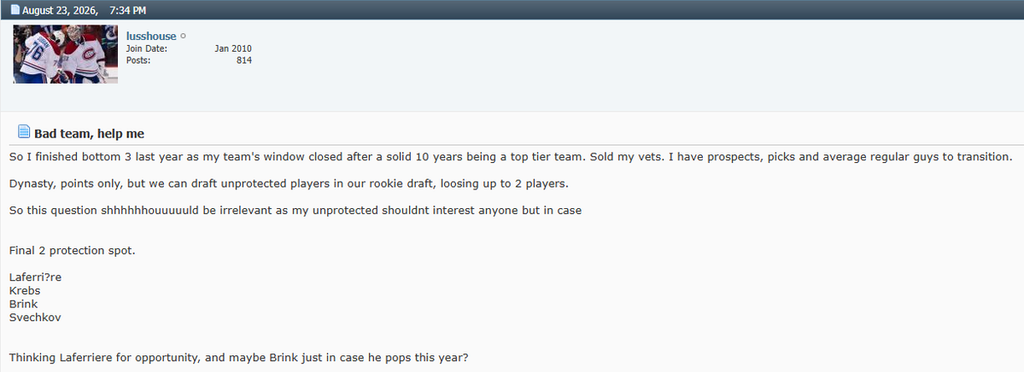
As with others who replied in his thread, the slam-dunk is Laferriere. His two seasons of 42 and 44 points are better than any other season from the other three names, he crossed the 200-game threshold midway through the season last year, turns 25 years old in October, and will probably get second-line duties either as the centre or a winger (likely both). The Dobber Fantasy Guide has him projected for the most points and points per game of the four, and my projections say the same.
Svechkov is automatically out. Skating for the Colorado Avalanche means he is on the best team on this list, but barring several key injuries, he’ll be nowhere near a top 6 forward. They are in win-now mode, not development mode, so Svechkov might not even stay in the lineup, let alone in a position to meaningfully contribute to fantasy teams.
Where it gets interesting is what to do with Krebs. The Fantasy Guide has him for 44 points in 83 games and the guy to hold onto. Alex Tuch left the Buffalo Sabres, sure, but Jiri Kulich missed 70 games last year and is going to be a top 9 forward. Konsta Helenius had 62 points in 63 AHL games, showing well late in the NHL season and the playoffs, so he should be a top 9 forward, too. Then we add Tage Thompson, Zach Benson, Josh Norris, Josh Doan, Jason Zucker, Ryan McLeod, and Jack Quinn as locked top 9 forwards. That gives us nine forwards, and doesn’t include Noah Ostlund. Without multiple injuries, it just seems hard for me to count Krebs as a locked-in top 9 forward given the Sabres’ depth. My projections have him for 30 points.
The Minnesota Wild let Mats Zuccarello walk and didn’t really replace him. They brought in Maxim Shabanov, and he likely gets a chance at a top-6 role, but he’s far from cemented in that spot. That is where Bobby Brink comes in. Over the last two seasons, he has 1.8 points per 60 minutes at 5-on-5, which is higher than Krebs’ breakout 2025-26 rate of 1.7. Brink also did that playing for a below-average Philadelphia Flyers offence as opposed to Krebs playing for a top-5 Buffalo offence. I have Brink projected for 39 points compared to Krebs’ 30.
The Dobber Fantasy Guide would say to keep Krebs, I say to keep Brink. I don’t think either has high long-term fantasy value, but if I had to bet on one guy being a 60-point player in the next three years, it’s Brink over Krebs. (aug27)
9. Pair of Wings
Our next question comes from Forum user ‘itzjules’ and is a logjam of wingers from which we have to select two:
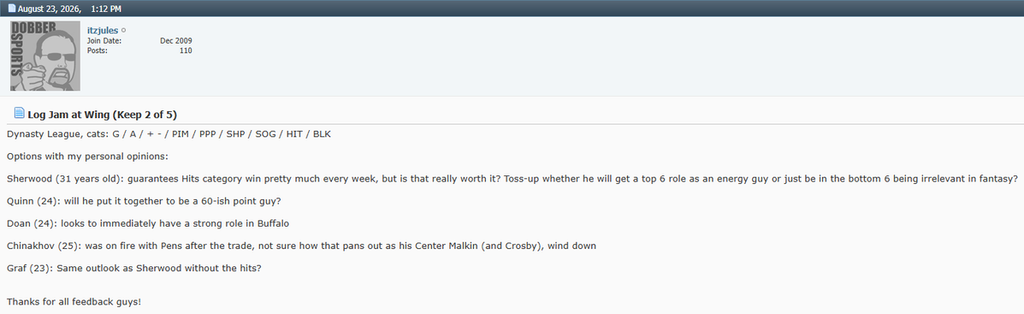
The first to eliminate is Collin Graf. I am a fan, but with a healthy Kiefer Sherwood, the signing of Mason Marchment, the drafting of Ivar Stenberg, and the ascension of Will Smith and Igor Chernyshov, there is just too much competition for Macklin Celebrini‘s wing. Not playing on the top line or top PP unit caps his upside until Michael Misa really starts to hit his stride.
I would also not include Egor Chinakhov. Another player I’m a fan of, but we’re relying on him repeating his second half with a 40-year-old Evgeni Malkin. He won’t get top PP time with a healthy Pittsburgh Penguins roster, and the addition of Andrei Kuzmenko may have pushed Chinakhov even further down the PP depth chart. Too many warning signs.
This comes down to Sherwood, Josh Doan, and Jack Quinn.
In the Forum replies, Alex MacLean mentioned that physical scorers can fall off quickly, and that is definitely a problem for Sherwood. A few examples:
- Evander Kane‘s points per game from his age-28 to age-30 season was 0.83, and that has fallen 34% since passing his age-30 season.
- Milan Lucic produced 1.94 points/60 minutes at 5-on-5 in the three years from his age-25 through age-27 season; he never surpassed 1.3 points/60 in any season afterwards.
- Jamie Benn had eight straight seasons of at least 0.8 points per game from the age of 21 through the age of 28 but has just one season of 0.8 points per game in the eight years since.
- Pat Maroon posted 1.84 points per 60 minutes from the age of 25 through the age of 29. He never reached that mark in any season afterwards and saw a decline of 23% in the three years after reaching age-30.
As with Graf, I do worry about Sherwood’s ice time. I don’t think he falls off to 13 minutes a game or anything, but skating around 15 minutes a night is a lot different than 17. He should still be productive – the Dobber Guide has him for 18 goals and 37 points while I have him for 16 goals and 36 points – but I think we’ve seen the best from him already, and he might only have another year or two left in the tank.
I would keep Doan and Quinn. Both are guys I’ve been touting for a couple of years now, and Quinn just needed to move past his Achilles surgery. At the least, one of them should end up on the top PP unit for most of the season, and it may end up being both. My opinion on Quinn is he’s one of the most skilled players in the league that doesn’t get any coverage, he’s 25 years old next month, hit the 200-game plateau last year, and is far enough removed from that Achilles injury for it to not be a concern. He has 30-30 upside in 2026-27, and while I’m a little lower on Doan, he brings more hits, so that helps balance things out. (aug27)
10. Bryan Rust vs. Marco Rossi
From user 'MikeDeee', we get a question with a very interesting pairing to consider, even if three players are listed here:
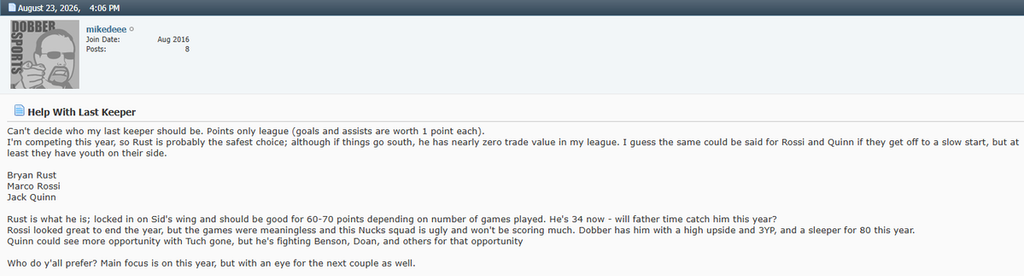
I am a big fan of Quinn, but even I have to admit there’s far too much competition in Buffalo for me to bank on him skating 18+ minutes a night with top PP time. I think he has 60-point potential this season, but I don’t see him breaking out for 75 points just due to his role.
Rust might be one of the more underappreciated fantasy players of the last five years. Since 2021, he has averaged 31 goals, 37 assists, 20 power-play points, 228 shots, 68 hits, and 59 blocks every 82 games. His inability to play full seasons – he has missed at least 10 games in four of those last five seasons and at least 20 games twice – kept him from reaching his full fantasy value, but when he was healthy, he was great.
That said, I am very much out on Rust this year. Whether looking at 5-on-5 tracking data from All Three Zones, the Synthetic Goals player value model from HockeyViz, or the Expected Goals Above Replacement model from Evolving Hockey, Rust’s last two years have been a substantial decline from the 2023-24 season; his fantasy value was maintained thanks to a career-best 24 PP points. He gets a lot of minutes to Sidney Crosby and that keeps him afloat. At 34 years old with a lengthy injury history, I have serious concerns that alongside the aging Penguins core, the age-related decline is in full swing, which will affect his ice time and production at any moment.
My bet is on Rossi. He should skate 17-18 minutes a game (at least) with top PP time. He is on a much worse offensive team than Quinn, but volume matters, and I will take 18 minutes with a firm top PP role on a bad team over 16 minutes with a flimsy top PP role on a good team. The Dobber Fantasy Guide has Rossi for more points (61) than Quinn (58), so I would go in that direction. (aug27)
11. Last Man In
We will quickly touch on one final question and it’s about a handful of rookie keepers from Forums user ‘The Hitchhiker’:
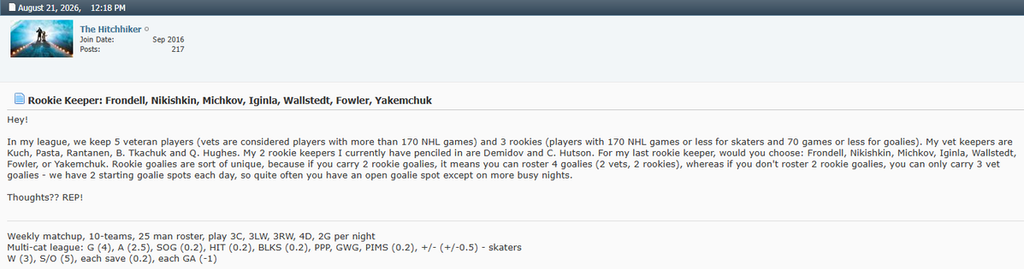
For me, this comes down to Anton Frondell, Matvei Michkov, or Jesper Wallstedt.
As mentioned in the post, there is a good argument for keeping Wallstedt. If he is kept, and another rookie goalie is drafted, The Hitchhiker can roster four goalies. That is helpful, but here’s the problem: how many ‘rookie’ goalies A) will have any meaningful fantasy impact in 2026-27, and B) will be available to draft? I imagine Jakub Dobes, Brandon Bussi, Jacob Fowler, and Yaroslav Askarov are going to be kept. Maybe Arturs Silovs? A swing on Devon Levi in a three-goalie tandem? Pickings are slim. Then again, without a goalie kept among the veterans, he may be necessary.
The Dobber Fantasy Guide has Frondell projected for 23 goals and 42 assists with Michkov at 23 goals and 45 assists. The difference is Frondell is projected for 25 more hits, 31 more shots, and 41 more blocks. That is a substantial improvement in the peripherals.
Also, if Michkov is kept, he will pass the 170-game cutoff and be a veteran next year. Let’s say he does have a 25-goal, 70-point season. Assuming the current keeper veterans don’t see any sort of substantial decline, is Michkov being kept next year over Nikita Kucherov, David Pastrnak, Mikko Rantanen, Brady Tkachuk, or Quinn Hughes? Not a chance. Frondell can be kept for at least two more years as a rookie, and if he misses more than 10 games in the next two seasons, he can be kept for three years.
For me it’s Wallstedt or Frondell. I can see the argument for Wallstedt, especially because of Filip Gustavsson‘s post-season hip surgery. If he’s not ready to go next month, or starts slow as he works his way back, Wallstedt might be a 50- to 55-start goalie rather than 40-45 starts. I would keep Frondell because I believe he’s a genuine superstar in the making and lean skater over goalie when it’s a close decision, but I am fine with Wallstedt for all the reasons mentioned. (aug27)
12. Bubble Keeper Week, also known as the week where I get to shamelessly walk through all of my keeper options and ramble about my thought process on all of it.
First up, my favourite partial keeper league I’m in, where we keep six forwards, four defencemen, one goalie, and an optional prospect. It’s a 12-team, H2H league with the following categories: G, A, PPP, SOG, Hits, Blks, FOWs, W, GAA, Svs, Sv%.
I eeked out a championship win last year while sending away the majority of my draft picks, so I really need to have a stable foundation that covers every possible category going into the draft, because I can’t be chasing both quality and quantity at the draft table with all my late picks.
Luckily, with a league-winning team the keeper options are usually solid. I have made a couple of minor deals so far, and have a few choices to make at each position (barring any future deals).
At forward, my locks are Jack Eichel, Aleksander Barkov, and J.T. Miller (due to his peripherals and triple position eligibility). Then I have to cut one of Adam Fantilli, Sidney Crosby, Filip Forsberg, or Mika Zibanejad. Forsberg is just inching past his prime, but is very consistent, and is a star producer across the board. Fantilli isn’t quite there yet, but he could be as good as Forsberg as soon as this season. Dobber actually has Fantilli projected to outscore Forsberg in the guide, to go with nearly identical Hit and Blk numbers – though Forsberg is still the bigger volume shooter. The other two options are Crosby and Zibanejad, who are also projected to score roughly the same amount as Forsberg and Fantilli, but they have the benefit of being elite in FOWs as well, which cancels out the lower SOG and Hits numbers. This might be my last season keeping Crosby, but it’s easy enough to find a filler keeper next summer, so I really am focusing more on which one helps me contend more this season. Ultimately, I think it comes down to Crosby or Forsberg as the cut, because Zibanejad also has the dual position advantage, and the benefit of the Rangers having a solid schedule. At this point my last cut will be Forsberg, but I’m working on trade options and may change my mind before the keeper deadline.
On defence, I had my four set in stone with Roman Josi, Dougie Hamilton, Mackenzie Weegar, and Darnell Nurse. They cover the peripherals very well, though I realize they all peaked a few years ago. That’s where my dilemma comes in, as I recently acquired Artyom Levshunov as part of a summer trade, and I’m debating the benefits of him versus Nurse. Both are projected around 30 points, though if Bowen Byram doesn’t stick on PP1, then Levshunov could jump up as soon as this season. However, Nurse’s peripherals have always been elite, and the Hit/Blk numbers could jump even higher as he gets fed defensive zone shifts for the Sharks – a big difference from playing behind the elite forwards in Edmonton who can be a one-man breakout. Levshunov isn’t a slouch in the peripheral categories, but he’s not elite with the Hits and Blks like Nurse is. Tough call if I can’t trade one, and I seem to flip flop each day on it. In the end, I think I’ll end up keeping Levshunov because defencemen are hard to find in this league, and with the age of the rest of my options I should probably have an eye on how I’ll manage in the coming years.
Speaking of, for my prospect options I have either Carter Yakemchuk or Bradley Nadeau, whom I could keep in place of my last round pick (round 24 of our draft). Yakemchuk is where I’m leaning, because it’s nice to have an extra Dman on board, and because I think he ultimately has the higher upside relative to his position. Nadeau may make the more immediate impact though, as there’s the possibility that he slides right into Seth Jarvis‘ lineup spot (while Jarvis recovers from surgery), supported in a very cushy landing spot beside Andrei Svechnikov and Sebastian Aho. The other piece to consider, is whether either would be drafted by round 24, and I could decide whether to pick one of them in the moment during the draft, or if there is a better option on the board – my thinking here is that while Nadeau may be available, I don’t think Yakemchuk would make it past round 21 or so, which tells me he’s the keep here.
In net, I just acquired Lukas Dostal in a deal on Monday, which probably tells you he’s the one I’m going to keep as my goaltender. I paid a very small draft pick price to keep Dostal over Spencer Knight or Jacob Markstrom because of how our league is set up. You need your goalies to win you at least two categories every week, and it’s often fairly easy to split the W/Svs from the GAA/Sv%. With Dostal and the inexperienced Anaheim defence, I expect him to have a higher win number and a higher number of saves per game compared to Knight. I like either one over Markstrom who won’t get the saves, and because of his age I’m not convinced the game volume is there, let alone the talent anymore after how he fell apart last year. (aug26)
13. My other keeper league is a smaller setup, with only eight teams, and six keepers (any skater or goalie) per team (to do the math for you, 48 players are kept, meaning a player should be a top-50 fantasy option if you want to keep them). It’s also a H2H league, and the categories here are G, A, +/-, PPP, SOG, Hits, Blks, W, GAA, Sv%, SHO.
I kept Igor Shesterkin a few years ago, but other than owning the top goalie on the board, I try not to keep goalies here. Not too much of an issue for me with only owning Yaroslav Askarov and Joel Hofer this year.
At forward, I have Macklin Celebrini, Tage Thompson, Jack Hughes, Martin Necas, Cutter Gauthier, Leo Carlsson, and that would be six if it wasn’t for Alex Debrincat and Tim Stutzle making me have to think about it as well. Fairly easy to cut DeBrincat on the sinking Detroit ship, and then flip flop on Stutzle vs Gauthier depending on if the contract and slower second half for Gauthier bring him down lower than Stutzle sans his long-time running mate Brady Tkachuk. If it came down to it, I would probably take Stutzle, as I like him as a better floor/ceiling combo compared to Gauthier.
However, the debate is a moot one, because I also roster a few defencemen who are worthy of being kept. Zach Werenski and Evan Bouchard are pretty impossible to cut, as they should both be top-25 players. As my favourite player, I wish I could keep Roman Josi too, but at this point it would be negligent to do so. That being said, I probably will draft him a round early here just to get him on my team again. Fantasy is all about the balance of competition and fun.
As tough as it is to let go of Carlsson, Gauthier, Stutzle, DeBrincat, and Josi, none of them are surefire top-25 players like my other six options are. Maybe I could listen to an argument for Carlsson over Thompson, but this year I expect Buffalo to be better than Anaheim, and that certainty with Thompson has value. Stutzle is someone I will be looking to redraft, as I do like his outlook, his cross category coverage, and I don't think the loss of Brady is much of a negative to his overall scoring profile. However, DeBrincat I will likely be avoiding this year as I think he topped out last year, and Detroit on the whole is going to take a step backwards. (aug26)
14. For those of you in much deeper leagues, my 24-team “dynasty” league requires us to cut down from 40 players to 30 each spring, which trims the fat and adds a little bit of intrigue to the draft each year in the form of secondary older prospects being weighed against the new wave.
This year my notable final cuts were Herman Traff, Nikita Grebenkin, Vincent Iorio, Lukas Beckman, and Lassi Thomson. Thomson signed overseas and appears to be off of the NHL path. Grebenkin I left off because of the depth the Flyer have at wing in combo with his injury making it so that a slide down the depth chart felt inevitable – it does sound like he could be ready close to camp, which would be big for him to be able to re-slot himself at the beginning instead of starting a lap behind. Iorio showed a flash with seven points in six games at the AHL level for San Jose, but otherwise the offensive ability hasn’t shone through, so he’s not a tough one to cut. Beckman I like as a longer-wait goalie prospect, but I prefer a 1-3yr timeline rather than his likely 5+ years before reaching the NHL. I might be able to re-acquire him in a year or two anyways. That takes us to Traff, who is someone I may still re-draft with a later pick, as I do like his upside, but it’s the wait time that made him my last cut. Traff is a big bodied player who also bumped up his skill game this past year with 41 points in 51 games playing in the Swedish version of the AHL. He’s joining the Ducks’ AHL affiliate this fall, and could be a year or two away from an NHL debut if he keeps on his current trajectory.
Circling back on the goalies, I ended up leaving the rookie draft with a pair of goalie prospects who have similar upside to Beckman, but are both 24-year-olds, and are much closer to the NHL. Both Michael Postava and Joel Blomqvist are worth taking a look at in any format with a farm system this year, as they’re number three on the depth chart on teams with very little stability ahead of them. (aug26)
15. For today’s Bubble Keeper Week Ramblings, I perused the Dobber Forums to find those keeper decisions that managers are evaluating. If any reader has questions they wish to ask, post over in the Forums, leave a comment below, or reach out to me on Twitter or BlueSky.
Keep Six
Our first question comes from Forum user ‘Grapes’ and it’s a 10-team head-to-head league with six keepers:
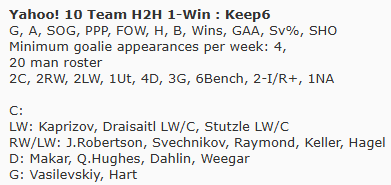
There are four automatic keepers for me in Leon Draisaitl, Cale Makar, Quinn Hughes, and Andrei Vasilevskiy. Draisaitl is a top 10 pick and the other three are at the top of their positions. That leaves us with two more choices.
I would be inclined to include Tim Stutzle. The main reason is that his across-the-board appeal is something not many others here can bring. After Draisaitl, none of the forwards on this list really take any face-offs, so even if Stützle only takes half the face-offs when he’s on the ice, his 300 FOWs is multitudes more than every other non-Draisaitl forward combined. Besides the FOWs, Stützle’s volume of hits is only matched by Andrei Svechnikov, so that’s another deciding factor. The Ottawa Senators forward doesn’t have the same point production upside of Kirill Kaprizov or Jason Robertson, but they don’t have his multi-cat upside, either. Add that to the fact that Stützle has missed just 16 games over the last five years and he has durability that some others do not. The fact that he’s dual-eligible works in his favour, too, because being able to get his multi-cat production with 300 FOWs from the left wing is a big checkmark in his favour.
The last spot comes down to Jason Robertson and Rasmus Dahlin.
In his post, Grapes brought up an important point and it’s Dahlin’s dropping peripherals. If Dahlin were to post last year’s goal, assist, and shot production with the hits and blocks he totaled 3-4 seasons ago, he would be a slam-dunk keeper. Back in May, I wrote about league-wide drops in hits and blocks among defencemen: over the last two seasons, hits per minute have dropped by about 25% and blocks per minute have declined by about 8%. Over the 2024-2026 seasons compared to 2022-2024, Dahlin’s hit rate has declined about 38% and his block rate has declined a whopping 30%. Even in an environment where peripherals from defencemen are falling, Dahlin’s decline stands out. He doesn’t produce points that compare to the Cale Makar/Quinn Hughes tier, and he doesn’t produce peripherals to compare to Moritz Seider. Dahlin is still a top-10 defenceman, I’m just not sure he’s a keeper here.
That brings us to Robertson. Last week, I wrote about his playmaking issues at 5-on-5, and how an elite power play and huge TOI increase papered over that problem. If he skates 18 minutes a game rather than 20+, he becomes an 80- to 90-point winger rather than one who can push past 100.
We have to remember a big part of Robertson’s TOI increase came from injuries elsewhere on the team: Mikko Rantanen missed 18 games; Jamie Benn missed 22 games and saw his role diminish to 13:17 per outing; Matt Duchene missed 25 games and wasn’t very effective otherwise until after the Olympic break; Roope Hintz missed 29 games and appeared just once after the Olympic break; Tyler Seguin missed 55 games. Five of Dallas’ top nine forwards combined to miss 149 games, averaging nearly 30 missed games apiece. That left a lot of minutes for Robertson to soak up, which he did. Each of those players is expected to be healthy and ready for training camp.
My instinct is to make Robertson the sixth keeper. The reality is that with Makar and Hughes already kept, Grapes has two of the three top keeper-league blue liners wrapped up for the foreseeable future. Makar and Hughes give Grapes the edge on the blue line over every other manager, and keeping Dahlin doesn’t offer much more of a competitive advantage. Robertson’s dual eligibility gives him flexibility to work well with the C/LW duo of Draisaitl and Stützle, and his shot volume is something the group desperately needs. I have my concerns about Robertson this season, but the Dobber Fantasy Guide has him as 1 of 6 forwards projected for 35+ goals, 60+ assists, and 250+ shots.
There is also the possibility of not keeping Vasilevskiy, holding onto both Robertson and Dahlin, and then hunting for goalies early and often in the draft. I would still keep Vasy, but the option is there. (aug25)
16. Jordan Kyrou or Logan Stankoven
Our next question comes from bbfl1987, and regards a pair of forwards with intriguing trajectories:
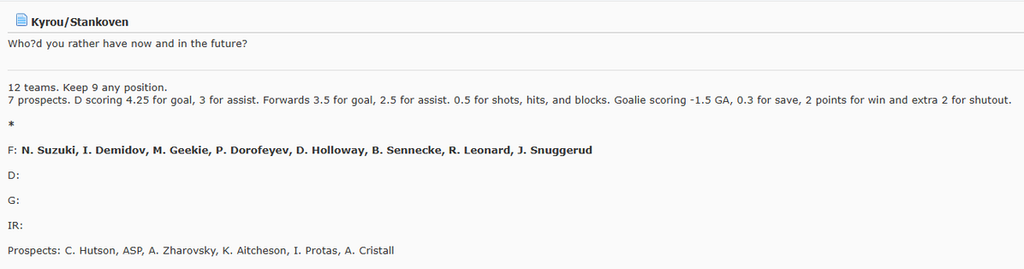
This league doesn’t differentiate between forward positions and doesn’t include face-off wins. It does have heavier scoring for defencemen and each of bbfl’s keepers are forwards. He has Cole Hutson and Kashawn Aitcheson as prospect depth, so that’s something, but I might look to package a couple forwards for a top-end defenceman.
The Dobber Fantasy Guide has Kyrou projected for 32 goals, 30 assists, and 210 shots while Stankoven is projected for 24 goals, 30 assists, and 180 shots. Kyrou just turned 28 years old in May, so while he’s starting to get towards the downside of his career, he should still have a few good seasons left. Assuming bbfl isn’t looking more than three years down the road, Kyrou seems like the answer.
My personal projections gave pretty similar results. I haven’t finished my short-handed projections, but neither Stankoven nor Kyrou kills penalties, so that’s irrelevant here. This is where my outlooks land for them, and they also give the edge to Kyrou:

What I will say is that bbfl’s team is not one that’s built to win right now. There are no defencemen or goalies and the only top 25 forward being kept out of nine players is Nick Suzuki. In a few years, the group of Suzuki, Ivan Demidov, Matvei Michkov, Dylan Holloway, Beckett Sennecke, Ryan Leonard, and Jimmy Snuggerud could push for a title, but it almost certainly won’t be in 2026-27. In that sense, I don’t care if Kyrou has six more points and 20 more shots than Stankoven this coming campaign. I care about the long-term outlook, probably in 2028-29 and beyond. If this were a roster with immediate contention potential, I would keep Kyrou, but it doesn’t, so my answer is Stankoven; I would much rather have him three years from now than I would Kyrou. (aug25)
17. Our final query today comes from Dobber Forum user Cataphard, and is a very interesting choice not only because of the players involved, but the context of the league:
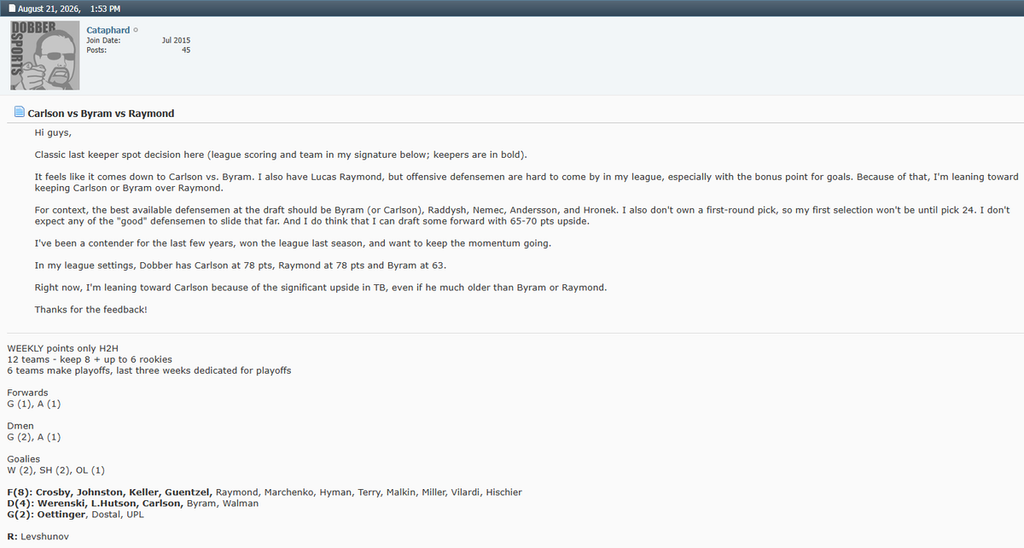
This is another format where scoring from defencemen, specifically goals, are weighted more than forwards. In this league, 15 goals from a defenceman are equivalent to 30 goals from a forward. Last year in this format, John Carlson had 74 points while Lucas Raymond had 76 because of this unique scoring.
The Dobber Fantasy Guide gives a big edge to Carlson as it has him and Byram projected for the same goal total but Carlson with 16 more assists in four fewer games played. My personal projections are a bit closer, but still give the edge to Carlson:

That is with age-related decline factored in, too, which is key here because Carlson turns 37 years old in January. If Carlson had signed with any of 26 or 27 other teams, it’s probably Byram, but Carlson signed with one of the top 5-on-5 scoring teams in the league who also have a spot for a top PP defenceman.
Beyond all that is the fact that Cataphard has Artyom Levshunov as a rookie keeper. It is at least possible that Levshunov overtakes Byram on the power play. Maybe not this year, but sometime in the next 2-3 years. The same could be said for Carlson with Victor Hedman, but Hedman turns 36 years old in December. Even if he overtakes Carlson, it won’t last for more than a couple of seasons. If Levshunov overtakes Byram, he could have that PP role for the next 5+ years.
One last note, and it’s that I think there’s an argument for keeping Lucas Raymond. Cataphard already has Zach Werenski and Lane Hutson as keepers, and both are top-5 defencemen in this format. Either Carlson or Byram would be nice to have, but it’s not as if we’re talking about keeping Makar, Hughes, or Evan Bouchard. The gap between the elite defencemen like those guys, and someone like Carlson who is a fringe top-10 blue liner, is about the same size as the gap between a fringe top 10 defenceman and a fringe top 30 defenceman. The relative differential just isn’t a big deal here, especially for a guy his age.
There isn’t a huge competitive advantage over a top 60 forward for Raymond as a fifth forward, either, but he’s also 12 years younger than Carlson. Because of that, my decision tree would be like this:
- If I only care about the 2026-27 season and pushing for a fantasy title immediately, it’s Carlson.
- If I want to keep a defenceman but look further down the road, it’s Byram.
- If I want to take a more proven producer while keeping a long-term outlook, it’s Raymond.
My final answer is keeping Raymond and then looking to grab one of Carlson or Byram (probably Byram) in the first couple rounds of the draft. (aug25)
18. For Bubble Keeper Week, I like to look at a few of my own players who are on the bubble and walk through the logic behind why I’d keep one or more over another. Not every player is going to make an immediate impact, but some are worth holding onto for their potential future production. When I’m evaluating these players, I’m usually asking a few simple questions: What role can they realistically fill? When could they break out? How much room is there for their value to grow?
Context also matters. Your league format, roster size and team construction can all change how much value a player actually has, which is why there isn’t always a clear-cut answer when it comes to these bubble keepers.
Mavrik Bourque is coming off a strong season in Dallas, setting career highs across the board with 20 goals, 21 assists and 41 points in 82 games. He also put 147 shots on net, which is encouraging because his production wasn’t simply the result of an unsustainable shooting percentage. That makes him an interesting player to consider in deeper keeper leagues, although the biggest question now is whether he can carry that momentum over after being dealt to Nashville. The Predators clearly believe in Bourque, handing him a six-year, $33 million contract after acquiring him, which suggests they see him as an important part of the franchise moving forward. From a fantasy perspective, however, the situation is a little more complicated. Bourque is currently projected no higher than Nashville’s second-line right winger with players like Luke Evangelista likely taking that top line role. Not to mention he also won’t see top powerplay TOI either. He’s also coming off a season where he spent some of his playing time along side teammates like Jason Robertson and Wyatt Johnston, so there’s no getting around the fact that his supporting cast is taking a step back. That’s what makes Bourque a true bubble keeper for me. I’m not rushing to drop him, but I’m also not treating him as a must-keep. If Nashville gives him a permanent top-six role, puts him on PP1 or moves him to centre alongside one of their better offensive wingers, the upside becomes much more appealing. There are still plenty of moving pieces up front for the Predators, and Bourque is one of the players who could benefit the most if he’s given a larger offensive role. For now, I’d lean toward keeping him in deeper leagues and seeing how his deployment develops. (aug24)
19. Marco Rossi
Marco Rossi is another player I would be inclined to keep in a deeper keeper league, especially because I think his situation in Vancouver could give him a chance to re-establish himself as a legitimate top-six offensive player. Rossi was acquired by the Canucks in the Quinn Hughes trade and finished last season with 35 points in 57 games between Minnesota and Vancouver, including eight goals and 14 assists in 33 games with the Canucks. Those numbers don't exactly jump off the page, but there is more to Rossi's fantasy outlook than his production suggests. He has already shown he can produce at the NHL level, putting up 60 points in 82 games with Minnesota in 2024-25, including 24 goals and 36 assists, albeit on a much stronger team. However, at just 24 years old, I don't think we've seen the best of Rossi yet, and the move to Vancouver could give him an opportunity to become a bigger part of the Canucks' offensive core rather than continuing to fight for consistent minutes. The biggest question is once again deployment. If Vancouver gives Rossi a permanent top-six role and meaningful power-play time which are both likely to happen at least to start the season, I could see him getting back into the 55-60 point range, with 65-plus points as the upside if everything falls into place. Unlike some of the other players on this list, Rossi has already demonstrated that level of production, which makes him a much easier player to hold. In deeper keeper leagues, I would be holding Rossi rather than cutting bait and allowing another manager to potentially benefit if he breaks out. For me, he's still a late-round breakout candidate, but he's also one of the more comfortable keeps on this list. (aug24)
20. Philip Broberg
Broberg is more of a defenseman breakout candidate, with his value tied heavily to his age, opportunity and the potential for his offensive game to take another step. He had a decent season with St. Louis, playing 81 games and recording 34 points, five more than the previous season. He also finished the year strong, which gives me some optimism that there could be more offensive production coming. The biggest thing working in Broberg's favor is that he appears to have established himself as an important part of the Blues' blue line. The problem, as it is with most defensemen in this fantasy range, is power-play opportunity. If Broberg remains primarily a second-unit option, it will be difficult for him to make a major jump from the mid-30-point range. However, if he can earn consistent PP1 time while playing top-pair minutes, I could see him pushing beyond 40 points and potentially reaching the 45-point range. The only competition ahead of him is Cam Fowler who did not play well for having majority share of the top powerplay unit ice time last season. All signs point towards Broberg taking over the top unit in the near future, although nothing has been confirmed just yet by the coaching staff. I'm currently looking at Broberg as a 35–40-point defenseman with 45-plus point upside if the power-play opportunity improves. He is someone I have in one of my keeper leagues and hope he see’s that uptick in production. There is enough talent and opportunity here to keep him around and see if his role continues to grow in St. Louis. (aug24)
[Follow the link for more…]
21. Continuing with Bubble Keeper Week, here are five more forwards that I have the option of keeping at a certain price in one of my leagues. The relevant rules for this league were covered in the August 22 Ramblings, as is what Bubble Keeper Week is if you’re not familiar.
Zuccarello delivered 54 points in 59 games last season — a 0.92 points‑per‑game pace, his best since 2021‑22. He also recorded 20‑plus power‑play points in four of the past five seasons, reinforcing how much of his value comes from power-play production. Those are legitimately strong numbers, but several indicators suggest his outlook could slip in 2026‑27.
First, the power‑play environment is a downgrade. Minnesota operated as a top‑five unit at 25.2%, while Los Angeles sat in the bottom five at 17.0%. Even if the Kings try to carve out a PP1 role for Zuccarello, there’s no guarantee he earns or keeps it. On top of that, he loses Kirill Kaprizov as a linemate at both even strength and on the man advantage — a major hit to his assist‑driven production.
Durability is another concern. Zuccarello hasn’t reached 70 games in any of the past three seasons, and he’ll be 39 years old on opening night. Availability risk is now a core part of his profile.
If he stays healthy, Zuccarello can still match last year’s output. But because his scoring is heavily assist‑weighted, his projected point totals don’t offer enough upside to justify a keeper‑level investment. In many formats, he’s more likely to be a watchlist or waiver‑wire candidate than a player worth protecting. (aug23)
[Follow the link for more…]
Have a good week, folks!
Thanks for continuing to support the website and if you’re bored and need a fantasy hockey fix – visit the gang in the forum here.
Related Posts
Starting Goalies



Top Skater Views
 MIN
MIN STL
STL DET
DET
Top Goalie Profile Views
| Players | Team | |
|---|---|---|
| DYLAN GARAND |
 NYR NYR | |
| JACOB FOWLER |
 MTL MTL | |
| DEVON LEVI |
 EDM EDM | |
| JOSHUA RAVENSBERGEN |
 S.J S.J | |
| NICO DAWS |
 N.J N.J
| |
LINE COMBOS
| Frequency |
 VGK Players VGK Players
| |
|---|---|---|
| 24.4 | MARK STONE JACK EICHEL IVAN BARBASHEV | |
| 21.8 | RAPHAEL LAVOIE TOMAS HERTL TREVOR CONNELLY | |
| 19.4 | MITCH MARNER WILLIAM KARLSSON BRETT HOWDEN | |
DobberHockey Podcasts

Keeping Karlsson: Delusions of Garandeur
Elan and Brian dive into the latest NHL hot streaks, cold streaks, line changes, outjuries, injuries, buy-lows and sell-highs to give you top notch tips in your fantasy hockey league

Fantasy Hockey Life: TiDy Takes Part 2
Last week, Victor Nuno and Ryan Downey broke down trades from our top tier dynasty league. This week, they consider some dynasty trades from other divisions. Have a listen! Our show is part of the Dobber Podcast Network and sponsored by Fantrax.com. Email [email protected] and ask to join our free discord. Join our Patreon at […]
Keeping Karlsson: Matchup Maximizer 2026/27 Week 3
Elan takes a look at the schedule for the upcoming weeks of NHL action and recommends players with good schedules that you should consider streaming in to win your head to head matchups.
Keeping Karlsson: Short Shifts – Sharks Looked Like Celebweenies
Elan recaps the major injuries, outjuries, game results and changed line combos that we’ve seen since Sunday’s mega-show.
Keeping Karlsson: Cole, There’s No Time!
Elan and Brian cover all the action from the first week of the NHL season, and identify our earliest must-adds, can-drops, sell highs and buy lows in your fantasy hockey leagues.