

Analytics Advantage: Top Waiver Wire Skaters to Target and When a Role Becomes Real
Stas Pupkov
2026-10-02
Opportunity Knocks: Week One’s Best Jobs Are Still on the Waiver Wire
Sean Durzi is on a roster in 3 percent of ESPN leagues. He's played 22.1 minutes a night through two games with the New York Rangers, on the second pair, and that's almost three minutes more than he averaged with the Utah Mammoth last season. Nobody on the Rangers' blue line is hurt. So the coaches gave him a bigger job because they wanted to, and there's nobody coming back from an injury to take it away. He might have found a spot there.
Denton Mateychuk is on even fewer rosters, 2.5 percent, and he played 27 and a half minutes in the Columbus Blue Jackets' opener, which is eight more than his average last season. But those minutes are there because Ivan Provorov is week-to-week and Damon Severson hasn't come back from shoulder surgery yet, even though he's been medically cleared. The night either of them walks back in, Mateychuk loses a big piece of that ice time. It could also have just been a high-minute game. But it's still a good sign that they trust him with that much ice, and I'd ride it while it lasts.
I went through every team's line chart and the first game or two of real ice time, and I pulled out the skaters who got bigger jobs. Then I sorted them two ways. First by how much the minutes back the job up and how widely the player is already rostered, and then, further down, by how long the job is likely to last.
Three Terms to Know
PP share is how much of his team's power-play time a player eats up, like his slice of a pie chart. It's a percentage instead of raw minutes because teams draw different numbers of penalties, so raw minutes would mostly tell you about the other team. Last season, anyone above about half of it was effectively on the first unit, which I'll call PP1. Trust weight is how much this season's number should count against last season's after a given number of games. And rostered is the share of ESPN leagues where somebody has the player, as of Thursday night.
Grab Now: Bigger Jobs Still on the Wire
To make this board a player has to be in the top six, the top four or on PP1 on today's Daily Faceoff chart, and then his ice time in the first game or two has to back that up, and he has to be rostered in fewer than 80 percent of ESPN leagues. Anyone above 80 is almost certainly gone in yours already.
The bar is cautious on purpose. It's last season's fantasy points per minute times the extra minutes I project him to keep, and with one or two games played the projection only keeps about a quarter to two-fifths of the early jump. A big opening night doesn't get full credit.
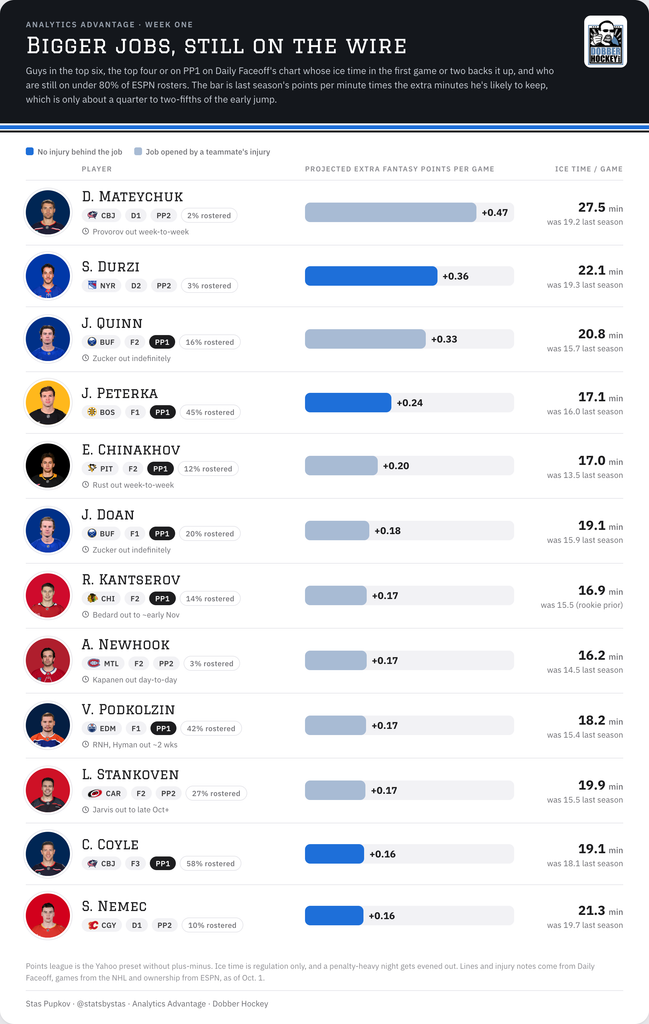
Figure 1
You've already met the top two. Mateychuk is the shorter bet, so I'd treat him as a this-week add in deep leagues and check the Columbus injury report before every lineup lock. Durzi is the one I'd hold.
The Buffalo Sabres are where it gets interesting, because Jason Zucker is out indefinitely and that opened up the top power-play unit. Jack Quinn went from 45 percent of the power play to 71 percent in the opener and played 20.8 minutes, and he's on 16 percent of rosters. Josh Doan is on that unit too, at 20 percent rostered.
With the Chicago Blackhawks, Connor Bedard is recovering from July shoulder surgery, and the timeline points to about early November. That leaves room for Roman Kantserov, a first-year import from the KHL, who's on Chicago's second line and PP1 at 16.9 minutes. He's on 14 percent of rosters.
Egor Chinakhov is on the Pittsburgh Penguins' PP1 with Bryan Rust week-to-week. Twelve percent of leagues have him.
Logan Stankoven played 19.9 minutes for the Carolina Hurricanes, up from 15.5 last season, and Seth Jarvis is out until late October at the earliest, so that role has a few weeks behind it at minimum. He's at 27 percent.
Alex Newhook is up to 16.2 minutes for the Montreal Canadiens while Oliver Kapanen is day-to-day. That could end any night. But he's on 3 percent of rosters, so finding out costs you very little.
Then there's Vasily Podkolzin, who has four points and 11 shots in two games. No projection here takes that pace seriously. What it does take seriously is the role, because he's on the first line and PP1 with 65 percent of the Edmonton Oilers' power-play time, after 11 percent last season. The catch is that the role has an end date, since Ryan Nugent-Hopkins and Zach Hyman are both expected back in about two weeks. The market has noticed too. He's at 42 percent rostered, and his 16.5-point jump in ESPN's latest change figure is the biggest of any player in the game.
The last three have no injury attached to their jobs at all. JJ Peterka spent last season in Utah. Now he's playing 17.1 minutes for the Boston Bruins with 74 percent of their power play, and he's 45 percent rostered. Charlie Coyle has 71 percent of Columbus' power-play time, up from 49, and he's at 58 percent. Simon Nemec moved from the New Jersey Devils to the Calgary Flames, and he's playing 21.3 minutes on their top pair while only 10 percent of leagues have picked him up.
Watch: New on the First Unit
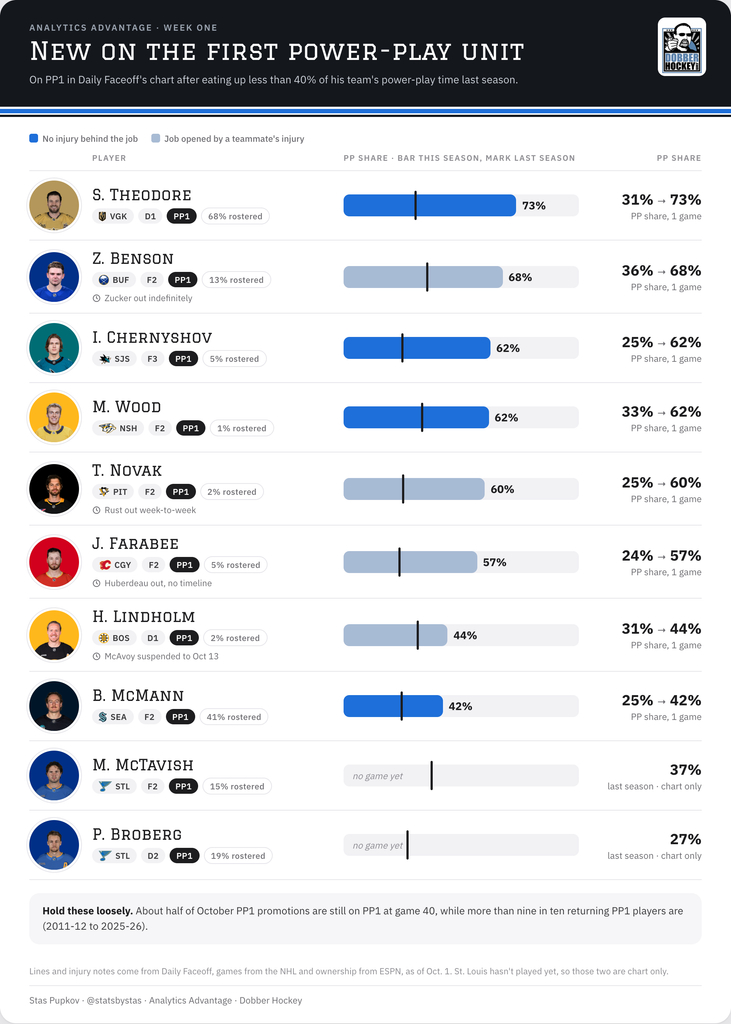
Figure 2
Every name on this second board was under 40 percent of his team's power-play time last season and is on PP1 now. I'd hold these loosely. About half of October PP1 promotions are still on PP1 at game 40, while more than nine in ten returning PP1 players are, and most of these guys are close to unowned anyway.
Matthew Wood of the Nashville Predators nearly doubled his share of the power play, from 33 percent to 62, and he's on 1 percent of rosters. Zach Benson in Buffalo went from 36 to 68 and sits at 13 percent. Joel Farabee made a similar jump in Calgary, from about a quarter of the power play to 57 percent, with Jonathan Huberdeau still out and no timeline. Tommy Novak did the same in Pittsburgh and got to 60.
Shea Theodore is quarterbacking the Vegas Golden Knights' top unit at 73 percent. Hampus Lindholm is on Boston's PP1 while Charlie McAvoy, also a defenceman, serves a six-game suspension that ends Oct. 13, so Lindholm's spot may not survive the week after that. Mason McTavish and Philip Broberg are on the St. Louis Blues' PP1 on the chart only, because the Blues haven't played yet.
Andrew Copp is on the Detroit Red Wings' PP1 chart too, and I left him off the board, because Dylan Larkin is expected to miss only Friday's and Saturday's games.
How Fast a Role Becomes Real
By October the rosters are basically set, right? So this is where we really see who deserves the ice time, and that's the part that carries through the rest of the season. Points are different, because a player can get hot and get cold, and there's a lot more that goes into them. This fall I measured how fast each fantasy number becomes trustworthy, with every rosterable returning skater from 2011-12 to 2025-26. Ice time and power-play share move fastest. After only four games they earn about half the weight against last season, while shots get about 15 percent and goals about 6 percent. Ice time is the early October tell. That gap is why every bar here is built on minutes.
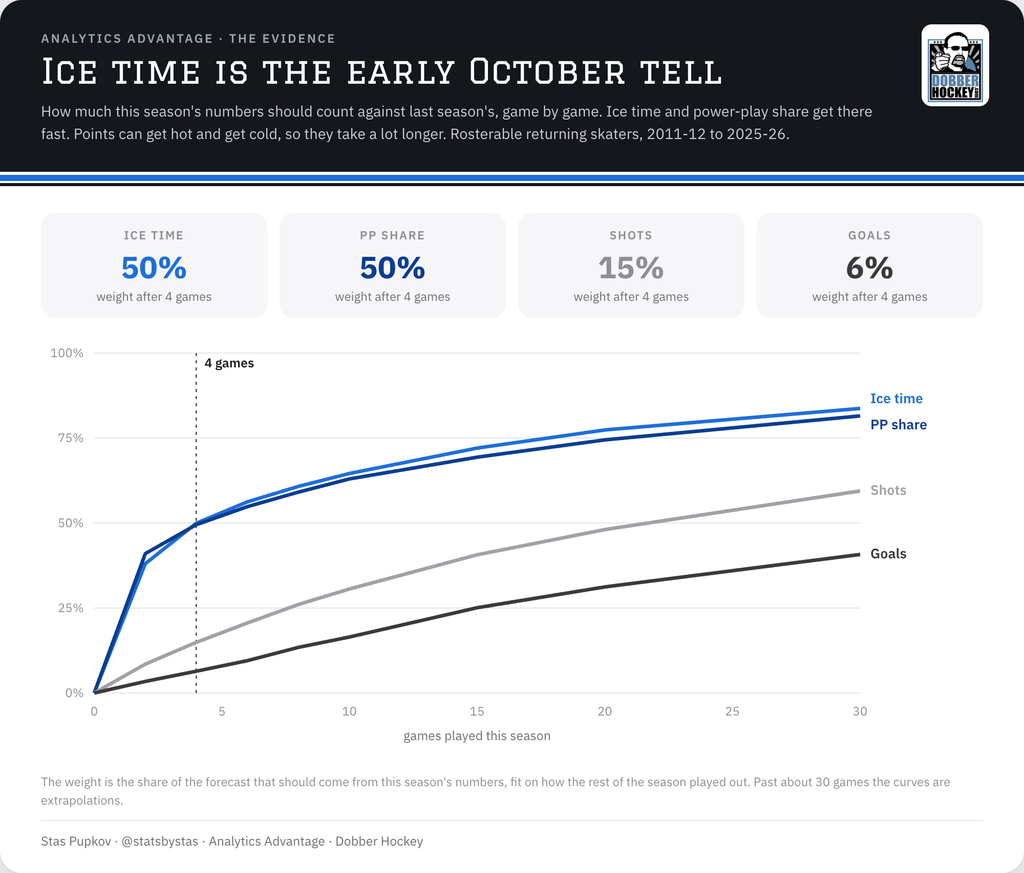
Figure 3
Two things can inflate a single game's ice time without telling you anything about a player's role. One is overtime. The other is a team drawing a pile of penalties, which pumps up every PP1 forward's minutes. So before projecting anything I take overtime out on both sides of the comparison, and I rebuild each game with an average night's power-play time, about 4.7 minutes per team last season, at the share the player actually got. That's why a player can show a big raw jump and still end up with a modest bar.
The Injury Clock
Most of these openings exist because somebody is hurt or suspended, which means the real question is how long the door stays open. Here's how it looks from Daily Faceoff's injury notes as of Thursday night.
The long ones first. Bedard is out until about early November, and that's good news for Kantserov. Zucker is out indefinitely, so Quinn, Doan and Benson have a real runway. Huberdeau has no timeline at all, which helps Farabee. And Jarvis won't be back before late October, so Stankoven is covered for a while.
The short ones are where you have to pay attention. McAvoy is eligible again on Oct. 13, which matters for Lindholm. Nugent-Hopkins and Hyman are about two weeks away, which is Podkolzin's window. Provorov is week-to-week and Severson is already cleared, so Mateychuk's minutes could shrink any day. Rust is week-to-week too, which covers Chinakhov and Novak. And Kapanen is only day-to-day, which is the thinnest cushion on the list because he could be back any night, and it's Newhook's.
Then there are the jobs with no same-position injury behind them, which belong to Durzi, Peterka, Coyle, Nemec, Wood and Theodore. Nobody is coming back to take those.
Ownership tells you which of these the market has already found. Patrick Kane has played top-line minutes and PP1 in Chicago through two games, but Bedard's surgery was public in July and Kane is on 85 percent of ESPN rosters, which is why he isn't on the board. Podkolzin's opening came on or after the Sept. 28 practice injury to Nugent-Hopkins, and his ownership is rising faster than anyone's. Durzi, Mateychuk and Newhook are still on about 3 percent of rosters or fewer, and Nemec is on about 10.
The Playbook
- Trust the minutes first. Ice time and power-play share are the first numbers worth believing. Points will follow the minutes or they won't, and you won't know which for another month.
- Check how long the door stays open. When a star's injury opened the job, the job has an end date. The long runways (Quinn, Doan, Stankoven) are worth a roster spot, and the short ones (Podkolzin, Mateychuk) are streams.
- Give extra credit to jobs that came with no injury. Durzi, Peterka and Nemec got more ice time without anybody getting hurt, so there's no return date hanging over them.
- Hold PP1 promotions loosely. About half of October PP1 promotions are still on PP1 at game 40, while more than nine in ten returning PP1 players are.
- Look again after four games. That's when ice time and power-play share reach about half the weight against last season, and in a backtest over the last ten seasons, an act-now board built at four games from role jumps beat same-value players by about 1.2 fantasy points per game over the rest of the season.
- Keep the stars you drafted. Everybody here is an add for the bottom of your roster, and none of them is a reason to move anyone you drafted.
How This Was Built
Lines and power-play units come from Daily Faceoff's team charts as of Thursday night (Oct. 1), matched to NHL player ids. Games so far come from NHL boxscores and shift charts through Oct. 1. I derive power-play time per player from the shifts and check it against the NHL's own number for every player-game, and ice time is compared in regulation only. Last season's usage is 2025-26 ice time and PP share. Players who missed most of last season are measured against their most recent season with 20 or more games, and rookies against a draft-and-league-equivalency prior. Fantasy points use the Yahoo points preset without plus-minus (6 per goal, 4 per assist, 2 per PPP, 0.9 per shot, 1 per block). Injury timelines come from Daily Faceoff's news notes, so treat them as reported timelines. Ownership is ESPN's percent rostered, pulled Thursday night. Game data is from the NHL, lineups and injury notes from Daily Faceoff and ownership from ESPN, as linked above, and the projections and boards are my own.
Related Posts
Starting Goalies













Top Skater Views
 COL
COL S.J
S.J CHI
CHI

Top Goalie Profile Views
| Players | Team | |
|---|---|---|
| DEVON LEVI |
 EDM EDM | |
| JOSEPH WOLL |
 PHI PHI | |
| FREDERIK ANDERSEN |
EDM | |
| KAREL VEJMELKA |
 UTA UTA | |
| AKIRA SCHMID |
 FLA FLA
| |
LINE COMBOS
| Frequency |
 ANA Players ANA Players
| |
|---|---|---|
| 17.1 | ALEX KILLORN CUTTER GAUTHIER LEO CARLSSON | |
| 13.4 | TIM WASHE NIKITA NESTERENKO JUDD CAULFIELD | |
| 12.6 | FRANK VATRANO RYAN POEHLING NIKITA KLEPOV | |
DobberHockey Podcasts

Keeping Karlsson: Short Shifts – I Tried to be Like Parker Kelly
Elan is joined by Ryan Downey for the premiere of season 8 of Short Shifts! — KKUPFL late registration is ongoing! We’re still filling new divisions in the world’s greatest fantasy hockey league. Details at https://www.kkupfl.com/. Join the Keeping Karlsson patron community! Patrons get access to all our perks all year round, including KKUPFL […]
Keeping Karlsson: Shabanov Ranks
Elan and Brian fly through the final preseason lines for every NHL team ahead of opening night, and share their guys to watch– or look away from– in your fantasy hockey leagues.

Fantasy Hockey Life: Western Conference Catchup and Mustard
Jesse and Victor are here to Catch Up on everything in the Western Conference that transpired ofter our team previews. We also have our annual spicy mustard competition – two hot takes per team. Our show is part of the Dobber Podcast Network and sponsored by Fantrax.com. Email [email protected] and ask to join our free […]
Keeping Karlsson: Matchup Maximizer 2026/27 Week 1
Elan takes a look at the schedule for the upcoming weeks of NHL action and recommends players with good schedules that you should consider streaming in to win your head to head matchups.
Fantasy Hockey Life: Dallas Stars with Taylor Newby
Taylor Newby joins the program to discuss the Dallas Stars.