

Frozen Tools Forensics: Shooting Regression Candidates in Catton, Michkov, Bourque, Wilson, and More
Chris Kane
2026-11-27
Today we are going to invest time looking at player shooting percentages. Shooting percentage is perhaps the quickest number we can look at to determine whether a player is likely going to continue with what they are doing. We have some understanding of what a generically high or low shooting percentage is so we can easily look at a player who is shooting below 5% and guess they will score more in the future, or a player who is shooting 25% and guess they are going to score less going forward.
Today we will hit both sides of the equation. To be really helpful though we need some sort of understanding of how those players usually perform and whether or not what we have seen so far is something unusual for that player. In order to gather this information, I pulled a Big Board report over the last three seasons to get an average shooting percentage for players and then I pulled the same report for the season to date. By comparing the current number to the baseline average we can get a better picture of who is doing something unexpected. Once we have the list, we can then dig in to what is actually happening for that player and determine whether or not this new shooting percentage is sustainable, or if we expect it to regress back to the recent average.
The tables below include basic player information (name, position, and team), and then the players current, and 3-year shooting percentage. Next, we see what regression to that career percentage would mean in terms of a change in goal scoring, and then how that would impact their overall season pace.
First up, we have players who are scoring on more shots than expected.
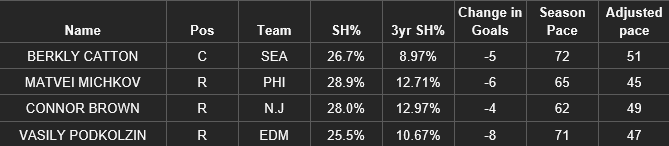
Berkly Catton is an interesting one to include here as he doesn't have a long track record. In 25-26 he put up 7 goals in 66 games, with a shooting percentage of 8.97. Given his pedigree it is not surprising that he has had a better start to 26-27, though I think it is just a question of where he lands. It is safe to say he is not a 25+ percent shooter, but it also would not be surprising for him to land over 9%. Still, were he to land in the 14% range, that would only give him four goals on the season and around a 56-point pace. It is nice to see the breakout of Catton, though going forward he may not be able to sustain his current 70+ point pace.
Matvei Michkov has a bit of a longer track record, but we are still waiting on a breakout for him as well. His 65-point pace is great, but that near-30% shooting percentage is not. Again, even if we assume he is slightly better than is past career average and give him a 17% shooting average he has 6 or 7 goals instead of 11. That puts the pace closer to 50 than 45 sure, but still a far cry from 65.
Connor Brown had three goals over four games in the middle of November and that has certainly juiced his shooting percentage. It helps spending time on the top line and top power play in New Jersey. Still, he isn't really shooting, and even last year when he was getting a good run on that top power play, his shooting percentage was only 15%. Best case scenario for him then is something like a 53-point pace going forward, assuming he retains at least top power-play deployment.
Vasily Podkolzin is another who won't sustain his 25% shooting percentage but, it is certainly fair to wonder what his true number should be. He has six power-play goals already this season, and when he has been getting games on the top power play in Edmonton it is no wonder. The question is future deployment. Zach Hyman is still out, and Ryan Nugent-Hopkins is back. When both were in the lineup, Edmonton moved Podkolzin off that top unit. When they are injured Podkolzin is there – scoring power-play goals. It seems plausible that Podkolzin on the top unit could maintain something closer to a 20% shooting percentage. Without it though he likely drops back down to something closer to his career average.
On the flip side, we have players who are shooting well below their recent career average.
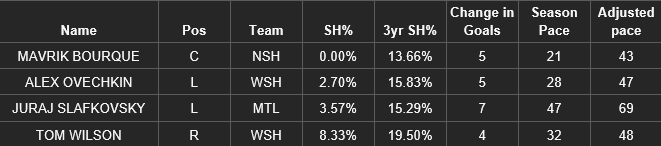
Mavrik Bourque should have more than zero goals to his name for the season. Even getting up to five, though, which would double his expected point pace, would still be a bit of a disappointment. Starting in mid January, Bourque put up a 65ish point pace in Dallas over the final 34 games. That was because he was elevated to top line deployment because of some injuries in Dallas. The assumption over the summer was that a move to Nashville would cement that top line deployment and then hopefully production over a full season. So far, he is on a 21-point pace. Part of the issue is that he has not had consistently top line or top power-play deployment, part of the issue has been his shooting percentage. During the beginning of November, Bourque seemed to be on the rise, getting over 50% of the team's power-play and averaging over 17 minutes a night. Recently though, with Jonathan Marchessault's return, Bourque has spent time off of that unit and has averaged 13 minutes or less overall, even while playing with Steven Stamkos and Ryan O'Reilly. Low 40's certainly sounds better than low 20s, but for that point pace to really improve, he needs to be getting consistently better deployment.
Alex Ovechkin is on a 28-point pace and has only one goal. He is 41 and so there has to be a legitimate question on whether he is still worth rostering. Just a year ago he scored 32 goals and put up 64 points. Regressing to his usual shooting percentage would give him five more goals and closer to a 47-point pace, but assuming that will happen might be a bit of wishful thinking. Over the last couple of seasons Ovechkin managed to maintain that goal pace partly because he was on the ice for the entirety of Washington's power play, and the team was all in on making sure he hit the goal scoring records. At this point, there has been an influx of skater talent, there is no record to strive for, and Ovechkin just isn't the focal point of the team any more. He is playing less than 14 minutes a night, not on both power-play units, shooting less, and is just less involved in the offense. So sure, he won't maintain a sub 3% shooting percentage all season, but hoping for a full regression seems like the wrong choice.
Juraj Slafkovsky's 3.5 shooting percentage on the other hand seems to bode very well for a rebound. He is skating over 18 and a half minutes a night, has almost 70 percent of the team's power play, is matching his shot rates from last season's 30 goal pace and is now almost certainly going to be playing with one of Nick Suzuki or Dylan Larkin at even strength. There is a lot of like here and Slafkovsky is certainly the most compelling buy-low candidate we have seen thus far in this article.
After two consecutive 70ish point seasons, Tom Wilson's 32-point pace leaves a lot to be desired. It is worth noting though that in each of those two seasons Wilson shot in excess of 19%, after a career of closer to 13.5%. Some of what was true for Ovechkin is also true for Wilson. The last two seasons, he was much more of a focal point for Washington's offense, but with the influx of talent he has dropped to his lowest time on ice in the last four seasons. That means less power-play time, lower shot rates, and lower expected goals. If we are looking for areas for growth though, he has yet to register a power-play point, and has been less involved in goals scored than has been typical. Couple that with a lower shooting percentage and he seems like a candidate for a bit of a bounce back going forward, but we are also looking at a new normal for Washington, and potentially a new role for Wilson as he ages.
That is all for this week.
Do your part to support organizations working to make hockey for everyone.
Related Posts


Starting Goalies



Top Skater Views
| Players | Team | |
|---|---|---|
| TOM WILSON |
 WSH | |
| ROMAN KANTSEROV |
 CHI | |
| LOGAN MAILLOUX |
 STL | |
| JIRI KULICH |
 BUF | |
| TREVOR CONNELLY |
 VGK | |
Top Goalie Profile Views
| Players | Team | |
|---|---|---|
| DANIIL TARASOV |
 DET | |
| DAN VLADAR |
 PHI | |
| STUART SKINNER |
 WPG | |
| JOEL HOFER |
STL | |
| CAM TALBOT |
 CBJ | |
LINE COMBOS
| Frequency |
VGK Players
| |
|---|---|---|
| 25.3 | MITCH MARNER WILLIAM KARLSSON TREVOR CONNELLY | |
| 21.5 | MARK STONE BRETT HOWDEN JACK EICHEL | |
| 14.8 | VICTOR OLOFSSON TOMAS HERTL IVAN BARBASHEV | |
DobberHockey Podcasts

Keeping Karlsson: Short Shifts – Thanksgiving Episode
Ryan Downey romps through the league after a busy Wednesday night of NHL action on this Thanksgiving episode of Short Shifts.
Keeping Karlsson: Dylan Goes Québectric
Elan and Brian serve up their instant takes on the live-breaking Dylan Larkin deal; also, IR stashes gone wrong, a mess of new injuries, and everyone puts up numbers against Anaheim.

Fantasy Hockey Life: Scout’s Tout
On today’s Scout’s Tout, Jesse and Victor give reports on draft eligibles: Landon DuPont, Dima Zhilkin, Nazar Privalov, Sergei Skvortsov, Carter Meyer, Sammy Nelson, and Diego Gutierrez. Then we turn to Michael Misa, JP Hurlbert, Ryan Brown, Viggo Bjorck, Xavier Villeneuve, and Michael Hage. FHL Scout reports by: Sasha, Kara, Tomer, Mike M, and Kendrick, […]
Keeping Karlsson: Matchup Maximizer 2026/27 Week 9
Elan takes a look at the schedule for the upcoming weeks of NHL action and recommends players with good schedules that you should consider streaming in to win your head to head matchups.
Keeping Karlsson: Short Shifts – Bedard’s Injury Fallout and Crazy Goalie Results
Elan and Lewis cover all the big fantasy news since last Sunday’s mega-show including a big time injury and some crazy goalie results.