

Ramblings: Extensions for Tsyplakov, Timmins, Söderblom, and Struble; Projecting Goalies – July 29
Michael Clifford
2025-07-29
The 2025 Dobber Hockey Fantasy Guide has been released and is available for purchase in the Dobber Shop! It has projections, a draft list, team-by-team breakdowns, rising and falling players, category-specific options, and a whole lot more. Help support what we do year-round by purchasing a copy today!
For fantasy managers looking to expand their player pool knowledge, the Dobber Hockey Keeper Pack includes both the guide and the Prospects Report. That Prospects Report has everything that poolies need to know on this year's crop of draftees as well as each team's prospect pool. That is also available now in the Dobber Shop.
*
Over the weekend, there was a trio of players who signed two-year contract extensions with their current team, all of whom were supposed to have arbitration hearings this week, so let's look at each of them.
Maxim Tsyplakov (New York Islanders)
It was a successful rookie season for Tsyplakov as he finished with 10 goals, 25 assists, 39 penalty minutes, 40 blocks, and 140 hits. That is pretty good across-the-board fantasy coverage for someone skating under 15 minutes a game on a below-average offensive roster and finishing ninth among his team's forwards in share of power-play ice time. Per Evolving Hockey, he also had extremely strong play-driving metrics, though actual goal-scoring and goal prevention didn't live up to those strong metrics.
Not living up to metrics was kind of a calling card for Tsyplakov's season. To illustrate this, here are Tsyplakov's comparables across the league by assist rate and individual expected goal rate at 5-on-5:

That is a pretty good list, but the gap between his individual expected goal rate and actual goal scoring rate at 5-on-5 was the 22nd largest gap among 336 regular forwards in the league. In other words, he scored far less than the individual expected goals rate would indicate. The big issue was that just 43.5% of Tsyplakov's shot attempts landed on goal, which was the 23rd-worst rate in the league.
It isn't hard to imagine Tsyplakov being even better this season given how he underperformed those metrics. Just some positive regression without other changes means a better offensive season. The issue is where he stands on the roster's pecking order. There is still Anders Lee, Kyle Palmieri, Simon Holmstrom, Anthony Duclair, and Jonathan Drouin to contend with for ice time among wingers. The first three names all exceeded Tsyplakov for share on even-strength ice time, Duclair should be healthy, and they added Drouin, who likely gets a shot with either Bo Horvat or Mathew Barzal to start the season (and Barzal has even been moved to the wing at times). If Tsyplakov sees positive regression, but is a third-line, second power play option, maybe he gets to 15 goals and 30 assists? That will be just fine with the peripherals he can post but expecting a massive leap in production feels unlikely unless the coaching staff boosts his role.
Conor Timmins (Buffalo Sabres)
Injuries have really derailed Timmins' progression. A concussion in junior hockey kept him out of action for the entire 2019-20 AHL season, he started the 2023-24 NHL season on the LTIR thanks to a lower-body injury, was activated in late November, and was back on the injured reserve thanks to a bout with mono in January that kept him out of the lineup for two months. With other knicks and cuts plus the COVID shutdown, it has been constant stops-and-starts for Timmins throughout his pro career. If nothing else, he just needs to stay healthy.
When he's been able to stay healthy, Timmins has been an effective depth defenceman. Over the last three seasons, here are his comparables by Evolving Hockey's expected goals-for and expected goals-against impacts at even strength:

Most of his games were in bottom-pair minutes, but not only did he have positive expected goals impacts, he had positive actual goal impacts. Like Tsyplakov, the actual-goal impacts didn't live up to the expected-goal impacts, but positive is still good, and an improvement over Connor Clifton, whom Timmins is replacing.
With Rasmus Dahlin, Owen Power, and Bowen Byram, Timmins will be no higher than fourth on Buffalo's defensive depth chart. He may be sixth when including Mattias Samuelsson and Michael Kesselring. In that sense, it's unlikely Timmins has any significant fantasy relevance himself. However, if he's healthy and can play as he did in Toronto and Pittsburgh, he can boost the fantasy values of the forwards he's moving the puck to and the goalies behind him. That matters.
Arvid Soderblom (Chicago Blackhawks)
Spencer Knight made his Chicago debut on March 3rd following the trade from Florida, and he started 15 of Chicago's 22 remaining games while Söderblom got just seven. In a full season, that would give Knight around 56 starts and Söderblom around 26. That might not be great news for Söderblom's fantasy value, but the key here is that between splitting time in the AHL and NHL, and time in the Player's Assistance Program, Knight hasn't appeared in 50 games in any season since 2018-19 when he was with the US National Team.
Knight was the centrepiece of the Seth Jones trade, so I don't think this ends up a true split-start situation, and they probably try to get Knight to 50-ish starts. (For posterity, the 2025-26 Dobber Hockey Fantasy Guide has Knight with 50 appearances). However, if Knight should miss games for any reason, Söderblom will be the go-to guy.
It is worth keeping an eye on the goaltending situation here because both Knight and Söderblom have one year left on their current contracts. If Knight shows well in the first three or four months of the 2025-26 season, it could make Söderblom a trade target at the Trade Deadline. Chicago probably doesn't take much of a step forward this year, and Söderblom is at best the 1B in a 1A/1B situation, so the fantasy value is minimal right now, but that could change in February or March.
*
Remaining arbitration cases are Dylan Samberg (July 30) and Nick Robertson (August 3), per PuckPedia. We can take Jayden Struble's name off the list as he signed a two-year extension with Montreal worth just over $1.4M per season.
*
For the last couple of weeks, these Ramblings have included a step-by-step process in what to do when creating projections for the upcoming fantasy hockey season. The first six steps so far include:
- Which stats to look at when figuring out a player's next-year projection.
- The difference between projecting forwards and defencemen.
- Changes in ice time across the league.
- Projecting changes (or lack thereof) in ice time at the player level.
- Why ice time for players who change teams requires a different calculation than ice time for players who stay with the same team.
- Production levels for each of the three forward positions.
Today's lesson is going to move to goalies, and we're going to be brief for today.
Goaltending is frustrating to deal with in fantasy, no doubt. It is always nice to have a Connor Hellebuyck on your roster, but that isn't the case for most fantasy players. One thing I have found that has helped is to not even bother with the goalies and focus on the team instead. This is why.
From 2022-2025, here is the relationship between expected goals against per 60 minutes at all strengths and overall save percentage among regular goalies (the top-37 goalies, so all starters and top-tier backups):
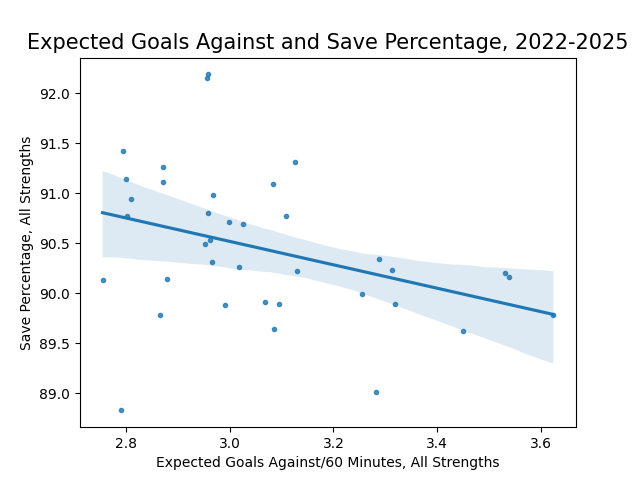
There is a lot of variation, but also a clear downward trend as more expected goals against has led to a worse save percentage. In fact, there were eight goalies who had an xGA/60 of 3.2 or worse and none of them had a save percentage of .905 or higher. What is also important to note is that adding more expected goals against led to a significant drop in save percentage (red box) and the p-value being under 0.05 (blue box) tells us it's statistically significant:

Despite a lot of variation for individual results, more expected goals against leads to a worse save percentage.
The same is true for goals against. Here is the graph for the relationship between expected goals against per 60 minutes and actual goals against per 60 minutes for the same 37 goalies over the last three seasons:
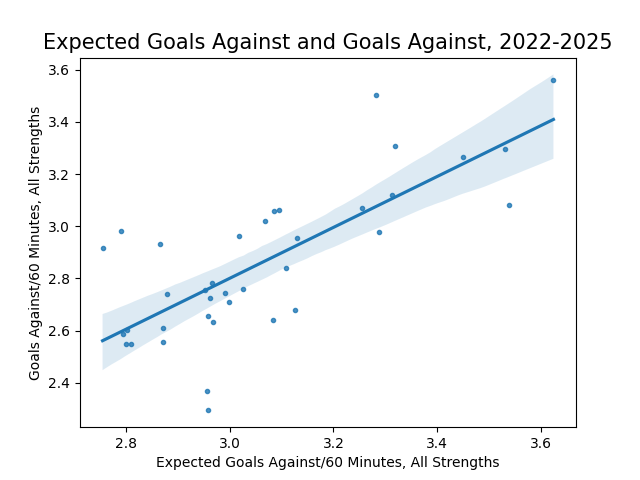
Again, there is a fair bit of variation among the individual results, but a higher expected goals against rate led to a higher goals against rate. In fact, no goalie with an xGA/60 of 3.2 or higher had a goals against rate of 2.9 or lower. Conversely, no goalie with an expected goals against rate below 3.0 had an actual goals against rate above 3.0.
Knowing how important expected goals against are for a goalie's ratio stats, and that expected goals against are largely controlled by the skaters in front of him, this is why the focus should be more on the team around the goalie than the goalie himself. Projecting how a team will do defensively in 2025-26 is different from correlating data from prior seasons is a different story, but it points us in the right direction.
Related Posts




Starting Goalies












Top Skater Views
 T.B
 OTT




Top Goalie Profile Views
| Players | Team | |
|---|---|---|
| NICO DAWS |
 WPG | |
| CONNOR HELLEBUYCK |
 N.J | |
| DEVON LEVI |
 EDM | |
| STUART SKINNER |
WPG | |
| JACOB FOWLER |
 MTL | |
LINE COMBOS
| Frequency |
 CGY Players | |
|---|---|---|
| 16.8 | BRENNAN OTHMANN ADAM KLAPKA JONATHAN CASTAGNA | |
| 15.5 | RYAN STROME MARTIN POSPISIL MATVEI GRIDIN | |
| 12.3 | BEN JONES JOEL FARABEE MATT CORONATO | |
DobberHockey Podcasts

Keeping Karlsson: Matchup Maximizer 2026/27 Week 5
Jeremy takes a look at the schedule for the upcoming weeks of NHL action and recommends players with good schedules that you should consider streaming in to win your head to head matchups.
Keeping Karlsson: Short Shifts – Injuries, Outjuries, and Duds
Elan talks about all the latest injuries, outjuries, big performances and duds over a tight 20 minutes in this week’s episode of Short Shifts.
Keeping Karlsson: Never Tell Me the Podz
Elan and Brian do a wellness check on the Maple Leafs, lament Chicago and Buffalo snoozers, wonder whether and which Flyers have figured it out, and pick out the Capital standing out from the crowd.

Fantasy Hockey Life: Ep 505 Prospects With Plenty to Prove Part 1
Victor and Jesse return to talk about prospects with plenty to prove. This week it’s: Tij Iginla, Berkly Catton, Konsta Helenius, Zayne Parekh, Igor Chernyshov, Jett Luchanko, Axel Sandin-Pellikka, Artyom Levshunov, Michael Hage, and Carter Bear. Have a listen! Our show is part of the Dobber Podcast Network and sponsored by Fantrax.com. Email [email protected] and […]
Keeping Karlsson: Matchup Maximizer 2026/27 Week 4
Elan takes a look at the schedule for the upcoming weeks of NHL action and recommends players with good schedules that you should consider streaming in to win your head to head matchups.