

Ramblings: Finding the Next Dylan Holloway For This Fantasy Hockey Season – August 21
Michael Clifford
2025-08-21
The Colorado Avalanche signed winger Victor Olofsson to a one-year deal. He had 15 goals and 29 points in 56 games for Vegas last season and gives the Avalanche a bit more scoring depth. With Gabriel Landeskog, Martin Necas, Valeri Nichushkin, and Artturi Lehkonen around, the top four winger spots are spoken for and there's no room on the top PP unit. That is when everyone is healthy or not suspended, though, and Olofsson has as good a chance of any to find some fantasy value here and there when those eventual injuries do crop up.
*
My next two Ramblings covering today and tomorrow are going to be connected to one I did a couple weeks ago but each have different themes. Two weeks ago, it was about finding The Next Zach Werenski for fantasy hockey. Today, we are going to be looking for The Next Dylan Holloway.
We are looking at forwards under 26 years old who have played at least two years in the league in lesser roles, and though they have shown improvements, they haven't had a true breakout yet. In 2023-24, Holloway saw a 78% increase in 5-on-5 goal rate compared to 2022-23, a 43% increase in shot rate, and had a solid playoff run in a small role. The signs were there, and though I'm confident no one saw his 26-goal, 63-point season coming, he represents the kind of bet fantasy managers should make 300-400 picks into a deep fantasy draft.
We are going to be using data from Evolving Hockey and Frozen Tools unless otherwise indicated.
Zach Benson (Buffalo Sabres)
This is kind of cheating because Benson was a highly-touted prospect who has played two full NHL seasons as a teenager, but it sure feels as if he's on the cusp of that breakout: With J.J. Peterka gone, there is a need for a left-shot top-6 winger in Buffalo's forward group, and the Sabres didn't add anyone in the offseason to fill that specific role. They might move Jiri Kulich to the left side, but other than that, the only real threat for a top-6, left-wing role is Jason Zucker. There is a real opportunity here for Benson.
According to Evolving Hockey, Benson improved both his actual goals-for driving at even strength last year as well as his expected goals-for driving:

On top of those goal/expected goal-driving metrics, Benson's primary assist rate at 5-on-5 was 0.86, an improvement from the year before (0.68), and higher than names like Jack Hughes (0.82), Matvei Michkov (0.82), and Nick Suzuki (0.81). Over his first two seasons, Benson's primary assist rate at 5-on-5 is 0.77, which is a mid-tier first-line rate in line with names like Mats Zuccarello and Andrei Svechnikov.
On top of the playmaking is Benson's shooting efficiency. In 2024-25, he required just a shade over 13 shot attempts for every expected goal generated at 5-on-5. As a rookie in 2023-24, that number was 12.3 attempts for every expected goal. Going back to 2007, here are all the forwards with seasons as a teenager where they averaged fewer than 14 shot attempts per expected goal generated:
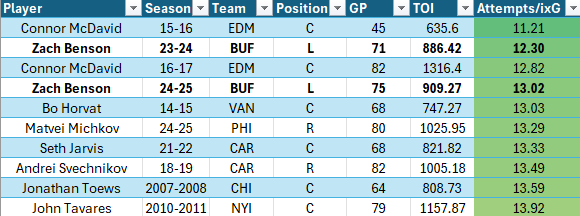
Benson is on that list twice. Half the seasons are from future Hall of Famers in Connor McDavid, Jonathan Toews, and John Tavares, and the 'worst' player there is probably Bo Horvat, who has three 30-goal seasons and five 25-goal seasons before the age of 30.
One reason I believe Buffalo was fine letting Peterka go in a trade for Josh Doan and Michael Kesselring is they think Benson is ready to take that next step forward. We have to remember he just turned 20 years old in May, but Benson has been tremendous at his age, and just good in general, his entire career thus far. Top power-play time might be hard to come by, but things are lining up for Benson to see a much bigger role in 2025-26, pushing for 20 goals and 50 points.
Lukas Reichel (Chicago Blackhawks)
Reichel is in the final year of his bridge deal with Chicago. He has seen his ice time decrease each of the last two seasons, but that would belie the fact that between 2023-24 and 2024-25, Reichel, like Benson, saw improvements in both his goals-for driving and his expected goals-for driving at even strength. Unlike Benson, Reichel also saw an improvement in his individual 5-on-5 goal rate:

To be clear, the overall numbers still aren't good, but they did get a lot better, and big improvements are better than big declines.
Another key for Reichel is that after an abysmally bad defensive season in 2023-24 – Evolving Hockey had him with the fifth-worst expected goal prevention ability among all regular forwards – he had a much better year in 2024-25. In fact, of the players with the largest expected goals against improvement compared to 2023-24, he was one of a handful that also had a large improvement in actual goals against:
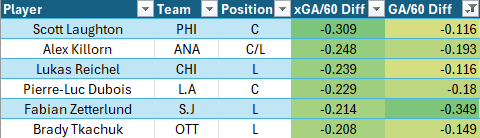
There is a lot of tracking data that shows Reichel has great puck skills, but he hasn't put it all together just yet. Given all the improvements he saw in a lot of key areas last season, it's a wonder if he's started to put it together. His leash in Chicago is pretty short now, but it feels as if he's on the cusp of a breakout. Just beware that with the Blackhawks likely to struggle offensively again, even if Reichel keeps getting better in 2025-26, he won't reach Holloway levels yet.
Tye Kartye (Seattle Kraken)
Neither Benson nor Reichel are truly in the vein of Dylan Holloway because they don't hit anywhere near as much: Benson and Reichel have averaged 36 and 31 hits, respectively, every 82 games over the last two seasons, whereas Holloway averaged 160 hits every 82 games in Edmonton. That physicality is what elevated Holloway from just a good breakout year to a high-end multi-cat fantasy option.
This is where Kartye comes in. He has 404 career hits in 140 career NHL games, averaging 237 every 82 games, and doing so while skating under 11 minutes a game. On a per-minute basis, Kartye is a top-20 forward by 5-on-5 hit rate over the last two years, and when looking at all the forwards inside the 95th percentile by hit rate at 5-on-5 in that span, here are the comparable forwards to Kartye by goals, shots, and expected goals per 60 minutes:

Kiefer Sherwood hits a lot more, Will Cuylle has a much better expected goals rate, but there is a clear kinship between the three of them. Both Sherwood and Cuylle were tremendously impactful banger league options in 2024-25, and Kartye may be the next man up for 2025-26.
It isn't just the similar production to make note of here. Kartye did see an improvement in his goal-driving and expected goal-driving at even strength in 2024-25 compared to his rookie year:

The goal-driving is a small improvement, and the expected goal-driving improvement is good-not-great, but just getting better is a nice sign.
What is keeping Kartye back from having a real Holloway-like breakout is his role. Last year, Seattle had 13 forwards play at least 30 games and Kartye was last by both share of even-strength time and power-play time. Going from basically the 13th forward to top-6 minutes with meaningful power play time would be a huge leap. What works in his favour is that it isn't as if Seattle has a lot of high-end winger depth, and if Kartye does take a big step in his development, it isn't hard to see him going from the 13th forward to the middle of the roster. Unless Seattle gets way better, even a big year from Kartye won't mean 25 goals and 60 points, but a big rebound is very possible, and any sizeable rebound, with his hit rates, will make him an extremely valuable multi-cat forward.
David Gustafsson (Winnipeg Jets)
This is our longest shot, but he is worth highlighting because Winnipeg still doesn't have a reliable middle-6 centre to pair with Adam Lowry. They are hoping it can be Jonathan Toews, but he is a huge question mark. They could try Morgan Barron, but Gustafsson is at least in the mix.
It was a tough year for Gustafsson in 2024-25 as he started the season injured, couldn't crack the lineup when he got healthy, suffered a concussion in December, and played just four playoff games. Overall, he played just 40 total games last season, totaling three goals and 11 points.
The sample of young forwards I'm using has 107 names on it. Of those 107 forwards, there nine who were in the top-25 for improvements in both goals-for driving and expected goals-for driving at even strength between 2023-24 and 2024-25. These are those nine forwards:
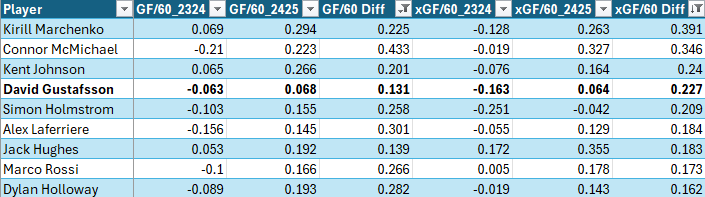
There are a handful of high-skill players that aren't really Gustafsson comps in Kirill Marchenko, Connor McMichael, Kent Johnson, Jack Hughes, and Marco Rossi, and there are a couple banger options like Alex Laferriere and our titular Dylan Holloway. And there is also Gustafsson, which is why there should be some hope that he can have a real breakout.
On top of the metrics improving, Gustafsson's rates of shot attempts, shots on goal, and individual expected goals increased by 20%, 21%, and 49%, respectively. Things got a lot better for Gustafsson in 2024-25, albeit in a half-season sample because of the injuries. He isn't nearly as physical as Holloway, but some kind of third line/second PP role might be enough to push him to 70 hits in a full year.
I don't think this is a situation where Gustafsson blows the doors off in training camp and is on Cole Perfetti's line out of the gate. The Jets will give Toews plenty of time to try and prove he can play a middle-6 role, they still have Mark Scheifele at the top of the lineup, and Lowry is the team's dependable two-way pivot. But if Toews can't contribute to a middle-6 scoring role and the calendar turns to December, maybe they give Gustafsson a shot in a bigger role. A lot of things have to go right for Gustafsson to have a meaningful fantasy season, and I think the best-case scenario is an early-season lull followed by a surge after the American Thanksgiving holiday, but the pieces are here for it to happen, and that's not nothing.
Related Posts
Starting Goalies









Top Skater Views
 SEA
SEA S.J
S.J DET
DET


Top Goalie Profile Views
| Players | Team | |
|---|---|---|
| DYLAN GARAND |
 NYR NYR | |
| JACOB FOWLER |
 MTL MTL | |
| IGOR SHESTERKIN |
NYR | |
| JOEL HOFER |
 STL STL | |
| SERGEI MURASHOV |
 PIT PIT
| |
LINE COMBOS
| Frequency |
 MIN Players MIN Players
| |
|---|---|---|
| 31.2 | KIRILL KAPRIZOV JOEL ERIKSSON EK MATT BOLDY | |
| 19.7 | MAXIM SHABANOV RYAN HARTMAN BLAKE COLEMAN | |
| 14.7 | DANILA YUROV RIEGER LORENZ BOBBY BRINK | |
DobberHockey Podcasts

Keeping Karlsson: Matchup Maximizer 2026/27 Week 3
Elan takes a look at the schedule for the upcoming weeks of NHL action and recommends players with good schedules that you should consider streaming in to win your head to head matchups.
Keeping Karlsson: Short Shifts – Sharks Looked Like Celebweenies
Elan recaps the major injuries, outjuries, game results and changed line combos that we’ve seen since Sunday’s mega-show.
Keeping Karlsson: Cole, There’s No Time!
Elan and Brian cover all the action from the first week of the NHL season, and identify our earliest must-adds, can-drops, sell highs and buy lows in your fantasy hockey leagues.
Keeping Karlsson: Matchup Maximizer 2026/27 Week 2
Elan takes a look at the schedule for the upcoming weeks of NHL action and recommends players with good schedules that you should consider streaming in to win your head to head matchups.

Fantasy Hockey Life: Tidy Takes Part 1
TiDy Admiral Ryan Downey and Victor Nuno break down recent trades in the FHL Tiered Dynasty’s top division, the Lord Stanley division. Tune in to consider trades between some of the best dynasty sharks we know, including patron polls on the trades and Victor’s analysis. Have a listen! Our show is part of the Dobber […]