

21 Fantasy Hockey Rambles
Dobber Sports
2025-11-16
Every Sunday, we share 21 Fantasy Rambles from our writers at DobberHockey. These thoughts are curated from the past week’s 'Daily Ramblings'.
Writers/Editors: Ian Gooding, Michael Clifford, Alexander MacLean, Puneet Sharma, and Dobber
—
1. As everyone is aware by now, the new wave of scorers is here, with Leo Carlsson, Connor Bedard, and Macklin Celebrini leading the way. Each of them are top-two picks from the three most recent drafts, and they have the skill and pedigree to put up some incredible numbers for the next decade. The fun part now is knowing how much is too much to pay for them, and also who they are going to bring along on their ascent to the top of the scoring leaderboard. (nov12)
For the first point, I own Celebrini in a shallow keeper league, and have turned down both Nikita Kucherov, and Jack Eichel for him in one-for-one offers. They were close, they were tempting, and they were just not quite enough!
In another league, which is a full redraft, I did move Leon Draisaitl and Anze Kopitar for Leo Carlsson, Filip Forsberg, and Timo Meier. Was this an overpay? Perhaps. It’s also not my most serious league, and I’m going to have more fun with those three guys on my roster than Draisaitl and Kopitar (and Rasmus Andersson who was my drop), who left me lacking in the Shots and Hits columns. If the scoring keeps up for Carlsson, then I’ll call it a fair trade. If it drops off, then I lose it by a little, but not by a landslide. (nov12)
2. Looking under the hood on all three youngsters, Carlsson’s only real red flag is the shooting percentage, which was double that of an average player, and at least 1.5 times that of the top snipers at time of writing. If we take off a third of Carlsson’s goals, then he was still at 22 points in 16 games, which would be a fantastic start to the year, and if we adjust it down a touch more to account for the high team shooting percentage, then we could still see him score at a 100-point pace for the rest of the season.
Bedard’s underlying numbers look similar to Carlsson’s in that the shooting percentage binge is driving his on-ice shooting percentage numbers up, which is the only major red flag for him. A slight regression, but he should be able to keep up a heavy scoring pace.
Unfortunately for Celebrini, he looks like the one of the three that could drop the most. His shooting percentage was at 20%, but his IPPs and on-ice shooting percentage were higher than Bedard and Carlsson, meaning there’s more room to drop. Celebrini is shooting less than last season, which does leave him some room either to bump the shot rate back up and keep the scoring more by volume than efficiency, or it could be a sign that he is picking his shots better and the higher shooting percentage is more sustainable. (nov12)
3. Should Carlsson be considered in that Celebrini/Bedard tier, or will he cool off? His advanced stats entering Saturday (23.5 SH%, 11.5 5on5 SH%, 4.8 PTS/60) show some degree of regression should surface. However, Carlsson is showing increases in other indicators of potential improvement.
Compared to last season, he’s up more than a full shot per game, averages almost three minutes more, and is clearly cemented on the top power play. He’s clearly a better player this season – just not a player that will continue at a 125-point pace. Do with that what you will in single-season leagues. I don’t think he’s in the Celebrini/Bedard tier, but we’ll find out over time. He’s a fine player though. (nov9)
4. Either way, if I had to project the scoring for each of Bedard, Celebrini, and Carlsson in the remaining 60-odd games this year, it would be something along the lines of (at time of writing):
– Bedard: 80 points in 60 games to finish at 105 points in 76 games.
– Carlsson 75 points in 60 games to finish at 101 points in 76 games.
– Celebrini: 65-70 points in 60 games to finish at about 93 points in 77 games. (nov12)
5. Some injury news, since we can’t get enough of it with this season’s condensed schedule. Filed under the weird and bizarre category, Jack Hughes reportedly suffered a cut to his hand at a team dinner and missed Saturday’s game against Washington as a result. (nov15)
(Update: Well, what can you say about Jack Hughes. With the news that he will miss eight weeks following finger surgery, you can dock at least 20 games again from him for the third consecutive season. The fact that this was not even an injury from a game or even practice this time around (a team dinner!) is truly awful luck. His reputation of finding new and inventive ways to get injured will be tough to shake, and a reason that he will fall down draft boards next season. Follow the link for more… (nov16)
Hughes is a certified Band-Aid Boy, as his injury issues throughout his career have been well documented. Hughes has missed a total of 40 games over the past two seasons, which is why he was projected for 67 games played in this season’s fantasy guide. We might have to bet the under on that now.
Alex Newhook will be sidelined for the next four months following surgery to repair a fractured ankle. This is a tough break (literally) for the Habs and Newhook, who is off to a great start with 12 points in 17 games. Newhook had been enjoying his success on a line with rookies Ivan Demidov and Oliver Kapanen, all of whom are over the 0.5 PT/GP mark. Jared Davidson, who has 31 goals and 56 points in 82 AHL games over the past two seasons, has been recalled from the AHL in a corresponding move. The Canadiens are also believed to be in the mix for David Kampf, whose contract with the Leafs has been terminated.
The Canadiens also announced that Kaiden Guhle will miss another 8-10 weeks following surgery to repair a partially torn adductor muscle. Guhle is already a Band-Aid Boy Trainee and may reach Certified status once the next Band-Aid Boy Review takes place next offseason. (nov15)
6. Elsewhere, Marco Rossi is currently listed as week-to-week with a lower-body injury. With an opening at the center position, Danila Yurov could move up in the lineup. (nov15)
Jiri Kulich got some very bad news, as Coach Lindy Ruff said he will miss significant time because of a blood clot. Hopefully he can get this under control and return to normal in the coming months. We shouldn’t expect him to return to the ice this season until well into 2026, if at all. (nov11)
We also got an update on Valeri Nichushkin: though he’s week-to-week, coach Bednar doesn’t think this is something too serious. Nichushkin had five goals and 12 points in 17 games before the injury, and Gavin Brindley took his spot on the second line on Thursday night. That is a great opportunity for Brindley to continue impressing after a solid start in the bottom-6. In Brindley’s first game on the Brock Nelson line, he had a goal, an assist, two shots, and two hits in 13:02 of ice time. After posting one point in his first 10 games, Brindley was up to six points in his last six games (before Saturday action). (nov14)
7. Going into the season, one of the biggest stories for the Vancouver Canucks revolved around the health of goaltender Thatcher Demko. He missed a large chunk of the 2024-25 season and looked to be ready to go in 2025-26, but after missing games last weekend, and leaving Tuesday night’s game after the first period, he is back on the injured list, according to Frank Seravalli. He is going to miss at least a couple of weeks and while the team is saying it’s not related to any prior injury, they have been very secretive about Demko’s health status this season in general, so take everything they say with a Hope Diamond-sized grain of salt. (nov13)
8. Ottawa Senators forward Shane Pinto has signed a four-year contract extension. The new deal has a $7.5-million average annual value and will carry Pinto until his age-30 season when he’ll be able to sign another contract, supposing that this one goes well.
As long as Pinto keeps doing anything close to what he’s doing now, which is nine goals, six assists, 47 shots, 13 blocks, and 16 hits in 17 games (entering Saturday), that extension will play just fine in multi-cat salary cap leagues. He is also averaging seven faceoff wins per game, which isn’t a huge number, but was inside the top-50 forwards among those with over 60 faceoff wins overall. That gives him an added boost for leagues that count FOWs. (nov14)
9. Colorado Avalanche defenceman Samuel Girard was in action on Thursday night, his first game in five weeks after suffering an upper-body injury. He generally doesn’t have a lot of multi-cat fantasy value – 82-game pace of 26 points, 104 shots, 130 blocks, and 86 hits over the last 2.3 seasons – but when he’s at his best, he’s very good defensively and that helps a Colorado team that is already among the best defensively in the league. In other words, this is good news for MacKenzie Blackwood and Scott Wedgewood. In Girard’s first game of the season he had an assist, a shot, and a block in 16:54 of ice time. (nov14)
10. In one of the more unlikely fantasy performances we’ll see this season, Simon Nemec recorded a hat trick (!), including the overtime winner, to lift the New Jersey Devils to a 4-3 win over the Chicago Blackhawks last Wednesday. Nemec finished that game with five shots in 26:27 of ice time, trailing only Luke Hughes‘ 26:48. Entering Saturday, Nemec had 12 even-strength points on the season, tying him for third in the NHL among blueliners. Overall: 12 points in 17 games with 27 blocks. (nov13)
11. Looking at the Predators for a minute, Steven Stamkos‘ underlying numbers are screaming buy-low. While he is turning 36 soon, that doesn’t mean there’s absolutely nothing left in the tank. The holding might be painful for a little while longer, and it might only be a bounce back to a 50-point-pace, but the bounces are coming. (nov12)
12. The scoring leaderboard for defensemen is something to behold. There’s Cale Makar at 24 points (entering Saturday), Miro Heiskanen and Josh Morrissey at 17. It’s a tribute to Makar and just how dominant he is on both the ice and the scoresheet, but it’s also interesting to see Heiskanen this high after a slow start from him. He had two points in his first seven games, but then something clicked and he has 15 points in nine games. This current scoring rate is back in the range he put up from 2022-2024, and is making last season’s dip look like an aberration. It’s also not the best result for Thomas Harley, who has been stuck with second power play minutes thus far. (nov12)
13. We had some NHL debuts for Gabe Perreault and Nate Danielson. Perreault was up on the top line with Mika Zibanejad and J.T. Miller, and notched a power play assist in 14 minutes of ice time. He could be worth a look for those of you in non-keeper leagues and in need of some added offence.
For Danielson, he’s likely not going to make an immediate fantasy impact, though playing as the third-line centre, he did manage four shots and an even rating despite the Wings losing 5-1 to Chicago. (nov12)
14. Jet Greaves was one of the most popular goalie breakout picks in the offseason, but thus far he hasn’t really been able to outplay the incumbent Elvis Merzlikins, who has been about average for him thus far through his career. His save percentage is up, though his GAA hovers around 3.00, which tells you that Columbus hasn’t been as stout defensively thus far, and that Merzlikins (and Greaves to a slightly lesser extent) have seen more shots against than they were last season.
Greaves started the season opener, but the two netminders have been alternating to this point in the season. Expect that to continue (which makes projecting a starter a few games out much easier if you’re looking at streaming), at least in the shorter term, or until we see an injury. Ivan Fedotov has been solid at the AHL level so far and shouldn’t be forgotten about either. (nov12)
15. Still worried about Brandon Hagel? Don’t be. After registering a single point in his first seven games, Hagel has heated up with 13 points in his last nine games (entering Saturday). Hagel’s power-play time isn’t quite where it could ideally be, but he has been an extremely strong 5-on-5 scorer throughout his career with a career high of 13 power-play points. (nov9)
16. With how quickly shot volume has changed in the NHL, from between 30 and 32 shots per team per game in each 82-game season from 2016-17 through 2023-24 to under 28 shots per team per game this season, it is concerning when we see a player who should be piling up the shot totals not doing so. We don’t always need to panic, but sometimes we do, so it’s worth going over which players we should absolutely have concerns about.
To do this, we are going to look at the market share of shot attempts, or how many shot attempts an individual player is taking as a percentage of their team’s shot attempts when they’re on the ice, compared to last year. So, if a forward has been on the ice for 200 shot attempts, and they’ve taken 50 of them, their market share is 25%. It helps identify which players are the real shot-volume kings on their teams and which might be supported for other reasons.
Data for this is from Natural Stat Trick and as of the morning of Monday, November 10. Players in the sample must have at least 150 minutes of ice time and this is at all strengths.
To start, I do want to highlight one player that is excelling here and it’s Tage Thompson:
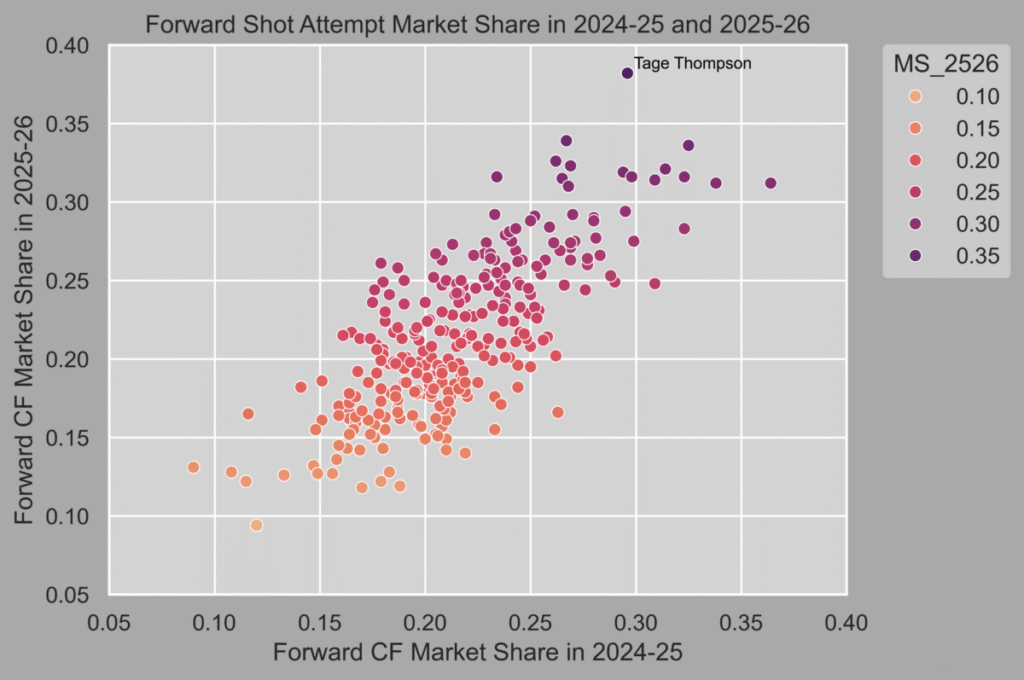
We know Tage has been shooting a lot, but it’s truly preposterous when stacked against the rest of the league: he is taking 38.2% of the shot attempts when he’s on the ice, no other forward in the league is over 34%, and only two (Alex DeBrincat and David Pastrnak) are over 33%. Thompson’s previous career-best rate was 31.5% back in his breakout 2021-22 season, so staying at this level would truly be otherworldly for him. Nonetheless, he is very much in line for at least 30 more goals from here on out. (nov11)
[Follow the link for more…]
17. “Goaltending is voodoo”. It is one of the most famous phrases to come out of the online hockey analyst community in the near-15 years that I’ve been doing this, and it’s hard to disagree. Very few goalies are great year after year, sometimes goalies we thought weren’t very good have a tremendous season (Darcy Kuemper in 2024-25 comes to mind), and it can be very frustrating for fantasy managers.
Often, the best we can do in the preseason is target goalies on good teams, or goalies on improving teams, and hope they’re 2024-25 Sergei Bobrovsky and not 2024-25 Stuart Skinner. After that, it’s in the hands of the hockey gods.
One thing worth looking at is shot distance faced. That can be found both in our Frozen Tools as well as Natural Stat Trick. There is a caveat here: shot distance appears to have one specific use-case and that’s looking for goalies with the longest average shot distance. The reason for that is that when looking at goalies from 2021-2025 that had at least 2000 minutes played in a season – it generally gives us 30-35 goalies a year – the correlation between shot distance and save percentage is very low (yellow box) but the p-value (light-blue box) is also very low:
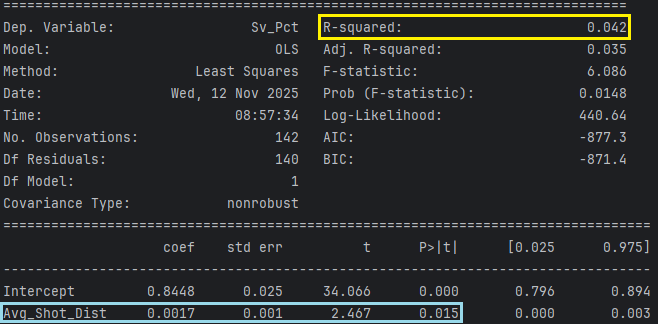
In short, this tells us that while the single-season correlation between shot distance and save percentage is minimal, it is very unlikely that the save percentages results from the shot distance are random chance. There is something here.
18. To visualize what the low correlation looks like, here are 142 goalie seasons in the 2021-2025 sample:
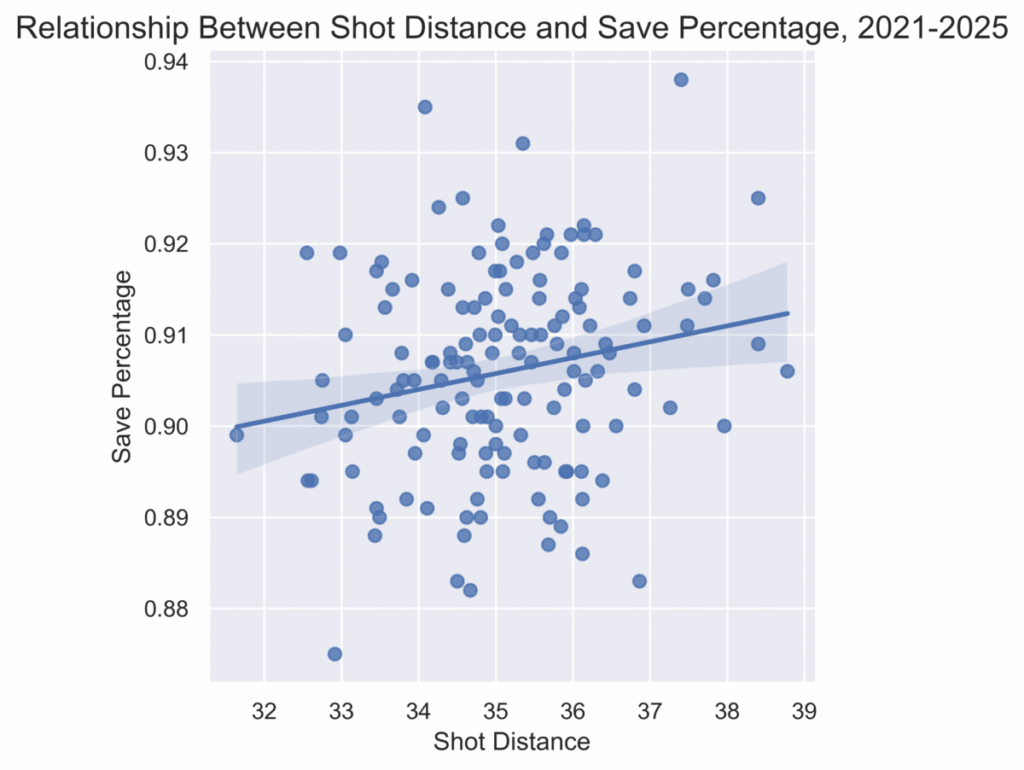
We can see that there is an upward slope, which means that, in general, a further shot distance gives us higher save percentages, but there is variance when looking at individual goalie seasons.
But this is where I think it can be valuable: the goalies facing extremely far shot distances. If we look at just the goalies with an average shot distance one standard deviation above average, we have the goalie seasons with the 23 furthest shot distances. This is the same plot with those 23 goalies and their save percentages:
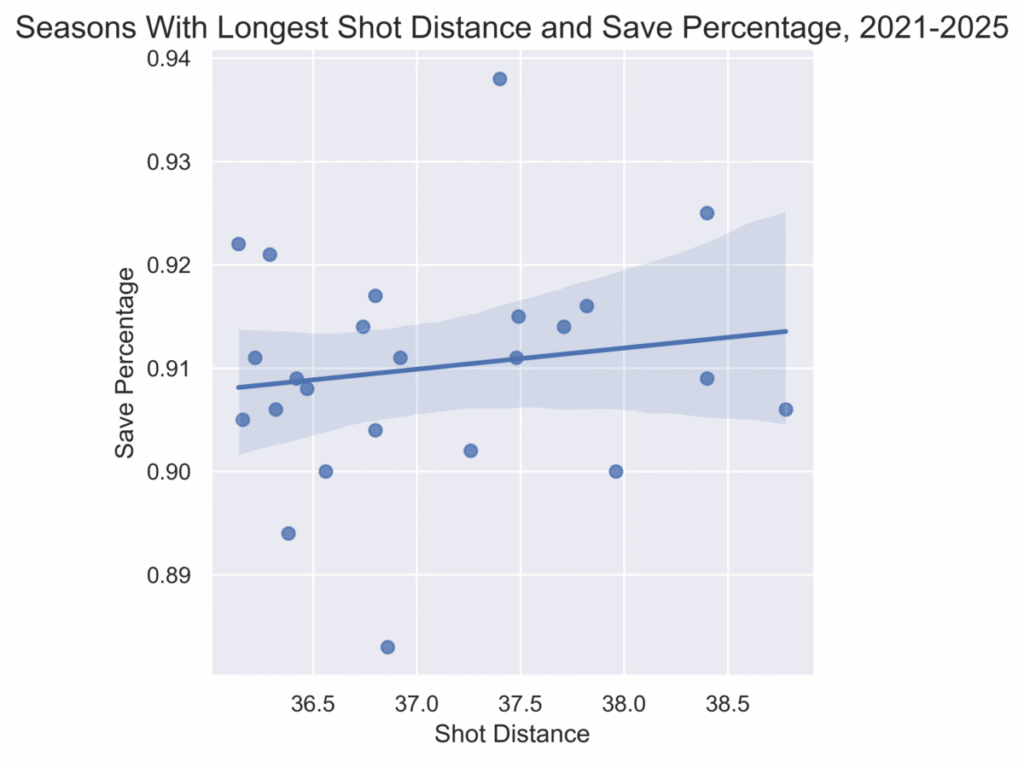
Out of those 23 goalie seasons with at least 2000 minutes and average shot distance faced of 36.15 feet or longer, just two of them (Samuel Ersson and Alex Nedeljkovic in 2024-25) finished their campaign with a save percentage under .900. The other 21 goalies finished the year with a save percentage of .900 or better, and they averaged .912.
This is one of those things that makes intuitive sense. The further the shot, the more time the goalie has to react to the shot, and the more likely they will be to make the save. Once we get down from the extreme long distances there is a lot of randomness and team effects that come into play, but it does seem as if the goalies with the long shot distances generally stand a very good chance of having a solid-to-great performance.
19. That brings us to the 2025-26 season. We are still early-ish, but 20% of the season is behind us. At some point, we have to stop saying “it’s still early” and make some decisions. I am going to use a low ice-time cutoff of 250 minutes to try and get in some goalies who may be heading for positive regression, but here are a few goalies with long shot distances we need to (re)consider.
(At time of writing:)
Jordan Binnington (St. Louis Blues)
The goalie with the longest average shot distance in the NHL is Jake Oettinger in Dallas. The goalie with the second-longest average shot distance in the NHL is Binnington:

Binnington has been one of the worst goalies in the league to start this year with an .872 save percentage in 12 games but recently had a great outing at home to the Calgary Flames with 38 saves on 40 shots. It is also worth pointing out that in his first 11 games last year, Binnington had an .886 save percentage and then from Game 12 onward he posted a .904 save percentage. Not elite, but above average, and serviceable for fantasy. It may be hard to trust him right now, but if the Blues can keep up this kind of defensive performance in front of him, his numbers are only going to get better.
20. Alex Lyon (Buffalo Sabres)
A big problem for Lyon right now is the Sabres have three goalies on the roster and potentially being part of a three-goalie rotation on a non-playoff team is just about the definition of a fantasy headache. All the same, he is 1 of 4 goalies with an average shot distance faced of at least 37 feet:
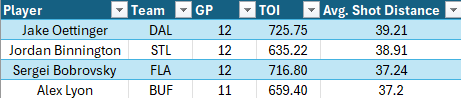
The key here is that in Ukko-Pekka Luukkonen‘s three games, UPL has an average shot distance faced of 39.6 feet, so it does seem as if the Buffalo defence has improved compared to last year. It seems unlikely that the Sabres run a three-goalie rotation all year, so whether Colten Ellis gets demoted or one of UPL/Lyon gets traded, whomever is left over may have some solid fantasy value over the next 60-some games. Or they should, if the Sabres can ever get-and-stay healthy.
21. Dustin Wolf (Calgary Flames)
There is a double-edged sword with Wolf this season. The good news is that he’s facing the sixth-furthest average shot distance of any goalie in our sample at 36.7 feet:
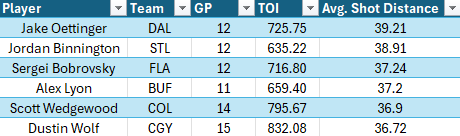
After a very tough start, Wolf has a .912 save percentage with a 2.71 goals against average in his last 10 starts. Those are very good ratios and are more like what we expected from him when doing our season-long drafts.
The bad news is that Calgary can’t score. Despite a .912 save percentage and a 2.71 GAA in those 10 starts – both better than league average, the former by a lot – he has just three wins in those 10 starts, Calgary has scored 24 goals, and are a distant last in goals scored per 60 minutes this season. Wolf could perform as a top-10 goalie and lose over half his starts because his team can’t score. A long shot distance faced is nice, and the ratios should stabilize with that kind of performance, but if the team can’t score, he won’t rack up wins. (nov13)
[Follow the link for more…]
—
Have a good week, folks!
Thanks for continuing to support the website and if you’re bored and need a fantasy hockey fix – visit the gang in the forum here.
Related Posts
Starting Goalies







Top Skater Views
| Players | Team | |
|---|---|---|
| JACK QUINN |
 BUF BUF | |
| MASON MCTAVISH |
 STL STL | |
| T.J. HUGHES |
 COL COL | |
| QUINTON BYFIELD |
 L.A L.A | |
| FRASER MINTEN |
 BOS BOS
| |
Top Goalie Profile Views
| Players | Team | |
|---|---|---|
| JACOB FOWLER |
 MTL MTL | |
| SERGEI MURASHOV |
 PIT PIT | |
| DYLAN GARAND |
 NYR NYR | |
| CARTER HART |
 VGK VGK | |
| ARTURS SILOVS |
PIT
| |
LINE COMBOS
| Frequency |
PIT Players
| |
|---|---|---|
| 29.4 | BRYAN RUST RICKARD RAKELL SIDNEY CROSBY | |
| 20.3 | NICK ROBERTSON ANDREI KUZMENKO BEN KINDEL | |
| 19.6 | TOMMY NOVAK EVGENI MALKIN VILLE KOIVUNEN | |
DobberHockey Podcasts

Keeping Karlsson: Short Shifts – NHL Frozen Frenzy Recap
Elan and Lewis recap the Frozen Frenzy as well as two big returns and more!
Keeping Karlsson: Delusions of Garandeur
Elan and Brian dive into the latest NHL hot streaks, cold streaks, line changes, outjuries, injuries, buy-lows and sell-highs to give you top notch tips in your fantasy hockey league

Fantasy Hockey Life: TiDy Takes Part 2
Last week, Victor Nuno and Ryan Downey broke down trades from our top tier dynasty league. This week, they consider some dynasty trades from other divisions. Have a listen! Our show is part of the Dobber Podcast Network and sponsored by Fantrax.com. Email [email protected] and ask to join our free discord. Join our Patreon at […]
Keeping Karlsson: Matchup Maximizer 2026/27 Week 3
Elan takes a look at the schedule for the upcoming weeks of NHL action and recommends players with good schedules that you should consider streaming in to win your head to head matchups.
Keeping Karlsson: Short Shifts – Sharks Looked Like Celebweenies
Elan recaps the major injuries, outjuries, game results and changed line combos that we’ve seen since Sunday’s mega-show.