

The Journey: U20WJC Top Players Who Helped or Hurt Their Stock Most
Victor Nuno
2026-01-10
Welcome back to The Journey, where we track how prospect development curves translate into real fantasy relevance. The World Junior Championship is often remembered for its headline names and highlight plays, but its real evaluative value lies in how players handle pressure, responsibility, and high-leverage minutes against their elite peer group. This tournament produced clear movers in both directions. Some prospects elevated their trajectory, others largely met expectations, and a few failed to capitalize on a prime opportunity. Below is a breakdown of how the top names entering the event impacted their long-term outlooks.
Stock Up
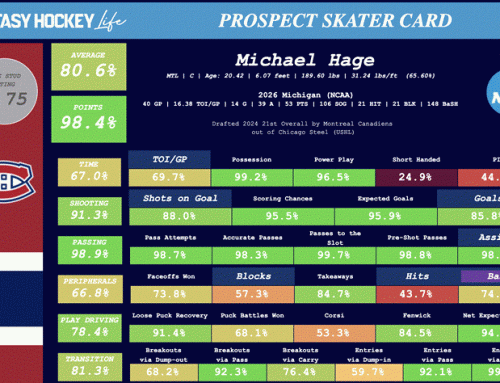
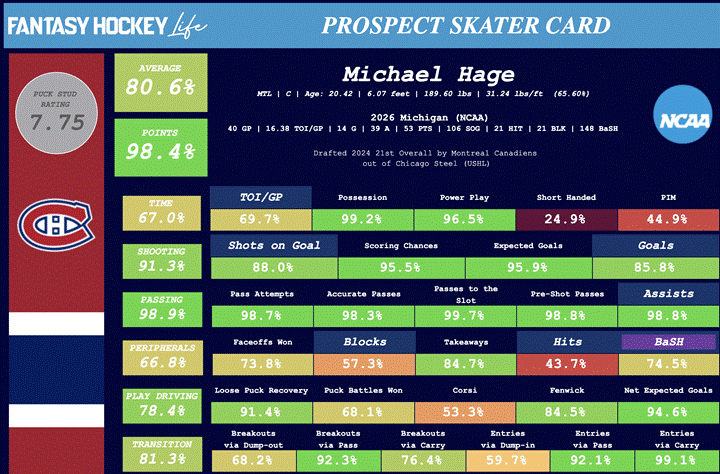
Michael Hage, F, Canada (Montreal Canadiens)
Hage finished as the tournament's leading scorer with 15 points, recording two goals and 13 assists while driving Canada's offense in all situations. He consistently dictated play with his vision and puck distribution, serving as a primary facilitator on the power play and in transition. He was named one of the tournament's Top Forwards, recognition that reflected both his elite production and his reliability in high-leverage minutes. While he still projects as a middle-six pivot at the NHL level, this performance continues to push his outlook toward a true second-line center rather than a depth third-line option, reinforcing his long-term offensive projection as a high-end producer when games tighten and responsibility increases.
Gavin McKenna, F, Canada (Draft Eligible)
McKenna finished second in tournament scoring with 14 points, posting four goals and 10 assists while playing a central role in Canada's attack. His ability to control possession, win battles along the wall, and generate offense off the cycle stood out against top competition. The performance reinforced his standing as a premier draft-eligible forward and validated his projection as a foundational offensive piece with legitimate fantasy-driving upside rather than merely a complementary scorer. McKenna's tournament now places him fourth among Canadian draft-eligible performers historically, trailing only Connor Bedard, Eric Lindros, and John Tavares, an impressive benchmark by any measure.
However, when viewed directly against Ivar Stenberg in this event, the contrast was stark. Stenberg was relentless, impactful with and without the puck, and consistently difficult to play against, while McKenna was most noticeable primarily when the puck was on his stick. Based on this tournament alone, it is increasingly likely that Stenberg is the forward dynasty managers and scouts alike will ultimately covet most from this draft class.
Vojtěch Čihař, F, Czechia (Los Angeles Kings)
Čihař emerged as Czechia's offensive engine, finishing among the tournament's top scorers while driving play against elite competition. He combined pace, creativity, and strong situational awareness, delivering key goals and playmaking contributions throughout the medal round. He was named the tournament's Most Valuable Player (MVP), an honor that reflected not just his scoring, but his consistent ability to elevate his team in critical moments. This performance significantly boosted his draft-year momentum and strengthened his projection as a top-six forward with legitimate offensive-driving upside.
He may also have scored the goal of the tournament to put Czechia up 4–3 in a moment of pure individual skill. Canada eventually tied the game, Czechia regained the lead on a somewhat fluky goal to make it 5–4, and Čihař then sealed the win with an empty-netter. Given his impact across those decisive sequences, his MVP selection was thoroughly earned.
Tomas Galvas, D, Czechia (Draft Eligible, Overager)
Galvas recorded nine points and finished among the tournament's most productive defensemen, logging heavy minutes against top competition. He contributed consistently on the offensive side while holding his own defensively, showing poise, mobility, and improved decision-making under pressure. The performance strengthened his profile and elevated his dynasty appeal, particularly for managers targeting mobile blueliners who can support offense without being sheltered.
Galvas was one of the most noticeable players on the ice throughout the event, making an impact on nearly every shift and fully earning recognition as one of the tournament's top defensemen. It is increasingly difficult to justify how he went undrafted in 2025, and it would be surprising to see all 32 teams make that mistake again in 2026. While he may be undersized, his game translates, and if he earns an NHL role, he is exactly the type of defenseman fantasy managers will want on their roster.
Viggo Björck, F, Sweden (Draft Eligible)
Björck finished with nine points and was one of Sweden's most consistent possession drivers throughout the tournament. His transition play, puck protection, and ability to generate offense without needing prime deployment stood out. While not leading the scoring race, his overall impact reinforced his projection as a reliable middle-six forward with fantasy utility. Previously seen as a second day of the draft talent, it would be surprising to see him last past pick 20 at this point.
Love Härenstam, G, Sweden (St. Louis Blues)
Härenstam was outstanding throughout the tournament, backstopping Sweden to the gold medal with a calm, composed presence in net. He consistently delivered timely saves in high-pressure moments, tracking pucks well through traffic and showing strong rebound control against sustained zone time. His performance anchored Sweden's run and rightfully earned him Best Goalkeeper honors.
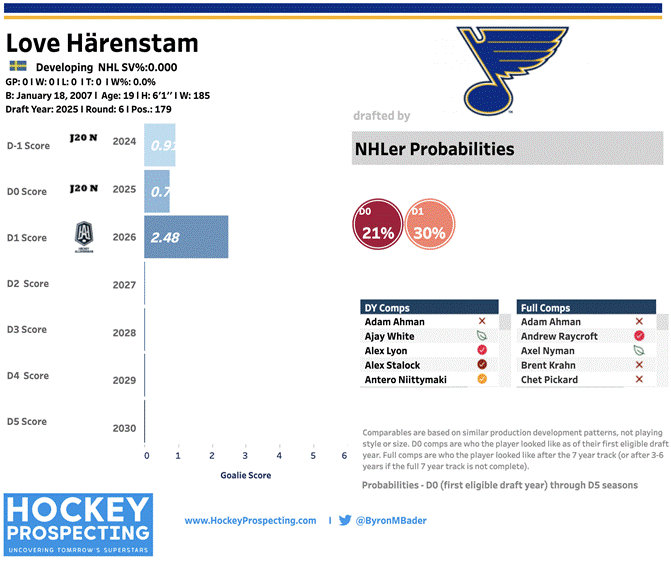
According to Hockey Prospecting, Härenstam currently carries roughly a 30% chance of becoming an NHLer, a figure that should rise following this showing. He looked like more than a simple backup projection, flashing traits consistent with a potential 1A or even starter-caliber goaltender, and a comparable such as Andrew Raycroft feels reasonable based on the poise, athleticism, and big-game effectiveness he displayed.
Aron Kiviharju, D, Finland (Minnesota Wild)
Kiviharju did not finish near the top of the scoring leaderboard, but his tournament was defined by poise and control in difficult matchups. He effectively managed breakouts, quarterbacked the power play, and handled pressure without forcing plays. This performance reinforced his projection as a future top-four defenseman whose fantasy value may be driven by usage and trust rather than raw point totals.
Neutral
Zayne Parekh, D, Canada (Calgary Flames)
Parekh finished the event with 13 points, recording five goals and eight assists to finish third overall in tournament scoring despite playing defense, consistently driving offense from the back end with confident activation and strong influence over pace and spacing. The tournament reinforced his projection as a high-impact offensive defenseman with legitimate top-pair, power-play-one fantasy upside, but the defensive side of his game remains a work in progress, as he often gave back nearly as much as he created through coverage lapses, high-risk decisions, or untimely penalties that led to goals against, at times making his overall impact harder to fully leverage despite the elite production.
Porter Martone, F, Canada (Philadelphia Flyers)
Martone finished with nine points, including six goals, and at times, found ways to impact games in the offensive zone, showing a strong ability to get to dangerous areas and convert chances, particularly in tight games where space was limited. However, while he was effective, he was not as dominant or influential as expected in several key moments, and although he did score the tying goal against Czechia, his line did not consistently deliver in the biggest situations. As a result, his high-end projection as a goal-driven fantasy asset with translatable scoring traits remains intact, but unchanged, placing him firmly in the neutral category.
Cole Eiserman, F, USA (New York Islanders)
Eiserman contributed offensively and flashed his elite shot throughout the tournament, but his overall production and impact largely matched pre-tournament expectations. The narrative on him remains unchanged: he can score big goals and owns a lethal release, but he still does not do enough away from the puck to materially shift his projection, leaving both his long-term development arc and fantasy outlook essentially unchanged.
Emil Hemming, F, Finland (Dallas Stars)
Hemming produced at a steady rate and remained effective around the net, with an overall influence that largely fell within pre-tournament expectations, making the event more confirmatory than accelerative for his projection. While his outlook is similar to Eiserman's, Hemming distinguished himself as the more complete player, showing stronger playmaking ability and a more consistent impact away from the puck.
Alberts Smits, D, Latvia (Draft Eligible)
Smits handled significant responsibility for Latvia and showed occasional offensive involvement, but his overall impact did not meaningfully exceed expectations, keeping his stock largely stable. The limited talent around him often forced Smits to try to do too much out of necessity, which made it harder for his individual strengths to stand out despite a solid overall tournament.
Stock Down
James Hagens, F, USA (Boston Bruins)
Hagens posted respectable counting stats, but his overall dominance and influence fell short of expectations given his pedigree. He was fine, and even good at times, but as a returning top-line player, the expectation was for him to take over games, which did not consistently happen. In a tournament where several peers clearly elevated their stock, his relatively muted impact led to a modest cooling of momentum and raised questions about whether he can truly dominate at the highest level.
Will Horcoff, F, USA (Pittsburgh Penguins)
Horcoff struggled to consistently generate high-danger offense despite having opportunities, and he failed to stand out in key moments. Given the dominant NCAA season he is having and his size and strength, the expectation was for more physical imposition, will, and game-to-game dominance, none of which consistently materialized, placing added pressure on his long-term projection after a tournament that fell short of breakout expectations.
Max Plante, F, USA (Detroit Red Wings)
Plante finished below expectations and did not consistently tilt play at even strength, making this a missed opportunity to solidify a higher offensive projection despite an intriguing skill set. After leading the NCAA in scoring, he was expected to drive the Americans' offense but did not, and the overall results were underwhelming. While an injury may have limited him later in the tournament, his impact prior to that also fell short of expectations.
Michael Misa, F, Canada (San Jose Sharks)
Michael Misa, drafted second overall in 2025, entered the tournament with expectations of dominance after already logging NHL games this season. Instead, his impact fell well short of that standard, as he struggled to consistently drive play or impose himself offensively and was often invisible despite being tasked with leading Canada's top line.
Final Thoughts
The World Junior Championship remains one of the most useful checkpoints in prospect evaluation, particularly for fantasy managers projecting future opportunity, trust, and usage. Production matters, but so does how it comes, who earns responsibility in high-leverage moments, and which players can tilt games against elite peers. Some prospects used this stage to meaningfully elevate their trajectory, while others drifted closer to baseline expectations despite strong reputations. These performances are not definitive, but they often foreshadow early professional roles and developmental confidence. Continuing to track these curves remains one of the best edges in dynasty formats.
Thanks for reading! See you next week. For more fantasy hockey analysis, or if there's a prospect, topic, or theme you'd like me to cover, follow and message me on X: https://x.com/VictorNuno12
Related Posts

Starting Goalies



Top Skater Views
| Players | Team | |
|---|---|---|
| ROOPE HINTZ |
 DAL DAL | |
| ALEX LAFERRIERE |
 L.A L.A | |
| LUKE HUGHES |
 N.J N.J | |
| OWEN TIPPETT |
 PHI PHI | |
| KEVIN FIALA |
L.A
| |
Top Goalie Profile Views
 WSH
WSH CBJ
CBJ MIN
MIN UTA
UTA


LINE COMBOS
| Frequency |
 ANA Players ANA Players
| |
|---|---|---|
| 14.6 | BECKETT SENNECKE ALEX KILLORN MIKAEL GRANLUND | |
| 10.4 | TROY TERRY ALEX KILLORN MIKAEL GRANLUND | |
| 6.0 | BECKETT SENNECKE CHRIS KREIDER LEO CARLSSON | |
DobberHockey Podcasts

Keeping Karlsson: The 2026-27 Keeping Karlsson Breakfast Club
Don’t you forget about them! Elan and Brian remind you of at least one player on each NHL team whose name you might forget to consider at the draft table.

Fantasy Hockey Life: Tampa Bay Lightning with Erik Erlendsson
Erik Erlendsson joins the program to discuss the Tampa Bay Lightning. Jesse and Victor ask about pros Nikita Kucherov, Jake Guentzel, Brandon Hagel, Brayden Point, Anthony Cirelli, Ilya Mikheyev, Gage Goncalves, Conor Geekie, Benjamin Rautiainen, John Carlson, Victor Hedman, Charle-Edouard D’Astous, Andrei Vasilevskiy, Jonas Johansson, and Dennis Hildeby. In Cat’s instincts, Cat Silverman of InGoal […]
Fantasy Hockey Life: New York Rangers with Colin Stephenson
Colin Stephenson joins the program to discuss the New York Rangers.
Keeping Karlsson: Matchup Maximizer Schedule Deep Dive
Elan is joined by the Keeping Karlsson Accountability Czar Trev to take a deep dive into the NHL schedule for next season and how it should affect our drafting decisions.
Fantasy Hockey Life: Carolina Hurricanes with Ryan Henkel
Ryan Henkel joins the program to discuss the Carolina Hurricanes. Jesse and Victor ask about pros Sebastian Aho, Seth Jarvis, Andrei Svechnikov, Nikolaj Ehlers, Jackson Blake, Logan Stankoven, Jordan Staal, Bradly Nadeau, Felix Unger Sorum, Shayne Gostisbehere, K’Andre Miller, Alexander Nikishin, Sean Walker, Brandon Bussi, and Pyotr Kochetkov. In Cat’s instincts, Cat Silverman of InGoal […]