

The Journey: USHL Mid-Season Leaders
Victor Nuno
2026-01-31
Welcome back to The Journey, where we track the players who are turning their development curves into real fantasy relevance. The USHL may be a slightly more muted crop this season, but it remains one of the most revealing development leagues in the world, and there is always value to be mined for those paying close attention. The 2025–26 season offered a clear look at which prospects are beginning to translate raw tools into pro-projectable habits, whether through consistency for draft-eligible players or refinement and pace for those already affiliated with NHL organizations. Below is a mix of draft-eligible risers and NHL-affiliated prospects whose seasons provided meaningful signals for long-term projection, clarifying roles, pushing stock forward, and reinforcing the importance of patience in prospect evaluation.
Tynan Lawrence – C (Draft Eligible)
Currently rated as the fourth-best prospect on consolidated rankings, Lawrence's USHL tenure was defined by meaningful growth in pace, processing, and decision-making. He played with increased confidence carrying the puck through the neutral zone and showed a clearer understanding of when to attack versus when to simplify. That improved efficiency translated into more consistent offensive impact as the season progressed, particularly at five-on-five, where better reads and timing helped him extend possessions and generate cleaner rush chances.
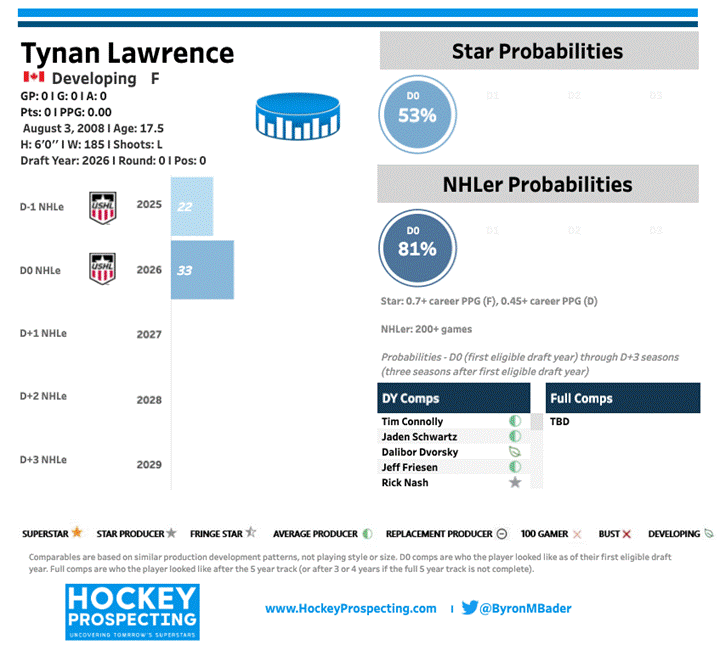
He wrapped this USHL season with 17 points in 13 games for Muskegon, building on a draft-minus-one season that sat just below a point-per-game pace. Now transferred to Boston University, Lawrence is included here for completeness, as his USHL body of work remains highly relevant. In a draft class thin on high-end centers, his hockey sense, improving efficiency, and encouraging pNHLe suggest he could go earlier than expected. Hockey Prospecting assigns him a 53% chance of becoming a star, with optimistic comparables such as Rick Nash. While those outcomes represent an upper bound rather than an expectation, Lawrence profiles as a strong upside swing who could quietly offer point-per-game potential for patient fantasy managers.
Victor Plante – F (Draft Eligible)
Plante showed clear signs of growth during the 2025–26 season, particularly in his engagement level and physical presence. He earned heavier minutes as the year has progressed and became more effective in contested areas along the boards and around the crease. Offensively, his production was driven more by effort, positioning, and play extension than creativity, but that consistency matters. His ability to wear down defenders and stay involved in possessions gives him a foundation that often translates better than junior-level flash.
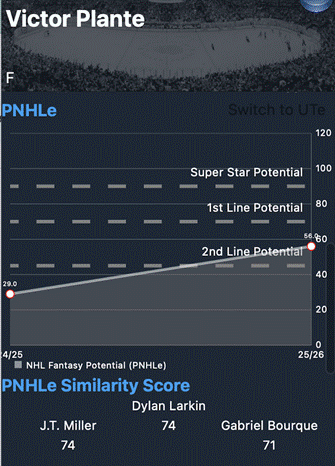
Currently ranked 46th by consolidated rank, Plante is the younger brother of Zam and Max Plante, with Max leading the NCAA in scoring. His pNHLe sits at 56, supported by some intriguing comparables including Dylan Larkin and J.T. Miller, though his true upside will depend on continued skill development alongside his physical tools. He is not a lock to become a high-end scorer, but the trajectory, family pedigree, and underlying indicators make him an appealing long-term bet, particularly for managers willing to be patient.
AJ Francisco – D (Draft Eligible)
Francisco's 2025–26 season served as a clear reminder of how valuable translatable scoring habits can be at the junior level. His release remains his defining trait, but this year he showed progress toward becoming a more complete offensive threat by improving his off-puck movement, timing, and shot selection. Rather than forcing low-percentage attempts, Francisco demonstrated better patience and spacing, allowing his scoring chances to emerge more naturally within the flow of play.
His defensive game is still a work in progress, but the effort level trended in the right direction, particularly in his neutral-zone tracking and willingness to re-engage after turnovers. Francisco's ability to play both forward and defense for the USNTDP speaks to his versatility, and while this was a down year overall for the program from a talent perspective, he stood out as its most impactful defender. His long-term projection will depend on how much further he can round out his game, but the scoring upside remains legitimate and continues to drive his draft value.
Shayne Gould – D (Draft Eligible, Overager)
Gould entered the 2025–26 season as a curiosity and is finishing it with a more clearly defined projection. His game is built on competitiveness, positioning, and intelligent puck support rather than flash, and those traits allowed him to remain consistently involved despite physical limitations. He does not overwhelm opponents with speed or creativity, but he reliably places himself in areas where plays can develop and stay alive.
Offensively, Gould's production stemmed more from improved timing and anticipation than from any major skill jump. He became more effective at activating into space and contributing on extended offensive-zone possessions, showing growth as a secondary facilitator rather than a driver. That reliability is likely what will keep him on evaluators' radars. As an overage, undersized defender at 5-9 who posted just 10 points in 50 games for the Sioux City Musketeers during his first draft-eligible season, it's understandable why he has gone largely unranked by major outlets. He remains a long shot, but his upcoming move to the University of Connecticut next season offers a development runway worth monitoring. In deep fantasy formats, Gould is the type of bet that costs little and could quietly return value if his game continues to mature.
Justin Graf – F (Draft Eligible, Overager)
Graf has played this season with noticeable calm in all three zones, managing game flow effectively against tougher competition. While his offensive totals do not jump off the page, his impact on possession, structure, and puck support was consistently evident, and his quick processing and low-risk decision-making point to a highly coachable profile.
Justin Graf, the younger brother of San Jose Sharks winger Collin Graf, played his draft-eligible season at Rivers School in Massachusetts and is now an overager with the Cedar Rapids RoughRiders, producing 38 points in 32 games. Committed to Harvard for next season, Graf remains a long shot to reach the NHL, but so was his brother, and in deep enough fantasy leagues he is at least worth monitoring as a patient, long-term play.
Cooper Simpson – LW/RW (Boston Bruins)
This season was less about proving upside for Cooper and more about refining execution. Already drafted and affiliated with an NHL organization, his play reflected a noticeable shift toward detail, puck management, and situational awareness. He looked more deliberate in his decision-making and less reliant on improvisation, showing a better understanding of when to push pace and when to simplify.
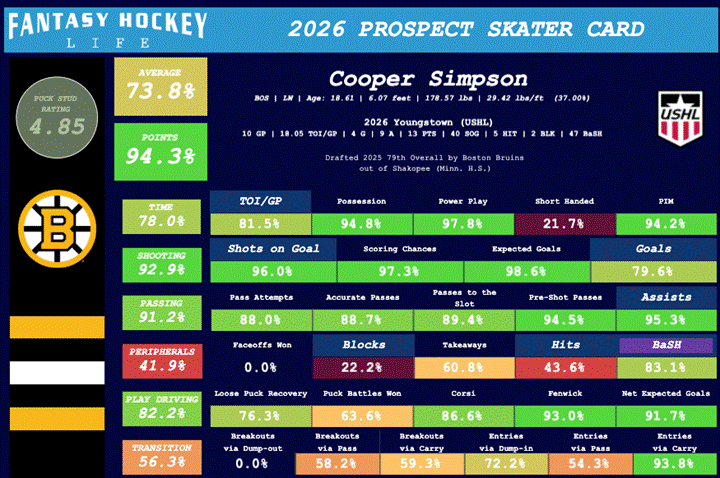
The most meaningful step forward came defensively. Simpson showed improved tracking, stronger positioning, and a greater willingness to play within structure, traits that should ease his transition to the professional level. His Fantasy Hockey Life skater card supports the eye test, highlighting strong play-driving results and a reasonably effective transition game. While he is unlikely to add much value through hits or shot blocking, his high shot volume keeps the offensive floor intact. Posting 54 points in 41 games with Youngstown represents a strong adjustment after being drafted out of Minnesota high school hockey, and his overall profile now looks more complete and projectable as a middle-six scoring winger.
Melvin Novotny – LW/RW (Buffalo Sabres)
Drafted in the seventh round in 2025, Novotny has transitioned smoothly from Sweden's J20 Nationell to the USHL, producing 29 points in 25 games, an encouraging sign as he prepares to head to the University of Massachusetts next fall. While his ceiling may not match that of flashier peers, his predictability works in his favor, as players with this profile often carve out professional roles by doing many things well enough rather than excelling in one area.
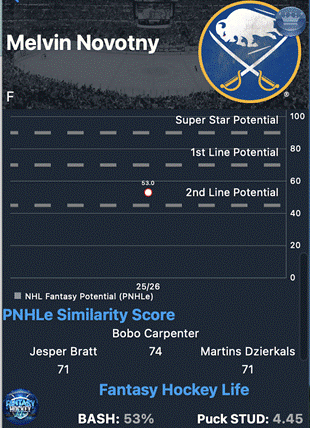
His NHL Rank King pNHLe of 53, with a Jesper Bratt comparable, likely represents an optimistic upper bound rather than a true expectation, but it still reflects a healthy projection signal. Overall, Novotny's season reinforced his outlook as a long-term, projectable prospect whose value lies in reliability, versatility, and steady development.
Ryan Rucinski – C/RW (Buffalo Sabres)
Rucinski's 2025–26 season showed encouraging progress, particularly in how he handled increased pace and pressure. He played with more confidence carrying the puck and displayed improved reads when joining or supporting the rush, allowing him to remain effective against stronger competition. That added decisiveness helped his offensive game take a meaningful step forward without forcing plays.
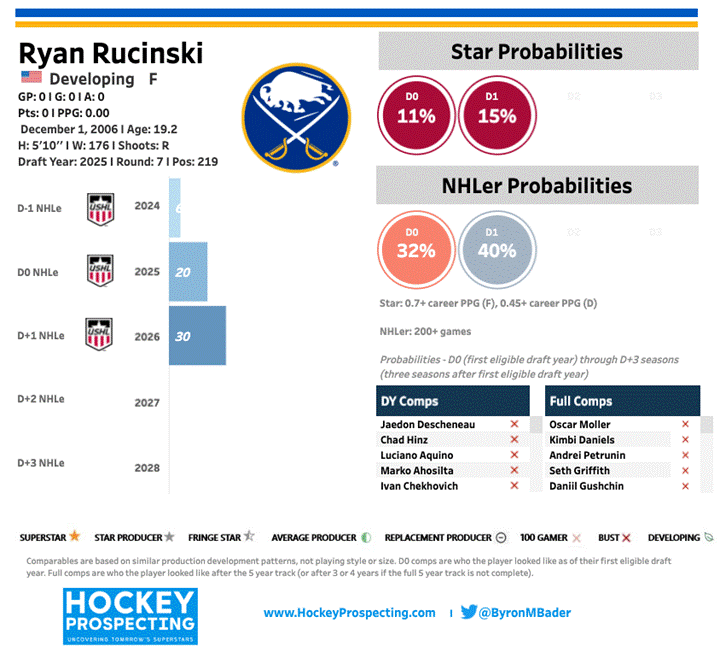
Drafted as a seventh-round pick by the Buffalo Sabres, Rucinski is on his third USHL season, and he has finally found consistency at over a point-per-game pace. Defensively, there are still areas to clean up, but his willingness to engage and adapt stood out throughout the year. With a move to Ohio State next season, this campaign looks very much like a bridge year, focused less on dominance and more on preparing his game for the more difficult environment ahead. Hockey Prospecting now gives him a 15% star probability, a notable increase from his draft season and a sign that his developmental curve is trending in the right direction.
Final Thoughts
The 2025–26 USHL season underscored an important reality: this was not a particularly star-driven crop. With Tynan Lawrence having moved on, there are few, if any, players currently in the league who project as true high-end NHL difference makers. For much of this group, development was less about breakout moments and more about incremental gains in decision-making, structure, and consistency.
That does not mean the league lacks value. In deeper dynasty formats, the USHL remains a useful hunting ground for complementary pieces and long-term bets. Several NHL-affiliated prospects took meaningful steps toward professional readiness, and a handful of draft-eligible players showed enough underlying growth to warrant continued tracking. The edge, as always, comes from identifying sustainable progression rather than chasing upside that may no longer be present.
Thanks for reading! See you next week. For more fantasy hockey analysis, or if there's a prospect, topic, or theme you'd like me to cover, follow and message me on X: https://x.com/VictorNuno12
Related Posts

Starting Goalies



Top Skater Views
| Players | Team | |
|---|---|---|
| ROOPE HINTZ |
 DAL DAL | |
| ALEX LAFERRIERE |
 L.A L.A | |
| LUKE HUGHES |
 N.J N.J | |
| OWEN TIPPETT |
 PHI PHI | |
| KEVIN FIALA |
L.A
| |
Top Goalie Profile Views
 WSH
WSH CBJ
CBJ MIN
MIN UTA
UTA


LINE COMBOS
| Frequency |
 OTT Players OTT Players
| |
|---|---|---|
| 19.0 | BRADY TKACHUK RIDLY GREIG DYLAN COZENS | |
| 14.6 | SHANE PINTO CLAUDE GIROUX MICHAEL AMADIO | |
| 11.4 | TIM STUTZLE WARREN FOEGELE DRAKE BATHERSON | |
DobberHockey Podcasts

Keeping Karlsson: The 2026-27 Keeping Karlsson Breakfast Club
Don’t you forget about them! Elan and Brian remind you of at least one player on each NHL team whose name you might forget to consider at the draft table.

Fantasy Hockey Life: Tampa Bay Lightning with Erik Erlendsson
Erik Erlendsson joins the program to discuss the Tampa Bay Lightning. Jesse and Victor ask about pros Nikita Kucherov, Jake Guentzel, Brandon Hagel, Brayden Point, Anthony Cirelli, Ilya Mikheyev, Gage Goncalves, Conor Geekie, Benjamin Rautiainen, John Carlson, Victor Hedman, Charle-Edouard D’Astous, Andrei Vasilevskiy, Jonas Johansson, and Dennis Hildeby. In Cat’s instincts, Cat Silverman of InGoal […]
Fantasy Hockey Life: New York Rangers with Colin Stephenson
Colin Stephenson joins the program to discuss the New York Rangers.
Keeping Karlsson: Matchup Maximizer Schedule Deep Dive
Elan is joined by the Keeping Karlsson Accountability Czar Trev to take a deep dive into the NHL schedule for next season and how it should affect our drafting decisions.
Fantasy Hockey Life: Carolina Hurricanes with Ryan Henkel
Ryan Henkel joins the program to discuss the Carolina Hurricanes. Jesse and Victor ask about pros Sebastian Aho, Seth Jarvis, Andrei Svechnikov, Nikolaj Ehlers, Jackson Blake, Logan Stankoven, Jordan Staal, Bradly Nadeau, Felix Unger Sorum, Shayne Gostisbehere, K’Andre Miller, Alexander Nikishin, Sean Walker, Brandon Bussi, and Pyotr Kochetkov. In Cat’s instincts, Cat Silverman of InGoal […]