

The Journey: 2026 Draft Preview
Victor Nuno
2026-02-07
Welcome back to The Journey, where we track the players from development to fantasy relevance. The 2026 NHL Draft class is an interesting one from a fantasy perspective, less about depth across positions and more about identifying where true upside actually lives. While real-life draft boards will be shaped heavily by positional scarcity, fantasy managers should be far more selective, prioritizing ceiling, deployment pathways, and long-term offensive roles over NHL-safe projections. Of course, we are a long way from fantasy drafts and having a clear picture of where the value lies, but fantasy managers might be deciding on trading picks and need to be prepared for what kind of value they are either trading for or away.
The Clear Fantasy Number One
NOTE: This discussion focuses on the on-ice components. Many of the legal issues facing Gavin McKenna are unknown and won't be speculated upon here.
No matter where he ultimately lands in the real-life draft, Gavin McKenna should be the unquestioned first overall pick in fantasy formats. No player in this class offers more offensive upside. Even if some teams prioritize centers or defensemen at the top of the NHL draft, that logic does not apply in fantasy. Wingers often gain top-line and power-play deployment more easily, and McKenna's combination of skill, creativity, and scoring potential clearly separates him from the rest of the field. If you are drafting for fantasy, this is not a debate.

The data reinforces that conclusion. Hockey Prospecting places McKenna in a tier populated by current superstars and Hall of Fame–level outcomes, a range very few prospects ever touch. A particularly apt modern comparable is Ivan Demidov, both in terms of offensive profile and projection curve. McKenna should be able to reach Demidov's upside relatively easily, with the primary variable being timeline rather than ceiling. How quickly he gets there will depend on the organization that drafts him and the opportunities he is given, but from a fantasy perspective, no other player in the class comes close to matching his long-term offensive potential.
Ivar Stenberg sits just behind him. While his raw offensive upside may fall slightly short of McKenna's, his all-around game is more complete, and that matters when projecting how quickly a player earns trust and opportunity. Stenberg's two-way reliability, processing, and physical engagement give him a cleaner translation path, and he may reach fantasy relevance sooner even if his ultimate ceiling is marginally lower.

His Hockey Prospecting profile reflects that balance. Stenberg's comparables span a wider range, mixing true stars with solid NHL contributors and a few lower-end outcomes. That variance speaks to how role-dependent his ceiling may be. One key variable will be whether he settles in as a center at the NHL level. If he does, it could slow his offensive ascent, as greater defensive responsibility would likely take priority early on. Regardless, his combination of skill, competitiveness, and translatable habits makes him one of the safest bets in the class, with strong fantasy value even if he does not ultimately match McKenna's peak.
Breaking Down the Defensemen
This draft class is notably stronger on the blueline than down the middle, and the defenders can be broadly grouped into two categories: offensive-leaning defensemen and all-around contributors. For fantasy purposes, understanding where each player falls on that spectrum is critical, as role and usage will ultimately dictate value as much as raw talent.

Among the offensive-leaning group, Hockey Prospecting identifies Xavier Villeneuve and Ryan Lin as the two defenders with the highest offensive upside. Villeneuve likely owns the highest ceiling overall, driven by his creativity, puck skills, and willingness to push offense, but he also carries the lowest floor. His defensive game remains a work in progress, and the optimistic outcome hinges on him settling into a sheltered role at even strength while running a top power-play unit. His Fantasy Hockey Life skater card reflects that volatility, showing a strong transition game but mixed play-driving results. While much of his profile grades out as good to great, his net expected goals and Corsi remain low, and he has not earned short-handed trust, which helps explain his limited usage there.

Lin presents a different profile. He would likely be viewed as a top-three talent in this class if he were 6-2, but even at his size, his skating, vision, and puck management give him legitimate top-pair and power-play quarterback potential. Crucially, Lin is far more reliable defensively than Villeneuve, giving him a better chance to earn heavy minutes and sustain a true top-line role. His Hockey Prospecting comparables span a wide range, from Ryan Merkley to Michael Del Zotto to Scott Niedermayer, which underscores both the upside and variance in his projection. That range reflects how dependent his outcome will be on deployment and development, but the underlying tools give him a real chance to land on the higher end of that spectrum.
Chase Reid is somewhat underrated within this grouping. While he is not always viewed as flashy, his offensive impact is likely closer to Villeneuve and Lin than to the rest of the class. He combines good size with strong mobility and a well-rounded game, which should allow his offense to translate more smoothly than some projections suggest. Reid's overall reliability increases the odds that he earns the kind of deployment needed to unlock his fantasy upside.

That blend of safety and upside shows up in his Hockey Prospecting comparables, which range from Ryan Ellis to Phil Housley to Bobby Orr. It is a wide spectrum, but it highlights how Reid's projection straddles two valuable outcomes, either as a steady, high-minute defender with secondary offense or, if everything breaks right, a true offensive driver. While the upper bound is ambitious, the underlying profile supports a higher ceiling than his current perception suggests.
The all-around defenders bring a different type of value. Keaton Verhoeff sits at the top of this tier and looks every bit like a future top-pair defenseman. He does everything well, processes the game at a high level, moves pucks efficiently, and defends with purpose. His ultimate fantasy value will depend on how much of his offense translates at higher levels, but the floor here is extremely strong. Carson Carels fits neatly into this mold as well and may be slightly underrated, offering strength, composure, and steady two-way impact that NHL teams will value, even if fantasy managers need to temper expectations.
Daxon Rudolph and Alberts Smits round out the group as reliable two-way defenders. They project as players who can handle difficult minutes, contribute in multiple situations, and stabilize a lineup. Stylistically, they are not entirely unlike Mo Seider, though it is unlikely either reaches that level of impact. For fantasy purposes, their value will be more context-dependent, tied closely to role, usage, and whether incremental offensive growth materializes.
Overall, this is a deep and varied defensive class. The challenge for fantasy managers will be separating true power-play drivers from those whose value lies more in real-life reliability than in point production.
A Weak Center Class
This draft is thin at center, and fantasy managers should be cautious. Centers will almost certainly be pushed up NHL draft boards due to positional scarcity, but that does not mean they should be prioritized in fantasy drafts.
Tynan Lawrence and Caleb Malhotra could be among the first centers selected in real life. Lawrence offers more offensive upside and is the better fantasy swing, while Malhotra's value lies more in his floor and two-way reliability. Neither profile as a true fantasy cornerstone.
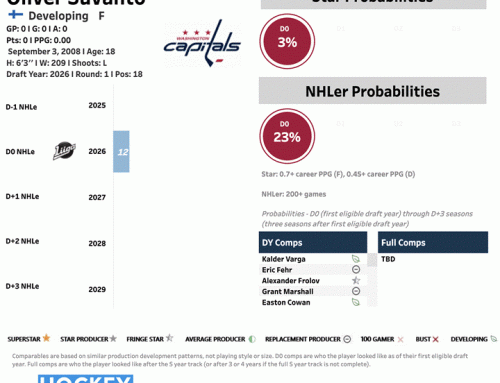
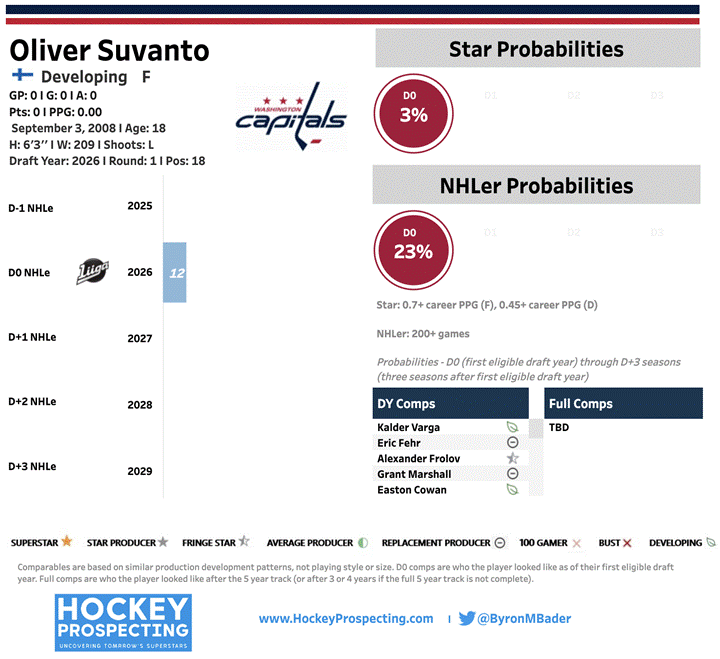
Beyond them, centers such as Ryan Roobroeck, Oliver Suvanto, and Yegor Shilov should be viewed strictly as depth options in fantasy formats. Expecting more than a 50-60-point contributor from this group is likely unrealistic, and they should only be selected if league depth or roster construction demands it.
Final Thoughts
The 2026 draft class is one where fantasy managers need to stay disciplined. True star upside is concentrated at the top and along the blue line, while center depth is more illusion than substance. Let NHL teams chase positional need. In fantasy, the edge comes from targeting ceiling, power-play potential, and players whose paths to offensive deployment are the clearest.
Thanks for reading! See you next week. For more fantasy hockey analysis, or if there's a prospect, topic, or theme you'd like me to cover, follow and message me on X: https://x.com/VictorNuno12
Related Posts
Starting Goalies












Top Skater Views
 T.B
 DET
 SEA
 CGY
Top Goalie Profile Views
 N.J
 WPG
 MTL
 EDM


LINE COMBOS
DobberHockey Podcasts

Keeping Karlsson: Short Shifts – Hellebuyck’s Debut, Larkin Fall Out, and Much More
Elan covers all the big news since last Sunday’s mega-show including Hellbuyck’s first game, Larkin’s absence and much more in this week’s episode of Short Shifts.
Keeping Karlsson: Down Across the Helle-ware
On this episode of the Keeping Karlsson Fantasy Hockey Podcast, Elan and Brian dissect the implications of the Connor Hellebuyck trade, injury returns in Carolina and Washington, hot streaks in Philadelphia and Seattle, crease contenders in Calgary and San Jose, a must-add in Tampa Bay and a sell-high in Colorado for your fantasy hockey league.

Fantasy Hockey Life: Ep 506 Prospects with Plenty to Prove II
Victor and Jesse return to talk about more fantasy hockey prospects in critical seasons. Covered are David Reinbacher, Cayden Lindstrom, Dalibor Dvorsky, Bradly Nadeau, Ilya Protas, Charlie Stramel, Otto Stenberg, Emil Hemming, Trey Augustine, Sebastian Cossa, Jacob Fowler, Easton Cowan, Matthew Wood, Gabe Perreault, and Victor Eklund. Thanks to Mason Black @NHLRankKing for his polls. […]
Keeping Karlsson: Matchup Maximizer 2026/27 Week 5
Jeremy takes a look at the schedule for the upcoming weeks of NHL action and recommends players with good schedules that you should consider streaming in to win your head to head matchups.
Keeping Karlsson: Short Shifts – Injuries, Outjuries, and Duds
Elan talks about all the latest injuries, outjuries, big performances and duds over a tight 20 minutes in this week’s episode of Short Shifts.