

Ramblings: Comparing the Fantasy Seasons of Johnston, Slafkovský, Raymond, Sennecke, and Cooley – June 9
Michael Clifford
2026-06-09
In a pair of Ramblings last week, we highlighted some of the top fantasy performers among forwards and defencemen this past season, and then compared them to similar performances in any season from 2021-2025. We do this to find some comparable players that could give us insight into what we can expect in the future from this season's top performers.
Today, we're going to do the same thing but discussing younger forwards. We're going to review the fantasy seasons of some key under-25 players, a player they compare to from recent seasons, and what that might tell us about their future. The stats we're using are goals, assists, power-play points (PPP), shots, blocks, hits, face-off wins (FOW), and penalty minutes (PIM).
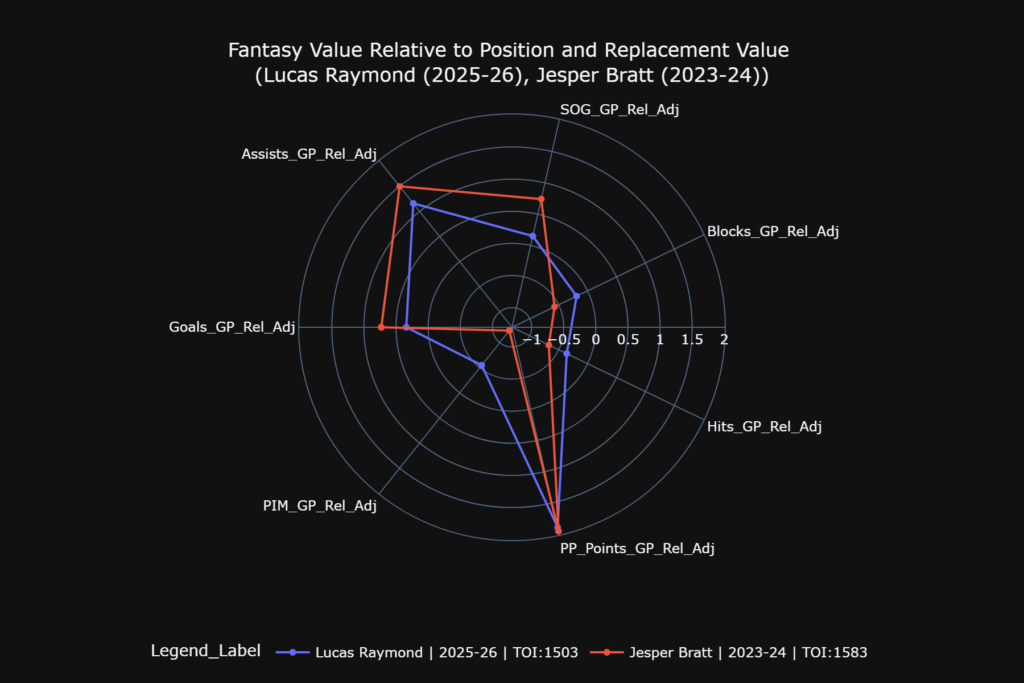
Keep in mind that these evaluations are on a per game basis, and players are compared to replacement-level forwards. All that was discussed in more detail in the earlier Ramblings.
Wyatt Johnston (2025-26) and John Tavares (2022-23)
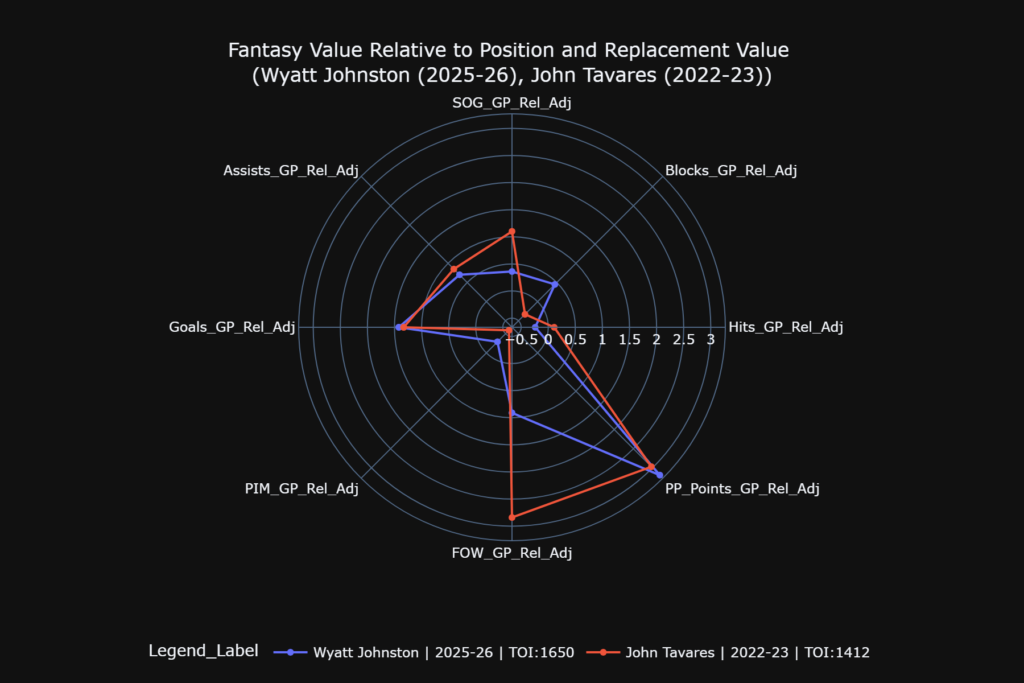
There are minor differences between the two seasons mentioned, but what stuck out to me are the similarities in goals, assists, and power-play points. Johnston's season saw him as 1 of 3 players with at least 40 goals, 40 assists, and 40 PPPs, with the others being Connor McDavid and teammate Jason Robertson. He has three straight seasons with at least 30 goals, 30 assists, and 200 shots, is sixth in PPPs over the last two seasons, and just turned 23 years old a month ago.
The reason the similarities stuck out to me isn't just because of what Tavares did in 2022-23, but what Tavares has done for his career: According to Hockey Reference, he is 1 of 7 players with at least seven seasons of 30 goals, 30 assists, and 200 shots since the 2011-12 campaign. The others are all future Hall of Famers: McDavid, Nikita Kucherov, Nathan MacKinnon, David Pastrnak, Sidney Crosby, and Alex Ovechkin.
That Johnston's fantasy value in 2025-26 compares well to Tavares' campaign three years prior is nice to see. What might be more important is that Johnston is showing the same traits that Tavares showed for much of his career, namely great goal scoring with solid assist and shot totals. Johnston is still a young player, but he now has three seasons of good-to-great production. Maybe the comparison isn't that far-fetched.
Juraj Slafkovsky (2025-26) and Gabriel Landeskog (2021-22)
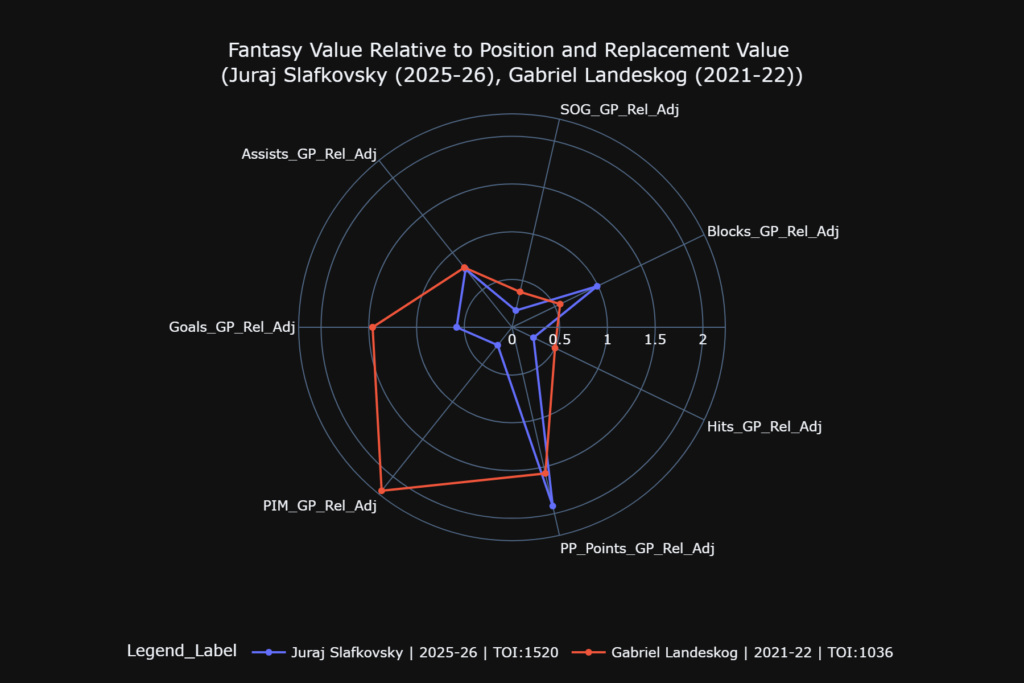
Because these two guys are both wingers, we removed FOWs from the final tally here. What is interesting is that the big difference between Slafkovský's 2025-26 campaign and Landeskog's final season before his career-altering knee surgery are the penalty minutes. We take that out, and the two have near-identical fantasy value.
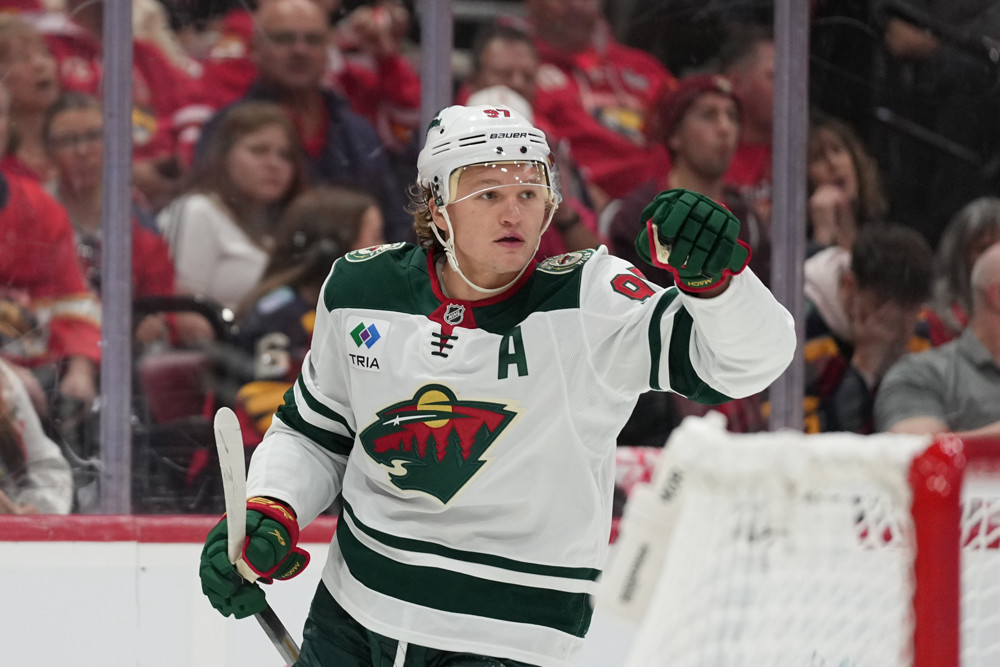
As with Johnston and Tavares, it is the similarities that stick out. Slafkovský and Landeskog were close in value by assists, shots, hits, and power-play points. When Landeskog was at his best in the late 2010s and early 2020s, he had 82-game paces exceeding 30 goals, 40 assists, and 1.5 hits per game. Slafkovský just finished his age-21 season with 30 goals, 43 assists, and 1.3 hits per game. We have a higher scoring environment in the NHL now than we did 10 years ago, but Landeskog didn't consistently hit his stride until his age-25 season. Slafkovský just turned 22 years old in March.
These two aren't identical players, as Landeskog was more responsible defensively early in his career than Slafkovský is. All the same, we're here for fantasy value, and it's hard to not see the similarities between the two: good goal and assist rates with a solid dose of shots and hits. Whether Slafkovský turns into the elite two-way forward that Landeskog was in his prime remains to be seen, but the comparison for fantasy value seems apt given their respective profiles.
Lucas Raymond (2025-26) and Jesper Bratt (2023-24) (w/o FOWs)
Raymond is mentioned here for two reasons. The first being the report of centre Dylan Larkin requesting a trade. The Detroit Red Wings have been desperate for a second-line centre to use in tandem with Larkin for years, and while Andrew Copp had a solid 2025-26 season, that was just one year, and Copp turns 32 years old next month. Even if Copp repeats that performance next season, it's still not to the level Larkin can reach, and it would still leave the Red Wings without a true second-line centre. If Copp takes a step back? Raymond and Alex DeBrincat will be like Milhouse when he was outside throwing the frisbee to himself.
The second reason is that Raymond has shown excellent consistency over the last few years, achieving at least 25 goals, 40 assists, and 160 shots in three straight campaigns, averaging 28 goals, 49 assists, and 177 shots per 82 games. That consistency overshadows the fact that Raymond has not achieved his next level in fantasy value: over those three years, there are 1206 individual seasons of forwards with at least 41 games played. Raymond has three top-400 seasons, two top-200 seasons, but zero top-100 seasons. He has been consistently good, but not close to elite. Even if we exclude PIMs, he has one top-100 season, and zero top-75 seasons. In other words, even in leagues without FOWs and PIMs, Raymond has yet to have a top-25 campaign.
The good news is that compares well to Bratt. From 2021-2024, Bratt averaged 29 goals, 49 assists, and 225 shots every 82 games. However, it took until 2024-25 for Bratt to have a top-25 season. He had years of consistently good production, but never elite, and then he turned in a top-15 performance at the age of 26. Raymond turned 24 years old in March.
Throwing a wrench in all this is Larkin's status. If he is traded and the Red Wings start building for the future, Raymond has no one to play with aside from DeBrincat, and those two rarely skate on the same line. It is very plausible Raymond's fantasy value takes a leap sometime in the next five years, but the likelihood of it happening gets slimmer if Larkin departs the franchise without an immediate replacement.
Beckett Sennecke (2025-26) and Brandon Hagel (2022-23) (w/o FOWs)
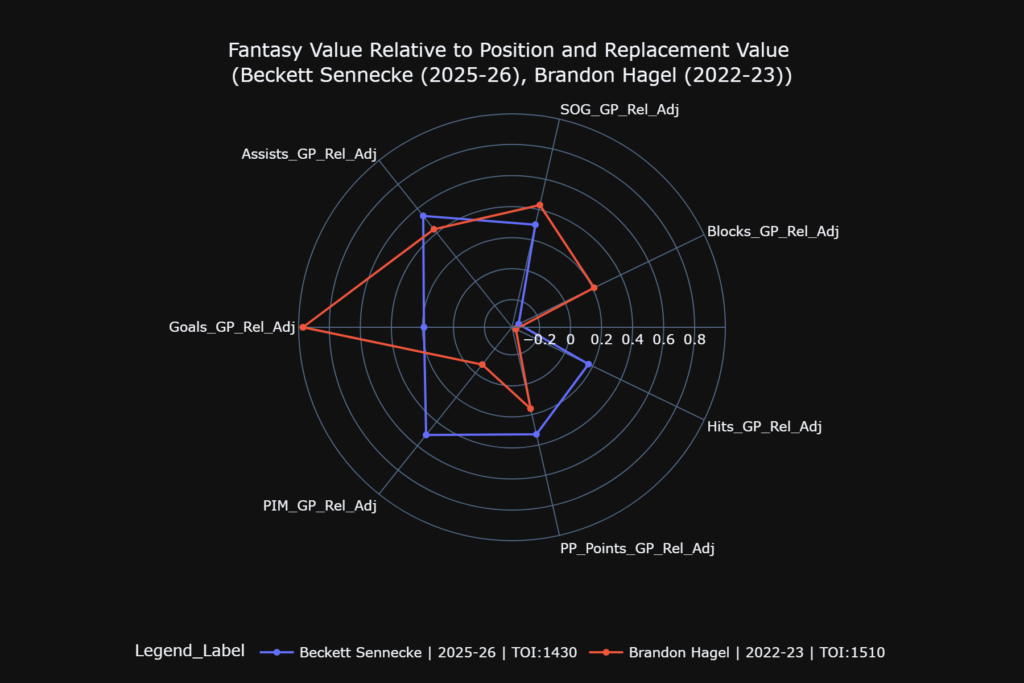
I found this comparison fascinating. Hagel had some good tracking data in Chicago but never really exploded. Then he's traded to the Tampa Bay Lightning, and he averages 33 goals and 46 assists per 82 games over his four full seasons. That is also without a lot of top power-play time as he averaged just 11 PPPs per 82 games in that span.
The same can be said for Sennecke, though being a 60-point rookie is going to put the spotlight on him. Either way, Sennecke also had some very good tracking data in his first full season, and though there are differences between his season and Hagel's first year in Tampa, the overall fantasy value fell to a similar spot. The Anaheim Ducks are still growing as a team, but Sennecke comparing favourably to Hagel when Anaheim's true ceiling might not show up for another 2-4 years is a great sign.
Our only concern for Sennecke should be his usage. He is on a team with Cutter Gauthier, and while Sennecke did seem to pass him on the depth chart at times, what that looks like in 2-3 years' time is up in the air. Additionally, Leo Carlsson is the team's top centre, but Mason McTavish has kind of stalled out and Mikael Granlund turned 34 years old in February. If Sennecke doesn't line up with Carlsson, there may not be another centre on the roster who can truly elevate him to elite fantasy status.
With all that said, posting 60 points, 197 shots, and 97 hits as a 20-year-old rookie is a superb effort. His physicality sets him apart from Hagel, which could give him some additional fantasy value that Hagel has lacked. The only thing really keeping Sennecke from ascending to a high-end multi-cat winger is whether he has a centre who can push him to that level, but he can get there if the circumstances align.
Logan Cooley (2025-26) and Nick Schmaltz (2025-26)
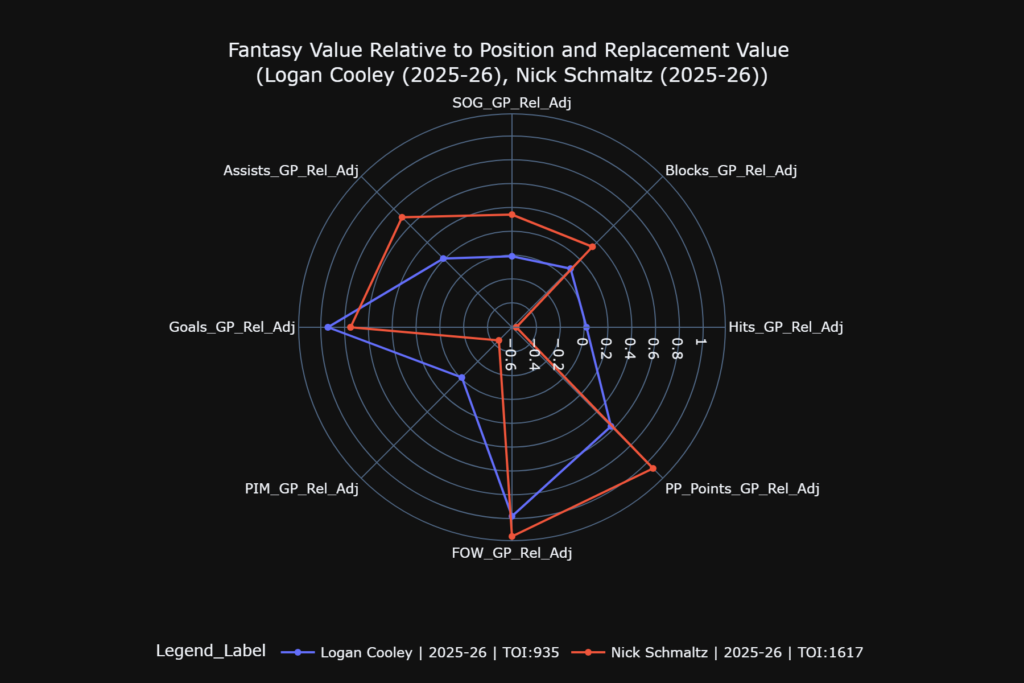
As we've done in recent Ramblings, we'll finish by comparing a pair of players from the same season. That they both play on the same team adds another layer of intrigue, especially where the young player is looking to take the spot of the veteran.
What sets these two apart immediately is Cooley's goal scoring. He has averaged 27 goals every 82 games for his career, a level that Schmaltz didn't reach until he was in his mid-20s. Cooley attaining that level from the ages of 19-21 makes him a bit of a different player from Schmaltz. Whether Cooley can keep averaging 17% shooting as he has for his career is a fair question, but when a player shoots at that rate for over 200 games, it's hard not to believe in his efficiency.
We all want to know whether Cooley can overtake Schmaltz on the depth chart. My question is whether he has to. In Utah's six playoff games, Schmaltz averaged earned 34.3% of the team's ice time, per Frozen Tools, and that led Mammoth forwards. In second place was Cooley at 33.1%. In regular season games, earning around 33% of the team's ice time means skating around 20 minutes a game. If Cooley is skating 20 minutes a game next to Dylan Guenther, and that ice time includes top PP time, it doesn't matter to me that Schmaltz is skating 21 minutes a game next to Clayton Keller. In fact, it may even help, as Cooley could avoid shutdown defence pairs from the opposition when Utah is on the road.
That these two had similar per-game fantasy value this past season in a year where Schmaltz had a career-high in goals, points, shots, and blocks speaks to the upside that Cooley has. The two things that should concern us are Cooley's overall ice time level, and whether that ice time includes a top PP role. If he stays anywhere close to the 20-minute mark with top PP time? He has 30-goal, 80-point upside immediately.
Related Posts


Starting Goalies







Top Skater Views
 PHI
 T.B
 N.J
 L.A

Top Goalie Profile Views
| Players | Team | |
|---|---|---|
| JACOB FOWLER |
 MTL | |
| DANIIL TARASOV |
 DET | |
| DYLAN GARAND |
 NYR | |
| DEVON LEVI |
 EDM | |
| ALEX NEDELJKOVIC |
 S.J | |
LINE COMBOS
| Frequency |
 STL Players | |
|---|---|---|
| 21.8 | ROBERT THOMAS JIMMY SNUGGERUD DYLAN HOLLOWAY | |
| 16.7 | MASON MCTAVISH CONNOR MCMICHAEL JONATAN BERGGREN | |
| 15.7 | JAKE NEIGHBOURS DALIBOR DVORSKY PAVEL BUCHNEVICH | |
DobberHockey Podcasts

Keeping Karlsson: Never Tell Me the Podz
Elan and Brian do a wellness check on the Maple Leafs, lament Chicago and Buffalo snoozers, wonder whether and which Flyers have figured it out, and pick out the Capital standing out from the crowd.

Fantasy Hockey Life: Ep 505 Prospects With Plenty to Prove Part 1
Victor and Jesse return to talk about prospects with plenty to prove. This week it’s: Tij Iginla, Berkly Catton, Konsta Helenius, Zayne Parekh, Igor Chernyshov, Jett Luchanko, Axel Sandin-Pellikka, Artyom Levshunov, Michael Hage, and Carter Bear. Have a listen! Our show is part of the Dobber Podcast Network and sponsored by Fantrax.com. Email [email protected] and […]
Keeping Karlsson: Matchup Maximizer 2026/27 Week 4
Elan takes a look at the schedule for the upcoming weeks of NHL action and recommends players with good schedules that you should consider streaming in to win your head to head matchups.
Keeping Karlsson: Short Shifts – NHL Frozen Frenzy Recap
Elan and Lewis recap the Frozen Frenzy as well as two big returns and more!
Keeping Karlsson: Delusions of Garandeur
Elan and Brian dive into the latest NHL hot streaks, cold streaks, line changes, outjuries, injuries, buy-lows and sell-highs to give you top notch tips in your fantasy hockey league