

The Journey: Top 2026 Draft Eligible Defenders
Victor Nuno
2026-06-13
Every draft develops its own identity. Some years are defined by elite centers. Others feature dynamic wingers or franchise goaltending prospects. The 2026 NHL Draft may ultimately be remembered for its deep and diverse collection of defensemen. While there may not be a consensus generational blueliner at the top of the class, there are multiple players who project as future NHL impact defenders, and perhaps more importantly, they arrive there through very different pathways.
Some bring elite skating. Others rely on intelligence and positioning. Some project as power-play quarterbacks capable of producing 60-plus points, while others look more like minute-munching shutdown defenders who may never become fantasy stars but could enjoy long NHL careers.
Using viewings and reports from Fantasy Hockey Life scout Patrick Ploch, let’s examine the major defensemen in the 2026 class and compare their strengths, weaknesses, and long-term projections.
Comparing the Class
| Player | Skating | Offensive Upside | Defensive Projection | NHL Ceiling | Fantasy Ceiling |
| Chase Reid | Elite | High | High | #1 Defenseman | 65+ points |
| Carson Carels | Above Average | High | Average | Top Pair | 50-60 points |
| Daxon Rudolph | Very Good | High | Developing | Top Pair | 60+ points |
| Ryan Lin | Very Good | High | Good | Second Pair | 50-60 points |
| Tommy Bleyl | Very Good | Very High | Good | Top 4 | 50-60 points |
| Xavier Villeneuve | Very Good | High | Developing | Top 4 | 60+ points |
| Keaton Verhoeff | Very Good | Moderate | Elite | Top Pair | 40-50 points |
| Alberts Smits | Above Average | Moderate | Very Good | Top Pair | 35-45 points |
| Malte Gustafsson | Above Average | Moderate | Very Good | Top 4 | 35-45 points |
Tier 1: Potential Franchise Cornerstones
Chase Reid
If teams are looking for the highest-upside complete defenseman in the class, Chase Reid is it. Reid’s skating is his defining trait, which combines high-end straight-line speed with exceptional lateral mobility and smooth transitions. More importantly, he uses that skating effectively. He consistently arrives in the right areas of the ice, supports transitions, and recovers defensively.
His puck skills are equally impressive. Reid handles the puck comfortably in all three zones and distributes efficiently in transition and offensive situations. What separates him from many offensive defensemen is that Reid is also strong defensively and demonstrates advanced hockey intelligence.
Reid gets pucks through effectively though he lacks the heavy one-timer or intimidating point shot that often elevates some offensive defensemen into elite fantasy assets. Quinn Hughes has done pretty well as an elite NHL defenseman without a booming one-timer. Reid is so smart and offensively gifted, he will figure it out, just like Hughes did.
Best Case: Zach Werenski-type number one defenseman running a power play and producing 65+ points.
Most Likely Outcome: Top-pair defender who contributes in all situations.
–
Carson Carels
Carels' offensive talent is undeniable. He distributes effectively on the power play, consistently gets pucks through traffic, activates into dangerous areas, and has a knack for finding ways to contribute offensively. He processes the game well and plays with a confidence that allows him to impact the game in multiple ways. Unlike many of the offensive defensemen in this class, Carels is also willing to engage physically, consistently competing in difficult areas of the ice and making his presence felt beyond the scoresheet.
Even if the offense doesn’t fully translate, his physical engagement provides another path to NHL value. His combination of blocks, shots, and hits (BASH) could make him particularly valuable in bangers formats, where he may ultimately rank near the top of this defense class. The range of outcomes is wider than for Reid, but the overall package is compelling enough that he firmly belongs among the top defenders in the 2026 draft.
Best Case: Jake Sanderson-lite offensive contributor.
Most Likely Outcome: Power-play contributor with offensive value.
Tier 2: Offensive Difference Makers
Daxon Rudolph
Rudolph remains one of the more difficult players to evaluate in the 2026 class. The central question is whether he is truly driving offense or simply benefiting from being involved in it. That distinction often separates future NHL difference-makers from role players.
The offensive upside is undeniable. Rudolph is comfortable carrying the puck, joining the rush, and activating in the offensive zone. At his best, he looks like a defenseman capable of quarterbacking a power play and generating offense from the back end.
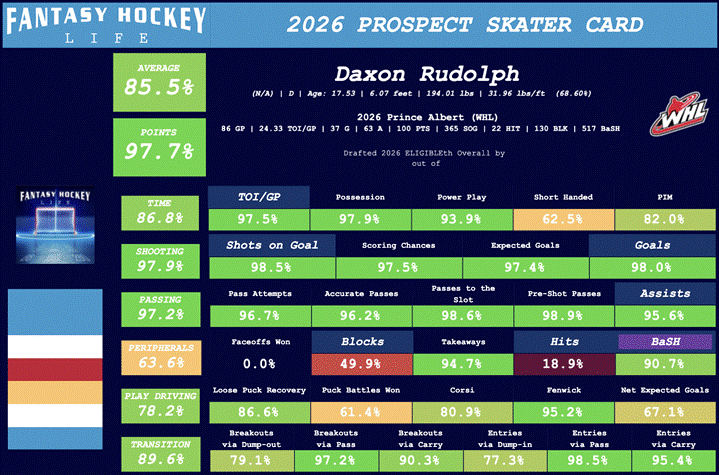
The concern is that, unlike prospects such as Reid or Lin, Rudolph’s defensive game remains a work in progress. His positioning can be inconsistent, and his offensive instincts sometimes pull him out of structure. That combination of offensive potential and defensive uncertainty creates one of the widest ranges of outcomes among the defensemen in this class.
Best Case: Dynamic offensive defenseman capable of running a power play and producing 50-plus points.
Most Likely Outcome: Offensive-minded middle-pair defender whose value depends on how much of his scoring translates to higher levels.
–
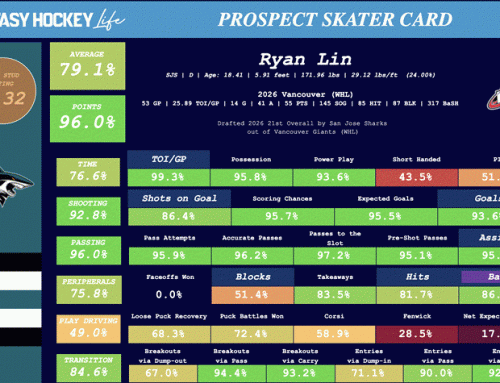
Ryan Lin
Ryan Lin may possess some of the best raw tools in the entire draft class. His skating is explosive, his puck skills are dynamic, and he has the ability to generate offense as both a shooter and a playmaker. He can create advantages in transition, attack space off the rush, and make difficult plays at speed. The primary concern is his frame, as he currently stands just 5-11 and 176 pounds, leaving questions about how his game will translate against stronger and more physically mature competition.
While some scouts have raised concerns about Lin’s decision-making, I see it as one of his greatest strengths. He spent the season on one of the WHL’s weakest teams, often carrying a disproportionate share of the offensive burden with limited support around him. In that environment, he was forced to attempt difficult plays that may appear risky when viewed in isolation. What stands out is his ability to process the game quickly, identify passing lanes, manipulate defenders, and create offense under pressure. Unlike some offensive defensemen who rely purely on skill, Lin consistently demonstrates an understanding of when and where opportunities will develop. If he continues to add strength and proves capable of handling larger opponents defensively, there is legitimate top-pair upside here, with the potential to become one of the biggest steals of the 2026 draft class.
Best Case: Josh Morrissey-like defensive contributor.
Most Likely Outcome: Bottom pair, second power play.
–
Tommy Bleyl
Among the offensive defensemen in the class, Tommy Bleyl may be the most intriguing fantasy asset. He skates extremely well, moves pucks efficiently, distributes effectively, and owns a dangerous wrist shot that allows him to score from range. Unlike many offensive defensemen whose production is heavily tied to the power play, Bleyl creates offense in a variety of ways. He transports pucks through the neutral zone, supports the cycle effectively, activates intelligently into scoring areas, and consistently finds ways to generate chances at even strength. His offensive game is built on pace, movement, and anticipation rather than simply waiting for opportunities to come to him, which should help his skill set translate to higher levels.
His hockey sense also appears stronger than many similarly offensive-minded defensemen. Bleyl generally makes good decisions with the puck, recognizes developing plays quickly, and shows a strong understanding of when to join the attack versus when to stay connected defensively. There is a level of polish to his game that is sometimes missing in younger offensive defenders. The biggest concern is physical maturity. At 6-0, Bleyl is not undersized, but there were situations where his current strength limitations became apparent, particularly in board battles, net-front scrums, and extended defensive-zone possessions. Fortunately, this appears more like a developmental issue than a fundamental flaw. As he adds strength and continues to round out his defensive game, there is legitimate top-four NHL upside with the potential to become a significant fantasy contributor.
Best Case: Brian Rafalski-type offensive defenseman.
Most Likely Outcome: Top-four defenseman with power-play value.
–
Xavier Villeneuve
Villeneuve may possess the highest pure offensive ceiling among all defensemen discussed here. His puck skills stand out immediately, and few defenders in this class can match his creativity with the puck on his stick. Villeneuve displays poise, vision, and imagination as both a passer and puck transporter, frequently identifying passing lanes and offensive opportunities that others simply do not see. Unlike many young defensemen, he often appears to be processing multiple options simultaneously, allowing him to manipulate defenders and create openings through deception rather than simply relying on raw skill. His skating further enhances his offensive toolkit, giving him the mobility to evade pressure, activate into dangerous areas, and drive play through all three zones.
The concern remains his defensive projection. There remains substantial work to be done in terms of physical engagement, defensive consistency, and overall reliability away from the puck. At times, Villeneuve’s offensive instincts can pull him out of structure, creating situations where he relies on recovery rather than prevention. The encouraging aspect is that many of his shortcomings are coachable, while the offensive creativity he possesses is much harder to teach. As the NHL continues to place greater value on defenders who can create offense and run power plays, Villeneuve’s skill set becomes increasingly attractive. He may ultimately be one of the highest-risk defenders in the class, but he also possesses the type of offensive toolkit that could allow him to emerge as one of its highest-scoring blueliners if everything comes together.
Best Case: High-end offensive defenseman running a power play.
Most Likely Outcome: Bottom-four offensive specialist.
Tier 3: Strong Two-Way Defenders
Albert Smits
Smits may not generate the same excitement as Reid, Carels, or Bleyl, but NHL organizations are likely going to love him. At 6-3 and over 200 pounds, he combines size with mobility remarkably well, giving him a profile that is both safe and highly projectable. He displays fluid movement, strong positioning, physical engagement, and dependable defensive habits that allow him to impact the game in a variety of situations. Unlike some larger defensemen who rely primarily on reach and strength, Smits moves efficiently and processes the game well, allowing him to maintain tight gaps, win battles, and consistently steer opponents into lower-danger areas. His experience playing significant international competition, including against professional players, has only reinforced the maturity and reliability in his game.
Smits’ offensive game is competent rather than dynamic. He can move pucks efficiently, make the right first pass, get shots through traffic, and contribute offensively when opportunities arise, but he does not consistently display the elite creativity or offensive instincts seen in some of the higher-upside offensive defenders in this class. That may ultimately cap his fantasy value, particularly compared to players such as Reid, Bleyl, or Villeneuve. From an NHL perspective, however, his projection is extremely attractive. There is considerable value in a defender who can play difficult minutes, contribute in all situations, and provide steady two-way play. While he may never become a high-end fantasy producer, Smits has many of the traits teams look for in a long-term top-four defenseman and could ultimately carve out a larger NHL role than some of the flashier offensive names in this draft class.
Best Case: Moritz Seider-style two-way defender.
Most Likely Outcome: Long-term top-four NHL defenseman.
–
Keaton Verhoeff
If Reid has the highest ceiling, Verhoeff may have the highest floor. The combination of size, intelligence, skating, defensive awareness, and offensive competence creates an exceptionally projectable NHL profile. Verhoeff demonstrates the ability to read and react to plays before they develop. His positioning is consistently strong, and he rarely appears out of place.
Unlike some defense prospects who generate offense while creating defensive chaos, Verhoeff’s game remains structured. He joins the attack when appropriate but rarely sacrifices defensive responsibility. His shot is harder than Reid’s, and his overall defensive game may already be more advanced. The question becomes whether there is enough offensive dynamism to become a true elite fantasy producer. Even if there isn’t, NHL teams love defenders like this.
Best Case: Aaron Ekblad-style top-pairing minute muncher.
Most Likely Outcome: Reliable top-pair NHL defenseman.
–
Malte Gustafsson
Gustafsson may not receive the same level of attention as some of the higher-profile names in this class, but he checks many of the boxes NHL teams look for in projectable defense prospects. He brings good size, solid mobility, and a dependable two-way game that appears translatable to higher levels of competition.
Unlike the more offensively dynamic defenders in this group, Gustafsson’s game is built around efficiency. He moves pucks effectively, supports transition play, and generally avoids forcing low-percentage decisions. While he may never become a primary offensive driver, he consistently contributes to positive possession and territorial outcomes.
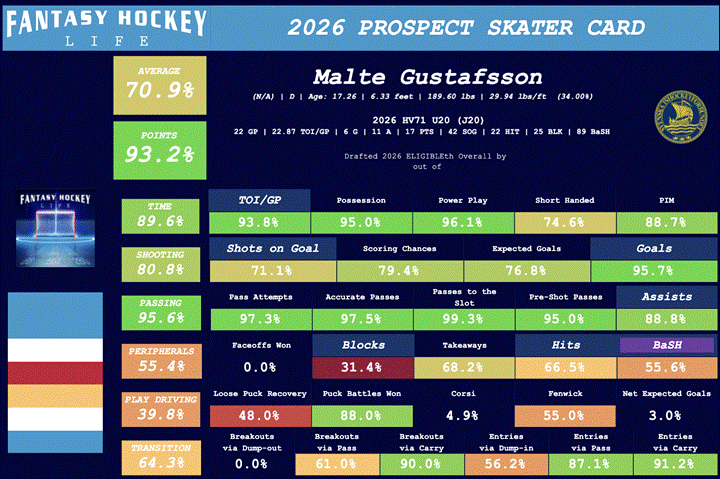
The fantasy upside may be somewhat limited compared to players such as Bleyl, Villeneuve, or Lin. However, his combination of size, defensive awareness, and overall reliability gives him a relatively safe NHL projection.
Best Case: Jonas Brodin-type two-way defender capable of playing heavy minutes.
Most Likely Outcome: Reliable top-four NHL defenseman who contributes in all situations.
–
Juho Piiparinen
Piiparinen represents another player whose NHL value may exceed his fantasy value. He demonstrates defensive intelligence, gap control, positioning, and overall reliability. What stands out is how comfortable he already looks against professional competition in Finland’s Liiga. His offensive toolkit is solid but not exceptional.
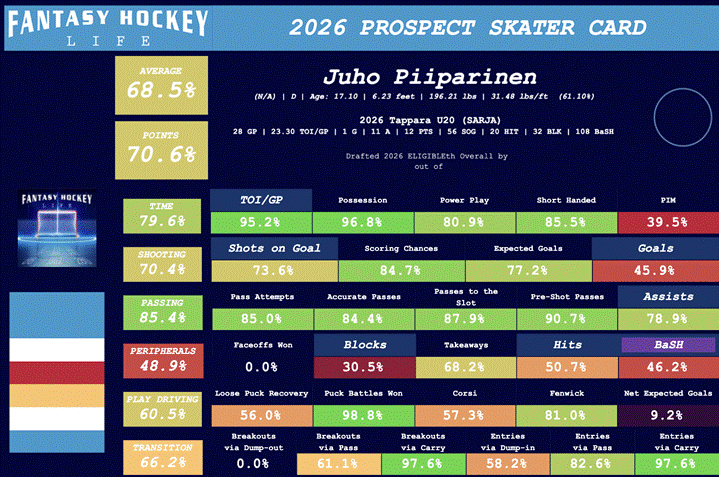
Unlike some players on this list, there is little indication that he will become a primary offensive driver. That limits his fantasy ceiling but significantly strengthens his NHL projection.
Best Case: Brett Pesce with slightly more physicality.
Most Likely Outcome: Reliable second-pair NHL defenseman.
Skill Rankings
Best Skaters
- Chase Reid
- Ryan Lin
- Keaton Verhoeff
- Tommy Bleyl
- Albert Smits
Highest Hockey IQ
- Chase Reid
- Tommy Bleyl
- Xavier Villeneuve
- Carson Carels
- Juho Piiparinen
Highest Offensive Ceiling
- Xavier Villeneuve
- Chase Reid
- Tommy Bleyl
- Carson Carels
- Ryan Lin
Best Defensive Projection
- Keaton Verhoeff
- Albert Smits
- Malte Gustaffson
- Juho Piiparinen
- Chase Reid
Safest NHL Projection
- Keaton Verhoeff
- Albert Smits
- Chase Reid
- Malte Gustaffson
- Juho Piiparinen
Final Thoughts
Unlike some recent drafts that featured a clear-cut elite defense prospect, the 2026 class is defined by depth, variety, and projection.
Reid currently stands as the most complete defender in the group, while Carels, Bleyl, Villeneuve, and Lin offer some of the highest offensive ceilings. Verhoeff appears to possess the safest blend of intelligence, skating, and defensive reliability. Smits, Gustafsson, and Piiparinen project as the type of dependable two-way defenders NHL organizations covet, even if their fantasy ceilings may be more modest. Rudolph remains one of the class’s most intriguing wild cards.
Thanks for reading! See you next week. For more fantasy hockey analysis, or if there's a prospect, topic, or theme you'd like me to cover, follow and message me on X: https://x.com/VictorNuno12
Related Posts

Starting Goalies



Top Skater Views
| Players | Team | |
|---|---|---|
| ROOPE HINTZ |
 DAL DAL | |
| ALEX LAFERRIERE |
 L.A L.A | |
| LUKE HUGHES |
 N.J N.J | |
| OWEN TIPPETT |
 PHI PHI | |
| KEVIN FIALA |
L.A
| |
Top Goalie Profile Views
 WSH
WSH CBJ
CBJ MIN
MIN UTA
UTA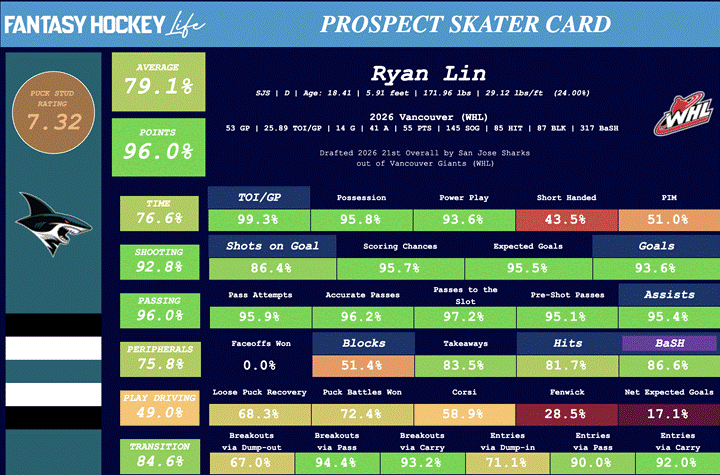


LINE COMBOS
| Frequency |
L.A Players
| |
|---|---|---|
| 19.1 | JARED WRIGHT ALEX TURCOTTE SCOTT LAUGHTON | |
| 15.4 | ARTEMI PANARIN TREVOR MOORE QUINTON BYFIELD | |
| 14.6 | ALEX LAFERRIERE ANZE KOPITAR ADRIAN KEMPE | |
DobberHockey Podcasts

Keeping Karlsson: The 2026-27 Keeping Karlsson Breakfast Club
Don’t you forget about them! Elan and Brian remind you of at least one player on each NHL team whose name you might forget to consider at the draft table.

Fantasy Hockey Life: Tampa Bay Lightning with Erik Erlendsson
Erik Erlendsson joins the program to discuss the Tampa Bay Lightning. Jesse and Victor ask about pros Nikita Kucherov, Jake Guentzel, Brandon Hagel, Brayden Point, Anthony Cirelli, Ilya Mikheyev, Gage Goncalves, Conor Geekie, Benjamin Rautiainen, John Carlson, Victor Hedman, Charle-Edouard D’Astous, Andrei Vasilevskiy, Jonas Johansson, and Dennis Hildeby. In Cat’s instincts, Cat Silverman of InGoal […]
Fantasy Hockey Life: New York Rangers with Colin Stephenson
Colin Stephenson joins the program to discuss the New York Rangers.
Keeping Karlsson: Matchup Maximizer Schedule Deep Dive
Elan is joined by the Keeping Karlsson Accountability Czar Trev to take a deep dive into the NHL schedule for next season and how it should affect our drafting decisions.
Fantasy Hockey Life: Carolina Hurricanes with Ryan Henkel
Ryan Henkel joins the program to discuss the Carolina Hurricanes. Jesse and Victor ask about pros Sebastian Aho, Seth Jarvis, Andrei Svechnikov, Nikolaj Ehlers, Jackson Blake, Logan Stankoven, Jordan Staal, Bradly Nadeau, Felix Unger Sorum, Shayne Gostisbehere, K’Andre Miller, Alexander Nikishin, Sean Walker, Brandon Bussi, and Pyotr Kochetkov. In Cat’s instincts, Cat Silverman of InGoal […]