

Frozen Tools Forensics: Positive and Negative Regression Candidates from the Atlantic Division
Chris Kane
2026-08-14
This week we are returning to our division reviews and identifying candidates to bounce back and candidates to avoid on draft day. We have already reviewed the Pacific, Central and Metro Divisions, so today we move on to the Atlantic
As a reminder here is a little context setting from the original article.
To make this process a bit more concrete we are going to focus on three stats from the Dobber Reports; five on five team shooting percentage (5on5 S%), individual points percentage (IPP), and individual shooting percentage (S%). These are certainly not the end all be all of player evaluation but do tend to flag players who are likely to see a different point pace in the future.
Before jumping into the players, let's do a quick refresher on what these stats tell us. We use team shooting percentage to get an idea of how many points are being scored while a player is on the ice. We use five on five because that is the largest game state for players. Power-play points count just the same on the score sheet so we could look at that as well, but in the interest of cutting down our data points we are going to focus on 5-on-5. IPP, which we will sometimes refer to as a player's points participation, is how often a player is getting a point on a goal that is scored while they are on the ice. Finally, shooting percentage is just the standard: what percent of a player's shots are going into the net?
With all of these stats, it is important to take them into context. Not just what would an average player do, but how does this number compare to their career numbers? To do that I grabbed the same data points for the 2025-26 season and am comparing them to each player's recent career average. Broadly speaking, and barring changes in the player's situation (changing teams, sudden promotion to a top line etc.) we would expect these numbers to return to that career average.
For our first group we are looking at players whose underlying numbers were lower than their recent career averages. Generally speaking, we might expect these numbers to revert to those averages and therefore those players to have a bit more production in the future.
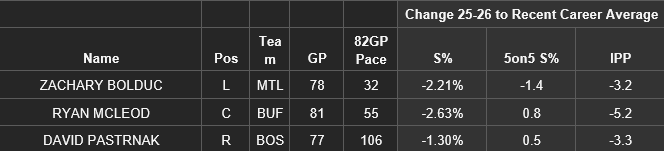
Honestly, it was a challenge to find players in the Atlantic who were fantasy relevant and potentially deserved better. Take Zach Bolduc for example. His 32-point pace is hardly relevant, but he did spend time on the top line, and his numbers indicate that maybe he should have gotten a few more points. The problem is that he only played 13 and a half minutes a night on average, dropped his shot rates from the 2024-25 season, and that implied improvement might only have put him in the 35- to 40-point range instead of 30-35. There just doesn't seem to be that much space in the top six in Montreal right now, but that is where Bolduc will need to be to see any meaningful sort of improvement.
Ryan McLeod makes the list primarily because there was a big drop in his points participation numbers between his first season and his second season in Buffalo. Despite that, he put up an identical 55-point season. The question is just which of these seasons is the real season? Still, his ice time jumped over 17 and a half minutes overall, and 30 percent of the team's power-play, which given his other stats could have earned him closer to a 60-point season. He does need to improve his shot rates though. Even with that increased time, he has actually decreased his shot rates consistently since 2022-23, and it isn't like he was shooting a lot to begin with. Ultimately 55-60 points seem reasonable if he continues to get more than 17 minutes a night.
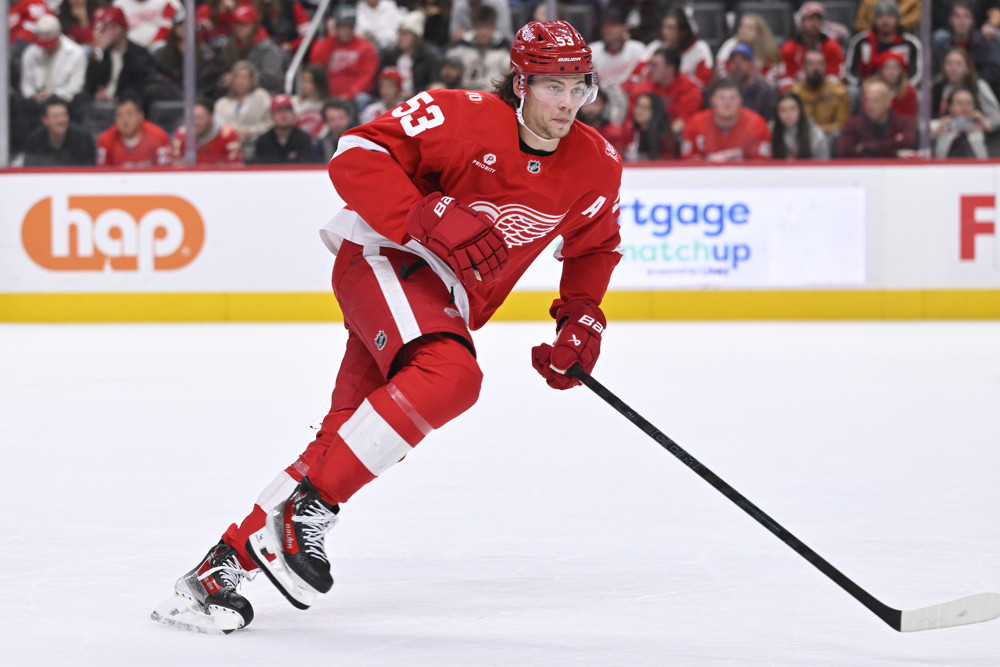
David Pastrnak makes the list here, but ultimately, we aren't looking at a big swing in production. He put up a 106-point pace over 77 games when if he scored a bit closer to those recent averages, he would have ended up around 110. So yes, could he have done a bit better, but we are very much still in the same ballpark.
Overall, we have very few players who seem in line for a natural bounce back in the Atlantic. Unfortunately, we have quite a few players whose underlying numbers were a bit higher than we expected, meaning that their production might not be the most sustainable. We won't go into all of them here, but some honorable mentions include: Sam Bennett, Victor Arvidsson, Casey Mittlestadt, Justin Faulk, and Drake Batherson.

Alex Newhook put up a 50-point pace for the second time in three seasons so surely at age 25 he is finally hitting his stride right? Unfortunately, the answer is very likely no. In 2023-24 he was actually doing the thing. He saw promotion to the top six and top power-play, got about 17 minutes a night overall, and put up a potentially legitimate 50-point season. In 2024-25 he did not get that deployment and dropped down to a 26-point pace. In 2025-26 he averaged even less time than in 2024-25, down to 14 and a half minutes a night with only 20 percent of the team's power-play time. He also only played 42 games, so obviously with a small sample his scoring pace is highly impacted by some percentage benders. That is exactly what happened in 2025-26, essentially across the board. If he were scoring at his usual pace he would have been around a 30-point pace. He did get some second line duties with Ivan Demidov and was the hero a couple of times during the playoffs so maybe there is an opportunity for growth in 2026-27, but the baseline here is about 30 points.
Brad Marchand stepped up in a big way in Florida's tank of a season, breaking the 80-point pace marker for the first time since 2021-22. Unfortunately, he has been dropping ice time consistently for years, and is on this list so clearly all this production wasn't for real. It looks like he earned about 75 points rather than 85, but the real question is deployment. With Aleksander Barkov, plus Matthew and Brady Tkachuk all back for a full season, what are the lines and the power play going to look like? Marchand will need access to decent deployment to have a chance at repeating this production.
Pavel Zacha had a wild end of the season with 28 points over his final 23 games. It resulted in a 68-point pace season over the full 78 games he played. He was on a line with another possible entry to this list, Viktor Arvidsson, which should give some kind of indication of what to expect here. He almost doubled his shooting percentage from 2024-25 and was high across the board in other places as well. On the plus side, he did see some time on the top power-play with David Pastrnak, so perhaps he won't crater as much as he would otherwise. Ultimately, he probably earned a 55- to 60-point pace compared to his 68-point actual pace. Looking forward to next season, that seems like a much more reasonable point projection than 70 points.
That is all for this week.
Do your part to support organizations working to make hockey for everyone.
Related Posts

Starting Goalies



Top Skater Views
 S.J
S.J CHI
CHI N.J
N.J COL
COLTop Goalie Profile Views
 T.B
T.B MTL
MTL STL
STL PIT
PIT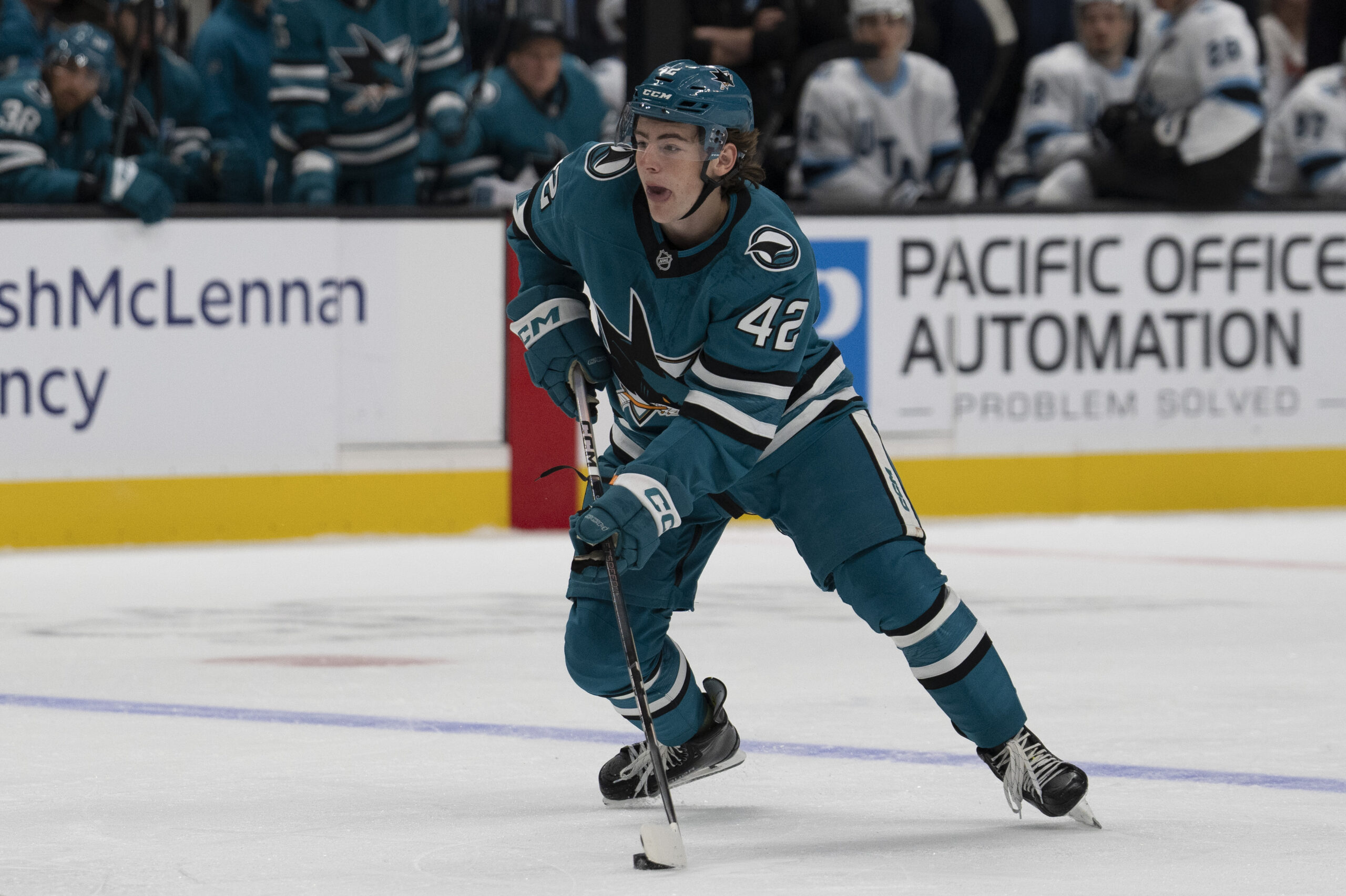

LINE COMBOS
| Frequency |
 VGK Players VGK Players
| |
|---|---|---|
| 21.2 | MARK STONE JACK EICHEL IVAN BARBASHEV | |
| 17.5 | MITCH MARNER WILLIAM KARLSSON BRETT HOWDEN | |
| 16.2 | VICTOR OLOFSSON TOMAS HERTL TREVOR CONNELLY | |
DobberHockey Podcasts

Keeping Karlsson: Shabanov Ranks
Elan and Brian fly through the final preseason lines for every NHL team ahead of opening night, and share their guys to watch– or look away from– in your fantasy hockey leagues.

Fantasy Hockey Life: Western Conference Catchup and Mustard
Jesse and Victor are here to Catch Up on everything in the Western Conference that transpired ofter our team previews. We also have our annual spicy mustard competition – two hot takes per team. Our show is part of the Dobber Podcast Network and sponsored by Fantrax.com. Email [email protected] and ask to join our free […]
Keeping Karlsson: Matchup Maximizer 2026/27 Week 1
Elan takes a look at the schedule for the upcoming weeks of NHL action and recommends players with good schedules that you should consider streaming in to win your head to head matchups.
Fantasy Hockey Life: Dallas Stars with Taylor Newby
Taylor Newby joins the program to discuss the Dallas Stars.
Keeping Karlsson: KKUPFL Tier 1 Draft Roundtable
Elan and Brian are joined by several KKUPFL Tier 1 managers, to bring you inside their draft table decisions and thought processes in building the teams competing in the top division of the world’s best fantasy hockey league.