

Ramblings: Fantasy Value Comparisons between MacKinnon/Kaprizov, Sherwood/Bratt, Eklund/Svechnikov, and Hughes/Clarke – September 1
Michael Clifford
2026-09-01
We have reached September and the NHL regular season starts in four weeks. Rookie camps start next week, training camps shortly after that, and then we're ready to rock for an 84-game campaign. Fantasy hockey draft season is truly here. It is time to look ahead to the season and start our fantasy valuations. I have mostly finished my personal projections – I need to add empty net situations and rookies to my data – but we are 95% of the way there. It is a good time to start sifting through player values.
***
Be sure to grab a copy of Dobber's 2026-27 Fantasy Hockey Guide, which is available now in the Dobber Shop! It has team-by-team outlooks, a customizable draft list including projections, a breakdown of the new schedule, players to target for peripheral stats, sleeper picks in each conference, and a whole lot more. It is also updated until the start of the regular season to reflect new signings, trades, injuries, or anything else. Support what we do year-round and get a headstart on your league mates by ordering the 2026-27 Fantasy Guide in the Dobber Shop!
***
I created an app to compare player fantasy values to replacement level talents at their position, and on a per-game basis. We are using Goals, Assists, Shots, Blocks, Hits, and Power Play Points for our measures. We will divide between forwards and defencemen, each player is projected for 84 games, and then those projections are compared to the replacement-level output last season at their position.
For replacement level, I am using 12-team leagues that have 11 forwards, 6 defencemen, and 3 goalies per roster. That means 132 forwards and 60 defencemen are selected. I found the 132nd-ranked fantasy forward from last year and averaged each stat for the 10 forwards above and below them, then I found the 60th-ranked defenceman from last year and averaged each stat for the five defencemen above and below them. That gives us our 'replacement' values that we are using for comparing 2026-27 projections.
Comparison 1:
Nathan MacKinnon (Colorado Avalanche) vs. Kirill Kaprizov (Minnesota Wild)
This comparison is just to show how much of a gap there is between the truly super-elite players and even a top 10 pick. Judging by most average draft positions I've seen so far, MacKinnon is the expected top pick and Kaprizov is somewhere between the 7th and 10th pick. Both are first rounders, but the true value gap between them is much larger than the title of 'first-round pick' indicates:
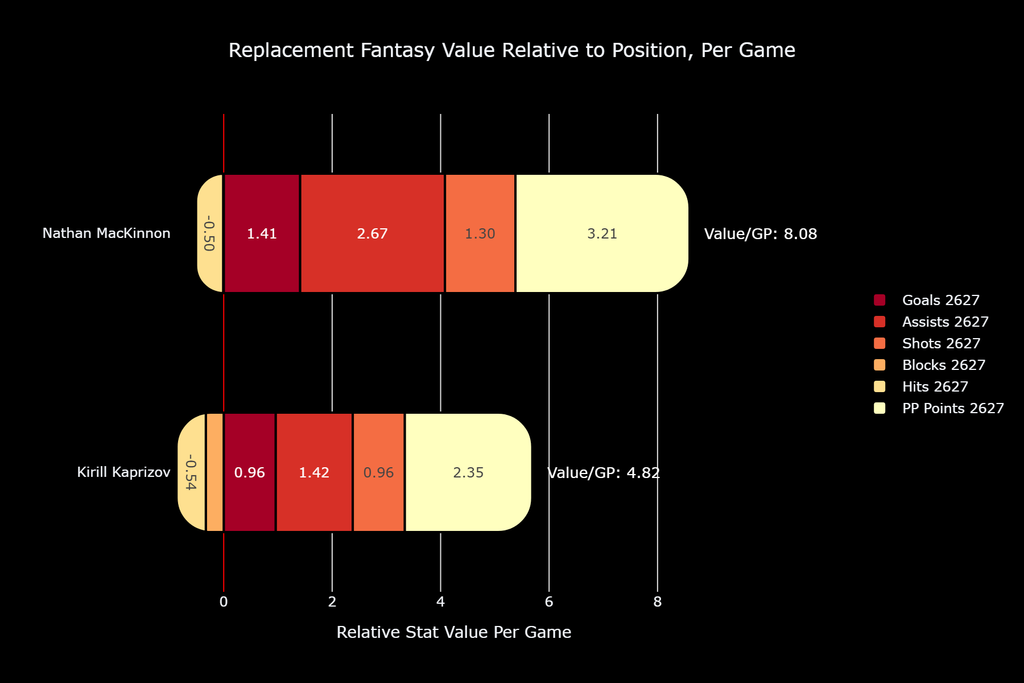
Despite both being top 10 picks, the per-game fantasy value gap between MacKinnon and Kaprizov is nearly 68%. In my projections, the per-game fantasy value gap between MacKinnon and Kaprizov is about the same as between Kaprizov and Adam Fantilli, and my projections value Fantilli as a 7th round pick.
Even if I were to move down the draft board and use Nikita Kucherov instead of MacKinnon, his expected per-game fantasy value surplus over Kaprizov is about 37%. That gap is about the same as between Kaprizov and a top 30 forward. That doesn't tell the whole story because if someone is drafting 1st overall, then they get the 24th pick, and it's about whether the 1st and 24th picks are better than, say, the 12th and 13th picks. (For posterity, my projections still say that having 1st and 24th is better than 12th and 13th, but the combined value gap shrinks considerably to about 10%). All the same, fantasy managers have to look at the top of the draft the same way NHL General Managers look at the Entry Draft: picking in the top 3 is nowhere near the same as picking in the 8-10 range.
Comparison 2:
Kiefer Sherwood (San Jose Sharks) vs. Jesper Bratt (New Jersey Devils)
In a multi-cat fantasy format, valuing players who contribute heavily to just one category is always tricky. It isn't that they bring absolutely nothing elsewhere – players don't put up 0 goals, 0 assists, 0 shots, and 300 hits – but it's about what a fantasy roster needs; if a fantasy manager has Brady Tkachuk, Tom Wilson, and Moritz Seider on their roster, then having Kiefer Sherwood is not only redundant, but probably harmful.
All the same, that Sherwood can contribute so well to one category while helping in a couple of others, and not hurting too much elsewhere, is what makes him nearly as valuable as a potential 90-point forward like Jesper Bratt:
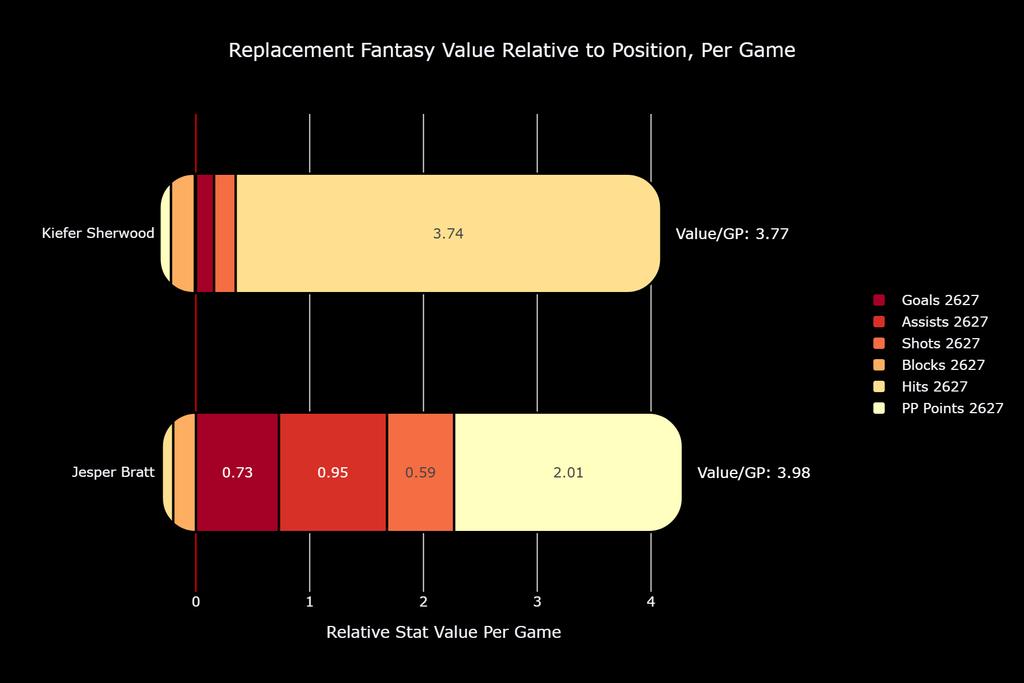
It is worth reiterating that what makes Sherwood valuable specifically is he isn't a huge drag in a bunch of categories, which is often the case with someone possessing this kind of banger profile. For example, Sherwood had just six fewer shots last season (172) than Adam Klapka and Yakov Trenin combined (178). Sherwood's fantasy value is derived from one category, but that isn't what makes him valuable. What makes him valuable is he's not a killer in several other categories.
Sherwood's profile, and others similar to him like Will Cuylle and Mathieu Olivier, need to be treated differently than the bangers like Klapka, Trenin, and so on. All should bring a lot of hits, but one group consists of players who can actually bring value to a fantasy roster, while the other group only brings value to one specific category while hurting in most, if not all, the others. Do not lump them together.
Comparison 3:
William Eklund (Ottawa Senators) vs. Andrei Svechnikov (Carolina Hurricanes)
This one stood out for two reasons:
- I was not expecting Eklund's projection to be as strong as it is.
- It further highlights how different types of players can bring similar fantasy value.
Eklund is a drag in the hits department while they are the second largest source of Svechnikov's value. All the same, this duo is projected to provide similar fantasy value on a per-game basis:
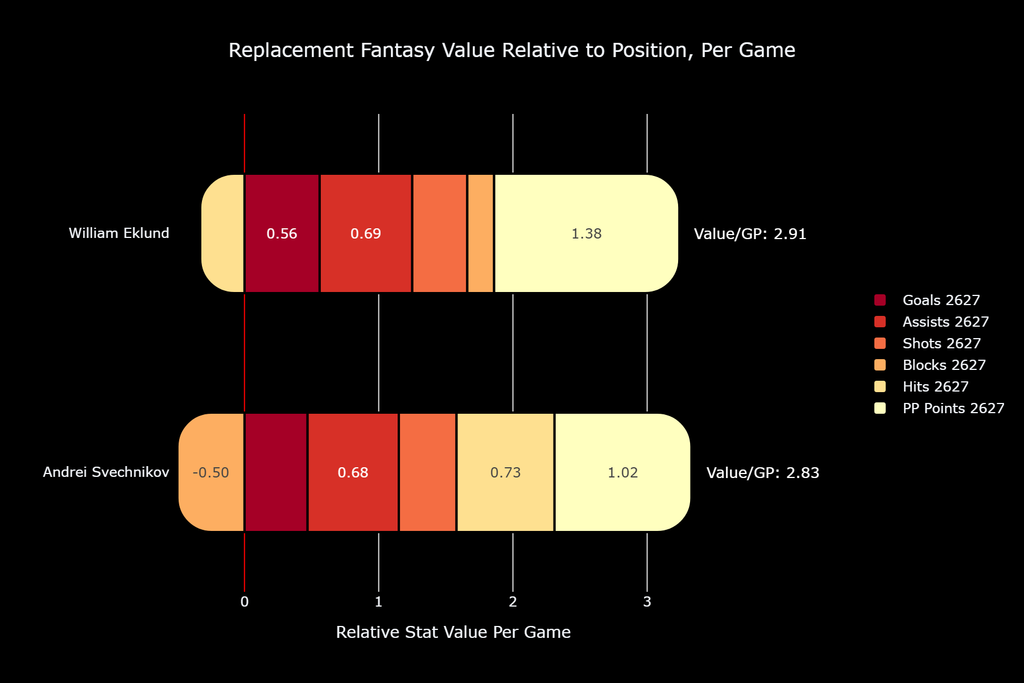
The similar fantasy value is pretty important when considering some of their early ADPs: on Fantrax, Svechnikov's draft position is in the late sixth round while Eklund's is in the early 12th round. Things are closer on Yahoo but still separated by a few rounds. For fantasy managers just looking for overall value, rather than help in specific categories, this is a good opportunity.
It should also be said that my projections are far more bullish on Eklund than the Dobber Fantasy Guide: my projection is 29 goals and 43 assists in 84 games, and the Fantasy Guide is for 18 goals and 39 assists in 80 games. The big difference is shooting percentage, as I have him scoring 29 goals on 204 shots, or 14.2% shooting, and the Fantasy Guide has him with 18 goals on 193 shots, or 9.3%.
For me, the rebound is on the power play. Last year, Eklund shot 8.3% on the power play, but he exceeded 20% shooting in each of the two prior seasons. I have his PP conversion rate getting to 19% with his PP goal total tripling (from 3 to 9). That is over half the goal difference between me and the Dobber Guide, so this all comes down to the Ottawa power play and Eklund's performance on it. Even if he's 10% worse than my projection, I still think he's a value outside the top 125 picks.
Comparison 4:
Luke Hughes (New Jersey Devils) vs. Brandt Clarke (Los Angeles Kings)
With a similar ADP gap we just saw with Eklund and Svechnikov, we have a comparison between the youngest Hughes brother and Los Angeles' top fantasy defenceman. On Fantrax, Hughes' early ADP is somewhere between the 11th and 12th rounds while Clarke is valued as a seventh-round pick. On Yahoo, the disparity shrinks but is still about 2.5 rounds of value. That is what makes their per-game fantasy projections stand out:
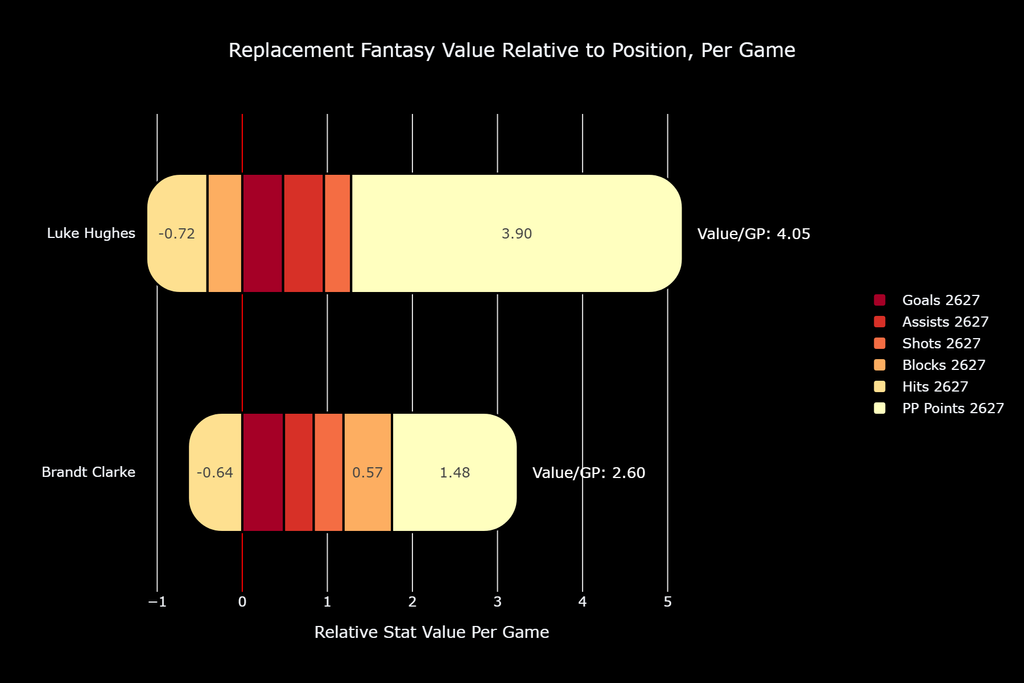
As is obvious in that graph, Hughes' value entirely hinges on not only being the top PP defenceman in New Jersey but being very productive with it. That is what my projections are assuming, which is why he's coming in with 27 power-play points. The projections also believe that Clarke will have less PP production on a per-minute basis but is also not locked into a top PP role (I still believe that the Kings will run a 5-forward power play a fair amount). A lower points-per-minute rate and less overall PPTOI is the difference here.
This is often the case with non-elite fantasy options. Any fantasy format that specifically values PP production as its own category has a massive impact on overall fantasy value. Consider that just 34 defencemen had 10 power-play points last season, and this fantasy format assumes 60 defencemen are drafted. Roughly half of all defencemen drafted in this format will not have double-digit PP production, so someone who can put up 2x-3x the PP production of an average blue liner in that league brings immense value, and that's the deal with Hughes.
That also shows the downside. If I'm wrong about Hughes, and Dougie Hamilton is the top PP guy for most of the year, then Hughes falls from a top-20 defenceman to a top-40 defenceman. The good news is that Hughes is not being drafted as a top 30 defenceman either on Fantrax or Yahoo. Things may change depending on specific fantasy settings, but if Hughes is going outside the top 30 defencemen, the worst-case scenario (barring injury) is he's being drafted where he should be. If I end up being right about the New Jersey power play, Hughes is one of the best draft values on the board, regardless of position. Something to keep in mind.
Related Posts
Starting Goalies







Top Skater Views
 DET
DET CHI
CHI BOS
BOSTop Goalie Profile Views
 EDM
EDM NYR
NYR MTL
MTL S.J
S.J WSH
WSH

LINE COMBOS
| Frequency |
 STL Players STL Players
| |
|---|---|---|
| 30.8 | ROBERT THOMAS JIMMY SNUGGERUD DYLAN HOLLOWAY | |
| 16.6 | MASON MCTAVISH CONNOR MCMICHAEL JONATAN BERGGREN | |
| 16.0 | PIUS SUTER JAKE NEIGHBOURS DALIBOR DVORSKY | |
DobberHockey Podcasts

Keeping Karlsson: Short Shifts – NHL Frozen Frenzy Recap
Elan and Lewis recap the Frozen Frenzy as well as two big returns and more!
Keeping Karlsson: Delusions of Garandeur
Elan and Brian dive into the latest NHL hot streaks, cold streaks, line changes, outjuries, injuries, buy-lows and sell-highs to give you top notch tips in your fantasy hockey league

Fantasy Hockey Life: TiDy Takes Part 2
Last week, Victor Nuno and Ryan Downey broke down trades from our top tier dynasty league. This week, they consider some dynasty trades from other divisions. Have a listen! Our show is part of the Dobber Podcast Network and sponsored by Fantrax.com. Email [email protected] and ask to join our free discord. Join our Patreon at […]
Keeping Karlsson: Matchup Maximizer 2026/27 Week 3
Elan takes a look at the schedule for the upcoming weeks of NHL action and recommends players with good schedules that you should consider streaming in to win your head to head matchups.
Keeping Karlsson: Short Shifts – Sharks Looked Like Celebweenies
Elan recaps the major injuries, outjuries, game results and changed line combos that we’ve seen since Sunday’s mega-show.