

Eastern Edge: Power Play Splits in New Jersey and Tampa Bay, Stankoven’s Hot Start, Montreal’s Goaltending Trio, and more
Khurram Sher
2026-11-10
In today's article, we will take a tour of the Eastern Conference with a special focus on defenseman and goalies.
Some interesting time on ice numbers that caught my eye when scanning the box scores included Dougie Hamilton (4:24) getting more power play time than Luke Hughes (1:59) in Saturday's game against the New York Islanders. This was partly due to a 5 on 3 situation where Sheldon Keefe deliberately wanted shooters. On Sunday, Luke Hughes was back to manning the usual PP1 with Jack Hughes, Jesper Bratt, Nico Hischier, and Connor Brown. Both Hamilton and L. Hughes have three points in their last four games.
Justin Faulk (2:53) had more power play time than Moritz Seider (1:54) against the Colorado Avalanche, who were able to stifle the Red Wings offense and hold them to zero goals. At 9:34 of the third period, Seider got a roughing penalty and a fighting major for a tilt against Gabriel Landeskog. Seider didn’t come back on the ice for the remainder of the game and finished with a time on ice below 20 minutes for the first time this season. Seider has 10 points (all assists) in 18 games for a 0.56 ppg. As long as his PP1 deployment is not threatened, he should be able to augment those numbers based on a low 5v5 shooting percentage (6.1%) and a low personal shooting percentage (0%, no goals on 32 shots).
The Tampa Bay power play went 3 for 6 on Saturday. Both John Carlson and Charle-Edouard D’Astous have been on the top unit. D’Astous is tied for 6th in the league for most 90+ MPH shots. Brayden Point was injured in the first period of Sunday’s game; Brandon Hagel replaced him on the top PP. On Sunday, the Lightning went 0 for 4 on the man advantage. Tampa Bay is a perfect 8-0-0 at home. They have a six-game homestand starting on November 14.
The Carolina Hurricanes also used two defenseman on their top power play: Alexander Nikishin and Shayne Gostisbehere. Nikishin scored a goal and added an assist in his first game back. He was +3 with two blocked shots. Nikishin doesn’t want to extend in Carolina, so there could be an element of showcasing involved here. Jesperi Kotkaniemi led the Canes in power play time in a game that got out of hand quickly. Gostisbehere had a career high 0.91 points per game last year, and has started hot this year as well (0.74 ppg). His 5v5 shooting percentage is slightly high (13.8%), but his IPP and secondary assist rates are a bit lower than usual, so he is neither a buy low or a sell high in my opinion.
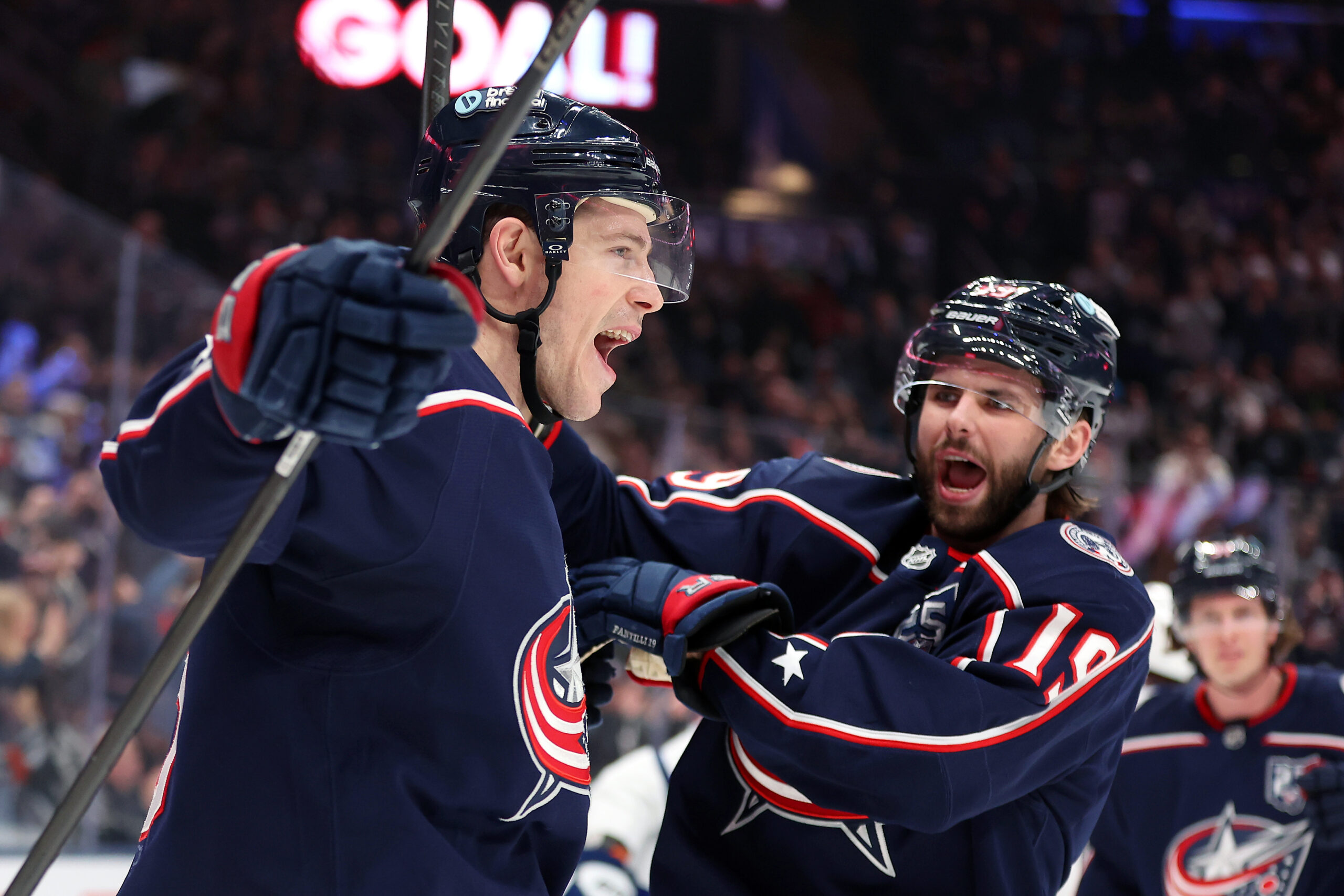
Logan Stankoven produced 0.54 points per game last campaign but upped it to 0.84 ppg over the 19-game playoff run that culminated in a Stanley Cup championship. This year he has scored 18 points in 19 games (0.95 ppg) including three-point performances against the Winnipeg Jets and the Vancouver Canucks (twice). He is only 23 years old and is getting 16:52 average ice time per game, which is nearly a minute and a half more than last year (15:27). With his early season success confirming his 2026 playoff heroics, he could be someone that many managers view as a young player that is in the process of breaking out. He was after all the crown jewel of the Mikko Rantanen trade to the Dallas Stars, who selected Stankoven 47th overall in 2021. There are two reasons to be cautious: 1) The way Rod Brind’Amour distributes his ice time, it is difficult for anyone to break out. 2) Stankoven has had a high personal shooting percentage in both last year’s playoffs (20%) and in the 19 games to start this year (20%). For his career, he is 11.2%. Crunching the point totals using his career shooting percentage, his points per game last playoffs falls to 0.59, and this season’s points per game drops to 0.69. These rates are closer to his career 0.56 points per game. It is possible that he has decided to become more selective with his shots, but it is more likely he is seeing an extended span of good luck. If I were a Stankoven owner, I would take advantage of his reputation as a young player potentially breaking out, and shop him around to see if I can flip him for someone who is a more proven point producer that is not being help up on such ballooned percentages.
Sam Ersson has never put together a season with a save percentage higher than 0.899%. However, he has only given up six goals in his last 3.5 games, putting up save percentages of 0.938, 0.958, 0.957, 0.909. With Linus Ullmark returning from injury, the Senators should have some newfound confidence in their backup position with Ersson’s improved play. Ullmark is second in the league in GSAx/60 (1.107).
The league leader in GSAx/60 is Jacob Fowler (1.117). Due to being waiver exempt, he started the year in the AHL, but a Samuel Montembeault injury opened the door for a call up. Fowler’s play (8-1-1, 0.925%, GAA 2.15) has left the Montreal Canadiens no choice but to keep him with the big team. Kent Hughes has gone on record to state that he doesn’t want to carry three goalies, making Samuel Montembeault (one year left at $3.15M AAV) a likely trade candidate. Montembeault's return is getting closer: he was on the ice Saturday morning at the Habs practice facility. Fowler’s value is so high that in an auction contract league with a salary cap, I was able to acquire Aleksander Barkov and Mackenzie Blackwood for Fowler (who I had signed to a cheap contract). Montembeault makes a sneaky IR stash, as a trade might give him an opportunity for starts.
Owen Power‘s 14 points in 17 games (0.82 ppg) is surprisingly higher than Rasmus Dahlin‘s 0.71 ppg (10 in 14). Power’s average ice time of 25:59 is fifth in the league. Dahlin isn’t far behind at 24:26, but remember he only played 9:06 in the game that he got injured, which brings his average down. With Bowen Byram gone, Power has PP2 on lockdown, but it won’t be enough to keep him ahead of Dahlin in scoring in the long run. Two metrics that have gone Power's way include his points participation percentage of 60.9% (was 33.7% last year), and his shooting percentage 9.1% (career 5.5%), both of which should regress down to his baseline.
That is all the analysis for this week! Will get working on next week's article to help give you the edge in player assessment!
Player data from Frozen Tools. Advanced stats from Money Puck. Shot speed from NHL EDGE stats.
Follow me on X/Twitter here: @KmanHockey_DH
Related Posts
Starting Goalies













Top Skater Views
 MIN
 ANA
 T.B

Top Goalie Profile Views
| Players | Team | |
|---|---|---|
| DEVON LEVI |
 EDM | |
| JOSEPH WOLL |
 PHI | |
| DYLAN GARAND |
 NYR | |
| KAREL VEJMELKA |
 UTA | |
| JACOB FOWLER |
 MTL | |
LINE COMBOS
| Frequency |
NYR Players
| |
|---|---|---|
| 23.9 | MIKA ZIBANEJAD GABE PERREAULT ALEXIS LAFRENIERE | |
| 23.4 | J.T. MILLER TYE KARTYE PAVEL DOROFEYEV | |
| 15.0 | NOAH LABA WILL CUYLLE OLIVER BJORKSTRAND | |
DobberHockey Podcasts

Keeping Karlsson: The Life D’Astous
Elan and Brian visit a cluster of NHL creases, highlight hot and cold power play units, and offer several sell-high opportunities around the league.

Fantasy Hockey Life: New York Islanders and Chicago Blackhawks Prospects
Today, Victor and Jesse talk prospects from the Islanders and Blackhawks. Discussed are: Dmitri Gamzin, Kashawn Aitcheson, Victor Eklund, Cole Eiserman, Kamil Bednarik, Quinn Finley, Anton Frondell, Roman Kantserov, Vaclav Nestrasil, Marek Vanacker, Sascha Boisvert, and Nathan Béhm. Have a listen! Our show is part of the Dobber Podcast Network and sponsored by Fantrax.com. Email […]
Keeping Karlsson: Matchup Maximizer 2026/27 Week 7
Elan takes a look at the schedule for the upcoming weeks of NHL action and recommends players with good schedules that you should consider streaming in to win your head to head matchups.
Keeping Karlsson: Short Shifts – Big Fantasy News
Elan covers all the big fantasy news since last Sunday’s mega-show in a tight sub-30 minute Short Shift.
Keeping Karlsson: Farabee Sharp
Elan and Brian talk through unhappy players (and the players they’ll eventually leave behind), Calgary’s surprising success, top tier power-play performances, sell high opportunities and buy-low mirages.