

Ramblings: Fantasy Guide Soon; Kakko Extension in Seattle; Projecting Ice Time for Players Changing Teams – July 24
Michael Clifford
2025-07-24
The 2025-26 Dobber Hockey Fantasy Guide is being assembled as we speak and will be ready for release next week, so be sure to pre-order a copy right now! It will have projections, a draft list, and plenty of articles covering category-specific options in fantasy drafts, players on the rise or decline, a team-by-team review, and a whole lot more. Aside from just the Guide, there is also the Dobber Hockey Keeper Pack which includes the 2025 Prospects Guide. Whether looking for just this season, or preparing for future seasons, the Keeper Pack has you covered so help support what we do by grabbing either today!
*
Kaapo Kakko and the Seattle Kraken have avoided their arbitration hearing by agreeing on a three-year extension for $4.525M per season. Kakko was traded to Seattle in December and proceeded to put up 10 goals and 30 points in 49 games with his new team. He will turn 24 years old in February.
While Kakko hasn't turned into a great point producer, he has been solid for the ice time he's been given. Over the last three years at 5-on-5, here are the comparable wingers to Kakko in terms of goals and primary assists per 60 minutes, limited to wingers who skated top-6 minutes (roughly 12:40 per game):

Those aren't elite producers or anything, but Conor Garland has two 20-goal campaigns and two 50-point efforts while Troy Terry has at least 20 goals and 30 assists in each of the last four years. The difference with Garland is that his most recent 50-point season came in a year where he skated 18:39 per game while Terry has surpassed the 18-minute mark in each of those four 20-plus-goal, 30-plus-assist seasons. Kakko has yet to reach the 18-minute mark in any of his six seasons.
Is there some hope Kakko gets that bigger role in Seattle? After joining the Kraken, he skated 17:03 per game, which would be a career-high for a full year. From the point he joined the team on December 18th, he was fourth among forwards in share of even strength ice time and second among wingers. When looking at just even strength and power-play time per game, he was also fourth, per Frozen Tools:
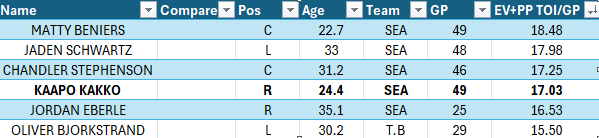
The team no longer has Oliver Bjorkstrand, but they did bring in Mason Marchment, so let's call that a wash. A big chunk of Kakko's games were without Jordan Eberle in the lineup, and Kakko did lose 31 seconds per game once Eberle returned, but even a small downtick to 16:32 per appearance is over three more minutes than his final two years in New York.
The difference between the two locales is the power-play time he got in Seattle, which was a shade under 2:00 each contest. His six power-play points in 49 games with the Kraken was as many as he had his previous 187 games with the Rangers. While splitting power-play time hurts the fantasy upside of the high-end players, Kakko getting this PPTOI that he never got with the Rangers helps. It takes him from a guy we can't rely on for more than 40 points to a guy who can reach 50 points.
It is also notable that Kakko was a lot more physical last year than normal. His 38 PIMs in 79 games was a career-high and a huge jump considering he was a guy who averaged 17 PIMs every 79 games in his first five seasons. He also had 68 hits, which was a career-high, and far exceeding 25 hits/79 games he averaged in those first five years. If those changes are permanent (always a big 'if'), there is a big difference between being a 15-goal, 25-assist, 20-PIM, 25-hit guy and being a potential 20-goal, 30-assist, 35-PIM, 70-hit guy.
There may be changes because Seattle has a new coach in Lane Lambert, so he's going to have his own hierarchy of player usage. It also seems likely that Kakko doesn't reach the scoring upside commensurate with being a second overall pick. But he's now in his prime, will hopefully retain that bigger role, and may be positively changing his peripheral profile. This isn't the same player who entered the 2024-25 campaign destined for New York's third line, and that's something to keep in mind for deeper fantasy drafts.
*
The last handful of Ramblings has started an offseason series about going step-by-step in creating projections. This is what we have so far:
- Stats we should and should not consider when projecting ahead.
- Some differences between forwards and defencemen.
- Changes in ice time at the league level.
- Projecting ice time levels from one season to the next at the player level.
Today, we're sticking with ice time but looking at a special group: players changing teams.
As we saw in the Ramblings on Tuesday, the players who can add a lot of ice time to their profile are those on new rosters. In fact, of the 20 largest risers by TOI per game in 2024-25, 14 of them were on a different team than in 2023-24 (including players traded in-season like Dante Fabbro and Olli Maatta).
The reason we have to look at players changing teams specifically is because ice time levels vary far more than for players remaining with the same team. For example, here is the R-Square in ice time per game among defencemen who changed teams from 2023-24 to 2024-25:

That means about 28% of the variation in ice time among defencemen who changed teams for the 2024-25 season can be explained by their ice time in 2023-24. That means about 72% of the variation is explained by other factors such as role on their new team, their growth as a player, injuries on the new roster, or whatever else. Compare that 0.282 R-Square to defencemen who did not change teams from 2023-24 to 2024-25:

For the defencemen who stayed put, about 73% of the variation of their ice time in 2024-25 can be explained by the year prior, giving us a much, much stronger correlation.
That is defencemen. We have to do the same for forwards because as mentioned in that Ramblings linked above, there is a difference between projecting defencemen and projecting forwards. Here is the R-Square for ice time per game among forwards who changed teams:

The R-Square is 0.558, which is considerably higher than what we saw among defencemen who changed teams (.282). That makes intuitive sense, right? Blue liners earn more ice time with fewer players on the roster, so if a team has a couple of significant injuries at that position, there are limited options to replace a lot of minutes.
If there is less variation from one year to the next among forwards who change teams compared to defenders, then it stands to reason that there is less variation from one year to the next among forwards who stay with the same franchise. That is indeed the case:

Forwards who stay where they are just really don't change much in their ice time levels.
Once we have our lists of players in new locations, the question is projecting their ice time. In my experience, there are two ways I've gone about this:
- Create sub-lists at each position based on a player's role with their old team – who got superstar-level minutes, top-line minutes etc. – then find the average ice-time change for players in those roles from prior seasons and apply that to these guys. For example, Noah Dobson is now in Montreal, and skated minutes equivalent to a low-end number-1 defenceman (not Zach Werenski or Quinn Hughes levels, but close to Ivan Provorov or Thomas Chabot). We look at similar players who changed teams in the last few years, how their ice time changed, apply that to Dobson, and repeat those steps for each defenceman in each role. It is straightforward to do this automatically with Excel or any coding language.
- Go player by player and manually change their TOI based on their expected new role. Staying with Dobson, he skated 37.3% of the Islanders' available even strength time in 2024-25. Last year, Montreal played their top-4 defencemen heavily as Mike Matheson, Lane Hutson, Kaiden Guhle, and Alexandre Carrier all skated between 36.8% and 38.7%. They are all returning, and now Dobson is in the mix. Where does he fit in? If he skates around 38% of the EVTOI, and the top-4 stays at a similar rae, then the number-6 defenceman will get considerably less ice time. Or does one of those top-4 defencemen get bumped down to bottom-pair minutes? Or does Dobson get less ice time and that means the top-4 gets marginally less?
Generally, I like to look at similar historical players and what that can tell us about a given skater, so I lean to Option 1. There are some adjustments that will need to be made – Noah Dobson not getting top PP minutes with the Canadiens that he often got with the Islanders – so always double-check everything, but this is a way to apply a consistent approach while adding a bit of artistic flair.
Again, projecting players can be hard, but we don't need to complicate matters. Players who stay with the same team frequently don't change much, so the bigger focus should be those on a new team.
Related Posts


Starting Goalies













Top Skater Views
 VAN
 T.B
 CBJ
 SEA



Top Goalie Profile Views
| Players | Team | |
|---|---|---|
| JACOB FOWLER |
 MTL | |
| DEVIN COOLEY |
 CGY | |
| LOGAN THOMPSON |
 WSH | |
| JAKUB DOBES |
MTL | |
| TRISTAN JARRY |
 EDM | |
LINE COMBOS
| Frequency |
 TOR Players | |
|---|---|---|
| 20.9 | NICK PAUL WILLIAM NYLANDER EASTON COWAN | |
| 18.6 | JACK ROSLOVIC GAVIN MCKENNA AUSTON MATTHEWS | |
| 11.8 | ZACK MACEWEN BRANDON DUHAIME TEDDY BLUEGER | |
DobberHockey Podcasts

Keeping Karlsson: Down Across the Helle-ware
On this episode of the Keeping Karlsson Fantasy Hockey Podcast, Elan and Brian dissect the implications of the Connor Hellebuyck trade, injury returns in Carolina and Washington, hot streaks in Philadelphia and Seattle, crease contenders in Calgary and San Jose, a must-add in Tampa Bay and a sell-high in Colorado for your fantasy hockey league.

Fantasy Hockey Life: Ep 506 Prospects with Plenty to Prove II
Victor and Jesse return to talk about more fantasy hockey prospects in critical seasons. Covered are David Reinbacher, Cayden Lindstrom, Dalibor Dvorsky, Bradly Nadeau, Ilya Protas, Charlie Stramel, Otto Stenberg, Emil Hemming, Trey Augustine, Sebastian Cossa, Jacob Fowler, Easton Cowan, Matthew Wood, Gabe Perreault, and Victor Eklund. Thanks to Mason Black @NHLRankKing for his polls. […]
Keeping Karlsson: Matchup Maximizer 2026/27 Week 5
Jeremy takes a look at the schedule for the upcoming weeks of NHL action and recommends players with good schedules that you should consider streaming in to win your head to head matchups.
Keeping Karlsson: Short Shifts – Injuries, Outjuries, and Duds
Elan talks about all the latest injuries, outjuries, big performances and duds over a tight 20 minutes in this week’s episode of Short Shifts.
Keeping Karlsson: Never Tell Me the Podz
Elan and Brian do a wellness check on the Maple Leafs, lament Chicago and Buffalo snoozers, wonder whether and which Flyers have figured it out, and pick out the Capital standing out from the crowd.