

Ramblings: Regression Caution for Pastrňák, Point, Tuch, and Tolvanen – January 30
Michael Clifford
2026-01-30
In my Ramblings on Tuesday, this column went over some forwards that have a couple of signs of positive regression that we look for when trying to figure out who is due for a rebound. Yesterday, these Ramblings covered the same signs of positive regression but for defencemen.
Today, we're going in the other direction: which forwards are due for negative regression? We are going to use the same timeframe, so this is from December 1st up until January 28th. There are two signs of regression that will be the focus:
- Gap between team expected goals-for per 60 minutes (xGF/60) and actual goals-for per 60 minutes (GF/60) with a given player on the ice. The larger the gap, the larger the expected drop.
- A high Individual Points Percentage (IPP), which is how often a player figures in on a goal when their team scores with them on the ice. Similar to the first point, a sky-high number indicates a large drop incoming.
We are again limiting the sample to forwards with at least 250 minutes played, which gives us 334 forwards. Data is from Evolving Hockey.
David Pastrnak (Boston Bruins)
This is a dicey proposition. In my weekly newsletter earlier this month, I mentioned that Pastrňák is able to create among the most scoring chances on the fewest shot attempts, which makes him a very efficient player, and which makes those around him more efficient. Additionally, Pastrňák exceeded an 80% IPP in each of the prior two seasons and his three-year average heading in 2025-26 was 82.3%, the highest of any regular forward in the league. All that is important context.
However, there is 'efficient' and then there is what Pastrňák has done over the last couple of months. Of the 334 forwards, he has the fifth-largest negative differential between his xGF/60 and GF/60, the fifth-highest IPP, and the second-highest teammate shooting percentage. All that puts him in a tier of his own:
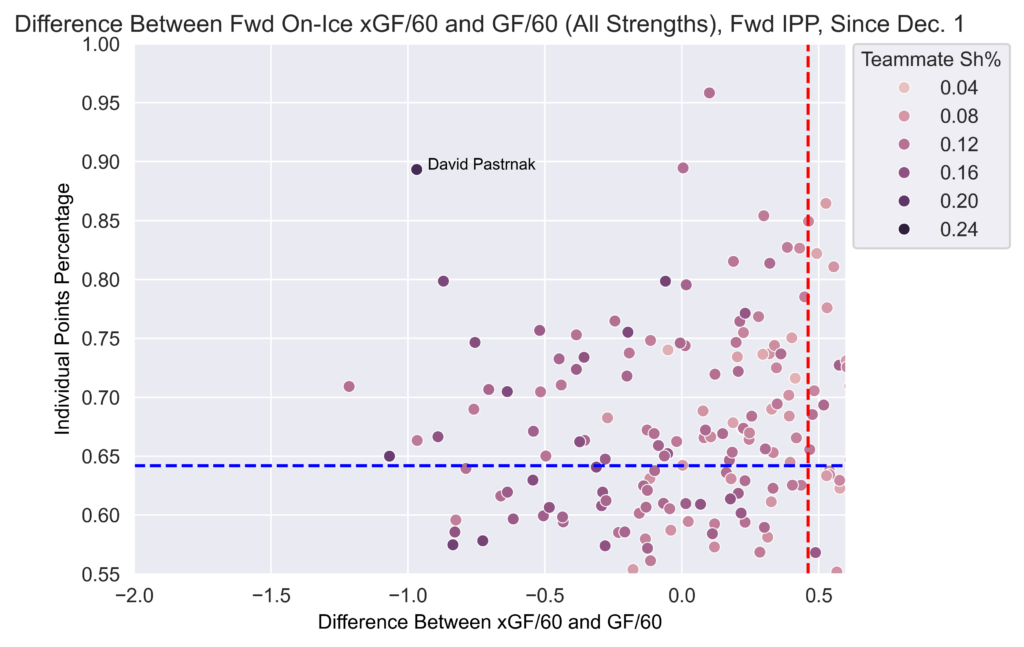
That Pastrňák is in a tier of his own, given his history, isn't a huge surprise. However, even just this season, his first two months saw him with an xGF/60 rate 0.23 points higher than his GF/60 rate. That his last two months see him nearly -1.0 xGF/60 lower than GF/60 is an indicator here. On top of that, his line mates have shot nearly 22% with him on the ice in that span. Last year, that number was 12.2% and his two-year average from 2023-2025 was 12.9%. His line mates shooting nearly 22% is a big outlier, even for a player who is definitionally an outlier.
But that is the conundrum. Pastrňák's prior two seasons saw him average 108 points every 82 games. This season, his 82-game pace is for 115 points. It isn't far off what we'd expect, but the difference is his 82-game assist pace is 79, far exceeding what he did in either of those prior two years. The concern with trading him away is that as his assist rate declines with the regression, he just starts scoring more on his own.
Trading away Pastrňák is tough to do, and I wouldn't do it without getting a comparable player back (if we're just talking wingers, someone like Kirill Kaprizov in most formats or Brady Tkachuk in banger formats). But the red flags exist, and managers with Pasta on their teams should prepare for a modest decline over the final third of the season.
Brayden Point (Tampa Bay Lightning)
The tough part about trading away Point is his injury. He is still week-to-week and may not return before the Olympic break. Trading away a player who is currently injured – for the second time this season – probably won't bring back a return that the team trading him away is looking for.
With that said, after a slow start, Point rebounded with 8 goals and 11 assists in 16 games in our timeframe. When looking at what happened when he was on the ice, Point is also in a tier of his own:
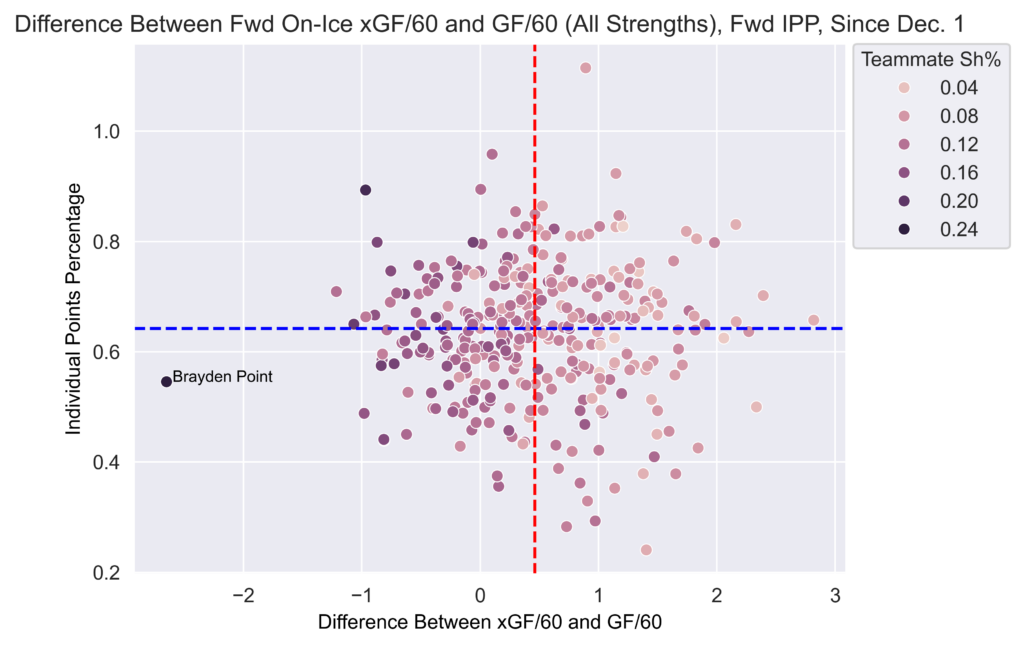
There is Point, all the way on the left, with by far the largest negative differential between his on-ice rate of xGF/60 and GF/60. In fact, his gap of -2.65 xGF/60 over GF/60 exceeds 2x the next-largest gap (Marat Khusnutdinov at -1.21). Playing with Nikita Kucherov can do that for a player to a degree, but that difference is also over 2x larger than the biggest gap in any of Point's last four years (-1.16 in 2024-25).
In all honesty, hanging on to Point and hoping he can go on a six-week heater after the Olympic break might be the right play here. It seems unlikely a fantasy manager trading Point away right now will be able to get a top-50 player in return, and if all they can get is a top-100-or-lower player, it's probably worth the risk that he can out-run the negative regression that should be coming. But it is on the horizon whenever he returns, and that's the concern here.
Alex Tuch (Buffalo Sabres)
Since December 1st, the Buffalo Sabres lead the league with a 14.2% team shooting percentage. The next-closest team is Boston at 13.1%, and the gap between Buffalo and Boston is the same size as the gap between Boston and ninth-place Detroit. Last year, Washington led the league at 12.5%, so that's the frame of reference here.
We mention all this because since December 1st, Buffalo is shooting 16.6% with Tuch on the ice and his teammates are shooting 15.8%. That is giving him the 10th-largest negative differential between xGF/60 and GF/60 in our sample:
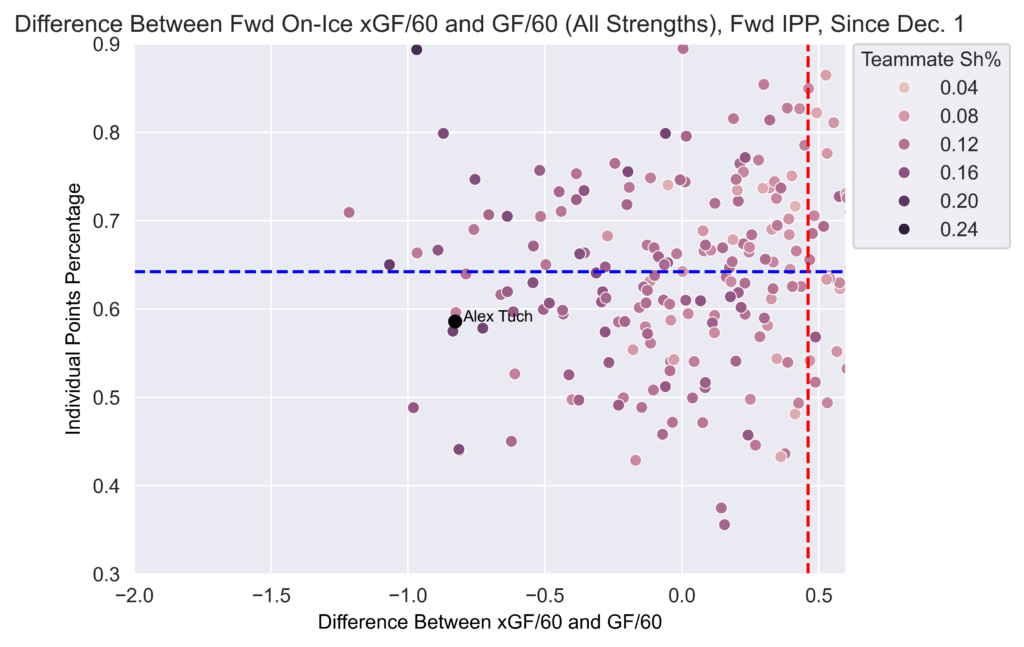
The last time Tuch did anything close to this was in 2022-23, but the difference was that he was a staple of the top PP unit that season. This year, he's averaging less than half the PPTOI (1:40 per game) that he did in 2022-23 (3:22 per game), so he's not getting that prime production ice time. That his last two months have seen him exceed his xGF/60 rate by as much as he is, without that PP time, is a red flag here.
What complicates matters is that Tuch is a good multi-cat forward. He is averaging 1.2 blocks, 1.1 hits, and 2.4 shots per game. Even if (when) he sees a production decline, there are still enough peripherals here to make him valuable in multi-cat leagues.
With all that said, Buffalo's post-Olympic break sees them play 25 games (11 teams play 26 or more), they have the 8th-toughest schedule by opponent points percentage, and those opponents are giving up just 2.84 goals against per game, tied for the ninth-lowest mark. Tuch doesn't have a very good schedule once the NHL resumes, and that large xGF/60 gap, without top PP time, makes his rest-of-season production upside lower than we've seen recently.
Eeli Tolvanen (Seattle Kraken)
Like Tuch, Tolvanen offers a lot in multi-cat formats with 1.8 shots, 1.1 blocks, and 2.6 hits per game. Even without a lot of production, Tolvanen can still help fantasy managers that have him in multi-cat leagues.
With that said, there is a giant caution flag here and it's Tolvanen's IPP. Over the last two months, he's figured in on 82.7% of goals scored with him on the ice, the 14th-highest mark of any forward in that sample:
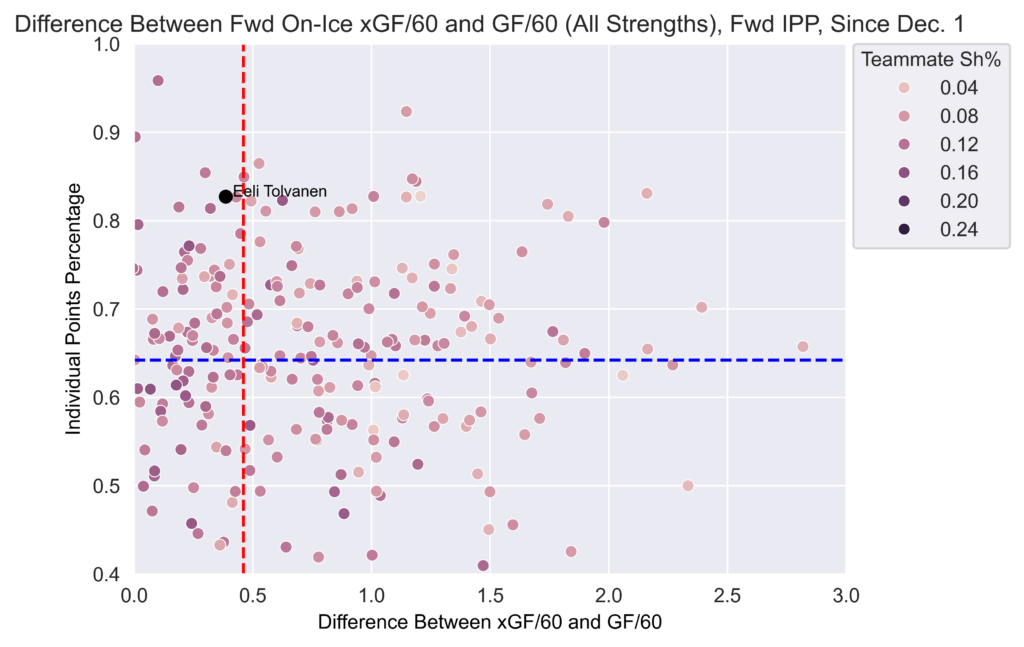
This is not a player who, like Pasta earlier, is usually among the league leaders in IPP. Tolvanen's best mark in his first three season was 70.7% (2023-24), and heading into 2025-26, his three-year average with the Kraken was 63.2%. That is far off the 83% rate he's managed over the last eight weeks. Had he been at 63% instead of 83%, he would have around 14 points in 27 games instead of the 19 points he has actually registered. That puts him closer to a 40-point/82-game pace that he normally sits with.
Whether fantasy managers should trade him or not depends on what the return is (as is always the case). In multi-cat formats, if he can be traded for a top-100 player that can help fill a roster need elsewhere, then that seems fine to me. However, if the return is closer to a top-200 or top-250 player, I would probably just hang onto him and hope that he can stay anywhere near what he's done recently. Even if he can't, he still brings enough peripherals to be valuable and whatever production comes with it is just gravy.
Related Posts




Starting Goalies













Top Skater Views
 T.B
 PHI
 N.J
 DET
Top Goalie Profile Views
 MTL
 WSH
 EDM
 MIN




LINE COMBOS
| Frequency |
 CAR Players | |
|---|---|---|
| 24.2 | JORDAN MARTINOOK JESPERI KOTKANIEMI SETH JARVIS | |
| 22.3 | LOGAN STANKOVEN NIKOLAJ EHLERS JACKSON BLAKE | |
| 21.3 | ANDREI SVECHNIKOV WILLIAM CARRIER SEBASTIAN AHO | |
DobberHockey Podcasts

Fantasy Hockey Life: Ep 506 Prospects with Plenty to Prove II
Victor and Jesse return to talk about more fantasy hockey prospects in critical seasons. Covered are David Reinbacher, Cayden Lindstrom, Dalibor Dvorsky, Bradly Nadeau, Ilya Protas, Charlie Stramel, Otto Stenberg, Emil Hemming, Trey Augustine, Sebastian Cossa, Jacob Fowler, Easton Cowan, Matthew Wood, Gabe Perreault, and Victor Eklund. Thanks to Mason Black @NHLRankKing for his polls. […]

Keeping Karlsson: Matchup Maximizer 2026/27 Week 5
Jeremy takes a look at the schedule for the upcoming weeks of NHL action and recommends players with good schedules that you should consider streaming in to win your head to head matchups.
Keeping Karlsson: Short Shifts – Injuries, Outjuries, and Duds
Elan talks about all the latest injuries, outjuries, big performances and duds over a tight 20 minutes in this week’s episode of Short Shifts.
Keeping Karlsson: Never Tell Me the Podz
Elan and Brian do a wellness check on the Maple Leafs, lament Chicago and Buffalo snoozers, wonder whether and which Flyers have figured it out, and pick out the Capital standing out from the crowd.
Fantasy Hockey Life: Ep 505 Prospects With Plenty to Prove Part 1
Victor and Jesse return to talk about prospects with plenty to prove. This week it’s: Tij Iginla, Berkly Catton, Konsta Helenius, Zayne Parekh, Igor Chernyshov, Jett Luchanko, Axel Sandin-Pellikka, Artyom Levshunov, Michael Hage, and Carter Bear. Have a listen! Our show is part of the Dobber Podcast Network and sponsored by Fantrax.com. Email [email protected] and […]