

21 Fantasy Hockey Rambles
Dobber Sports
2026-02-01
Every Sunday, we share 21 Fantasy Rambles from our writers at DobberHockey. These thoughts are curated from the past week’s 'Daily Ramblings'.
Writers/Editors: Ian Gooding, Michael Clifford, Alexander MacLean, Puneet Sharma, and Dobber
—
1. Don’t look now, but Stuart Skinner looks to be on a hot streak. A few weeks back I spoke on Skinner being a waiver wire option at best and how long he could keep his hot streak going. Well, entering Saturday, his hot steak has continued since as he has now posted seven wins with seven quality starts over his last eight games. So it got me thinking, why is Skinner playing better in Pittsburgh than he did in Edmonton.
Well, although Edmonton did a solid job suppressing overall shot volume, the chances they allowed were frequently high quality. Instead of forcing opponents to the perimeter or settling for point shots, breakdowns tended to come through the middle of the ice.
The Penguins tend to protect the middle of the ice more effectively, steering play toward the boards and funneling shots from less dangerous areas. Even if the raw shot totals end up similar, the quality of those shots is not. More perimeter attempts and points shots mean a cleaner xGA profile, which naturally helps a goalie’s SV% and overall results.
There’s also a usage and expectation shift to take note of. With the Oilers, Skinner was pushed into stretches where he had to be “the guy” behind an offense-first roster. In Pittsburgh, he is being ask to “hold the fort” and not have to steal games nightly. That shift matters. His strongest NHL stretches have always come when his workload was managed and his role clearly defined.
Skinner didn’t suddenly turn into a different goalie overnight. The Penguins have simply removed many of the conditions that consistently hurt him in Edmonton. Fewer chaotic rush chances, less rebound chaos, and more predictable defensive coverage all add up. There’s also a mental component that should not be ignored. Edmonton is a true hockey pressure cooker, where every mistake is magnified. Pittsburgh is still a strong hockey market, but the spotlight and finger-pointing are less intense, which can matter for a goalie’s confidence and consistency.
That’s my read on the situation. Take it for what it’s worth, but in the right setup, Skinner could be a viable option. If you are thin in goal and he is available on your waiver wire, he is a reasonable add who can give you usable results in the right matchups. (jan26)
2. Related to this recent run and his overall goal scoring (30 goals this season), the topic of conversation surrounding Cole Caufield has been his omission from Team USA in the Olympics. The US, like Canada, has a stacked enough roster where a few star players will be left off. Perhaps an injury could result in Caufield appearing anyway. This isn’t necessarily a fantasy hockey related debate, but remember that player comparisons are what we do all the time. (jan25)
3. The new coach bounce is definitely happening in Columbus. Since Rick Bowness took over from Dean Evason, the Blue Jackets have a record of 7-1-0. Despite the recent run, the Jackets are still six points out of a playoff spot in the Eastern Conference.
Charlie Coyle, who recently played his 1000th game, is scorching hot with eight points and a plus-7 over his last three games. In addition, he has at least one goal and two points in each of those three games. He has also been thriving on the Jackets’ top power play with four power-play points over his last nine games. Coyle, who is in his first season with Columbus, is worth adding in most leagues (27% Yahoo, 35% Fantrax) while he is on a bender.
Mathieu Olivier has back-to-back games with two points with his value being boosted by playing on a line with Coyle. Because he also averages over 3.5 hits per game, Olivier is flexing his muscles in multicategory leagues.
Meanwhile, Zach Werenski has seven points over his last four games. Entering Saturday, Werenski was tied for the league lead in scoring among defensemen, as both he and Evan Bouchard had 59 points. Werenski’s total was in six fewer games than Bouchard, which makes him the highest per-game scoring defenseman (1.20 PTS/GP). (jan31)
4. According to Elliotte Friedman on the 32 Thoughts podcast, Artemi Panarin is seeking a total value of $50 million on a new contract. A Panarin trade may not be imminent because he is reportedly trying to agree on an extension with an acquiring team. Panarin continues to be out of the Rangers’ lineup while they attempt to work out a trade. All of this means that Panarin’s next game could be after the Olympic break.
To summarize the list of potential destinations that Friedman listed, it seems like an acquiring team would need the cap space for his current contract (minus possible retention), as well as future cap space. That might rule out capped-out current contenders (eg. Colorado, Dallas, Minnesota, Vegas) while opening the door for up-and-coming teams with more cap flexibility (eg. San Jose, Utah, Detroit, Anaheim – just listing examples off the top of my head – not intended to be a full list). (jan31)
5. I was considering dropping Drew Doughty in one of my leagues if not for the five-game week this past week. Doughty has not registered a point since December 27. Now 36 years of age, Doughty might be experiencing wear and tear from long, hard NHL minutes through the years. His invite to Team Canada seemed to be based on past achievements, yet he may still step up his game for the Olympic tournament as he has for big games in the past. In the fantasy realm, I’m putting Doughty on probation, which is to say that he is droppable if he is still goose egging my roster a week from now. (jan25)
(Update entering Saturday) Checking in on Drew Doughty: no points in 14 games. Doughty was replaced by Brandt Clarke on the top power play on Thursday, although the Kings received only 2:11 of power-play time in that game. If things don’t turn around for Doughty, I could be talked into dropping him outright. (jan31)
6. By the way, check your league settings in the event that your scoring period is extended further than a week, or at least check how your league’s schedule is affected by the Olympic break. The NHL season pauses on February 6. This has been an unusual season with a condensed schedule and a break lasting nearly three weeks.
7. Adam Fox was at New York Rangers morning skate in a non-contact jersey on Wednesday. A good sign for Fox’s return, but with the Olympic break looming, it’s a wonder if they just don’t give him those few extra weeks to recover 100%. (jan29)
8. According to Patrick Present, Troy Terry joined the team in Vancouver and practiced with them on Wednesday. He has been out of action for over three weeks with an upper-body injury but looks like he will return to the lineup sooner rather than later. (jan29)
9. Thatcher Demko is going to miss the rest of the 2025-26 season, which should come as a surprise to no one. First-off, his previous three seasons were all injury-plagued, and this season was no different, even up to the latest injury. On top of that, the Canucks are already last in the league, by a decent margin, so they have nothing to gain by rushing back a high-quality goalie when there’s nothing to play for. The Canucks have already started selling, with Kiefer Sherwood out the door, and the Canucks should continue to move more bodies out the door as the season progresses.
With Kevin Lankinen signed until 2030, there is some contractual stability in net in the meantime, while Nikita Tolopilo will probably be given a longer leash to see what he can manage the rest of the way. (jan28)
10. Ondrej Palat was held out of Tuesday night’s Devils game for “roster related reasons” which was later revealed to be a trade to the Islanders. The Devils sent two picks with him to dump his salary, and in return they received frequent healthy scratch Maxim Tsyplakov. Tsplakov is a large 27-year-old Russian who scored 35 points last season as a rookie, but managed only two points in 27 games this year (at time of writing), along with many healthy scratches. There’s some upside here with the Devils, while Palat seems poised to fade further into irrelevancy. (jan28)
11. Dylan Guenther was missing for the Mammoth's last two games, and at this point we don’t know a timeline for his return. It sounds like a day-to-day thing, but check back later today for the Injury Ward article to see if there’s an update. (jan28)
12. Patrick Kane tied Mike Modano as the highest scoring American-born player Tuesday night, recording an assist on Detroit’s only goal against the Kings. Stick taps to him on the excellent career. (jan28)
13. As the owner of Joey Daccord, I can’t say I’m thrilled about the Phillipp Grubauer revival this year. The two have mostly alternated starts since early December. Grubauer does have the kind of game in him that could be an issue for other teams at the Olympics. Don’t count out the Germans, with an NHL MVP candidate leading the charge, a Norris contender leading the blueline, and Grubauer peaking at the right time in net. (jan28)
14. The Monday night game between the Columbus Blue Jackets and Los Angeles Kings was postponed due to the snowstorm that ran/is running through a good chunk of North America. It has been rescheduled for early March. (jan27)
15. The Canucks put both Boeser and Zeev Buium on the injured reserve. As of last Monday, they had to miss at least seven days, and there were 10 left until the Olympic break. Given the nature of their injuries, my guess is we won’t see them again until late February. (jan27)
16. At time of writing, we were over 60% of the way through the NHL season and by the time the Olympic break hits next Thursday, we will have just 30% of the season left. At this point, any fantasy manager looking to make a push for head-to-head playoffs, or a league roto/points title, will need to take some swings. Some of those swings involve acquiring players who’ve gone through a rough stretch in the hopes they turn things around over the final eight weeks.
In that spirit, let’s look at some of the ‘unluckiest’ players since December 1. We are looking at things like players with large expected goals-for rates (xGF) over actual goals-for rates (GF), low goal participation rates (Individual Points Percentage, or IPP), low shooting percentages (either from the individual or the team), and more. We are using data from Evolving Hockey, it is current as of the morning of Monday, January 26th, and this is at all strengths.
New Jersey Devils
Sympathies to those who invested heavily in the Devils offence because since December 1st, they are fighting with the Chicago Blackhawks for last in the league in goal scoring. It isn’t as if they aren’t creating, though, as Jesper Bratt has the largest difference between xGF per 60 minutes and GF per 60 minutes of all forwards in our sample, Timo Meier is fourth, and both are worse than league average by IPP in that span:
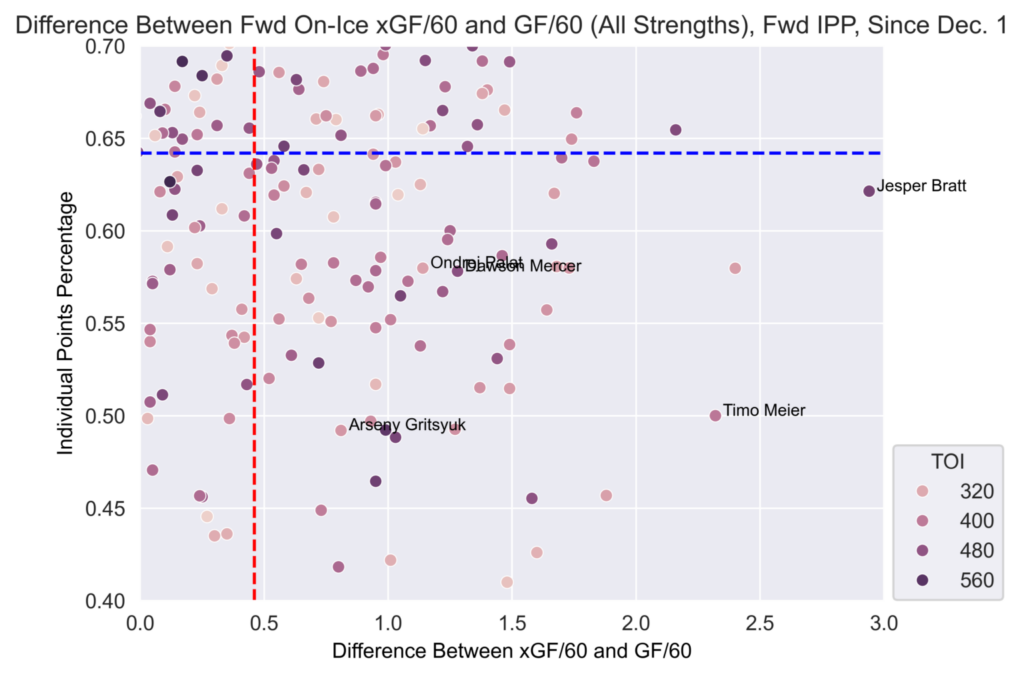
To be fair here, Meier is not someone who typically has a high IPP. He has had three straight seasons under 70% and his prior three-season average with New Jersey is under 65%. And the team has scored so little with him on the ice that being at that three-year average, rather than the 50% he’s had since December 1st, only adds two points. (jan27)
17. The same can be said for Bratt. His three-year rate of goal participation is 67.4%, which is the rate of a low-end first liner. That he is sitting at 62.1% isn’t a massive deviation from what he normally does.
With that behind us, it’s the xGF over actual GF that sticks out. The necessary context here, as I wrote about in a Ramblings a few weeks ago, is that public xG models have been over-counting much more than normal. But the average over-count among forwards is about 0.46 per 60 minutes. Bratt’s xGF rate since December 1st is 2.94 higher than his GF rate, and Meier’s is 2.32. Bratt’s difference is over 6x higher than the average forward and Meier’s is over 5x higher. It is a massive chasm.
The final note is Jack Hughes. Since returning from his hand injury, he has two goals in 17 games, shooting 3.8%, and Sunday’s game was the first time he took any faceoffs (and he only took three). Maybe his hand is finally close to healthy, but it’s clear it wasn’t for a solid month, and with him going to the Olympics, it’s not as if he’ll get to rest it for a few weeks. If he plays hurt for the rest of the year and shoots like 5%, then a massive improvement for Meier and especially Bratt will be tough to achieve.
All the same, we have seen this Devils roster be above-average goals-wise over the prior couple of seasons and they are far too talented to be at the bottom of the league. Maybe this is just a season where everything goes wrong, but there are reasons to think why both Bratt and Meier will be much more productive over the final third of the season. (jan27)
18. Elias Pettersson (Vancouver Canucks)
Since December 1st, of the top four largest differences between rate of xGF and GF with a forward on the ice, three belong to the New Jersey Devils. The fourth belongs to the franchise centre from the Canucks and, relatedly, his line mates are shooting just 7.6% when he’s on the ice, compared to the league average of 11.1% for all the forwards in our sample:
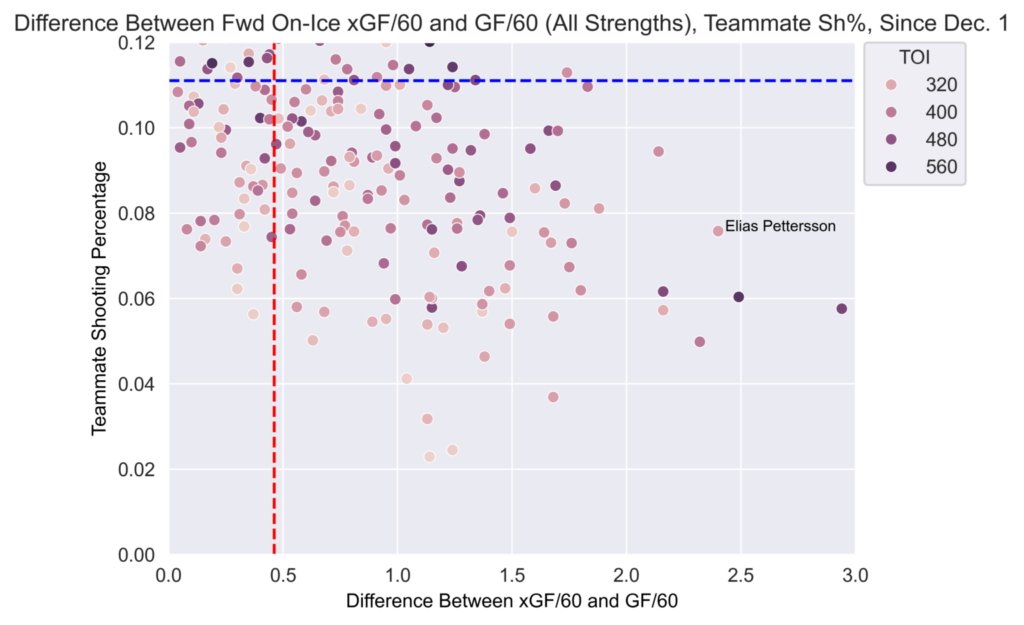
It probably isn’t a coincidence that the huge gap in xGF and GF coupled with low teammate shooting percentage for Pettersson comes largely in the post-Quinn Hughes era, who played his last game for Vancouver on December 11th. Even still, half the gap between xGF/60 and GF/60 would be about 1.2, or over 2.5x bigger than the league average, and just outside the top-50 rates in the league. At his regular IPP of about 63%, that would add five points to his total over the 18 games he played in that span. That matters a lot.
Anyone who reads my writing regularly knows I have not been a Pettersson proponent in any fantasy hockey format, at least since his knee issues that popped up a couple of years ago – knee issues that may or may not have since been resolved (I doubt it). But there is a difference between ‘Should this guy be rostered in anything besides deep formats?’ and ‘This guy’s recent stretch suggests 82-game pace of around 27 goals and 37 assists’. Surviving the post-Hughes era will be tough for Vancouver, but a healthy Filip Chytil and Marco Rossi after the Olympic break, plus his recent on-ice numbers, should help Pettersson’s production rebound over the final third of the season. (jan27)
[Follow the link for more…]
19. In my Ramblings on Tuesday, we covered some forwards who are due for improved production down the post-Olympic stretch run. The hope here is to provide fantasy managers with some buy-low options for the final third of the season (or just straight-up add them via waivers), particularly those fantasy managers that need a big swing to either work out or flame out.
Today, we are doing the same thing but moving to the blue line. Again, we are limiting the sample to defencemen who’ve skated at least 250 minutes since December 1st, we are looking at all strengths, data is current as of the morning of Wednesday, January 28th, and is from Evolving Hockey.
The two main data points we’re using are team expected goals-for per 60 minutes (xGF/60) over actual goals-for per 60 minutes (GF/60) with a given player on the ice, and Individual Points Percentage (IPP, or their goals-for participation rate).
Darnell Nurse (Edmonton Oilers)
What makes Nurse so valuable in multi-cat leagues is that even when he’s going through a stretch that he’s currently mired in – 7 points in 28 games since December 1st – his peripherals float his fantasy value. That has been the case here, as he has 54 shots, 56 blocks, 36 hits, and 42 PIMs in those last 28 games. It is what makes him hard to trade for because the person with Nurse on their roster will (or should) know this as well.
Peripherals aside, Nurse has been cheated out of some points:
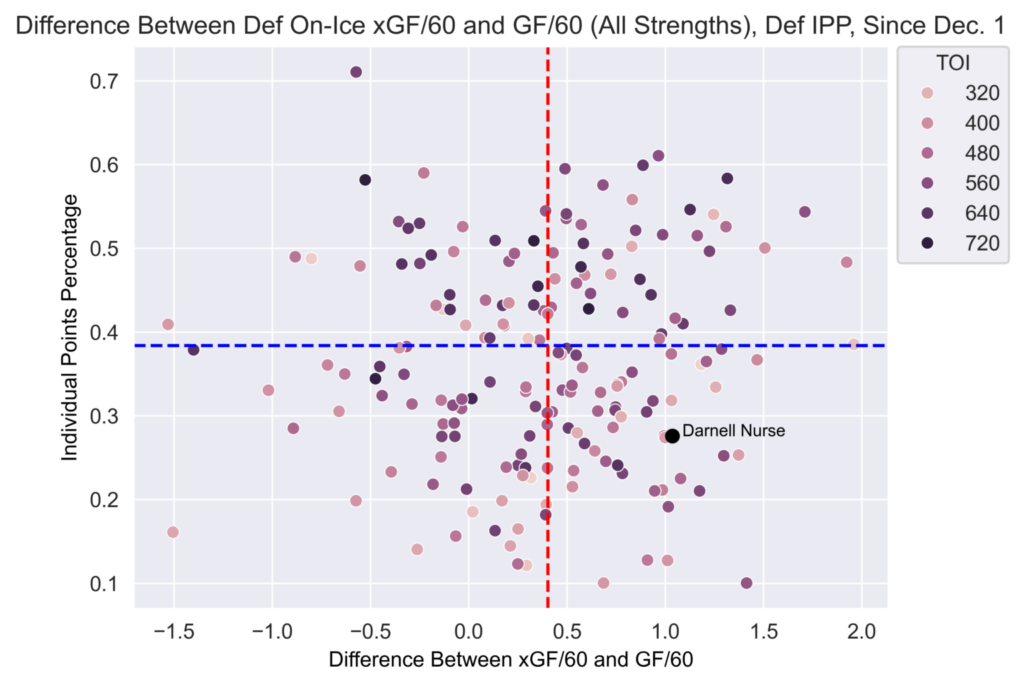
The difference between Nurse’s xGF/60 and GF/60 rate is one of the 25 largest in our sample. On top of that, his IPP of 27.6% is considerably lower than normal: He exceeded 40% each season from 2022-2025 and was over 50% through the end of November. He is also the only Edmonton defenceman in our sample with an xGF/60 over GF/60 differential greater than 1.0 with an IPP under 30%. Spencer Stastney has a low IPP, and Alec Regula has a higher xGF-GF differential, but neither have the combination that Nurse does.
As mentioned in the Ramblings on Tuesday, public expected goals models like the one used at Evolving Hockey have been over-counting expected goals this season. For defencemen, it means they typically are averaging an xGF/60 rate around 14% higher than their GF/60 rate. However, even factoring in that over-counting, if the team were scoring at the rate it should be with Nurse on the ice, and he’s figuring in on his typical 41% of goals, he’d have 13 points in his last 28 games rather than 7 points. It speaks to the upside that is on the table for Nurse after the Olympic break.
Just one word of caution here: after the Olympic break, the Oilers are 1 of 5 teams with 24-or-fewer games on the schedule and they have the fifth-hardest schedule by opponent points percentage (per Frozen Tools). Nurse is due for a big turnaround, but factoring in both games played and opponent strength, the Oilers might have the worst fantasy schedule of any team from late February onward. (jan29)
[Follow the link for more…]
20. In my Ramblings on Tuesday, this column went over some forwards that have a couple of signs of positive regression that we look for when trying to figure out who is due for a rebound. Yesterday, these Ramblings covered the same signs of positive regression but for defencemen.
Today, we’re going in the other direction: which forwards are due for negative regression? We are going to use the same timeframe, so this is from December 1st up until January 28th. There are two signs of regression that will be the focus:
- Gap between team expected goals-for per 60 minutes (xGF/60) and actual goals-for per 60 minutes (GF/60) with a given player on the ice. The larger the gap, the larger the expected drop.
- A high Individual Points Percentage (IPP), which is how often a player figures in on a goal when their team scores with them on the ice. Similar to the first point, a sky-high number indicates a large drop incoming.
We are again limiting the sample to forwards with at least 250 minutes played, which gives us 334 forwards. Data is from Evolving Hockey.
David Pastrnak (Boston Bruins)
This is a dicey proposition. In my weekly newsletter earlier this month, I mentioned that Pastrňák is able to create among the most scoring chances on the fewest shot attempts, which makes him a very efficient player, and which makes those around him more efficient. Additionally, Pastrňák exceeded an 80% IPP in each of the prior two seasons and his three-year average heading in 2025-26 was 82.3%, the highest of any regular forward in the league. All that is important context.
However, there is ‘efficient’ and then there is what Pastrňák has done over the last couple of months. Of the 334 forwards, he has the fifth-largest negative differential between his xGF/60 and GF/60, the fifth-highest IPP, and the second-highest teammate shooting percentage. All that puts him in a tier of his own:
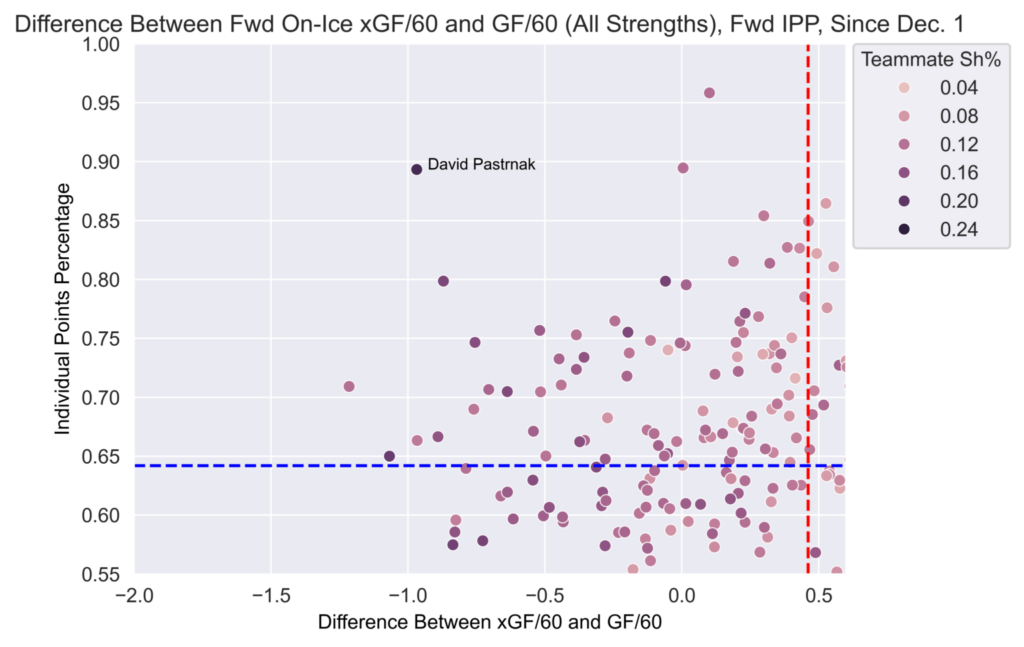
That Pastrňák is in a tier of his own, given his history, isn’t a huge surprise. However, even just this season, his first two months saw him with an xGF/60 rate 0.23 points higher than his GF/60 rate. That his last two months see him nearly -1.0 xGF/60 lower than GF/60 is an indicator here. On top of that, his line mates have shot nearly 22% with him on the ice in that span. Last year, that number was 12.2% and his two-year average from 2023-2025 was 12.9%. His line mates shooting nearly 22% is a big outlier, even for a player who is definitionally an outlier.
But that is the conundrum. Pastrňák’s prior two seasons saw him average 108 points every 82 games. This season, his 82-game pace is for 115 points. It isn’t far off what we’d expect, but the difference is his 82-game assist pace is 79, far exceeding what he did in either of those prior two years. The concern with trading him away is that as his assist rate declines with the regression, he just starts scoring more on his own.
Trading away Pastrňák is tough to do, and I wouldn’t do it without getting a comparable player back (if we’re just talking wingers, someone like Kirill Kaprizov in most formats or Brady Tkachuk in banger formats). But the red flags exist, and managers with Pasta on their teams should prepare for a modest decline over the final third of the season. (jan30)
21. Brayden Point (Tampa Bay Lightning)
The tough part about trading away Point is his injury. He is still week-to-week and may not return before the Olympic break. Trading away a player who is currently injured – for the second time this season – probably won’t bring back a return that the team trading him away is looking for.
With that said, after a slow start, Point rebounded with 8 goals and 11 assists in 16 games in our timeframe. When looking at what happened when he was on the ice, Point is also in a tier of his own:
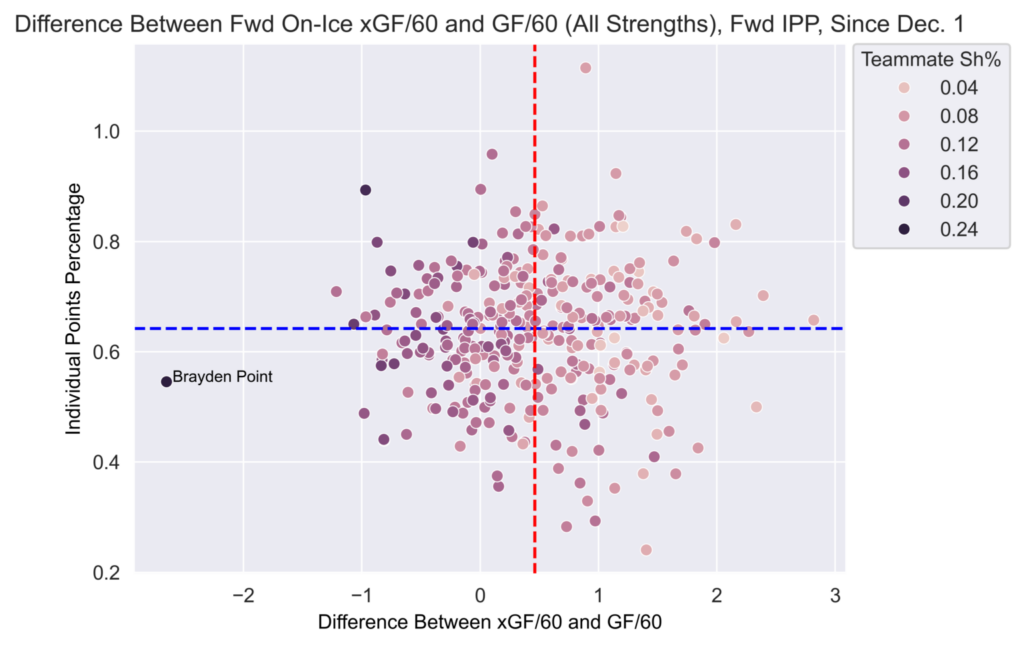
There is Point, all the way on the left, with by far the largest negative differential between his on-ice rate of xGF/60 and GF/60. In fact, his gap of -2.65 xGF/60 over GF/60 exceeds 2x the next-largest gap (Marat Khusnutdinov at -1.21). Playing with Nikita Kucherov can do that for a player to a degree, but that difference is also over 2x larger than the biggest gap in any of Point’s last four years (-1.16 in 2024-25).
In all honesty, hanging on to Point and hoping he can go on a six-week heater after the Olympic break might be the right play here. It seems unlikely a fantasy manager trading Point away right now will be able to get a top-50 player in return, and if all they can get is a top-100-or-lower player, it’s probably worth the risk that he can out-run the negative regression that should be coming. But it is on the horizon whenever he returns, and that’s the concern here. (jan30)
[Follow the link for more…]
—
Have a good week, folks!
Thanks for continuing to support the website and if you’re bored and need a fantasy hockey fix – visit the gang in the forum here.
Related Posts


Starting Goalies



Top Skater Views
| Players | Team | |
|---|---|---|
| ROOPE HINTZ |
 DAL DAL | |
| ALEX LAFERRIERE |
 L.A L.A | |
| LUKE HUGHES |
 N.J N.J | |
| OWEN TIPPETT |
 PHI PHI | |
| KEVIN FIALA |
L.A
| |
Top Goalie Profile Views
 WSH
WSH CBJ
CBJ MIN
MIN UTA
UTA



LINE COMBOS
| Frequency |
 T.B Players T.B Players
| |
|---|---|---|
| 21.7 | NIKITA KUCHEROV BRANDON HAGEL ANTHONY CIRELLI | |
| 18.8 | NICK PAUL YANNI GOURDE ZEMGUS GIRGENSONS | |
| 18.6 | DOMINIC JAMES GAGE GONCALVES OLIVER BJORKSTRAND | |
DobberHockey Podcasts

Keeping Karlsson: The 2026-27 Keeping Karlsson Breakfast Club
Don’t you forget about them! Elan and Brian remind you of at least one player on each NHL team whose name you might forget to consider at the draft table.

Fantasy Hockey Life: Tampa Bay Lightning with Erik Erlendsson
Erik Erlendsson joins the program to discuss the Tampa Bay Lightning. Jesse and Victor ask about pros Nikita Kucherov, Jake Guentzel, Brandon Hagel, Brayden Point, Anthony Cirelli, Ilya Mikheyev, Gage Goncalves, Conor Geekie, Benjamin Rautiainen, John Carlson, Victor Hedman, Charle-Edouard D’Astous, Andrei Vasilevskiy, Jonas Johansson, and Dennis Hildeby. In Cat’s instincts, Cat Silverman of InGoal […]
Fantasy Hockey Life: New York Rangers with Colin Stephenson
Colin Stephenson joins the program to discuss the New York Rangers.
Keeping Karlsson: Matchup Maximizer Schedule Deep Dive
Elan is joined by the Keeping Karlsson Accountability Czar Trev to take a deep dive into the NHL schedule for next season and how it should affect our drafting decisions.
Fantasy Hockey Life: Carolina Hurricanes with Ryan Henkel
Ryan Henkel joins the program to discuss the Carolina Hurricanes. Jesse and Victor ask about pros Sebastian Aho, Seth Jarvis, Andrei Svechnikov, Nikolaj Ehlers, Jackson Blake, Logan Stankoven, Jordan Staal, Bradly Nadeau, Felix Unger Sorum, Shayne Gostisbehere, K’Andre Miller, Alexander Nikishin, Sean Walker, Brandon Bussi, and Pyotr Kochetkov. In Cat’s instincts, Cat Silverman of InGoal […]